FTC Becomes White House Tool for AI Policy
Impact of Supreme Court ruling on consumer protection and AI regulation.
Model Diplomat10 min readNorth America
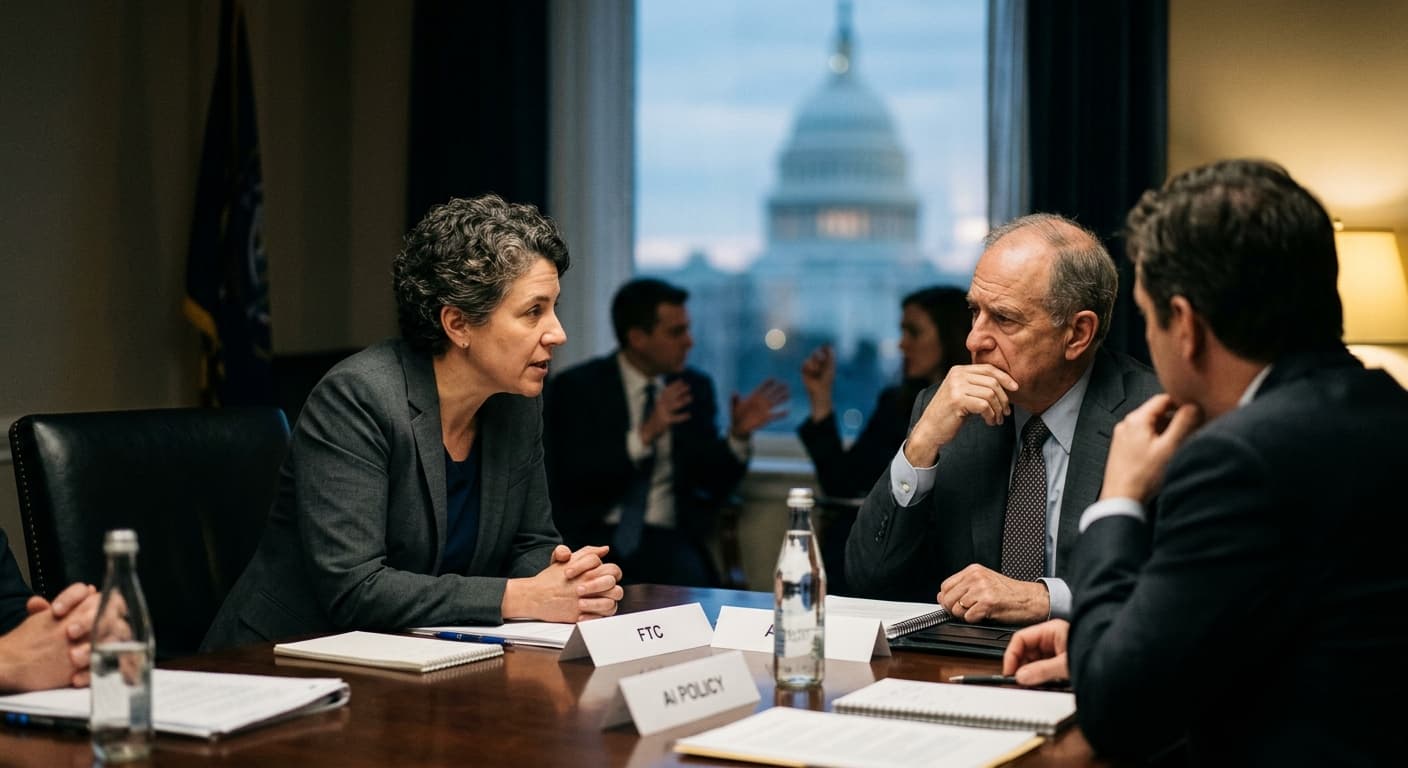
The FTC Just Became a White House Instrument — and AI Is the First Test
How the Supreme Court's June 29 ruling in Trump v. Slaughter reshaped US consumer protection, and why the FTC's July 1 AI policy statement targeting Colorado's law is the first proof of concept.
The Supreme Court overruled a 91-year-old precedent on June 29 and handed the president a loaded weapon: the power to fire Federal Trade Commission members at will. Forty-eight hours later, a two-commissioner FTC — both Republicans, no dissent possible — proposed declaring that state AI laws requiring bias audits or output alterations can be "deceptive practices" preempted by federal law. The immediate loser is not Rebecca Kelly Slaughter, the fired Democratic commissioner. It is Colorado's Artificial Intelligence Act, roughly a dozen sibling state statutes, and the entire theory that consumer protection in the United States operates independently of the White House.
The ruling: Humphrey's Executor, finally buried
In a 6-3 opinion by Chief Justice John Roberts, the Court held in Trump v. Slaughter that the FTC Act's for-cause removal protection is "contrary to the separation of powers enshrined in the Constitution," ratifying President Trump's March 2025 firings of Commissioners Slaughter and Alvaro Bedoya. Roberts wrote that the 1935 precedent in Humphrey's Executor v. United States "has not withstood the test of time" — per NPR's ruling coverage. "If anything more is left of Humphrey's," Roberts added in the majority opinion, "the Court overrules it." Justice Sonia Sotomayor's dissent, joined by Justices Elena Kagan and Ketanji Brown Jackson, said the majority "undoes centuries of political practice" and "welcomes untold chaos."
The Court carved out one exception. In the companion case Trump v. Cook, decided 5-4 with Roberts and Justice Brett Kavanaugh joining the three liberals, it blocked Trump's attempt to remove Federal Reserve Governor Lisa Cook. Roberts held that stripping the Fed's for-cause protection would "turn for-cause protection into little more than at-will employment," according to Al Jazeera. A footnote noted that Trump remains free to "try again" with proper notice — a small opening that Wall Street immediately understood as the Fed's independence being on probation, not preserved.
Everything else that resembled the classic New Deal independent commission is now, functionally, at-will. The National Labor Relations Board, the Merit Systems Protection Board, the Consumer Product Safety Commission, the Equal Employment Opportunity Commission — all of them lose the constitutional insulation that Congress designed. Justice Kagan's dissent from the September 2025 stay had already noted that the Trump administration used the same emergency-docket mechanism to fire members of each of those bodies over the preceding year, per the Cornell LII record. The doctrinal step is captured concisely in the Congressional Research Service summary hosted at
Constitution Annotated: the FTC now exercises "executive power" for Article II purposes, so it must answer to a single elected officer.
The historical parallel is exact. In 1933, FDR fired FTC Commissioner William Humphrey over ideological disagreements; in 1935, a unanimous Supreme Court ruled he could not — creating a "fourth branch" of expert commissions insulated from political tides. Chief Justice Roberts, quoting Solicitor General John Sauer at oral argument, called that precedent a "decaying husk." Roberts' line in oral argument said the FTC of 1935 "had very little, if any executive power." That empirical claim — that the modern FTC is a different beast — is what carried the majority.
The AI policy statement: preemption by press release
Two days after the ruling, on July 1, the FTC voted 2-0 to publish in the Federal Register a "Policy Statement Concerning the Suppression of Accuracy in Artificial Intelligence Systems." Comments are due July 31, 2026. The document, filed as Matter No. P264200, argues that AI companies that "steer" model outputs away from user expectations for undisclosed reasons — including to comply with state anti-discrimination law — likely commit deceptive conduct under Section 5 of the FTC Act.
The Federal Register text is unusually direct. Quoting the government's published version:
"An AI company might be tempted to alter or steer the output of its systems contrary to consumers' reasonable expectations for various reasons, including attempted compliance with a State law, such as Colorado's recently revised Artificial Intelligence Act. But steering an AI system in this manner may deceive consumers in violation of section 5 of the FTC Act. That is true even if the deceptive steering is done in an effort to comply with State laws."
The statement follows a December 2025 executive order in which President Trump instructed the FTC to address state laws requiring alteration of the "truthful outputs of AI models," per the Retail & Consumer Products Law Observer. That order established an "AI Litigation Task Force" at the Justice Department and directed both the FTC and the FCC to work with DOJ to circumvent "onerous" state regulations. Trump's AI adviser, venture capitalist David Sacks, told reporters the administration would "push back on the most onerous examples of state regulations" while preserving child-safety carve-outs, according to
NPR.
The order and the FTC statement together are Plan B — Plan A failed twice in Congress. In July 2025, the Senate stripped a 10-year moratorium on state AI regulation from Trump's budget reconciliation bill after Republican senators including Josh Hawley (R-Mo.) and Marsha Blackburn (R-Tenn.) refused to support it. In December 2025, GOP lawmakers tried to slip a similar preemption clause into the annual defense authorization and failed again. Brookings scholars Kyra Wilson and Aylin Caliskan tracked nearly 700 AI-related state bills introduced in 2024 alone, warning in a Brookings analysis that federal preemption without a federal standard would create a "regulatory vacuum." What Congress refused to enact, the executive is now attempting through commissioner discipline and Section 5.
Colorado's law is the marquee target. Signed by Governor Jared Polis in May 2024 and taking effect February 1, 2026, SB24-205 requires developers and deployers of "high-risk" AI systems to assess and mitigate algorithmic discrimination in employment, lending, housing, insurance, education, and healthcare. Wilson and Caliskan called it "reminiscent of the EU's AI Act." Roughly a dozen other states — Texas, California, Connecticut, Utah, Tennessee — have narrower analogues on deepfakes, mental health chatbots, or hiring algorithms. Tennessee's ELVIS Act, protecting musicians from AI voice cloning, is not obviously in the FTC's sights; Colorado's disparate-impact assessment mandate is directly there.
Why this is preemption by press release
The FTC's theory is thin, and its own former staff know it. As Brookings' Nicol Turner Lee and colleagues wrote in a Brookings piece analyzing the December 2025 executive order, the FTC "cannot preempt state regulation by mere assertion, nor will it have an easy time proving there is anything deceptive or not 'truthful' about state laws that require AI systems not to discriminate." One preemption advocate quoted in the same piece conceded that any effort to stretch the FCC's authority to preempt state AI laws was "a Quixotic exercise in futility." Florida Governor Ron DeSantis, no ally of state Democrats, publicly agreed with the constitutional objection: "An executive order doesn't/can't preempt state legislative action."
The Slaughter ruling does not fix that legal weakness — it changes the political calculus around it. Preemption still requires either a federal statute or a validly promulgated agency rule under Loper Bright standards. Section 5 policy statements are neither; they are enforcement guidance, subject to challenge. What the ruling does provide is durability. Under Humphrey's, a future Democratic president would inherit a 3-2 minority and could not fire Republicans who refused to reverse the AI statement without cause. Under Slaughter, that same president can clean house on day one. As the Global Advertising Lawyers Alliance noted in Mondaq, it is "unclear whether Commissioners with dramatically different views will be appointed to the Commission, and if they are, whether they will feel comfortable expressing them." Enforcement discretion — whom the FTC sues, whom it lets slide — has become presidential discretion.
Who benefits, who loses
The immediate winners are the frontier AI labs. OpenAI, Anthropic, Google DeepMind, Meta, and xAI have spent 18 months lobbying against Colorado's law and its imitators, arguing that a state-by-state compliance patchwork would be ruinous. The Chamber of Commerce made the same case. They now have a federal deterrent — the risk that any concession to state bias-audit regimes could itself be branded a Section 5 deception — without Congress having passed a single line of AI legislation. Sacks, a longtime venture capitalist with equity across the sector, is the connective tissue: the December order names him as the person directed to work with Congress on eventual federal AI legislation while, in the interim, the FTC does the deterrent work.
The losers are more scattered. Colorado Governor Polis, who signed SB24-205 with public reservations and asked lawmakers to refine it before the effective date, now faces the federal government branding his state's enforcement mechanism itself deceptive. State AGs in California, New York, Texas, and Illinois lose their most effective preemption defense — a genuinely independent FTC that stays out of federal-state fights. Civil rights groups including the NAACP Legal Defense Fund and Public Citizen lose the algorithmic-discrimination frame they built around Colorado's law. J.B. Branch of Public Citizen told NPR during the reconciliation-bill fight that stripping state protections was "appeasement to Big Tech with a giant bow on it" — a line that now reads as prophecy.
Less obviously, a Democratic FTC of the future loses the ability to bind its successors, because the pattern the Trump administration establishes cuts both ways. A future President Newsom or Whitmer could fire all sitting Republican commissioners on day one, reverse the AI policy statement, and use Section 5 to pursue algorithmic-discrimination cases against the same labs. Legal certainty for tech companies is the collateral casualty of political certainty for the executive.
The Brookings analysis by Sorelle Friedler, Suresh Venkatasubramanian, and Alex Engler warned years ago that the FTC's 1914 statute was designed for an industrial economy, and that asking Section 5 to do the work of AI legislation invites both overreach and legal defeat. That warning now runs in both directions — against a Khan-era FTC pushing algorithmic accountability, and against a Ferguson-era FTC pushing preemption.
The quieter half of the week: merger enforcement drops
Buried under the constitutional news, the FTC and DOJ Antitrust Division released their 48th Annual Hart-Scott-Rodino Report on July 2. Companies filed 2,006 HSR premerger notifications in FY2025, of which 31.8% carried a value above $1 billion — and the agencies brought just 18 merger enforcement actions total, with the FTC accounting for eight. The merger numbers matter here: a politically controlled FTC has every incentive to let deals slide in sectors where the White House has allies, and the HSR data will be the first empirical test of whether that happens.
The NewsGuard subtext
One reason the AI accuracy statement lands harder than a normal policy notice is that Chair Ferguson's FTC has already shown it will use Section 5 against companies whose speech it disagrees with. NewsGuard, a news-rating firm, sued the FTC in February 2026 alleging that Ferguson used investigative pressure and a merger consent decree — the Omnicom-IPG order — to punish it for what he called anti-conservative ratings. The complaint quotes Ferguson from April 2025 explaining how the FTC's "tremendous array of investigative tools" and "coercive power" work in practice: "The regulators can show up, they can audit, they can investigate, they can cost you a lot of money, and the path of least resistance is: 'Do what we say.'" The FTC initially imposed a consent condition prohibiting the merged ad-agency giant from using services that evaluate "political or ideological viewpoints"; after backlash, it revised the language to bar services that evaluate "veracity of news reporting" or "adherence to journalistic standards" — a distinction without much of a difference.
Whether the NewsGuard suit succeeds is secondary. The precedent it establishes — using Section 5 to shape private editorial and algorithmic choices — is the template now being scaled onto AI companies. Under Trump v. Slaughter, no dissenting commissioner exists to publicly document it. Victoria Nourse of Georgetown Law, writing in The Economist, argued the decision "ushers in momentous changes in the powers of the presidency, and with it, the potential for abuse of presidential power." American University law professor Chris Edelson put it more bluntly in Al Jazeera: combining Slaughter with the 2024 immunity decision "moves the president pretty far down the road toward what Trump aspires to — a kind of American monarch."
Diplomat View
The FTC has been converted from a bipartisan referee into a single-party enforcement arm. AI regulation is where that conversion pays its first dividend. The Trump administration's play is not to legislate AI policy — Congress will not — but to make state AI laws costly to comply with by threatening the compliers with federal deception liability. Expect the policy statement to be finalized largely intact in late 2026, followed by an early 2027 Section 5 investigation of at least one major frontier lab that has publicly committed to Colorado-style bias audits. That is the falsifiable call. What would force revision: a federal district court in Colorado enjoining the policy statement on First Amendment or federalism grounds; a state AG coalition winning an injunction against the FTC before a compliance case is brought; or a subsequent Supreme Court decision holding that Section 5 policy statements lack preemptive force. Any of those flips the leverage back to states. Absent them, US AI governance for the next three years will be set in the White House, not in Denver, Sacramento, or Austin.
What to watch
- July 31, 2026 — Public comment deadline on the FTC's AI accuracy policy statement (Matter No. P264200). Watch which state AGs, tech firms, and civil society groups file, and whether Colorado's Attorney General submits a formal preemption challenge preview.
- Late summer 2026 — Colorado's AI Act took effect February 1; the first Colorado enforcement action or settlement would create the test case the FTC statement is designed to preempt.
- Fall 2026 — Trump's expected second attempt to remove Fed Governor Lisa Cook with the procedural notice Chief Justice Roberts's footnote in Cook effectively invited.
- Q1 2027 — Likely first Section 5 investigation citing the AI accuracy policy statement, and the first litigation challenging FTC preemption in a federal district court outside D.C.
The Bottom Line
Trump v. Slaughter did not just end a 91-year-old precedent; it converted the FTC from an independent commission into a directly-controlled instrument of executive policy, and the agency's July 1 AI accuracy statement is the first live demonstration of what that instrument will be used for. The immediate stake is not Slaughter's job or even the FTC — it is whether states retain the authority to regulate algorithmic discrimination, and the answer, absent judicial intervention, is now no.
Discover more

Global Politics
Xi Jinping Calls China-Russia Ties 'Precious'
Xi Jinping's description of China-Russia ties as 'precious' reflects a strategic imbalance, with Beijing dictating terms in the partnership.

India
Delhi CM Rekha Gupta Blasts Opposition's Delm
Delhi CM Rekha Gupta's remarks on women's quota defeat reveal BJP's strategy for the 2029 Lok Sabha elections, focusing on delimitation.
India
Congress Accuses Modi of Stalling Women's Law
Congress accuses Modi of stalling women's reservation law by linking it to delimitation, revealing a deeper electoral strategy.

Economics
Fed's Amex AML order puts correspondent banking on notice
Federal Reserve's Amex AML order requires board-level controls and a 90-day plan; OCC fined the bank $350 million over enterprise-wide deficiencies.