France's Morocco Reset Locks In Decade-Long W
14 agreements lock in Macron's Western Sahara pivot, betting on Rabat over Algiers.
Model Diplomat9 min readNorth Africa
France's 14-Agreement Morocco Reset Locks In a Decade-Long Bet Against Algeria
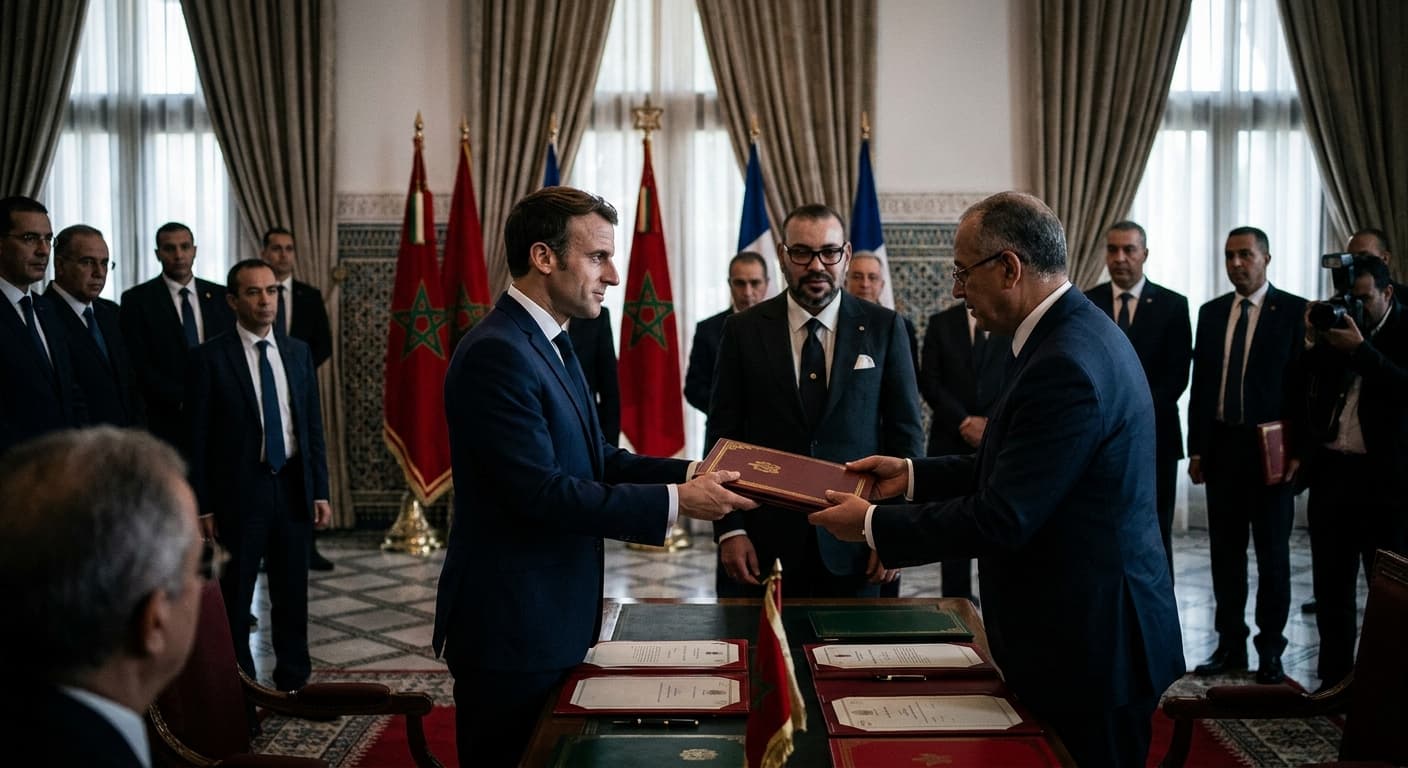
France and Morocco signed 14 cooperation agreements in Rabat on July 16, 2026, converting President Macron's 2024 Western Sahara recognition into institutional lock-in — and betting Morocco, not Algeria, is Paris's strategic anchor in North Africa for the next decade.
France and Morocco signed 14 cooperation agreements on July 16, 2026, during Prime Minister Sébastien Lecornu's two-day visit to Rabat — his first official foreign trip since taking office — covering the economy, security, migration, and defence, with specific deals on the Rabat Regional Express Rail and a water-policy loan via the French Development Agency, according to Africanews. The package matters less for its individual items than for what it confirms: Paris has decided that Morocco is its strategic anchor in North Africa, and it is now writing that choice into institutions, loan agreements, and defence files faster than any future French government can easily unwind. The trip, accompanied by roughly a dozen ministers, was co-chaired with Moroccan Prime Minister Aziz Akhannouch at the 15th Morocco-France High-Level Meeting, a format that has run since 1997 and is reserved for Paris's closest partners,
Al Jazeera reported.
What was actually signed
The named instruments include an AFD-backed package for the Rabat Regional Express Rail project, a loan agreement on water resource management, and a draft framework agreement on scientific cooperation. Lecornu also said France's visa policy would be recalibrated to ease mobility for entrepreneurs and students — the constituencies Rabat cares most about after the 2021–2023 visa dispute that nearly broke the relationship.
The headline count, 14, is modest beside the 22 agreements signed at the 2017 high-level meeting under Edouard Philippe or the more than 10 billion euros in investment deals struck during Macron's October 2024 state visit, catalogued in the Élysée's official synthesis. That state visit produced a declaration of a "reinforced exceptional partnership," a strategic partnership on energy cooperation and connectivity, a 100 million euro AFD loan for Morocco's National Water Strategy, and a framework agreement on agricultural and forestry cooperation, per the
Élysée's summary of decisions.
The 2026 batch is narrower and more structural: rail, water, science, and the security-and-defence files that follow directly from France's 2024 recognition of Moroccan sovereignty over Western Sahara. Foreign Minister Jean-Noël Barrot, visiting Rabat weeks before Lecornu, confirmed both governments were preparing a bilateral treaty — France's first such instrument with a non-European country — to "pose the framework of the Franco-Moroccan relationship for the decades to come," as reported by France Diplomatie. The 14 agreements are the down payment on that treaty.
| Sector | Named instrument / focus | Lead actor |
|---|---|---|
| Transport infrastructure | Rabat Regional Express Rail project | French Development Agency (AFD) |
| Water policy | Loan agreement on water resource management | AFD + Moroccan ministries |
| Science & research | Draft framework agreement on scientific cooperation | Both governments |
| Economy & investment | Bilateral cooperation agreements | Both governments |
| Security & defence | Files following 2024 Western Sahara recognition | Defence & interior ministries |
| Migration & mobility | Visa facilitation for entrepreneurs and students | French interior ministry |
| Overall framework | 15th Morocco-France High-Level Meeting | Lecornu & Akhannouch |
Sources: Africanews; Al Jazeera; Élysée (October 2024 synthesis). Published July 17, 2026.
The 2024 pivot that made 2026 possible
The 14 agreements are the operational follow-through on a decision made two years earlier. In October 2024, Macron told Morocco's parliament that "for France, this territory's present and future fall under Morocco's sovereignty," calling Moroccan autonomy for Western Sahara the "only basis" for a settlement — a line that drew a standing ovation from Moroccan lawmakers, BBC News reported. Macron also pledged unspecified French investments in Western Sahara itself. That ended decades of French ambiguity over the territory, which Morocco annexed in 1975 and which the Algeria-backed Polisario Front still claims.
By 2025, the diplomatic landscape had moved sharply in Rabat's favor. On October 31, 2025, the UN Security Council adopted resolution 2797, renewing MINURSO's mandate and, for the first time, explicitly naming Morocco's 2007 autonomy proposal as the basis for negotiations. The vote was 11 in favor, none against, with China, Russia, and Pakistan abstaining; Algeria, a non-permanent Council member at the time, did not participate, according to UN Security Council records. US Ambassador Mike Waltz urged all parties "to use the coming weeks to come to the table and engage in serious discussions using Morocco's credible and realistic Autonomy Proposal as the only basis,"
UN Media reported. France, Spain, and the United States had all backed autonomy under Moroccan sovereignty; Britain followed in June 2025, making it three of the five permanent Council members. The
Council on Foreign Relations called the vote Morocco's clearest diplomatic victory in a generation, noting that "autonomy under Moroccan sovereignty is the framework within which this issue must be resolved," as France's UN delegate put it.
The Moroccan autonomy proposal, as transmitted to the UN, envisions local legislative, executive, and judicial authority elected by Sahrawi residents while Rabat retains jurisdiction over defence, foreign affairs, and religious matters. The Polisario Front rejects this framework outright and continues to demand a referendum with independence as an option. Polisario representative Sidi Omar said the resolution "does not imply any recognition of Moroccan sovereignty over Western Sahara,"
Al Jazeera reported. That gap between the Council's framing and the Polisario's position is where Algeria continues to operate.
| Date | Event |
|---|---|
| December 2020 | Trump recognises Moroccan sovereignty over Western Sahara as part of the Abraham Accords |
| October 28, 2024 | Macron declares Western Sahara's "present and future fall under Morocco's sovereignty" |
| October 29, 2024 | Élysée signs more than €10bn in investment accords during Macron's state visit |
| April 2025 | France-Algeria diplomatic crisis: reciprocal expulsions of 12 officials each |
| October 31, 2025 | UNSC resolution 2797 names Morocco's autonomy proposal as basis for negotiations (11-0-3) |
| July 15–16, 2026 | Lecornu's first foreign trip as PM; 14 agreements signed at 15th High-Level Meeting |
Sources: UN Security Council; BBC; Élysée; Al Jazeera. Compiled July 17, 2026.
Who wins, who loses
The immediate winner is Morocco's monarchy. King Mohammed VI called the 2025 UN vote "a new and victorious chapter in the process of enshrining the Moroccan character of the Sahara," Al Jazeera reported. France's institutionalisation of that position — through defence cooperation, AFD loans, and visa facilitation — locks the recognition into state bureaucracy, making it resistant to a change of government in Paris. As researcher Ouissal Marsaoui told
Al Jazeera: "Opening defence and military files linked to the Sahara anchors France's recognition within state institutions, transforming what could have been perceived as President Macron's personal political choice into a durable strategic orientation."
France wins a reliable North African partner at a moment when its regional footprint is contracting. Paris has been expelled from Mali, Burkina Faso, and Niger following military coups; its relations with Algeria are at their worst since independence. Morocco, by contrast, offers political stability, the Tanger Med port complex — now one of the Mediterranean's busiest shipping hubs — and a growing defence industrial base. For French firms, Morocco serves as a gateway to sub-Saharan African markets, a function Paris has been unable to perform directly from its former Sahel bases.
The secondary winner is the World Bank Group, which launched a ten-year Country Partnership Framework with Morocco on July 9, 2026, anchored in the kingdom's New Development Model and focused on private-sector-driven job creation, the World Bank announced. France's bilateral push and the World Bank's multilateral framework are complementary: both bet on Morocco as a stable, reform-capable economy over a decade-long horizon.
The clear loser is Algeria. Algiers broke diplomatic ties with Morocco in 2021; President Abdelmadjid Tebboune said in 2023 that relations had "practically reached the point of no return," the Council on Foreign Relations noted. France's Western Sahara recognition in 2024 prompted Algeria to withdraw its ambassador from Paris. The relationship then deteriorated further: in April 2025, Algeria expelled 12 French officials within 48 hours after France arrested an Algerian consular official linked to the kidnapping of government critic Amir Boukhors in Paris,
BBC News reported. France reciprocated, expelling 12 Algerian diplomats in what observers called the worst crisis between the two countries since Algeria's 1962 independence,
Al Jazeera reported. In December 2025, Algeria's parliament went further, passing a law declaring France's colonial rule a "crime" and formally demanding an apology and reparations,
Al Jazeera reported. The law carries no enforceable international weight, but it signals that the rupture in Algiers-Paris ties is now structural, not cyclical.
The Polisario Front is the deeper loser. Every additional country that backs Moroccan autonomy narrows the political space for an independence referendum. The Council on Foreign Relations noted that of the 84 countries that previously recognised the Polisario, 44 have rescinded their support, a trajectory that the October 2025 Security Council resolution accelerated.
The Algeria factor and the Maghreb zero-sum
The Franco-Moroccan rapprochement is not occurring in a vacuum; it is the mirror image of the France-Algeria breakdown. Macron's October 2024 sovereignty declaration prompted Algeria to recall its ambassador, BBC News reported. France's subsequent decision to greenlight investments in Western Sahara itself — territory Algiers considers illegally occupied — converted a policy disagreement into a structural rupture.
The 2025 expulsions crisis confirmed that the rupture has moved beyond diplomatic signaling into institutional retaliation. French Interior Minister Bruno Retailleau's push to remove 60 Algerians classified as "dangerous" and Algiers' refusal to accept them added a domestic-politics layer that makes rapprochement harder, Al Jazeera reported. Barrot's April 2025 visit to Algiers, where he declared "we are reactivating all mechanisms of cooperation" and quoted Tebboune saying "the curtain is lifted," lasted barely a week before the Boukhors arrest blew the relationship apart again.
For Morocco, the France-Algeria freeze is a strategic asset. Every degree of distance between Paris and Algiers increases Rabat's value to France as the stable North African partner. As Nouh El Harmouzi, founder of the Arab Center for Scientific Research and Humane Studies, told Al Jazeera: "This is no longer a relationship driven primarily by historical affinities or episodic political convergence. It reflects a gradual shift towards a partnership based on strategic interdependence, where both countries increasingly perceive each other as essential actors in addressing long-term regional challenges."
The historical parallel is Spain's 2022 pivot. Prime Minister Pedro Sánchez reversed Spain's decades-long neutrality on Western Sahara, backed Morocco's autonomy plan, and signed roughly 20 agreements with 800 million euros in credit lines at a Rabat summit, Al Jazeera reported. Algeria responded by suspending a two-decade-old friendship treaty with Madrid and briefly threatening gas supplies. France is now following the Spanish template — sovereignty recognition, high-level agreements, institutional embedding — but at greater scale and with defence cooperation Spain never offered.
Key Takeaways
- France's 14 agreements with Morocco on July 16, 2026, institutionalise Macron's 2024 Western Sahara sovereignty recognition through rail, water, science, and defence cooperation.
- UN Security Council resolution 2797 (October 31, 2025) named Morocco's autonomy proposal as the sole basis for negotiations, with 11 votes in favor and Algeria not participating — the strongest international endorsement Rabat has received.
- The France-Algeria relationship is at its worst point since 1962 independence: reciprocal expulsions of 12 officials each in April 2025, followed by Algeria's December 2025 law criminalising French colonial rule.
- Morocco gains investment, technology transfer in AI and advanced manufacturing, and French institutional lock-in on Western Sahara; France gains a stable North African partner after losing its Sahel footprint.
- A bilateral Franco-Moroccan treaty — France's first with a non-European country — is in preparation, intended to frame the relationship "for the decades to come."
Diplomat View
The 14 agreements are not a diplomatic milestone; they are a lock-in mechanism. France has concluded that Morocco, not Algeria, is the partner worth investing in for the next decade, and it is now embedding that choice in loan agreements, defence files, and visa policy faster than any successor government in Paris can reverse. The bet rests on three assumptions: that Morocco's political stability holds, that the Western Sahara file continues to move Rabat's way, and that Algeria remains a declining, not a resurgent, power. If any of those shifts — an Algerian oil-and-gas revenue surge that funds a renewed Polisario military push, a Moroccan succession crisis, or a French government that seeks rapprochement with Algiers — the lock-in could become a liability. But the trajectory through 2026 points clearly toward deeper Franco-Moroccan entrenchment, and the bilateral treaty Barrot previewed will be the decisive test of whether the "reinforced exceptional partnership" survives beyond Macron's presidency.
What to watch:
- Late 2026: King Mohammed VI's state visit to France, expected to coincide with the signing of the bilateral framework treaty — France's first with a non-European country.
- October 31, 2026: MINURSO mandate expires; the Security Council will vote on renewal, testing whether the 2025 pro-autonomy majority holds.
- 2026–2027: World Bank's ten-year Country Partnership Framework moves to implementation, with Morocco's private-sector job creation targets as the benchmark for whether the Franco-Moroccan-WBG alignment delivers tangible results.
Discover more

US Politics
SNAP Food Assistance Faces Legal Challenges
In 2026, SNAP faces stricter eligibility rules and mounting legal challenges, threatening food assistance for the millions of Americans who rely on the program.

US Politics
Next Generation Republicans
A leaked survey shows 39% of Republicans under 30 do not identify as MAGA, revealing a split in the GOP's future leadership.
Global Politics
US-Iran Tensions Rise
Tensions escalate in the Strait of Hormuz as Iran and the US clash over maritime control, with a ceasefire hinging on a contested MoU paragraph.

Economics
Fed's Amex AML order puts correspondent banking on notice
Federal Reserve's Amex AML order requires board-level controls and a 90-day plan; OCC fined the bank $350 million over enterprise-wide deficiencies.