France and Syria to Exchange Ambassadors
Macron's visit marks a new chapter in Franco-Syrian relations.
Model Diplomat9 min readMiddle East
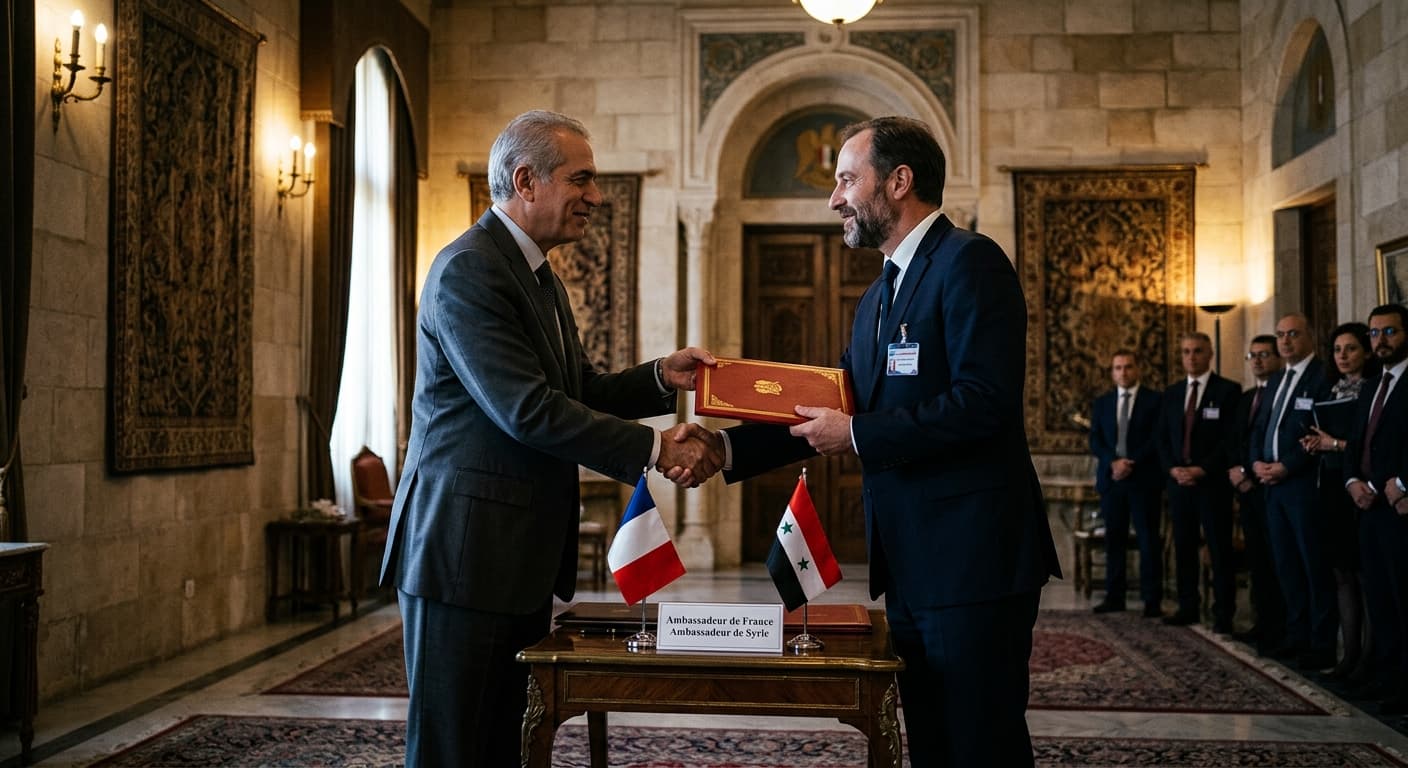
Paris Bets on Damascus: France and Syria to Swap Ambassadors
France and Syria will exchange ambassadors after a 14-year rupture, sealed by Macron's July 7 Damascus visit — the first by an EU head of state since Assad's fall.
President Emmanuel Macron and Syrian President Ahmed al-Sharaa agreed on July 7, 2026 to install ambassadors in Paris and Damascus "as soon as possible," closing a rupture that began when France shuttered its embassy in March 2012 and expelled Bashar al-Assad's envoys after the Houla massacre. The move is less a reconciliation than a European counter-bid — a French attempt to plant a foothold in a reconstruction market Turkey, Saudi Arabia, Qatar, and the UAE have spent 18 months carving up, priced by the World Bank at $216 billion. That Damascus was rocked by two roadside bombs near Macron's hotel the same morning is the point: France is buying into a country its own diplomats still classify as an active security theatre, on the calculation that whoever writes the contracts now writes the rules for a decade.
What was actually agreed in Damascus
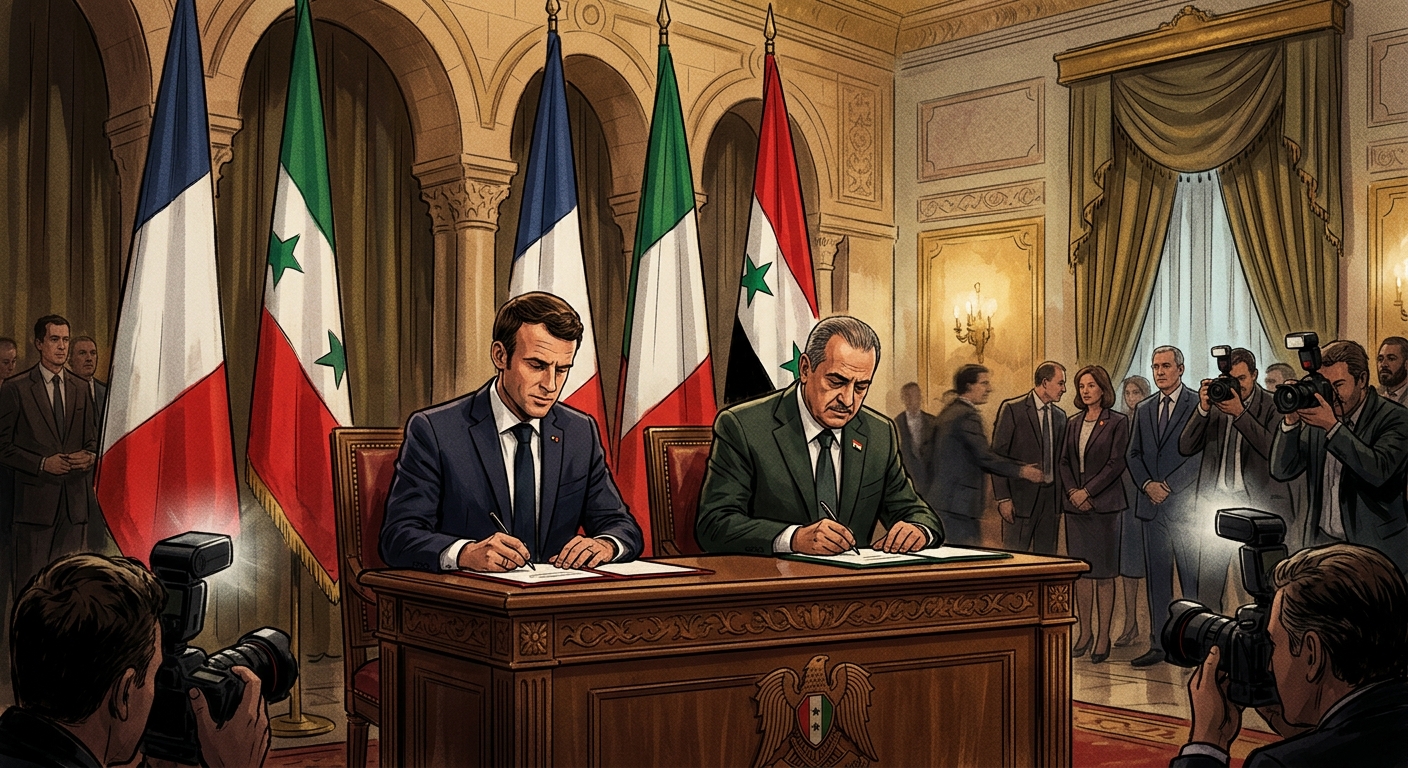
The Élysée framed the visit, in its official readout, as "the beginning of a new chapter in the Franco-Syrian partnership in the economic and security spheres." According to the Élysée Palace, Macron and al-Sharaa presided over an economic forum on "the reconstruction of Syria and strategic corridors," followed by a signing ceremony and joint press conference. Fifteen bilateral agreements were signed spanning civil aviation, health and banking,
the BBC reported, alongside a French commitment to help rebuild
Syria's banking sector and central bank capacity.
The headline commercial deal went to French shipping group CMA CGM, which added air-freight handling at Damascus International Airport to a 30-year concession it already holds to operate the port of Latakia and two dry ports, according to Al Jazeera. TotalEnergies CEO Patrick Pouyanné travelled with the delegation to negotiate an exploration contract — French oil back in Syria after a 14-year absence. On the sovereignty front, the two governments began the process of returning €51 million ($58.3 million) in assets seized from Rifaat al-Assad — the late Syrian dictator's uncle, convicted in Paris in June 2020 for laundering €90 million in embezzled state funds, per
BBC News — to a Syrian development fund. That transfer is more than symbolic: it hands al-Sharaa a nine-figure sum with a domestic political story attached, and it lets Paris close a legacy dossier without simply writing off assets to the French treasury.
Al-Sharaa, at the joint press conference, called France a "primary partner" for a Damascus he pitched as an alternative land corridor between the Gulf and Europe after Hormuz disruptions, Al Jazeera reported. Macron condemned Israeli incursions into southern Syria and pressed for Beirut-Damascus normalisation — a bid to keep France's Lebanon file relevant by tying it to Syrian sovereignty.
The historical parallel: 2012 in reverse
The symmetry with 2012 is exact. On May 29 of that year, France joined the United States, Britain, Germany, Italy, Spain, Canada, Australia, the Netherlands and Switzerland in expelling senior Syrian diplomats after the Houla killings; a week later, Damascus retaliated by declaring 17 Western envoys personae non gratae, according to BBC News. France had already withdrawn its ambassador and closed its embassy that March "in protest at the scandalous repression of dissent" — one of the more theatrical breaks in modern European diplomacy. Then-President François Hollande openly floated "armed intervention" contingent on a UN Security Council resolution that never came, per contemporaneous
Al Jazeera reporting.
Fourteen years on, the leader Paris is now hosting is Ahmed al-Sharaa — the former al-Qaeda commander once known as Abu Mohammed al-Julani, whose Hayat Tahrir al-Sham group led the December 2024 offensive that ended the war. The rehabilitation began fast: French Foreign Minister Jean-Noël Barrot and Germany's Annalena Baerbock were the first senior Western officials to meet al-Sharaa in Damascus, on January 3, 2025, Al Jazeera noted. Paris hosted an international Syria conference on February 13, 2025, and Macron
received al-Sharaa at the Élysée on May 7, 2025 — the Syrian leader's first visit to any Western capital. On May 20, 2025, the EU lifted its economic sanctions on Syria,
Al Jazeera reported, a week after Washington did the same. The exchange of ambassadors is the last formal box in an 18-month sequence Paris has been ticking off with unusual discipline.
The power play: France muscling into a market Ankara and Riyadh already own
The exchange of ambassadors is diplomatic infrastructure for a commercial ambition that is running well behind competitors. When Assad fell in December 2024, Turkey — HTS's long-time patron — moved first; Qatar's Emir Tamim al-Thani was the first head of state to land in Damascus on January 30, 2025, and al-Sharaa's first foreign trip was to Riyadh three days later. Saudi Arabia has since committed more than $6 billion via its Elaf fund, and in February 2026 signed multi-billion-dollar deals covering Aleppo airports, a Flynas–Syria joint venture and ACWA Power water projects, Al Jazeera reported. The UAE's DP World paid $800 million for Tartous port in July 2025, per
Al Jazeera's business coverage, while a $7 billion power-sector deal signed the same month brought together Qatari, Turkish and US firms. In August 2025, Damascus signed a further $14 billion in infrastructure agreements — including a $4 billion Qatari deal to rebuild Damascus airport and a $2 billion UAE-backed metro — according to a separate
Al Jazeera dispatch.
Europe has been trailing. In a February 2026 assessment, the Carnegie Endowment concluded bluntly that "in the great jockeying for influence in Syria that has followed the downfall of Bashar al-Assad's regime, the Europeans are decidedly trailing behind," with Turkey and the Gulf "reaping the rewards" and Brussels lacking a ring-fenced reconstruction budget. Carnegie's Middle East programme has separately argued that Syria's overall need — quoted by the transitional finance ministry at "
at least $1 trillion" for the full rebuild-plus-refugee-return package — dwarfs anything the Gulf plus Turkey can deliver alone. Macron's Damascus trip is the French answer: bypass Brussels' consensus paralysis, arrive with 15 bilateral deals and a CAC 40 delegation, and lock in position before the $216 billion physical-rebuild bill — the
World Bank's October 21, 2025 best estimate — moves from pledges to procurement.
The Élysée is playing to a specific French comparative advantage. Carnegie's Europe programme argues that "Europe's normative strengths could provide genuine institutional value" through property-registry work, legal-aid systems and returnee frameworks — the boring institutional plumbing that Gulf sovereign wealth funds do not want to do. France, historically the mandatory power in Syria until 1946, has both the legal-drafting infrastructure and the francophone bureaucratic pipeline to deliver it. That is what the Élysée readout means when it lists "banking sector" support alongside strategic corridors: France is offering technical assistance conditional on regulatory reform, mirroring the model the IMF and World Bank now run in Damascus. It is the one lane Ankara and Riyadh cannot easily fill.
Who wins, who loses
The clear winner is al-Sharaa. A French ambassador in Damascus is the last significant Western sovereign recognition his government lacked, and it comes bundled with €51 million in returned Assad-family loot, a TotalEnergies exploration prospect and CMA CGM's second major concession. It also legitimises his security services in a lane that matters domestically — Macron committed France to counterterrorism cooperation and training for Syrian financial institutions, per the Élysée's own readout, a de facto endorsement of the ex-jihadist as a partner against Islamic State.
The loser is Iran, and to a lesser degree Russia. The Gulf International Forum has estimated Tehran spent between $30 billion propping up Assad, an investment now written off; every additional Western embassy in Damascus is another lock on the door back to that sphere of influence. Israel is the ambiguous loser: Macron publicly criticised Israeli incursions into southern Syria and endorsed the framework of the 1974 Disengagement Agreement that Israel voided after Assad's flight. France, uniquely among P3 members, is now on record contesting the legal basis of Israel's post-2024 buffer-zone expansion — a position
Al Jazeera reported Paris has been quietly building via the Syria-Israel talks it has hosted since January 2026.
Turkey and the Gulf are neither pure winners nor losers. They keep the biggest tickets — Qatar's $4 billion Damascus airport, the UAE's $2 billion metro, Saudi Arabia's Aleppo package, Turkey's integrated military-economic footprint. But they now have a European competitor with the one thing they lack: a plausible offer on rule-of-law institution-building that Damascus needs to attract non-Gulf private capital. Whether France can convert that into a genuine share of the $216 billion pipeline depends on whether the security situation stabilises enough for French insurers and banks to underwrite the contracts.
The security question the bombs asked
Two IEDs went off near the Four Seasons hotel where Macron slept, wounding 18 people, moments after his motorcade left for the presidential palace, the BBC reported. Syria's Interior Ministry claimed the explosives detonated as security forces attempted to defuse them and insisted they lay outside the French delegation's security perimeter. Analysts speaking to Al Jazeera were less sanguine: Kamal Abdeo of the University of Idlib called it a "big security breach" and said the devices were "probably implanted at night after Macron arrived," almost certainly timed for the convoy route. A cafe bombing in central Damascus killed nine people just days earlier, and the government continues to face active threats from Islamic State remnants and pockets of Alawite armed resistance funded,
Al Jazeera reported, from exile in Moscow.
That is the risk France has just underwritten. The Kurdish question is officially closed — a January 18, 2026 ceasefire integrated SDF units into the Syrian army after a rapid government offensive backed by US envoy Tom Barrack, per BBC News — but "closed" here means the Kurds accepted individual integration rather than autonomy, and the political costs will surface later. Any French ambassador arriving in Damascus in autumn 2026 will operate in a capital where bombs still detonate near government hotels and where the writ of the state, as Al Jazeera's reporting on the July unrest noted, ranges from strong in western and central areas to weakest on the southern border and in Druze regions.
Diplomat View
France's bet is that in a reconstruction market of $216 billion, being the only European sovereign with an ambassador, a returned-assets deal, a shipping monopoly, and a banking-reform mandate is worth the residual security risk. That bet is defensible but not risk-free: it works only if al-Sharaa keeps the sectarian violence — the March 2025 Alawite killings, the July 2025 Druze clashes — from recurring at scale, and if the July 7 bombs prove to be Islamic State-signature rather than a domestic insurgent capability that grows. The forecast changes if a second attack kills a Western national in Damascus before the ambassador is formally accredited, or if Berlin (which has moved more cautiously since Baerbock's January 2025 visit) declines to follow with its own ambassador — leaving Paris exposed as the only European capital that jumped. Watch, too, for whether TotalEnergies actually signs an exploration contract before year-end: without a hard French commercial anchor, the diplomatic upgrade risks becoming symbolism Ankara and Riyadh can safely ignore.
What to watch next:
- Late summer 2026: Formal accreditation of ambassadors in Paris and Damascus; the name of France's nominee will signal whether Paris treats this as a political or a technical mission.
- Q4 2026: TotalEnergies exploration contract signing; Flynas Syria launch (Saudi-Syrian JV slated to begin operations).
- NATO summit follow-through: Whether al-Sharaa's planned meeting with President Donald Trump — postponed by the Damascus bombings — is rescheduled, and whether Washington matches the French embassy upgrade.
The Bottom Line
France's decision to exchange ambassadors with Syria is not a moral rehabilitation of Ahmed al-Sharaa — it is a commercial and geopolitical hedge to keep Paris relevant in a $216 billion reconstruction market that Turkey, Saudi Arabia and the Gulf have already begun to divide. Macron is betting that legal-institutional expertise and a returned €51 million in Assad-family assets buy France a seat at a table where Ankara and Riyadh hold the chips. If the security situation holds and TotalEnergies signs, this is the moment Europe stops being a spectator in post-Assad Syria; if it doesn't, Paris will be the isolated capital that moved first for nothing.
Discover more

US Politics
SNAP Food Assistance Faces Legal Challenges
In 2026, SNAP faces stricter eligibility rules and mounting legal challenges, threatening food assistance for the millions of Americans who rely on the program.
US Politics
Next Generation Republicans
A leaked survey shows 39% of Republicans under 30 do not identify as MAGA, revealing a split in the GOP's future leadership.
India
Romanian Coalition Party Demands PM Resign
Romania's Social Democrats withdrew from coalition, joining far-right AUR to topple PM Bolojan, risking €10 billion in EU funds by August 2026.

Conflict & Security
Drone Warfare Killing Aid Workers at Unprec
Over 1,000 humanitarian workers killed in three years as cheap armed drones collapse legal protections. Gaza, Sudan, Ukraine, and DRC see deliberate targeting of aid convoys and hospitals with zero prosecutions.