France and Syria to Exchange Ambassadors
Macron's strategic move in post-Assad Syria
Model Diplomat7 min readMiddle East
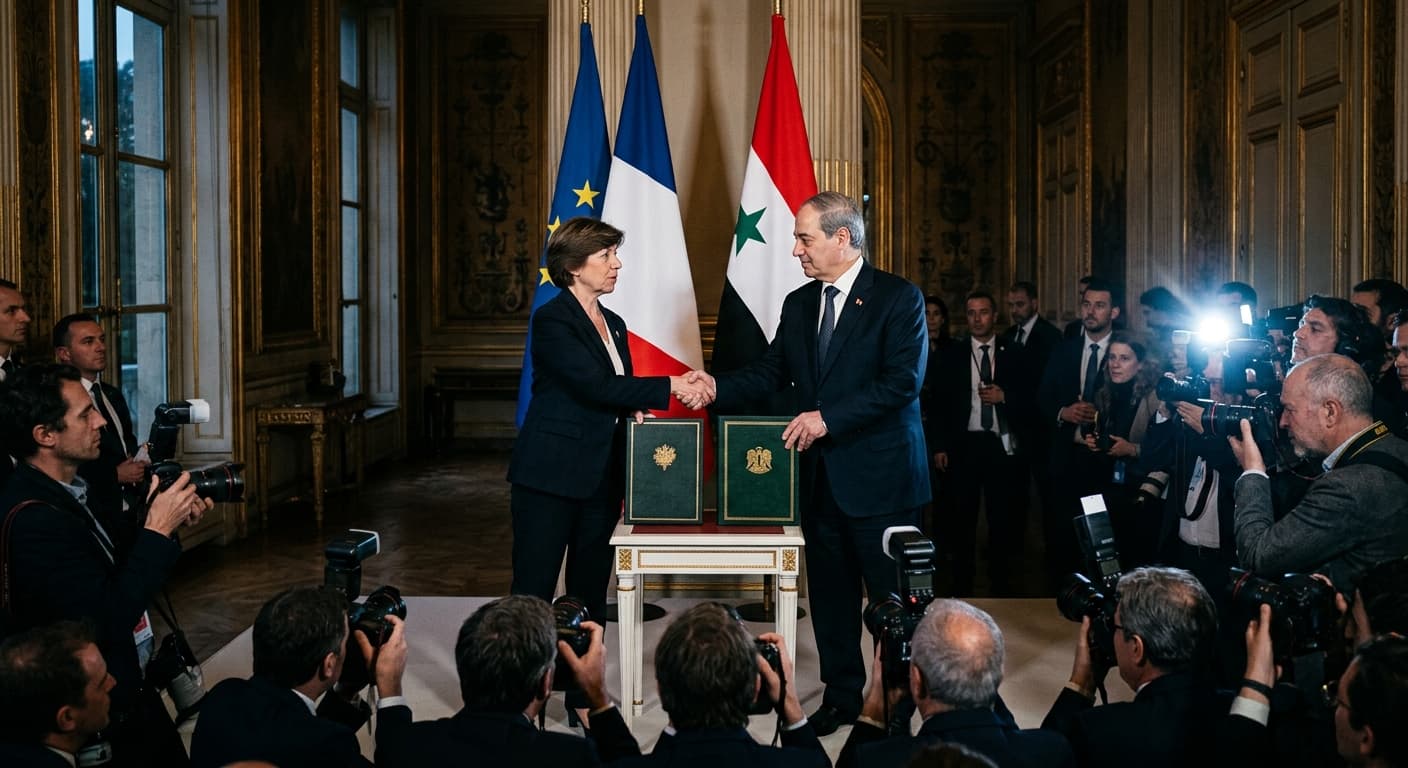
France and Syria to swap ambassadors: Macron's bet on post-Assad Damascus
France and Syria will exchange ambassadors after a 12-year break, sealing Macron's July 7, 2026 Damascus visit with 15 accords and a bid to anchor Western re-engagement in Syria's $216bn reconstruction.
France's decision to send an ambassador back to Damascus after 12 years is not a normalisation gesture — it is a positioning move. By becoming the first EU head of state on Syrian soil since Bashar al-Assad's ouster, Emmanuel Macron is trying to lock in a Western commercial and political foothold before Turkey, the Gulf and Russia carve up the reconstruction of a country the World Bank now prices at $216 billion. The ambassador exchange, announced alongside 15 bilateral agreements on July 7, 2026, is the diplomatic instrument that makes the rest of the package legally and politically operable — and it is why Paris, not Berlin or Rome, sets the tempo of Europe's Syria policy.
What actually happened in Damascus
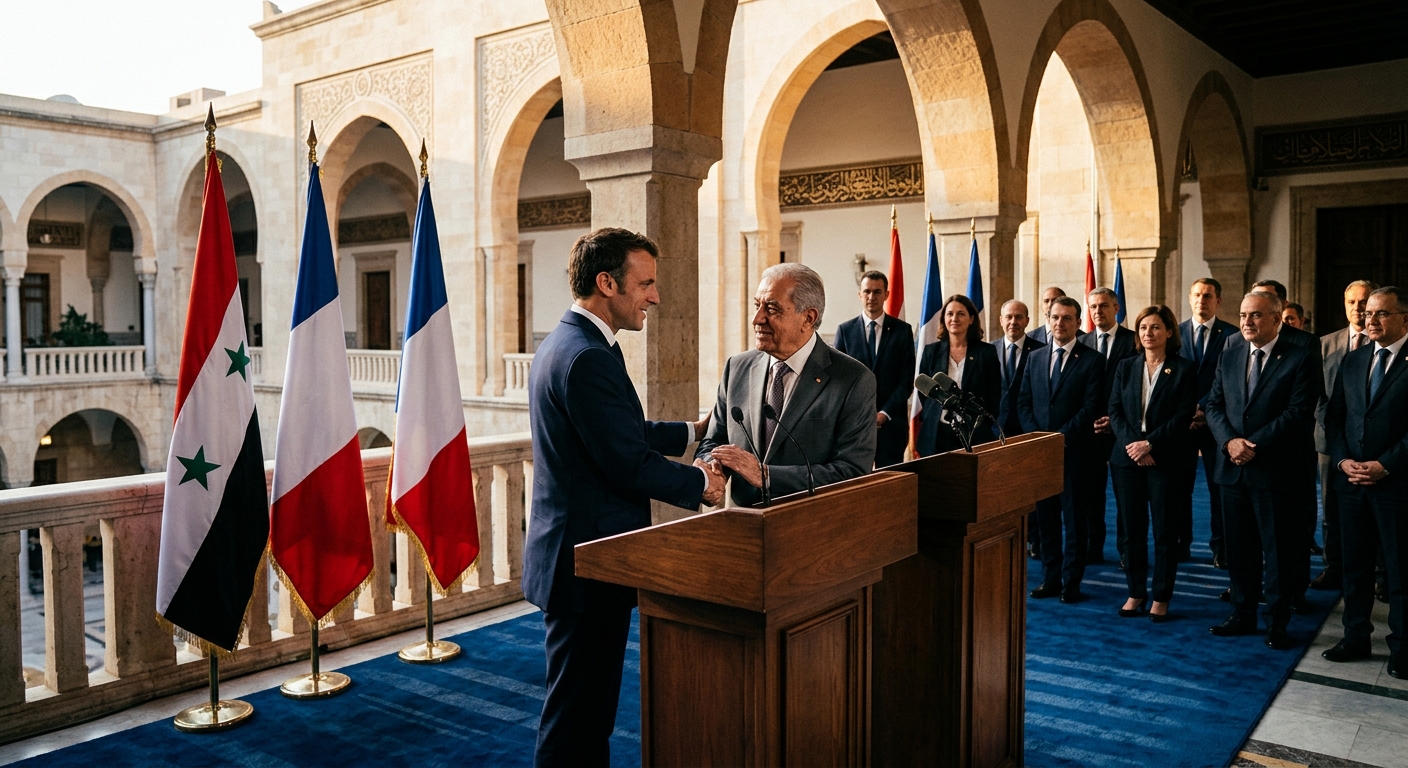
Syrian President Ahmed al-Sharaa announced on July 7, 2026 that he and Macron had agreed to install ambassadors in each other's capitals "as soon as possible", ending a rupture that began when Nicolas Sarkozy shuttered the French embassy on March 2, 2012 over Assad's repression, per the French foreign ministry's country file. Macron flew in on the evening of July 6, greeted at Damascus International Airport by Foreign Minister Asaad al-Shaibani, according to
Al Jazeera. It was the first French presidential visit to Syria since 2008.
The itinerary was engineered for optics and contracts in equal measure. Fifteen bilateral agreements were signed at a Syrian-French economic forum covering civil aviation, banking, health, ports and archaeology, the BBC reported. French shipping group CMA CGM took over air freight at Damascus International Airport, extending a May contract to run two dry ports; TotalEnergies chief executive Patrick Pouyanné met Syrian counterparts to discuss an exploration deal, per
Al Jazeera's reporting. Macron's office also confirmed that Paris has begun a process to return €51 million ($58.3m) in assets confiscated from Assad's uncle Rifaat al-Assad — sentenced in 2020 to four years for laundering Syrian public funds — to the Syrian state.
Then the backdrop cracked open. Two improvised explosive devices detonated near the Ministry of Tourism and the Four Seasons hotel where Macron had spent the night, wounding 18 people, according to the Syrian government. Macron's office said he "did not hear the explosions" and pressed on to the People's Palace. Syria's Interior Ministry told state agency SANA the blasts occurred "outside the security zone designated for the French President's residence". Al-Sharaa is expected to travel to the NATO summit in Ankara to meet U.S. President Donald Trump — a schedule that, per Al Jazeera, was under review after the attacks.
Why France is moving first — and fast
The Damascus trip is the payoff of an 18-month French bet that started before most Western capitals were willing to make one. On January 3, 2025, Jean-Noël Barrot was the first Western foreign minister into post-Assad Damascus, alongside Germany's Annalena Baerbock. On February 13, 2025, Macron hosted the third international Syria conference in Paris; his own remarks, published by the Élysée, promised "the imminent resumption of our diplomatic activity in Damascus" and pledged €50 million in humanitarian and stabilisation assistance. On May 7, 2025, Macron received al-Sharaa at the Élysée — the Syrian leader's first European trip — attaching explicit demands on inclusive transition, Lebanese sovereignty and counterterrorism, per the
Élysée readout.
Paris also did the unglamorous work: brokering the January 30, 2026 agreement between Damascus and the Syrian Democratic Forces that halted clashes in the northeast, per a France Diplomatie communiqué. A separate January 22, 2026
Élysée statement tied continued French backing to protection of Kurdish populations in Kobani and Hasakah and Syria's active participation in Operation Inherent Resolve against ISIS. That linkage — recognition and reconstruction in exchange for Kurdish integration and counterterrorism — is the political price al-Sharaa has been quietly paying since taking power.
The multilateral scaffolding arrived on schedule. In May 2025, the EU lifted its economic sanctions on Syria. On November 6, 2025, the UN Security Council delisted al-Sharaa and Interior Minister Anas Khattab from the ISIL/al-Qaeda sanctions list, 14–0 with China abstaining, per Al Jazeera — a resolution driven by Washington. On May 11, 2026, the Council of the EU terminated the partial suspension of the 1977 EU–Syria Cooperation Agreement, restoring full trade relations, according to
Consilium. Each step removed a legal reason for a French ambassador not to be in Damascus. The July 7 announcement collects the winnings.
The reconstruction race — and why France is a serial second
Here is the number that explains the choreography: on October 21, 2025, the World Bank put Syria's reconstruction bill at $216 billion — $75bn residential, $59bn non-residential, $82bn infrastructure. That is the pool every visiting delegation is trying to swim in. The Bank's Paris office had already hosted Syria's investment chief Talal al-Hilali on March 24, 2026 alongside French companies, the French–Syrian Business Council and MEDEF International, per the
World Bank — a preparatory session that essentially scoped the deal book Macron flew in to sign.
But France is arriving to a table already crowded. Turkey has moved on the border governorates and construction contracts. Saudi Arabia and Qatar have bankrolled early salary payments and energy imports. The U.S. moved first on sanctions: Trump's May 2025 executive order to lift most U.S. restrictions on Syria, per the BBC, effectively de-risked the sector for global banks — a step Europeans could not deliver on their own. And on the ground, France's TotalEnergies is competing with Chevron, which met al-Sharaa in December 2025, and with UK-based Gulfsands and Chinese Sinochem for a return to Syrian fields, per
Al Jazeera.
The Caesar Syria Civilian Protection Act is the loose wire in the room. It remains U.S. statute; European firms handling Syrian counterparties still risk secondary sanctions until Congress repeals it. Senators Jim Risch and Jeanne Shaheen said in November 2025 they were "actively working" on repeal. Until that vote lands, Paris's ambassador is a political flag more than a commercial guarantor.
What this means for regional stability — and for Russia
The France–Syria embrace is the most legible expression of a Western consensus that al-Sharaa's government, however uncomfortable its jihadist provenance, is now the transaction partner. That consensus is already reshaping three regional files.
Russia is the visible loser. Al-Sharaa met Putin in Moscow on January 28, 2026 explicitly to renegotiate the terms of the Tartus naval base and Hmeimim airbase — Russia's only military outposts outside the former Soviet Union, per Al Jazeera. Russia has already withdrawn from Qamishli. Every French, Turkish and Gulf project locked into Syrian infrastructure narrows Moscow's leverage over what remains of its 49-year base leases.
Lebanon is the quiet subject. The Élysée readout of the May 2025 al-Sharaa meeting listed "Syria's contribution to regional stability, particularly regarding Lebanon's sovereignty" among Macron's explicit demands. Paris has historically treated Beirut as its Levantine dossier; a Damascus that behaves toward Lebanon buys France leverage in both capitals.
Israel is the wildcard. Israeli strikes into Syria continued through 2025 and into 2026, and Damascus has publicly appealed to Moscow to constrain them. A French ambassador in Damascus is, among other things, a new European channel into any de-escalation architecture the U.S. eventually tries to construct.
The security question the bombs asked
The Four Seasons blasts are the analytical hinge. If they were ISIS — which has claimed a run of attacks in 2026, per the BBC — the ambassador exchange reads as an act of Western commitment under fire, and al-Sharaa's counterterrorism story sells. If they were remnants of the old regime's networks or a rival Islamist faction, the story is different: it says the state al-Sharaa is offering France as a "primary partner" cannot yet secure a two-kilometre perimeter around a G7 head of state. Macron chose to keep his schedule. The insurance markets that will price CMA CGM's port operations and TotalEnergies' rigs will make their own choice.
Macron told the joint press conference that people "must at once stand alongside those who have been injured … continue to be uncompromising on security … but not let ourselves be destabilised", per the BBC. That is the operative doctrine now: proceed regardless.
Diplomat View
The ambassador exchange is a defensible bet, not a moral vindication. Our call: within 12 months, France will be the largest EU commercial presence in Syria by contract value, but the largest single beneficiary of the reconstruction pool will not be French — it will be a Turkish–Gulf consortium operating with U.S. political cover. Paris's real return is diplomatic, not commercial: a channel to Damascus that Berlin, Rome and London will need to route through, and leverage over the Lebanon and Kurdish files it prizes above any contract. The forecast reverses if two things happen — a repeat Damascus attack that links to actors inside the al-Sharaa coalition, or a U.S. Congress that refuses to repeal Caesar Act sanctions before year-end. Either would strand French firms in a compliance no-man's land and force Macron to publicly narrow the partnership he just widened.
Watch these dates:
- August–September 2026: U.S. Congress vote on Caesar Act repeal. Without it, European banks cannot fully clear Syrian exposure.
- October 2026: Expected first Syrian ambassador to Paris presenting credentials; France's ambassador to Damascus expected in parallel.
- Late 2026: Constitutional drafting deadline al-Sharaa set for his own transition; French recognition is now leveraged to that milestone.
The Bottom Line
France's ambassador exchange with Syria is not about repairing a 12-year rupture — it is about being the European government that owns the Damascus channel before the reconstruction money is allocated. Macron is trading recognition for position: a seat at every table that matters on Kurds, Lebanon, ISIS and the $216 billion rebuild. If the bombs of July 7 stay isolated and Caesar Act repeal clears Congress, this will be remembered as the moment France reasserted itself as the West's operative interlocutor in the Levant. If they don't, it will be remembered as the moment Paris moved too early. *
Discover more

US Politics
SNAP Food Assistance Faces Legal Challenges
In 2026, SNAP faces stricter eligibility rules and mounting legal challenges, threatening food assistance for the millions of Americans who rely on the program.
US Politics
Virginia's Redistricting Referendum
Virginia's redistricting referendum is drawing a flood of dark money, shaping future elections and the fight for congressional control amid party stakes.
US Politics
Next Generation Republicans
A leaked survey shows 39% of Republicans under 30 do not identify as MAGA, revealing a split in the GOP's future leadership.

Conflict & Security
Drone Warfare Killing Aid Workers at Unprec
Over 1,000 humanitarian workers killed in three years as cheap armed drones collapse legal protections. Gaza, Sudan, Ukraine, and DRC see deliberate targeting of aid convoys and hospitals with zero prosecutions.