Fluorspar: China's Next Economic Weapon
Exploring China's control over fluorspar and its implications.
Model Diplomat7 min readAsia
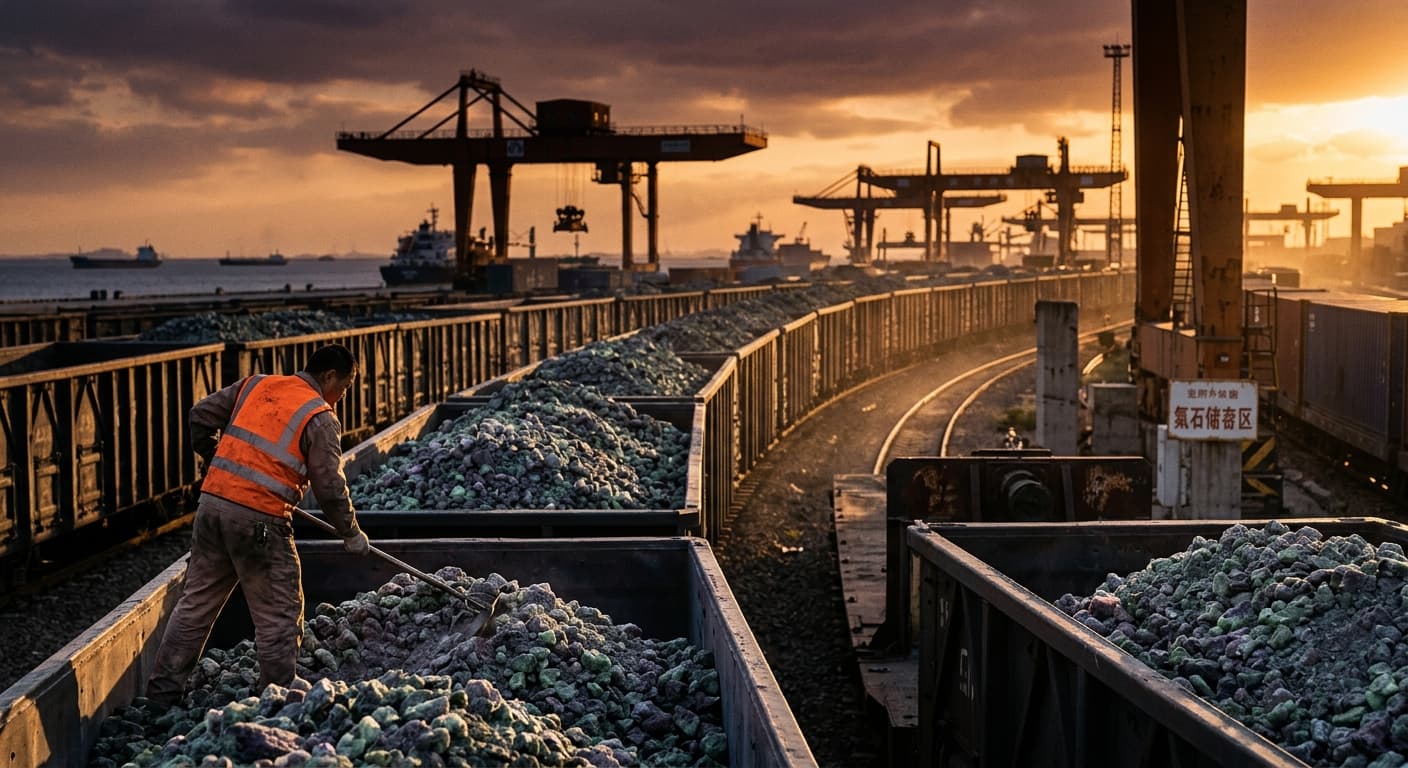
Fluorspar: China's Next Economic Weapon After Rare Earths
China mines roughly 69% of the world's fluorspar and controls the entire downstream chain — the next chokepoint in the energy-security race after rare earths.
The mineral that Beijing has not yet weaponised is fluorspar — and that is precisely why it matters. China produced about 6 million metric tons of the calcium fluoride ore in 2024, roughly 69% of global mine output, and dominates every downstream step that turns it into the hydrogen fluoride, lithium hexafluorophosphate and fluoropolymers that anchor semiconductors, EV batteries, nuclear fuel processing and F-35 coatings. After a two-year ladder of export controls that has already caught gallium, germanium, graphite, antimony, tungsten and twelve rare earths, fluorspar is the largest remaining critical mineral where China holds both the mine and the molecule — and where the Trump-Xi truce running to November 2026 has left Beijing an unused round in the chamber. If the truce collapses, or if Washington escalates on semiconductors, the fluorine economy is the next place to look.
The chokepoint that runs beneath rare earths
Fluorspar sits one layer below the minerals that make headlines. Almost all industrial fluorine begins by roasting acid-grade fluorspar (>97% CaF₂) with sulphuric acid above 300°C to produce hydrogen fluoride (HF), the reactive gas from which every other fluorochemical descends, as an Oxford group led by Véronique Gouverneur laid out in Nature while trying to invent a route that bypasses HF. From HF flow the etchants that pattern chips, the LiPF₆ salt in lithium-ion electrolyte, the PVDF binders that hold cathodes together, the PTFE seals inside enrichment centrifuges, and the refrigerants regulated under the Kigali Amendment. A 2025 review in npj Materials Sustainability
notes that global LiPF₆ production alone exceeds 100,000 tons a year and that fluorine "remains integral" to commercial battery electrolytes.
The upstream numbers hint at the leverage but understate it. The U.S. Geological Survey's Final 2025 List of Critical Minerals, published in the Federal Register on 7 November 2025, keeps fluorspar on the roster of 60 critical minerals; the
GAO's hardrock-mining review records that the United States has been 100% import-reliant on fluorspar since 1997. Mexico holds the world's largest reserves at 21.5% of the total, according to a 2025
supply-chain analysis in Nature Communications, yet does almost none of the downstream processing that gives fluorine its strategic weight.
Why fluorspar is not rare earths — it is worse
Rare earths gave Beijing leverage because the West lost the processing know-how. Fluorine is more concentrated still: China holds the ore, the acid-spar upgrading capacity, the HF plants, and the specialty derivatives. Industry data compiled by SunSirs, a Chinese commodity-price service, argues China holds "absolute international discourse power" in fluorite pricing — the phrase is telling because Chinese state media rarely uses it for other minerals. A 2026
Diplomat analysis reframes the fluorine economy as the next strategic lever, arguing that leverage lies in ecosystem control, not extraction alone.
Two features make the leverage sharper than the rare-earths case. First, fluorspar has already been litigated and lost at the WTO: the Appellate Body report in DS394/395/398 upheld the panel's finding that China's export duties on fluorspar were inconsistent with its Accession Protocol and could not be justified under GATT Article XX(g)'s natural-resources exception. Beijing complied in 2013 by shifting from tariffs and quotas to production quotas, environmental shutdowns and, since 2020, its Export Control Law — the same architecture now driving the rare-earths regime. In other words, the legal playbook to squeeze fluorspar exists and has been WTO-tested; only the political trigger is missing.
Second, the downstream substitution problem is severe. The 2024 Nature Communications study on lithium electrolytes found that "more than half of the weight of LiPF₆ arises from fluorine atoms," and that fluorine-free alternatives — LiFSI, borate salts, sulphonimides — remain sub-scale. A PubMed-indexed review from the U.S. EPA-linked literature concluded PFAS-free batteries are "technically feasible" but "not currently well-established on the market." That is a five-to-ten-year retooling problem, not a stockpile problem.
The ladder Beijing has already climbed
Beijing's use of export controls has followed a clear escalation pattern. According to the Swedish Institute of International Affairs, MOFCOM began with gallium and germanium licensing in July 2023, added graphite in December 2023, antimony in September 2024, and moved to outright bans on 3 December 2024 covering exports to U.S. end-users. On 4 April 2025, seven heavy rare earths were placed under licensing; on 9 October 2025 Beijing added five more, plus lithium-ion batteries, graphite anodes, and — critically — extraterritorial reach for goods containing even 0.1% Chinese-origin material, as the
European Parliamentary Research Service documented. The October 2025 wave was suspended on 7 November 2025 until 10 November 2026 following the Trump-Xi meeting in Busan.
What remains in place matters more than what was suspended. The DGAP notes that Beijing's July 2025 controls on LFP cathode technology were not lifted: licensing for fourth-generation LFP tech at or above 2.58 g/cm³ compaction density continues, giving MOFCOM visibility into every serious battery joint venture. In April 2026, according to a
SIPRI backgrounder on China's export-control framework, the State Council adopted a new regulation on industrial and supply-chain security that formalises export controls as countermeasures. In January 2026, Beijing banned all dual-use exports to Japanese military end-users following Prime Minister Sanae Takaichi's remarks on Taiwan — a signal that political triggers, not commercial ones, now determine what leaves China.
Fluorspar sits comfortably inside this framework. A February 2024 assessment by the Trivium consultancy, cited in the Swedish institute's report, ranked 74 critical minerals for control probability using three criteria: criticality to strategic competitors, China's supply dominance, and minimal domestic damage. Fluorspar scores on all three.
The Japan-Korea precedent that Beijing has read carefully
There is a working template. In July 2019, Tokyo tightened export licensing for three semiconductor chemicals bound for South Korea — fluorinated polyimide, photoresists and hydrogen fluoride — the last derived directly from fluorspar. A RIETI empirical study by Ryo Makioka and Hongyong Zhang found the HF measure alone produced a large decline in Japanese exports to Korea and forced Samsung, SK Hynix and LG to re-source through Belgium, the United States, and Taiwan and to accelerate domestic HF production. Seoul's
WTO complaint DS590 is still on the books.
The lesson Beijing drew is not that HF controls fail — they hurt Korean chipmakers in weeks — but that they push competitors to build alternatives. That accelerates the very de-risking China wants to postpone. The Center for Security Studies at ETH Zurich argues Beijing will therefore retain its critical-minerals chokehold in the short to medium term but "likely lose this leverage in the long term", a calculation that favours strategic and reversible pressure — licensing delays, whitelist selection, extraterritorial content rules — over outright bans. That is precisely how fluorspar would be used.
Who benefits, who loses
The immediate winners of any tightening would be Mexican and Mongolian ore producers with the reserves but not the downstream chain, plus Vietnam's emerging acid-spar processors. The medium-term winners are the handful of Western fluorochemical incumbents — Solvay, Honeywell, Daikin, Chemours, Japan's Central Glass and Stella Chemifa — that already run HF plants outside China. Losers cluster around European automakers dependent on Chinese LiPF₆, U.S. and Korean chipmakers dependent on ultra-high-purity HF (the BBC and JIIA analyses of the 2019 Japan-Korea dispute both flagged that purity, not tonnage, is the binding constraint), and the U.S. nuclear-fuel cycle, which consumes fluorine as UF₆.
The unexpected loser is the energy transition itself. Fluoropolymers such as PVDF are structural to every current-generation lithium-ion cell; PFAS restrictions floated by the European Chemicals Agency in 2023 already pushed the industry to search for substitutes without success. A Chinese licensing squeeze on fluorine derivatives would compress European and American EV timelines from the same direction as the LFP cathode controls — but through chemistry, not IP.
The Diplomat View
The most probable scenario over the next twelve months is not a fluorspar ban but a fluorspar licensing regime built quietly on the April 2026 supply-chain security regulation and layered onto the existing environmental-quota system. Expect MOFCOM to designate specific downstream items — LiPF₆, PVDF, electronic-grade HF, PTFE for defence applications — rather than the ore itself, mirroring the 2025 rare-earth architecture. That preserves plausible deniability, keeps most ore flowing to Japanese and Korean fluorochemical majors, and hits precisely the U.S. and European sectors most exposed. The forecast changes if: (a) Washington restarts advanced-node semiconductor equipment controls before November 2026; (b) Trump lets the Busan truce lapse; or (c) a Taiwan Strait incident occurs. In any of those cases, expect fluorine derivatives on the MOFCOM list within weeks, not months. This is a falsifiable call: if Beijing controls a specific downstream fluorochemical before November 2026, the thesis holds; if the ore itself is targeted first, it does not.
What to watch
- 10 November 2026 — expiry of the Trump-Xi truce on the October 2025 export-control wave. Any renewal, extension or lapse will signal Beijing's appetite for the next mineral round.
- USGS 2026 Mineral Commodity Summaries (typically late January 2026 release) — watch the fluorspar entry for any change to the "net import reliance" line for the United States and for updated Chinese production shares.
- MOFCOM's dual-use catalog updates through Q3 2026 — the
Andersen Institute and MERICS have flagged that a CAS Bulletin paper by Xianke Peng listing 23 candidate technologies for restriction has historically been a leading indicator of formal controls within 12–18 months.
The Bottom Line
China's next economic weapon is not another rare earth — it is the fluorine chain that runs from a common calcium mineral to the ultra-pure hydrogen fluoride, LiPF₆ battery salt and PVDF binder without which no semiconductor is patterned and no EV cell is assembled. Beijing has the ore, the processing, the WTO-tested legal architecture, and a Japan-Korea precedent that shows exactly how much damage a targeted HF squeeze can inflict in weeks. The truce holding until November 2026 is not restraint — it is a loaded round Beijing is choosing not to fire yet.
Discover more

US Politics
House Ethics Committee Pushes Sexual Miscond.
The House Ethics Committee has shifted responsibility for sexual harassment settlement records to the Office of Congressional Workplace Rights, complicating disclosure efforts.
India
700 Activists Accuse PM Modi of MCC Breach
Over 700 activists allege PM Modi breached election code with a televised address attacking opposition parties just before state elections.

India
Delhi CM Rekha Gupta Blasts Opposition's Delm
Delhi CM Rekha Gupta's remarks on women's quota defeat reveal BJP's strategy for the 2029 Lok Sabha elections, focusing on delimitation.

Economics
Fed's Amex AML order puts correspondent banking on notice
Federal Reserve's Amex AML order requires board-level controls and a 90-day plan; OCC fined the bank $350 million over enterprise-wide deficiencies.