Five Energy Lessons from the Hormuz Crisis
Insights on global energy security post-Iran war
Model Diplomat8 min readMiddle East
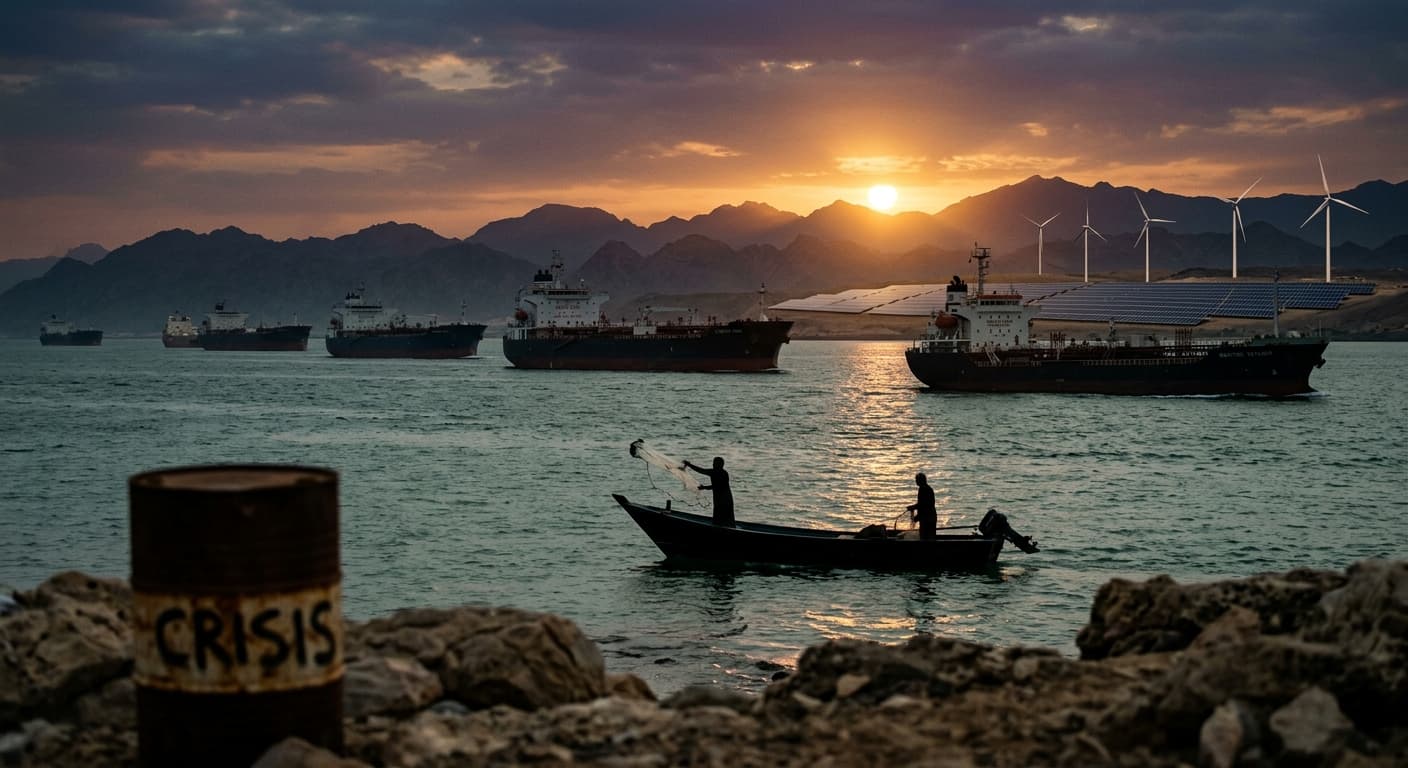
Deal or no deal: Five energy lessons from the Hormuz crisis
How the 2026 Iran war reshaped global energy security — and why the durable hedge is renewables, grids and electrification, not another LNG cargo.
The 100-day closure of the Strait of Hormuz did not just spike oil to $126 a barrel — it settled a decade-long argument about what energy security actually means, and the answer is not another pipeline or LNG contract. That is the through-line of the Institute for Energy Economics and Financial Analysis's July 8 assessment, Deal or no deal: Five energy market lessons from the Middle East crisis, and it is the frame policymakers from Tokyo to Brussels are now using to redirect capital. The crisis exposed a structural truth: swapping one fossil supplier for another moves the risk without removing it, and the only investments that mechanically cut exposure are domestic electrons — renewables, storage, grids, efficiency and electrification.
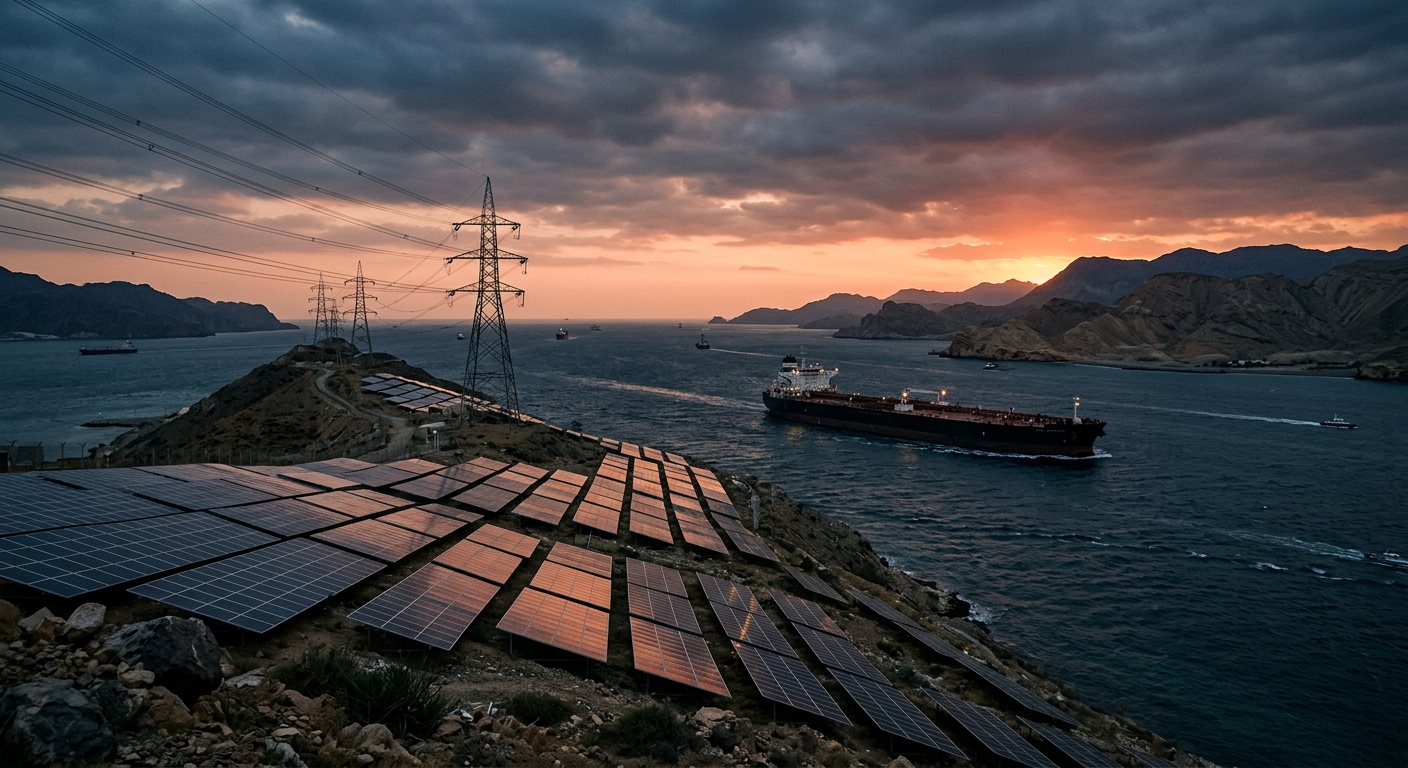
The shock, in numbers
Brent crude sat at roughly $73 the day before US and Israeli forces struck Iranian nuclear and military sites on February 28, 2026. Within a week it was over $100; by late April, per Al Jazeera's market tracking, it touched $126 a barrel before easing on ceasefire hopes. Traffic through the strait — which normally carries about a fifth of the world's oil and LNG — collapsed from 120–140 vessels a day to as few as five by early April, according to
Al Jazeera reporting on the reopening.
The mechanism was not a naval blockade. It was insurance. As RBC Capital Markets' Helima Croft told NPR, Iran needed only "several drone strikes in the vicinity of the Strait of Hormuz" for underwriters to walk away — an "insurance-driven shutdown" that shipping companies would not risk without cover. Iraq had to shut in production because it could not ship it. The IEA released a record 400 million barrels from strategic reserves and still called the disruption
"the largest supply disruption in the history of the global oil market".
The June 15 US–Iran memorandum of understanding briefly reopened the strait. It is now unravelling: US Central Command struck more than 80 Iranian targets after three tankers were hit, BBC News reported on July 8, and Brent jumped 4.2% to a two-week high. The Council on Foreign Relations warns the collapse of the 60-day MoU would deal "a severe blow" to any real recovery, arguing that mines, damaged infrastructure and Iranian toll demands mean the strait's
nominal reopening is only the first step.
Lesson one: import dependence is now a macro risk, not an energy risk
IEEFA's core finding is that oil and gas volatility long ago stopped being a sector story. In the countries most exposed — Pakistan, Japan and the Philippines each source over 90% of crude from the Persian Gulf, and India roughly 90% — the shock is passing straight into inflation, currency stress and central-bank tightening. Even indirect exposure bites: Australia depends on Asian refineries fed by Gulf crude and holds the IEA's smallest petroleum stockpiles, a vulnerability the IEEFA note flags with unusual bluntness.
The fiscal arithmetic is the tell. Japan spent more than $77 billion on fuel subsidies between 2022 and 2024, per IEEFA's tallies; India's oil marketing companies are absorbing over $4 billion in losses on cooking fuels alone; Bangladesh could pay over $1 billion in LNG subsidies in a single three-month window to keep power plants running. These are transfers from taxpayers to importers to preserve status-quo dependence — and the deeper the shock, the harder they are to reverse.
The second-order effect is investment. As IRENA's April policy advisory put it in its release, "Countries that invested in the energy transition are weathering this crisis with less economic damage", naming Spain, Portugal, China, India and Pakistan as visibly less exposed on the fossil-import channel. That is the empirical case IEEFA is amplifying: resilience showed up on the tape.
Lesson two: LNG is failing its "secure transition fuel" test
The strongest analytical claim in the IEEFA note is that LNG has not passed the security test Europe wrote for it after 2022. From March to May, the US supplied 60% of EU LNG imports even as Russian volumes rose 25% year on year; total EU and UK LNG imports still fell 3%. Switching suppliers, in other words, did not deliver security — reducing demand did.
The Australian case is sharper. Canberra is one of the world's largest LNG exporters yet its households and manufacturers face high domestic gas prices because so much production is contracted for export at global prices. In the United States, the same trap is now being built: IEEFA's earlier warnings on gas-power buildout imply US consumers will inherit both weather-driven price spikes and geopolitical premia as LNG exports scale.
The market response is already visible in cancelled projects. IEEFA flags LNG project cancellations in China and Vietnam, and the CSIS post-mortem on COP30 notes that Beijing spent the Belém summit "doing deals" on clean tech while Washington pushed fossil exports — a division of labour that hands the growth market to Chinese solar, batteries and EVs.
Lesson three: the shock is not staying in the energy silo
The Hormuz closure spilled into fertiliser, semiconductors and plastics before oil traders had priced it in. The strait carries roughly a third of global seaborne fertiliser trade and 7–8% of world fertiliser supply. The region is also a major source of helium — critical for semiconductor manufacturing — and of polyethylene, polypropylene and aluminum.
In India, petrochemical shutdowns put roughly 5 million jobs across 30,000 plastics micro-, small- and medium-sized enterprises at risk, per IEEFA. In Bangladesh, spot LNG prices and freight costs squeezed the garment export industry that anchors the current account. Jet fuel prices jumped by about half, pushing IAG's projected 2026 fuel bill to €9 billion, roughly €2 billion above 2025 — a single-airline data point that illustrates how the shock is landing in listed-company earnings, not just at the pump.
The humanitarian tail is heavier still. The Council on Foreign Relations reports that 45 million additional people now face acute food insecurity because of the war's cascading price effects, with Sudan, South Sudan and Somalia at risk of famine. That is what "energy security" now means as a concept: it is a food, fiscal and manufacturing category.
Lesson four: the market-based band-aid is failing
The reflex response — another cargo, another supplier, another subsidy — is what IEEFA calls "relief today, exposure tomorrow." The pattern is now familiar: fuel rationing, price caps and emergency deals contain the political damage while entrenching the underlying dependency. Japan's $77 billion subsidy bill is exhibit A; India's absorbed cooking-fuel losses are exhibit B.
Even the hardware fixes are slow. The CFR analysis notes there is "simply no precedent" for unwinding a market disruption equivalent to over 10 million barrels per day of oil supply and roughly 300 million cubic metres per day of LNG for over 100 days. Mines, damaged Gulf infrastructure and Iranian demands for transit fees mean seaborne exports will lean on alternate routes closer to Iran and Oman — amplifying, not reducing, the leverage of the two states whose behaviour created the problem.
Lesson five: the durable answer is electrons, and capital is already moving
The scoreboard the IEA maintains has flipped decisively. Its World Energy Investment 2026 figures, cited by the UK government at London Climate Action Week, put 2026 spending at roughly USD 2.2 trillion for renewables, nuclear, grids, storage, low-emissions fuels, efficiency and electrification, against USD 1.2 trillion for oil, gas and coal — nearly two-to-one in favour of clean energy. IRENA's 2026 stocktake found the world added
692 GW of renewable capacity in 2025 — a 15.5% annual jump — with the Middle East itself growing 28.9%, led by Saudi Arabia.
The EU is trying to match rhetoric with balance sheet. On March 10, 2026, the European Commission adopted a Clean Energy Investment Strategy targeting €660 billion in annual clean-energy investment through 2030 and €695 billion between 2031 and 2040, backed by an EIB commitment of over €75 billion over three years. That is the pace-and-scale response the Hormuz shock is meant to force.
The politics is lagging the money. COP30 in Belém closed in November 2025 without any direct reference to fossil fuels in the final text, with more than 80 countries — including the UK and EU — outmanoeuvred on the phase-out language. Brazil punted the fossil roadmap outside the formal COP process, with the first international conference on fossil-fuel phase-out set for Colombia in April 2026. The Middle East crisis is what happens in the gap between what the IEEFA lessons imply and what COP could deliver.
The critical-minerals catch
The durable strategy has its own choke point. China's April 2025 export controls on rare earths remain "largely unchanged" after the May 14–15, 2026 Trump–Xi summit, per Benchmark Mineral Intelligence; Washington quietly dropped its October 2025 claim that Beijing would "effectively eliminate" the controls. Benchmark projects China will hold
80%+ market share of refined rare earths and synthetic graphite through 2030, even as US and EU onshoring plans mature. Adamas Intelligence notes that China dominates over
99% of refined dysprosium and terbium, the heavy rare earths that make EV traction motors and wind turbines work.
Translation: the transition off Gulf oil runs through Chinese processing capacity. The Hormuz lesson — do not concentrate exposure in one geopolitically stressed chokepoint — applies with equal force to dysprosium as it does to diesel.
Diplomat View
The IEEFA framing will win the intellectual argument in Tokyo, Delhi, Manila and Brussels because the fiscal math on subsidy defence is unsustainable and the IEA's investment scoreboard now points the other way. The near-term forecast: capitals with high Gulf exposure — Japan, South Korea, India — quietly accelerate grid, storage and electrification spending in FY2026–27 budgets, and LNG offtake decisions in Vietnam and China continue to slip. What would change the forecast is a durable Hormuz reopening at pre-war volumes and prices sustained below $75 for two quarters — the conditions under which the political urgency evaporates and gas-power buildouts in the US and Southeast Asia lock in another decade of exposure. Absent that, the July 8 MoU collapse is the base case, and the IEEFA lessons will read less like advocacy and more like an after-action report.
What to watch
- April 2026, Bogotá: the first international conference on fossil-fuel phase-out, spun out of COP30's failure, will test whether Brazil's parallel roadmap can generate binding commitments.
- 60-day MoU window: whether the US–Iran framework survives through mid-August determines if Brent settles near $75 or retests $100+; CFR's Rubio-led "patience" strategy is now the swing variable.
- EU clean-energy investment reporting, Q4 2026: first data on whether the €660 billion annual target is being met — the credibility test for the post-Hormuz strategy.
The Bottom Line
The Middle East crisis of 2026 settled the energy-security debate on the evidence, not the ideology: countries that had already built out renewables, storage and grids absorbed the Hormuz shock with measurably less fiscal and inflationary damage than those that hedged with another LNG cargo. The durable strategy is domestic electrons, and the IEA's two-to-one clean-versus-fossil investment split says the capital has already made its choice. What is still in play is whether policy — at COP, in Brussels, in Delhi — moves fast enough to lock the shift in before the next chokepoint closes.
Discover more
US Politics
SNAP Food Assistance Faces Legal Challenges
In 2026, SNAP faces stricter eligibility rules and mounting legal challenges, threatening food assistance for the millions of Americans who rely on the program.
US Politics
House Ethics Committee Pushes Sexual Miscond.
The House Ethics Committee has shifted responsibility for sexual harassment settlement records to the Office of Congressional Workplace Rights, complicating disclosure efforts.
India
Congress Accuses Modi of Stalling Women's Law
Congress accuses Modi of stalling women's reservation law by linking it to delimitation, revealing a deeper electoral strategy.

Conflict & Security
Drone Warfare Killing Aid Workers at Unprec
Over 1,000 humanitarian workers killed in three years as cheap armed drones collapse legal protections. Gaza, Sudan, Ukraine, and DRC see deliberate targeting of aid convoys and hospitals with zero prosecutions.