Finland's Civil Servants Warn on Welfare
Civil servants declare welfare state unsustainable ahead of elections.
Model Diplomat4 min readeurope
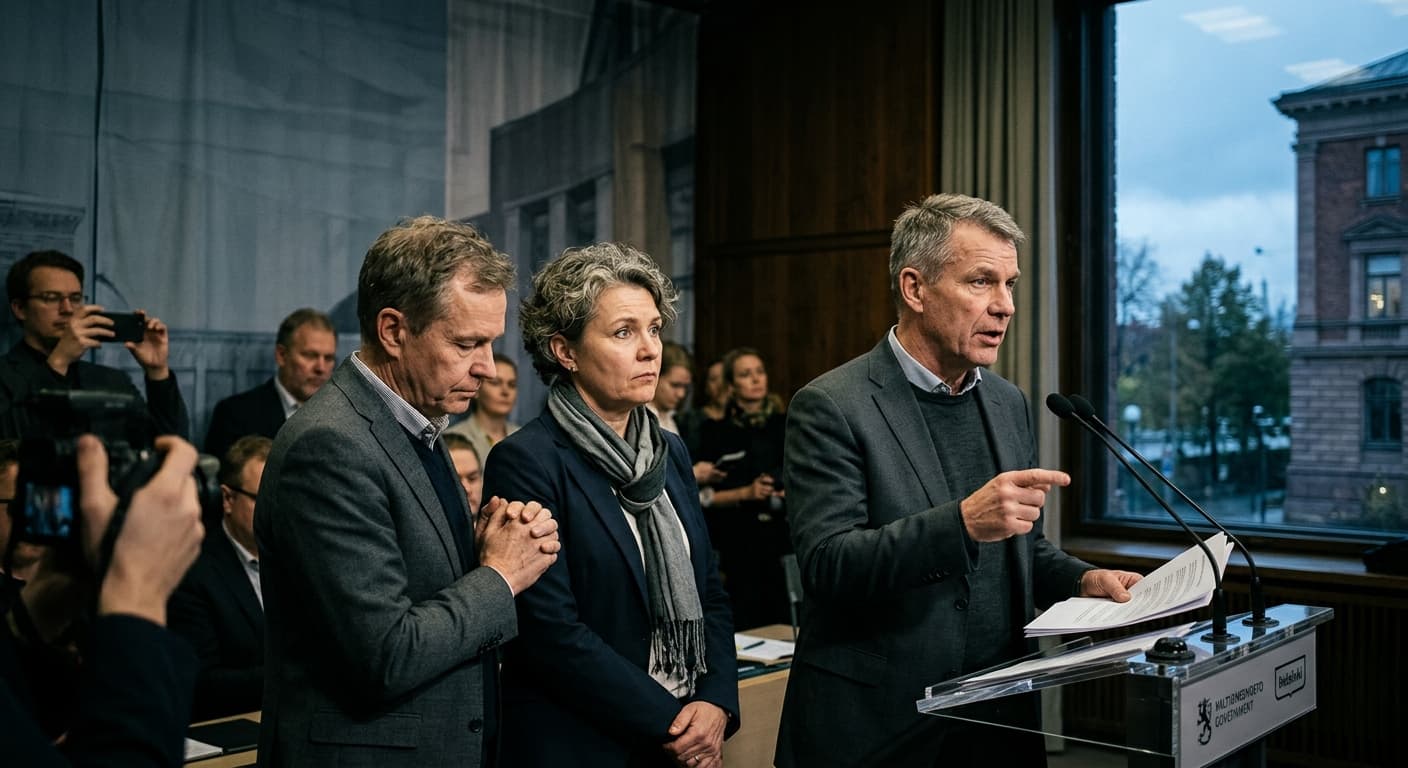
Finland's Top Civil Servants Declare the Welfare State Unsustainable — With Elections 10 Months Away
Finland's ministry permanent secretaries published a joint review on May 28 declaring the current public-service model cannot be maintained, forcing the April 2027 election to become a referendum on what the state will stop doing.
On May 28, the permanent secretaries of Finland's ministries did something their office rarely permits: they went public with a unified warning. Their report, Finland's Choices, published jointly across all ministries, states bluntly that "the current whole of public services cannot be maintained" and calls for a "broad societal debate" before the April 2027 parliamentary elections on what the welfare state should stop providing — and what citizens must take on themselves. Finnish Government
The report identifies four structural pressures: global instability, climate change and biodiversity loss, demographic and regional shifts, and a chronic general government fiscal imbalance. It proposes 31 policy approaches centered on trust, security, and sustainable growth. But the operative sentence is the admission that the existing model no longer adds up.
The secretaries are not political appointees — they are the most senior career civil servants in each ministry, responsible for strategic coordination and continuity across government terms. Their joint intervention, reported the same day by Swedish-language municipal affairs outlet Kommuntorget, amounts to the administrative state telling the political class that the math has run out.
The numbers behind the alarm
The civil servants' warning lands on terrain that has already been cleared by fiscal reality. In January, the IMF projected Finland's debt-to-GDP ratio will reach 95% by the end of the decade, with the overall fiscal deficit remaining above 3% and consolidation needing to continue at roughly 0.5% of GDP per year. IMF The Finance Ministry's own forecast is bleaker — public debt hitting 99.3% of GDP by 2030, driven by slow growth and rising interest costs.
ERR
Parliamentary parties have already acknowledged the scale of the problem. A cross-party fiscal policy working group — backed by 189 of 200 MPs, with only the Left Alliance dissenting — agreed that the next government must find €8–11 billion in consolidation over the coming electoral term, roughly double what Prime Minister Petteri Orpo's current government has managed. ERR
But the permanent secretaries' review sharpens the question from "how much to save" to "what to eliminate." They are calling for the next Government Programme to redefine the boundaries between public and private responsibility — which services, which rights, which obligations — before coalition talks begin. That shifts the election from a contest over spending levels to a contest over the state's core functions.
Who gains, who loses
Orpo's National Coalition Party and Finance Minister Riikka Purra's Finns Party benefit most from the framing. Both have run on fiscal consolidation and can now cite non-partisan civil servants as validation. Purra has already proposed €900 million in additional cuts for 2026, targeting development cooperation, business subsidies, and cultural spending. ERR
The Social Democrats, currently leading polls at around 25% to the National Coalition's sub-18%, face the harder task. Their base — public-sector workers, pensioners, and lower-income households — stands to absorb the largest share of any redefinition of public services. SDP leader Antti Lindtman has opposed pension cuts and called for protecting low and middle-income households, but the permanent secretaries' report effectively rules out a "growth alone will fix it" platform.
The wellbeing services counties — Finland's 21 regional authorities created in the 2023 reform to manage health and social care — are at the structural center of this. The costs they generate are the single largest driver of fiscal pressure. The permanent secretaries are signaling, without naming them explicitly, that the current division of responsibilities between municipalities, counties, and the state cannot survive in its present form.
Minna Karhunen, CEO of the Association of Finnish Municipalities, reinforced this on the same day, stating unusually bluntly that Finland has "too many municipalities" and questioning whether all of them have a future. Kommuntorget
What to watch
The next concrete milestone is December 2026, when the parliamentary fiscal policy working group will release its updated consolidation figures. That number — somewhere between €8 and €11 billion — will set the hard constraint around which every party must build its manifesto.
The permanent secretaries have now made it impossible for any party to campaign as if the status quo is an option. The question for April 2027 is not whether Finland's welfare state will shrink, but who decides how and who absorbs the cost. The civil servants have told the politicians to answer that question before election day, not after coalition talks. Whether any party takes them up on it will determine whether Finland's next government inherits a mandate or an abyss.
Discover more
Global Politics
Xi Jinping Calls China-Russia Ties 'Precious'
Xi Jinping's description of China-Russia ties as 'precious' reflects a strategic imbalance, with Beijing dictating terms in the partnership.
India
Congress Accuses Modi of Stalling Women's Law
Congress accuses Modi of stalling women's reservation law by linking it to delimitation, revealing a deeper electoral strategy.
Global Politics
Trump's Conflicting Messages on Iran War
Trump's mixed messages on Iran reflect a strategy of audience management, benefiting Tehran amid a complex geopolitical landscape.
Conflict & Security
Guatemala: El Niño 2026–27 becomes regional security test
UNICEF: 25.8M children face El Niño risks in Latin America; Guatemala maps 188 municipalities for drought and food insecurity amid regional security test.