Fed Holds Rates, Warsh's Dot Plot Split
Fed maintains rates amid divided projections on hikes.
Model Diplomat9 min readNorth America
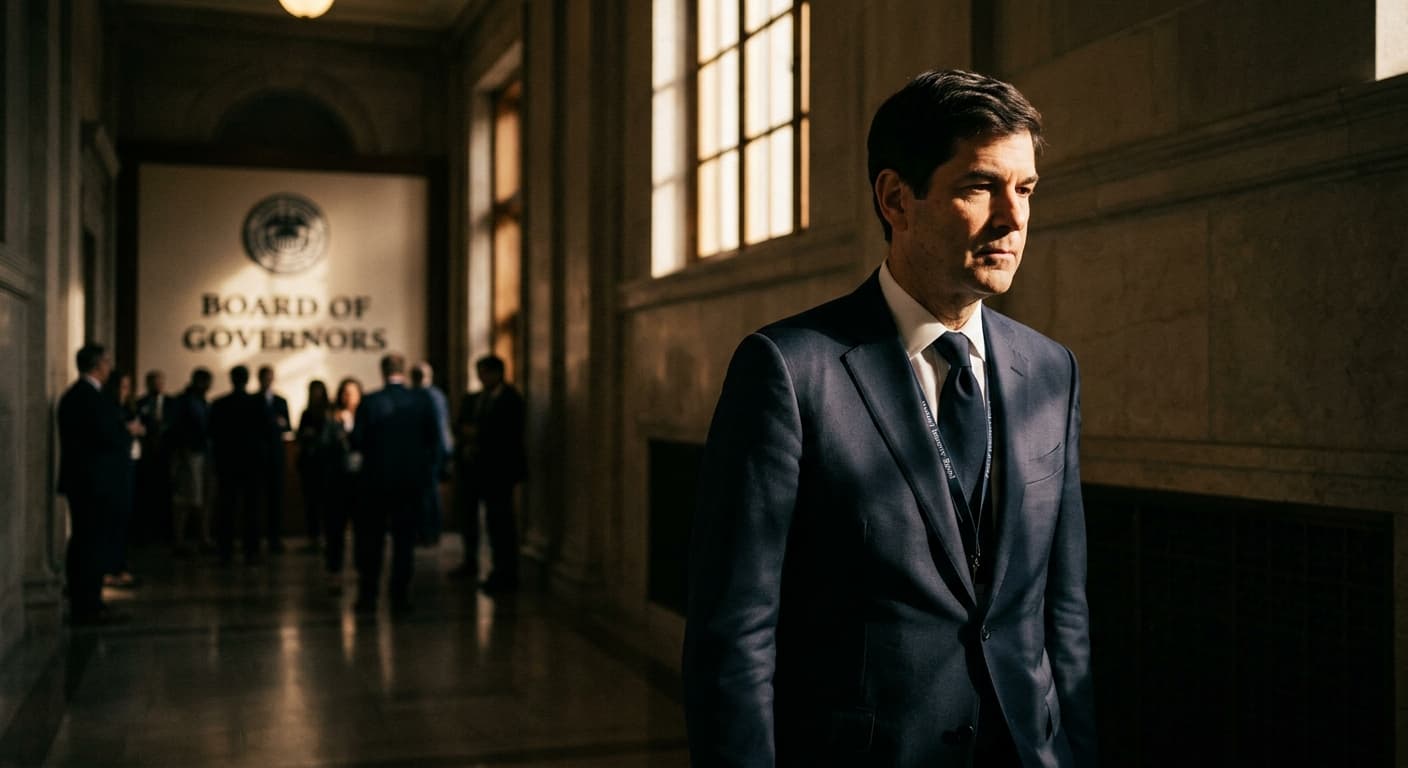
Fed Holds at 3.50%-3.75%, Dot Plot Splits 9-8 in Warsh Debut
The Federal Reserve held rates on June 17, 2026 and released a fractured dot plot — nine officials see a 2026 hike, eight see none, one sees a cut. Kevin Warsh abstained.
The most consequential thing the Federal Reserve did on June 17, 2026 was not what it kept — the federal funds target range at 3.50%–3.75%, unchanged for a fourth meeting — but what it broke: the dot plot, and with it the forward-guidance regime that has anchored global markets for over a decade. Nine of the 18 participants who submitted projections pencilled in at least one rate hike before year-end, eight expect no move, and one expects a cut, according to the Summary of Economic Projections. New Chair Kevin Warsh, who spent a decade attacking the dots, declined to submit one. The split is the story: a divided committee, a chair opting out of guidance, and an inflation shock from the U.S.–Israel war on Iran that has left the world's reserve-currency issuer without a clear rate trajectory for the first time since the taper tantrum of 2013. For emerging-market borrowers, that ambiguity is already doing the work of a hike.
What the primary document actually says
The full FOMC statement runs 132 words — down from about 350 in April — and closes with a single declarative line that captures Warsh's revised communications doctrine:
"Inflation remains elevated relative to the Committee's 2 percent goal, in part reflecting supply shocks that have driven price increases in certain sectors, including energy. The Committee will deliver price stability."
Gone is the sentence hinting the next move would be a cut. Gone is the calibrated conditionality — "in determining the extent and timing of additional adjustments…" — that let markets triangulate the Fed's reaction function since 2022. What remains is a pledge and a diagnosis. The Summary of Economic Projections fills in the rest: the median 2026 fed funds rate jumped to 3.8% from 3.4% in March, core PCE inflation is now expected to end 2026 at 3.3% versus 2.7% three months earlier, and one of the 18 dot-submitters declined to project for 2028 — someone besides Warsh is quietly walking away from long-horizon commitments.
The Implementation Note confirms the interest on reserve balances stayed at 3.65% and the balance-sheet runoff remains halted, consistent with the October 2025 decision to end net asset reductions and the December 2025 pivot back to bill purchases described in the Romers' Brookings retrospective on the
Powell years. Warsh has not moved the balance sheet. That fight — which the FT's Chris Giles noted would likely require a
new Fed–Treasury accord with Treasury Secretary Scott Bessent — is the next front.
The Warsh doctrine: less signal, more discretion
The Financial Times' Claire Jones, who was in the room, called the tone unmistakably hawkish: "This was a guy who people thought was hired by Donald Trump to cut interest rates. What we got yesterday was a very different Kevin Warsh." Jones also flagged an under-noticed detail — that a second participant, still unidentified, joined Warsh in refusing to project 2028 and longer-run rates, suggesting the abstention was not a solo protest but a coalition forming. Trump's public reaction, per the BBC, was a shrug: "It's alright… whatever." That is not resignation — it is a president who nominated a chair he expected to deliver cuts, discovering that Warsh has instead used his first meeting to bury forward guidance, launch five internal task forces, and abstain from the very tool markets use to price cuts.
The Council on Foreign Relations flagged this pattern before the meeting. In its first-100-days preview, CFR wrote that "the dot plot… could therefore become a relic of the past under his leadership" and predicted working groups over sweeping edicts. That is precisely what Warsh delivered on June 17: task forces on communications, the balance sheet, data use, the productivity-jobs link, and the inflation framework. CFR's earlier
confirmation-hearing analysis had also identified the intellectual tension that now defines the split: Warsh's belief that AI-driven productivity gains could justify lower rates, set against his instinct that the 2020 flexible-average-inflation-targeting framework was a mistake. The nine hawks share the second view. The one dove is betting on the first.
The Brookings Hutchins Center's 2026 survey of Fed watchers, conducted between March 23 and April 10, captured the tension in real time. Eighty-three percent of respondents said the chair should keep holding post-meeting press conferences after every meeting; Warsh has hinted he may not. Sixty percent said keep the dots; Warsh has now personally walked away from them. Seventy-five percent rated the threat to Fed independence a 4 or 5 on a five-point scale, with academics far more alarmed (87%) than private-sector Fed watchers (55%). Ellen Meade of Duke University framed the challenge bluntly in the survey: Warsh's task is "doing what's right even if it means President Trump won't like it." The paradox is that the chair Trump picked to be pliable is proving hawkish, but the institution he inherited is more politically exposed than at any point since the Burns years. The
Brookings paper by Christina and David Romer catalogued the recent attacks on independence: an attempted firing of Governor Lisa Cook currently in litigation, a suspended criminal investigation of Powell, and DOJ probes that hovered over the confirmation itself.
The Iran shock is doing the tightening
The macro backdrop is the load-bearing wall of this story. Personal consumption expenditures inflation rose to 3.8% year-on-year in April 2026 — the fastest pace in three years — driven by a 5.5% monthly jump in gasoline prices as U.S. strikes on Iran and Tehran's retaliatory closure of the Strait of Hormuz upended global crude flows, Al Jazeera reported citing Bureau of Economic Analysis data. The average U.S. gasoline price hit $4.42 a gallon in late May, up from $2.98 on February 28 — a 48% jump in three months. Olu Sonola of Fitch Ratings told Reuters that "the inflation picture is becoming increasingly uncomfortable for the Fed… price pressures are likely to persist over the next few months, and while the Fed cannot fix a supply shock, it cannot ignore one that is feeding into underlying inflation."
That is the split's origin. Nine officials read the energy shock as transitory but see enough second-round pass-through — into services, wages, expectations — to justify a hike. Eight (including the lone cutter) read it as a first-order supply shock that monetary policy cannot address without breaking the labor market. Samuel Tombs of Pantheon Macroeconomics told the BBC the "big news" was the dot plot pointing to hikes, not the hold itself. NPR's Scott Horsley called the meeting a moment when the Fed
hinted at a rate hike despite the president's insistence on cuts — the polar opposite of the outcome the White House expected when Warsh was nominated.
Market pricing has already capitulated. Crypto Briefing reports fed funds futures now assign roughly a 77% probability of no cuts in 2026, and
The Economist put the probability of a July hike at "roughly one-in-three" following Warsh's press conference. A JPMorgan Chase call cited by Al Jazeera now sees rates on hold until mid-2027, with the next move a hike rather than a cut. That repricing has erased more than 150 basis points of cuts once penciled in for 2026 under Powell's final SEP.
The unintended tightening: dollar spillovers into EM
Here is the angle the wire missed. When the Fed's forward guidance vanishes and the median dot rises 40 basis points in a single quarter, the dollar does the work of a hike whether or not one arrives. Indonesia's rupiah broke the psychological 18,000 barrier against the dollar on June 4, 2026 — a record low — after Bank Indonesia's 50-basis-point hike to 5.25% failed to stem outflows, according to Al Jazeera. Permata Bank chief economist Josua Pardede told AFP that "the increase in the BI lending rate and intervention is not enough to reverse the rupiah's depreciation." The Fed has not moved. The transmission is happening through expectations alone.
An IMF working paper by Cian Allen, Rudolfs Bems, Lukas Boer and Racha Moussa quantified this channel in April 2025: dollar appreciation shocks impose "sizable negative cross-border spillovers" that "fall disproportionately on emerging markets," with commodity exporters worst hit and policy rates in EMs forced into "systematic and long-lasting tightening" even when the Fed itself has not raised rates. Domestic credit in affected EMs, the IMF found, declines persistently beyond a 12-quarter horizon, and only countries with more anchored inflation expectations can respond by cutting rather than hiking into the shock. A separate IMF study by Engler, Piazza and Sher had already shown that
U.S. economic news, not just monetary policy, moves EM financial conditions via international risk aversion — precisely the channel Warsh's silence has opened.
The historical parallel is instructive. In May 2013, Ben Bernanke's off-hand mention of tapering produced a global sell-off — but Bernanke, at least, was signaling a direction. Warsh is signaling that direction is no longer the Fed's job. That is a step change. A Brookings analysis by Kenworthy, Kirby and Vorisek concluded that further increases in U.S. interest rates "can result in more widespread currency distress" given elevated EM debt stocks and depleted reserves — and today's expected-rate repricing has moved as much as an actual hike would have.
The mechanism is now live across Southeast Asia. Indonesia is an oil importer whose trade surplus collapsed from $3.3 billion in March to $89 million in April as crude bills exploded. Malaysia, the Philippines, and Singapore face the double blow of proposed U.S. import duties of 10%–12.5% on 60 economies over forced-labor allegations, layered on top of dollar strength. The losers of Warsh's ambiguity are not on Wall Street — they are in Jakarta and Manila, where central banks are being forced to defend currencies while the Fed publicly disagrees with itself.
Diplomat View
The bet worth making is that the FOMC does not hike at the July 28–29 meeting, but that the dot plot's hawkish tilt persists into the September SEP — and that Warsh's abstention hardens into a norm, ending the Bernanke-era dot regime by year-end. The falsifier: a July core PCE print materially below 3.0% coupled with a payrolls print under 75,000 would give the eight non-hikers enough cover to force a dovish statement rewrite, and Warsh would have to choose between his hawkish instincts and a president who has now spent six months publicly demanding cuts. The July 9 minutes will reveal whether the second unidentified abstainer is a lone eccentric or the nucleus of a faction — that distinction determines whether the dot plot has months or weeks left. If Bank Indonesia or the Bangko Sentral ng Pilipinas hikes again before July 28 without a Fed move, the phantom-hike thesis is confirmed and the case for coordinated EM defense — IMF swap lines or bilateral Fed facilities — becomes the next Washington fight.
What to watch next
- July 9, 2026 — release of the June FOMC minutes. Not the substance; the identity of the second abstainer and the shape of the hawkish-dove divide.
- July 28–29, 2026 — next FOMC meeting. The Economist puts July hike odds at roughly one-in-three; a hold with a hawkish statement is the base case.
- September 16–17, 2026 — next SEP release. First test of whether the dot plot survives Warsh's communications review, or whether scenarios replace it.
The Bottom Line
The Fed did not raise rates on June 17, 2026 — but by killing forward guidance and releasing a 9-8-1 dot plot without the chair's own dot, it delivered a de facto tightening that has already pushed the rupiah to a record low, forced Bank Indonesia into a 50-basis-point defensive hike, and erased 150 basis points of 2026 rate-cut bets. The story of this meeting is not the hold; it is that Kevin Warsh has begun dismantling the communications architecture that transmitted Fed policy globally for a decade, and the emerging markets caught in the resulting ambiguity are paying the cost of a hike that has not happened.
Discover more
Global Politics
Xi Jinping Calls China-Russia Ties 'Precious'
Xi Jinping's description of China-Russia ties as 'precious' reflects a strategic imbalance, with Beijing dictating terms in the partnership.
US Politics
SNAP Food Assistance Faces Legal Challenges
In 2026, SNAP faces stricter eligibility rules and mounting legal challenges, threatening food assistance for the millions of Americans who rely on the program.

India
Delhi CM Rekha Gupta Blasts Opposition's Delm
Delhi CM Rekha Gupta's remarks on women's quota defeat reveal BJP's strategy for the 2029 Lok Sabha elections, focusing on delimitation.

Economics
Fed's Amex AML order puts correspondent banking on notice
Federal Reserve's Amex AML order requires board-level controls and a 90-day plan; OCC fined the bank $350 million over enterprise-wide deficiencies.