EU-Armenia Relations Strengthen Against Putin
EU offers Armenia tariff-free access to counter Russian influence
Model Diplomat7 min readCaucasus
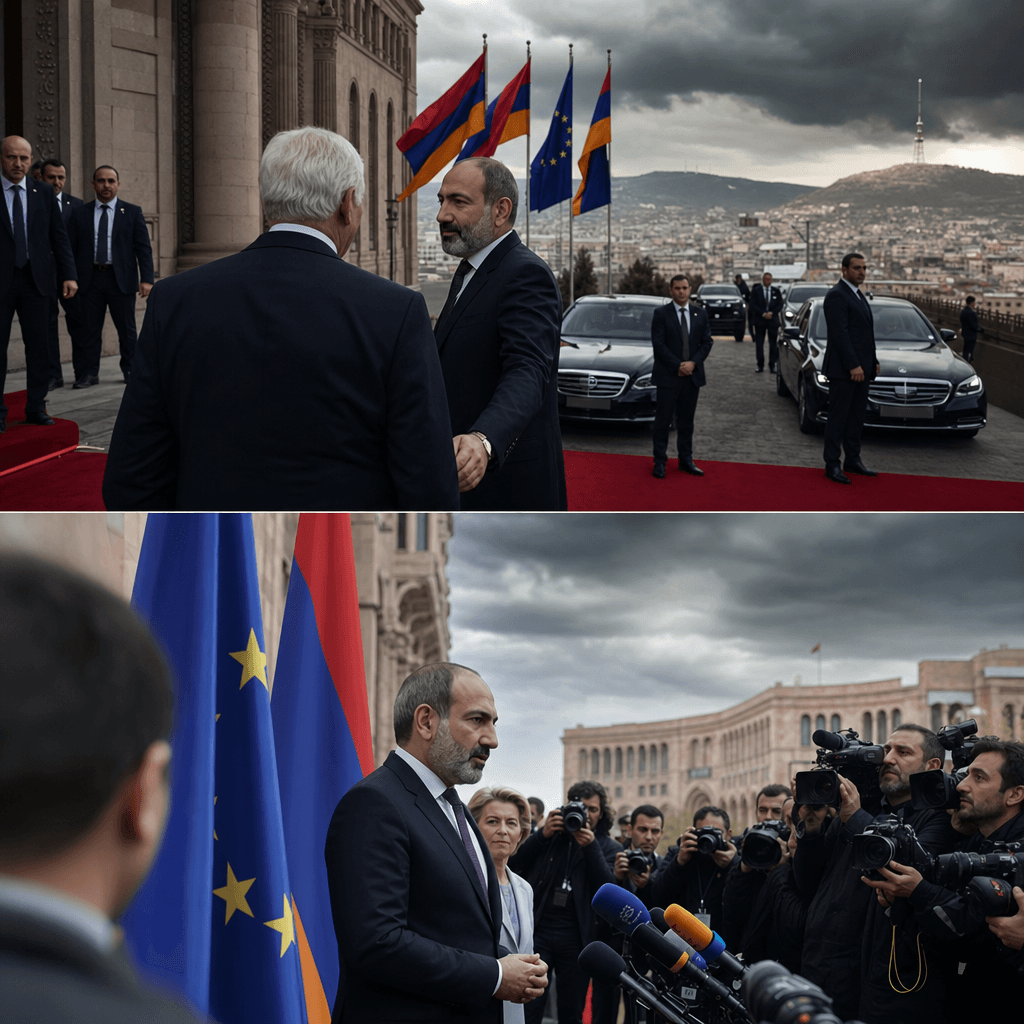
Armenia's EU pivot hardens: von der Leyen offers Yerevan a Russia-proof market
The EU's July 2 tariff-free package for Armenia is designed to blunt Moscow's economic coercion — but Brussels is still not offering Yerevan candidate status or security guarantees.
Ursula von der Leyen flew to Yerevan on July 2, 2026 and offered Armenia something Brussels almost never puts on the table for a non-candidate country: tariff-free access for roughly 80% of its exports, on Ukraine-style terms, plus €288 million in cumulative support. The unveiling of Autonomous Trade Measures (ATMs), together with Nikol Pashinyan's re-election three weeks earlier under a Russian trade embargo, marks the point at which the Kremlin's economic coercion in the South Caucasus has clearly boomeranged. Vladimir Putin set out to punish Armenia into a referendum choosing the Eurasian Economic Union; instead, Armenia's ruling party won 49.8% of the vote and the European Commission wrote it into the same trade-preference regime the EU built for wartime Ukraine. The core argument is narrower than the headlines suggest: Brussels is not offering Armenia membership — it is offering to underwrite the cost of leaving Russia's economic orbit, and it is doing so on a template first drawn up for a country at war.
The July 2 package, decoded
According to the European Commission's DG Enlargement release, the ATMs will "liberalise around 80% of Armenian exports to the EU" once adopted by the European Parliament and Council. The design is surgical: the measures cover almost 99% of Armenia's exports of fresh fruit, vegetables and plants to Russia and more than 91% of its beverages and spirits — precisely the categories Moscow banned in the run-up to the June 7 parliamentary vote.
The financial envelope is a stack, not a single line. Von der Leyen announced a €52 million support package in early June; €34 million was disbursed within two weeks and the remaining €18 million is due shortly, bringing total EU financial support to €288 million, per the Commission's readout. The May 5 EU–Armenia summit declaration also anchors a €270 million Resilience and Growth Plan and a Global Gateway commitment expected to reach €2.5 billion in EU investments. Brussels is dispatching Commission experts to Yerevan by mid-July to help exporters meet single-market standards — a technical mission most non-candidate neighbours never receive.
"No country should be pressured for a sovereign choice," von der Leyen said in Yerevan, adding: "the EU is stepping up, with €52 million and proposed tariff-free access for 80% of Armenia's exports to the EU. Armenia can count on us."
Putin's coercion, reverse-engineered
Read from Moscow's side, the Russia campaign against Armenia was textbook, and it failed on the exact metric Moscow chose. Since Armenia froze its participation in the CSTO in February 2024, citing what Pashinyan called the alliance's failure to defend Armenia during Azerbaijan's 2023 seizure of Nagorno-Karabakh, the Kremlin has escalated in three waves.
First came rhetorical intimidation. According to Al Jazeera, Putin used a May 29 EAEU summit in Kazakhstan to push Armenia — with Belarus, Kazakhstan and Kyrgyzstan co-signing — to hold a referendum on EU accession "as soon as possible," while warning that "the Ukrainian scenario" had begun with Kyiv's EU aspirations.
Second came the trade squeeze. As the BBC reported, in the two weeks before the vote, Moscow banned imports of Armenian flowers, mineral water, brandy, fresh vegetables and fruit. On June 1, Russia's agricultural watchdog suspended fish and seafood — a sector that had been sending 30% of exports to Russia. Russia still accounted for 36% of Armenia's foreign trade in 2025, so the bans were meant to bite.
Third came diplomatic escalation. Deutsche Welle confirmed Russia recalled its ambassador to Yerevan over Armenia's EU-tilt just days before the election. When Pashinyan's Civil Contract still took 49.81% of the vote — versus 23.29% for the pro-Russian Strong Armenia party led by billionaire Samvel Karapetyan, per
Al Jazeera's tally — the coercion story was over. What remains is the settlement of the economic bill.
The Ukraine template, quietly extended
The most consequential word in the Commission release is "autonomous." ATMs were the instrument Brussels used to give Ukraine unilateral tariff-free access after the 2022 invasion, bypassing the slow work of an association-agreement upgrade. Applying the same tool to Armenia — a country still nominally inside the EAEU and hosting Russia's 102nd military base at Gyumri — is a legal signal, not just an economic one. It treats Yerevan, for trade purposes, less as a neighbourhood partner and more as a state under Russian economic warfare.
The legal frame matters because Armenia has not been offered candidate status. The May 5 joint declaration acknowledges Armenia's "European aspirations" and notes its March 2025 accession-launch law, but stops short of a formal path. The BBC noted before the May summits that European leaders had come to Yerevan with civilian missions and visa-liberalisation promises, but "no timeline for EU membership, defence commitments nor any plan to replace Russian gas." That gap is still there. What the ATMs do is fill part of it economically without forcing the geopolitical question — Brussels de-risks Armenian trade diversification while the EAEU membership stays technically live.
The IMF Article IV report published in early 2026 projects Armenia's current-account deficit widening to 4.5% of GDP in 2025 as transit trade — much of it sanctions-related re-export activity through Russia — peters out, with both exports and imports set to fall more than 30%. In other words, Armenia's Russia-linked boom is already deflating on its own; the ATMs arrive as substitution capacity, not as a windfall.
Who benefits, who loses
The clearest winner from the July 2 package is Armenia's agri-processing and beverages complex, which had a Russia-only sales book and now has 27 EU member states as a legal export destination. The clearest loser is Rosatom and Gazprom's leverage bundle. Since VP JD Vance signed a civil nuclear "123 Agreement" with Pashinyan on February 9, 2026 — a deal the Council on Foreign Relations valued at
up to $9 billion — Rosatom's expected replacement of the Metsamor plant is no longer the default. Add the
World Bank's $200 million Economic Transformation Development Policy Operation approved on March 30, 2026, and Armenia has now assembled a Western financial stack — Commission, IMF, World Bank, DFC via TRIPP — that structurally reduces Kremlin economic influence.
Yet the story is not clean. Russia still supplies Armenia's gas at $177.50 per 1,000 cubic metres — the price Putin publicly reminded Pashinyan of at the Kremlin on April 1, 2026 — versus European market rates above $600, per the BBC. The Russian military base at Gyumri and the joint air-defence agreement of 2016 remain in force. As RAND's
Dara Massicot and Jeff Hornung argued, Armenia's gas, oil and nuclear sectors are "mostly controlled by Russia," which retains a "permanent pressure point." That is why Pashinyan told voters on June 1 that Armenia would remain in the EAEU "until the choice becomes unavoidable" — a formula the Kremlin publicly rejects but has, for now, been unable to force.
The non-obvious angle: an EU rebuke to its own doctrine
Extending Ukraine-style ATMs to a formal EAEU member sets a precedent Brussels has been careful to avoid. It concedes, in a legal instrument, that Russian trade sanctions against a post-Soviet neighbour are a form of coercion the EU will neutralise unilaterally — not through WTO litigation, not through an association agreement, but through the fastest tool in the toolbox. For Georgia and Moldova, both formal candidates, that is a template of what pressure buys. For Belarus and even Kazakhstan, it is a data point about the EU's willingness to pull an EAEU member out from under Moscow's tariff wall without insisting on full political rupture.
The €200 million EU Connectivity for Peace Package for the South Caucasus, together with an additional €20 million in Peace Dividends announced July 1, ties the trade opening to the Armenia–Azerbaijan peace initialled in Washington in August 2025. Brussels is effectively co-financing the U.S.-brokered TRIPP corridor infrastructure that will move Armenian goods to Europe via Türkiye — a route that bypasses both Russia and Iran. That alignment between EU money and a U.S. peace deal is unusual, and it is the geopolitical spine of the July 2 announcement.
What to watch
- European Parliament vote on the ATMs. The measures need adoption by Parliament and Council before goods move tariff-free. Watch for the INTA committee draft and a plenary vote in autumn 2026; opposition from EU horticulture producers is the likeliest friction point.
- The pre-year-end high-level EU–Armenia dialogue in Yerevan, mandated by the July 2 statement to review reforms under the Multi-Sector Budget Support Programme. That meeting will indicate whether Brussels moves from ATMs toward candidate status.
- Russian retaliation vectors. Watch Gazprom's April 2027 gas contract review, the status of the 102nd base at Gyumri, and any move against Armenian labour migrants (roughly one in ten Armenian households depend on remittances). These are Moscow's remaining pressure points now that trade bans have failed.
- The Armenia–Azerbaijan peace treaty ratification. Pashinyan lacks the two-thirds majority for the constitutional referendum Baku demands. Without it, the TRIPP corridor — the physical route the EU is financing — could stall.
The Bottom Line
The EU has not made Armenia a candidate, and it has not offered Yerevan a security guarantee. What it has done, on July 2, 2026, is quietly extend to a formal EAEU member the same emergency trade instrument it built for Ukraine at war — a legal admission that Russian economic coercion is now something Brussels will neutralise unilaterally. Putin tried to price Armenia's Western tilt out of reach; the answer from Brussels was to buy the price down. That is the settlement, and it is Moscow, not Yerevan, that now has to decide how to respond.
Discover more

Global Politics
US Seizes Iranian Ship, Tensions Surge
The US seizure of the Iranian ship Touska highlights a shift in control over the Strait of Hormuz, favoring Iran's strategic position.
India
Romanian Coalition Party Demands PM Resign
Romania's Social Democrats withdrew from coalition, joining far-right AUR to topple PM Bolojan, risking €10 billion in EU funds by August 2026.

Conflict & Security
Drone Warfare Killing Aid Workers at Unprec
Over 1,000 humanitarian workers killed in three years as cheap armed drones collapse legal protections. Gaza, Sudan, Ukraine, and DRC see deliberate targeting of aid convoys and hospitals with zero prosecutions.

Global
World Normalises Taliban as Afghan Women Eras
UN data shows Afghan women erased from public life as Russia recognises the Taliban, EU hosts officials in Brussels, and ICC warrants for gender persecution go unenforced.