Ethiopia's Red Sea Access: Development or Con
Ethiopia's new maritime rhetoric faces regional skepticism.
Model Diplomat3 min readafrica
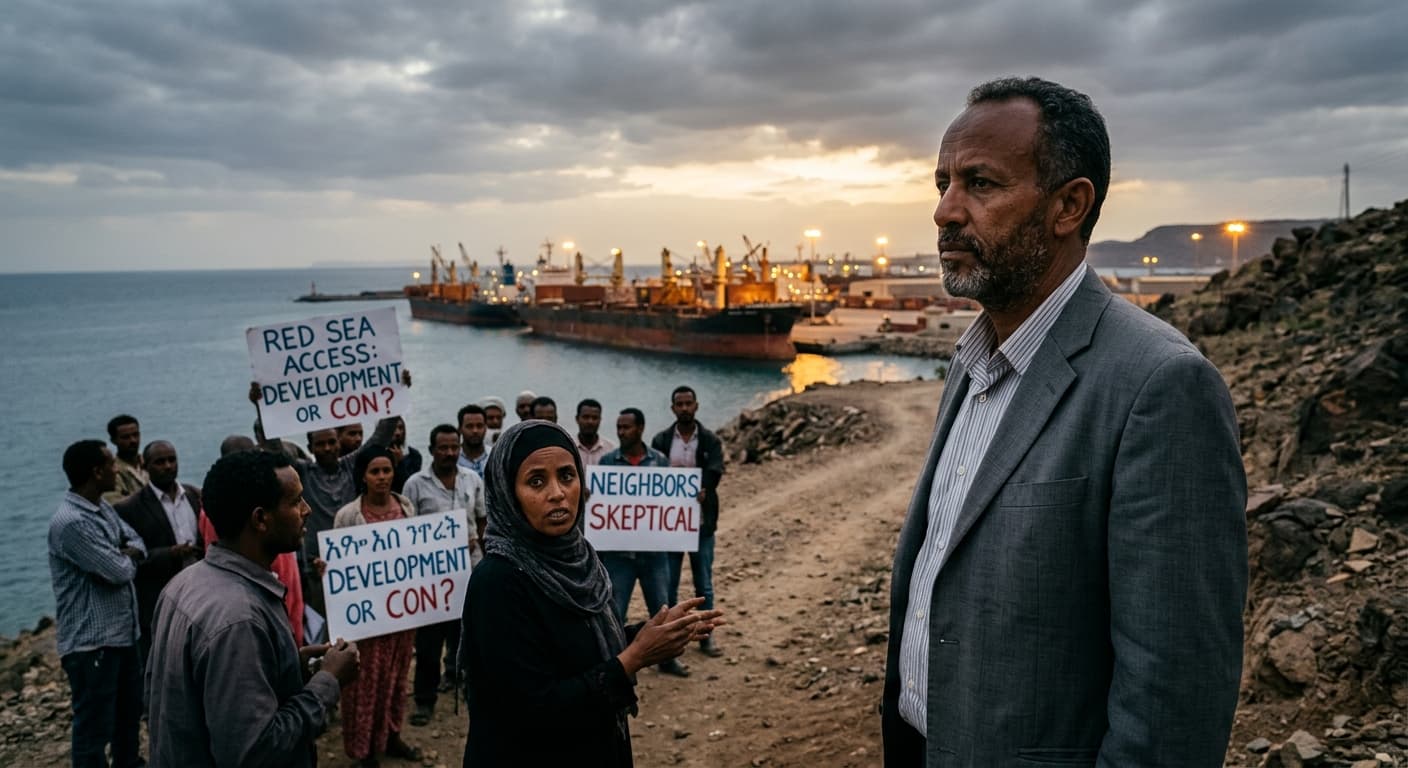
Ethiopia Reframes Red Sea Quest as Development, Not Destiny — But Neighbors Aren't Buying It
FM Gedion Timotheos tells Chatham House that maritime access is a "necessity, not confrontation." The language is new. The underlying power play isn't.
Ethiopia's Foreign Minister Gedion Timotheos delivered a carefully calibrated speech at Chatham House on June 17, describing Red Sea access as a "matter of national development and regional interdependence" — a deliberate departure from the existential, historically-grievance-laden rhetoric that has defined Addis Ababa's maritime campaign since 2023. Addis Standard reports that Gedion urged neighbors and international partners to view the issue as a "necessity," not a "confrontation," and warned against "securitizing" what is fundamentally a question of trade logistics, energy security, and long-term economic planning for a landlocked nation of over 130 million people.
The shift is strategic, not concessional. As the government-aligned Institute of Foreign Affairs noted, Ethiopia is not softening its maritime ambitions — it is "making a stronger claim, and a harder one to oppose" by anchoring sea access in development and regional integration rather than historical grievance or geopolitical leverage. IFA The logic is clear: a neighbor that objects to Ethiopian prosperity framed as a regional public good looks like an obstructionist, not a defender of sovereignty.
But that is precisely the problem. The Chatham House address landed in a region where Ethiopia's actions have spoken far louder than its development rhetoric. Prime Minister Abiy Ahmed's January 2024 MoU with Somaliland — offering diplomatic recognition in exchange for a 20-km naval lease at Berbera port — triggered a diplomatic crisis with Somalia that required Turkish mediation to contain. BBC The December 2024 Ankara declaration committed Ethiopia to seek access "under Somalia's sovereignty," but the technical talks agreed to in that deal remain opaque, and the MoU with Somaliland has never been formally rescinded.
Eritrea, meanwhile, has watched Ethiopia's maritime campaign with particular alarm. Assab is not an abstraction in Eritrean memory — it is the port through which Eritrea's independence was physically contested and eventually won. The Mesob Journal, in a sharp rebuttal to Gedion's Chatham House framing, argued that "a normal port-access negotiation begins with recognition of sovereignty, not ambiguity around it. It begins with commercial proposals, not national mobilization." Mesob Journal The critique is that while diplomats speak the language of cooperation, Ethiopian military-linked rhetoric and state media continue to treat Assab as a wound to be corrected, not a foreign sovereign space.
Gedion's speech also covered wider foreign policy ground — peace efforts in Sudan, South Sudan, and Somalia; the fragile Pretoria agreement with Tigray; the Grand Ethiopian Renaissance Dam on the Nile. On each, he applied the same frame: Ethiopia's development is a regional good, not a zero-sum threat. The Reporter Ethiopia But the TPLF hardliner accusation he leveled in the same speech — that factions are rearming and forging external alliances — undercuts the narrative of a government committed to dialogue over pressure.
Who benefits: Ethiopia gains a diplomatically defensible framing that shifts the burden of proof onto objectors. Somaliland, still unrecognized, sees any movement toward normalized Ethiopian port access as a step toward de facto statehood. Who loses: Eritrea, whose sovereignty over Assab is being implicitly relativized by a doctrine that treats coastline access as a structural development right. Somalia, which spent 2024 fighting to preserve its territorial integrity against the MoU. Egypt, locked in a parallel dispute over Nile waters.
What to watch: The Ankara technical talks between Ethiopia and Somalia — due to conclude within four months of February 2025 — remain the next formal decision point. Whether Ethiopia produces a concrete commercial proposal, or whether the "development necessity" frame remains a rhetorical placeholder while military posturing continues, will determine whether Gedion's Chatham House speech was a pivot or a repackaging. Eritrea's silence in response to the speech is itself a signal — and one unlikely to last.
Discover more

Global Politics
U.S. Naval Blockade Heightens Iran Tensions
The U.S. naval blockade of Iran collapsed oil exports, creating a new maritime regime in Hormuz that favors Tehran.

US Politics
SNAP Food Assistance Faces Legal Challenges
In 2026, SNAP faces stricter eligibility rules and mounting legal challenges, threatening food assistance for the millions of Americans who rely on the program.

Global Politics
US Naval Blockade on Iran
The US fully imposed a naval blockade on Iranian ports, escalating tensions even as Trump hinted the conflict may soon end while serious risks of war remain.

Conflict & Security
Drone Warfare Killing Aid Workers at Unprec
Over 1,000 humanitarian workers killed in three years as cheap armed drones collapse legal protections. Gaza, Sudan, Ukraine, and DRC see deliberate targeting of aid convoys and hospitals with zero prosecutions.