Erdoğan's Leverage at NATO Summit 2026
Turkey's pivotal role as NATO shifts focus from the US
Model Diplomat7 min readEurope
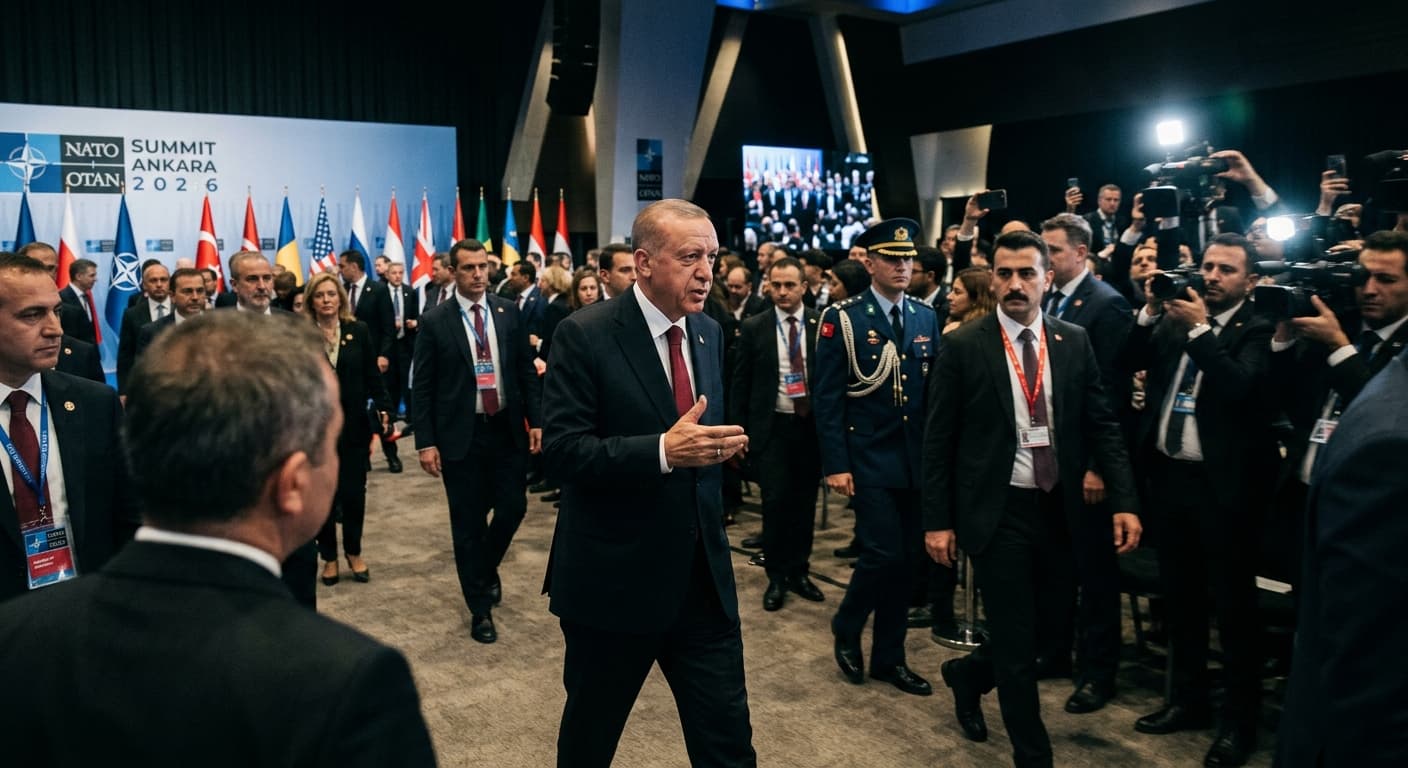
Ankara NATO Summit: Erdoğan's Leverage Moment as Alliance Splinters
Trump lands in Ankara on July 7, 2026 to enforce a 5%-of-GDP defense pledge — and hands Erdoğan the leverage of a lifetime over an alliance quietly decoupling from Washington.
Recep Tayyip Erdoğan opens NATO's 36th summit in Ankara on July 7, 2026 with a rare kind of leverage: he is the last NATO leader Donald Trump still calls a friend, the host of an alliance visibly decoupling from its American anchor, and the operator of the only European defense industry Brussels does not yet know how to absorb. The Ankara summit is not about Turkey — it is about who runs NATO after Washington starts to leave, and Erdoğan intends to be indispensable to the answer. The formal agenda — burden-sharing, Ukraine, the southern flank — masks the real business: pricing what a more European, more Turkish NATO will cost, and what Ankara extracts in return.
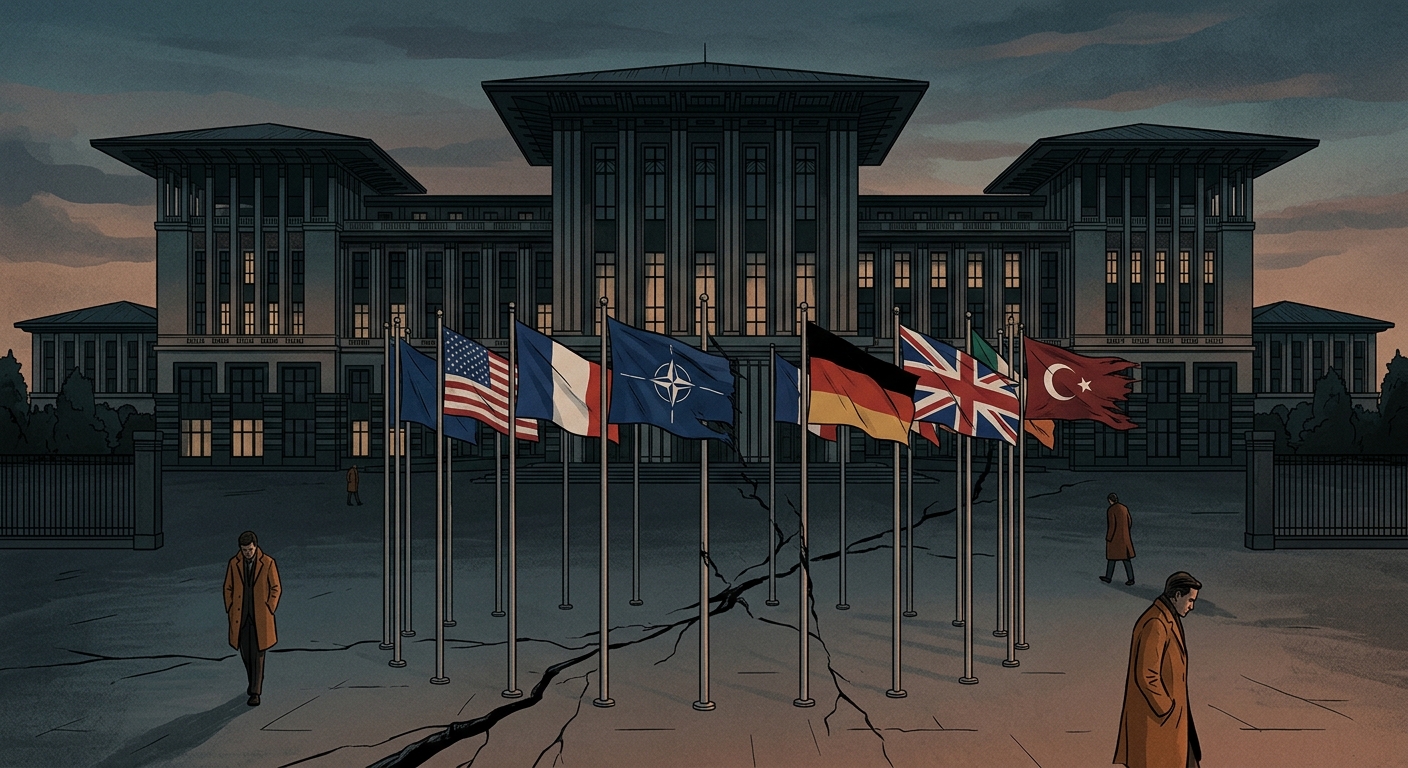
The summit Erdoğan wanted, and the one he inherited
The 36th NATO summit convenes on July 7–8 with 32 heads of state, Secretary General Mark Rutte, and hundreds of ministers packed into Beştepe. It is Türkiye's first NATO summit in 22 years, a fact Erdoğan has spent months turning into a political asset. According to Turkey's state agency
Anadolu, the agenda covers defense investment, deterrence, the war in Ukraine, and NATO's southern flank; the choreography — Trump–Erdoğan bilateral, joint press conference, gala dinner — is Ankara's, not Brussels'.
The summit Erdoğan planned was a scorecard on The Hague. Twelve months ago, allies signed the Hague Summit Declaration, committing to "invest 5% of GDP annually on core defence requirements as well as defence- and security-related spending by 2035" — 3.5% on hard capability, 1.5% on infrastructure, industry and resilience. By NATO's own count, European allies and Canada added $139 billion in nominal defense spending in 2025 alone, according to
Al Jazeera's compilation of alliance figures. Germany will hit 3.5% by 2029, Poland is heading toward 5%, and the Baltics are already there, per the
Council on Foreign Relations.
Then came Operation Epic Fury.
The Iran war blew up the choreography
The U.S.–Israeli war on Iran that began in late February 2026 fractured the alliance faster than Russia's invasion of Ukraine did. Spain refused to let U.S. aircraft use Rota and Morón; on March 30, Defense Minister Margarita Robles announced Madrid was closing Spanish airspace to any U.S. plane involved in the Iran operation. Trump publicly threatened to "cut off all trade" with Spain,
according to the BBC. Italy raised legal objections. Britain hesitated before opening RAF Fairford.
The White House did not forget. In a June 24 call, Trump told Rutte that European foot-dragging on Iran was "ridiculous." On May 1 the Pentagon confirmed the withdrawal of about 5,000 troops from Germany, and European and U.S. reporting cited by CFR suggests the coming force-posture review could cut U.S. F-16 and F-15 jets assigned to NATO by a third and strategic bombers by half. Secretary of State Marco Rubio has called the Ankara meeting "probably the most important meeting in NATO's history," in remarks flagged by the
Council on Foreign Relations — a phrase diplomats read as a warning, not a compliment.
That is the summit Erdoğan actually inherited: a scorecard on 5% has become a negotiation over whether the United States remains NATO's ultimate backstop at all.
Why Turkey holds the pen
Three variables put Ankara at the center of the post-Iran alliance.
The industrial variable. European rearmament has run into a wall: the EU's €90 billion SAFE loan and ReArm Europe initiative largely lock out non-EEA suppliers, meaning the only advanced NATO defense industries frozen out of EU procurement are American and Turkish, as the Atlantic Council has documented. But Turkey dominates niches Europe cannot fill fast — TB2 and Kızılelma drones, 155mm shells, armored vehicles — and Italy's Leonardo–Baykar joint venture and Spain's Hürjet buy are the templates for what
Aaron Stein of Brookings calls "strategic pragmatism, shaped by urgency, capability gaps, and industrial need." A NATO Defense Industry Forum alongside the summit is designed to convert that pragmatism into tens of billions of dollars in fresh contracts.
The airframe variable. In November 2025, Ankara signed a $10.7 billion deal for 20 Tranche-4 Eurofighter Typhoons from the UK, detailed by the Hudson Institute, with second-hand Qatari airframes explored to bridge the gap to 2030. It is a stopgap because Turkey remains locked out of the F-35 program over its 2019 purchase of Russian S-400 systems, and F-16V modernization talks with Lockheed Martin are stalled.
IRIS notes CAATSA sanctions still block Turkish T-129 helicopter exports to Pakistan. Erdoğan will use the Trump bilateral to press for both F-35 re-entry and F-16V terms — the price he can name in exchange for keeping Ankara useful to a Washington that wants Europe to pay more of the bill.
The command variable. According to the Atlantic Council, Turkey is slated to take command of NATO's Allied Reaction Force starting in 2028 — the alliance's premier high-readiness formation. In a NATO where U.S. reinforcements shrink, whoever runs the ARF runs Europe's first-response capability. That is not a symbolic role.
The Trump bilaterals: three files, one leverage play
Trump's schedule tells the story. Beyond Erdoğan, NPR reports his only scheduled bilaterals are with Ukrainian President Volodymyr Zelensky on July 8 and Syrian President Ahmed al-Sharaa on the sidelines. No meetings with Sánchez, Macron, Merz or Meloni. That is a message.
On Ukraine, Europeans want a U.S. license to build Patriot interceptors inside Ukraine, a step CFR describes as the summit's most consequential deliverable for Kyiv. Europe already carries the majority of financial and military aid to Ukraine in 2025, per the Center for Strategic and International Studies' NATO 3.0 in Practice brief; a Patriot license would let Europe carry the industrial burden too.
On Syria, the al-Sharaa meeting is more consequential than it looks. Trump has publicly floated a Syrian role in pressuring Hezbollah in Lebanon — al-Sharaa has said no, according to NPR — but a bilateral at a NATO summit legitimizes a former insurgent leader nine months after Assad's fall and hands Erdoğan a Sunni Arab partner integrated into the transatlantic system. Emmanuel Macron flew to Damascus on July 6 before Ankara, per Al Jazeera, signaling that Paris will not let Ankara own the Syria file alone.
On Turkey itself, the deliverable will be language — on defense-industrial cooperation, on Ukraine support, and, if Erdoğan gets his way, on a path back into F-35. Trump has an incentive to give it: Ankara is the only major NATO capital that did not embarrass him during the Iran war.
The quiet analytical consensus: this is a legitimation summit
The most pointed reading came from the Council on Foreign Relations, which argued days before the summit that "Trump and the NATO Summit Lend Legitimacy to Turkey's Autocratic President" — a reference to the March 2025 detention of Istanbul Mayor Ekrem İmamoğlu and the broader crackdown on the opposition. The counter-view, from
CSIS, is that NATO faces "overlapping crises" and cannot afford to litigate Turkish domestic politics while Russia grinds through eastern Ukraine and the U.S. reassesses its European posture. Both readings are correct. Both benefit Erdoğan.
The Carnegie Endowment captured the mood shift: European allies came to The Hague in 2025 wanting to prove they had listened to Trump; they come to Ankara in 2026 wanting to prove they can survive without him. That is a very different summit.
What to watch — the next 72 hours and beyond
- July 7, evening (Ankara): Trump–Erdoğan joint press conference. Watch for any language on F-35, F-16V, or CAATSA. A single sentence moves $20 billion in defense trade.
- July 8, morning: Trump–Zelensky bilateral. The tell is whether the U.S. commits to a Patriot production license inside Ukraine — the single most requested item on Kyiv's list, per CFR.
- Summit communiqué (July 8): Look for whether it endorses a "NATO 3.0" division of labor with Europe as first responder, or whether the U.S. blocks that language to preserve leverage over its own withdrawal schedule.
- 2028 handover of the Allied Reaction Force to Turkish command: the structural deliverable of this summit, whatever the communiqué says.
- 2029 spending review written into the Hague declaration: the checkpoint that determines whether the 5% pledge holds or slides.
Diplomat View
The Ankara summit will be remembered as the moment NATO stopped pretending the U.S.–Europe bargain of 1949 still applies and started pricing what replaces it. Our call: the summit produces a bland communiqué reaffirming the 5% pledge and Ukraine support, but the operational shift — a European-led first-responder posture, Turkish industrial integration, and a quieter U.S. drawdown — happens in the bilateral track, not the plenary. Erdoğan is the immediate winner: he trades hosting rights and Trump-whispering for movement on F-16V and, within 18 months, a conditional path back to F-35 co-production. Europe is the medium-term winner if — and only if — it stops excluding Turkish and Ukrainian firms from EU defense financing before the 2029 review. The loser is the fiction of a unified transatlantic alliance operating under American strategic direction. This forecast would revise if Trump publicly reaffirms Article 5 in absolute terms, if the summit language names Russia as the primary threat without U.S. caveat, or if Ankara walks away without any F-35 signal — any of which would suggest the underlying bargain still holds. None is the base case.
The bottom line: Ankara is a legitimation summit dressed as a burden-sharing summit. Erdoğan is not hosting NATO — he is auditioning to be the operational hinge of a post-American alliance, and Trump is the only leader in the room with an interest in helping him get the part.
Discover more
US Politics
SNAP Food Assistance Faces Legal Challenges
In 2026, SNAP faces stricter eligibility rules and mounting legal challenges, threatening food assistance for the millions of Americans who rely on the program.
India
UN Expert Albanese: India Violates Law
UN Rapporteur Francesca Albanese accuses India of breaching international law, spotlighting human rights concerns in Kashmir and prompting diplomatic pushback.

India
Delhi CM Rekha Gupta Blasts Opposition's Delm
Delhi CM Rekha Gupta's remarks on women's quota defeat reveal BJP's strategy for the 2029 Lok Sabha elections, focusing on delimitation.
Conflict & Security
West Africa Food Crisis: Three Shocks in 2026
Conflict, climate extremes, and the Strait of Hormuz closure drive a severe food crisis in West and Central Africa, with fertilizer prices surging 80% and millions displaced.