Ebola's $3.6 Billion Shock Meets Congo's War
UNDP warns of severe economic impacts from Ebola outbreak.
Model Diplomat9 min readAfrica
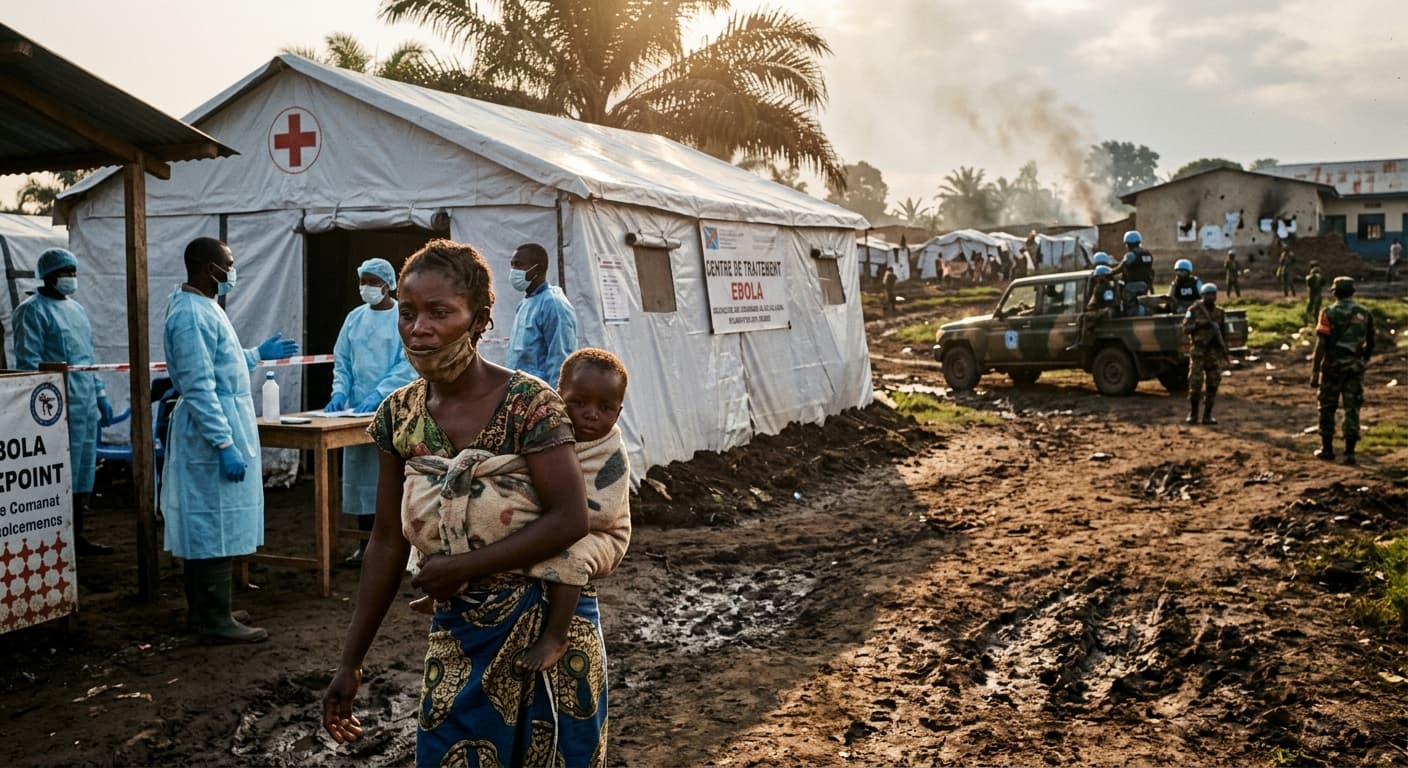
Ebola's $3.6 Billion Shock Meets Congo's War Economy
UNDP warns the Bundibugyo Ebola outbreak could cost Africa $3.6 billion and push 985,000 into poverty — with neighbours losing more than DRC itself.
The United Nations Development Programme's June 30 assessment puts a price tag on eastern Congo's cascading crisis: up to $3.6 billion wiped from African economies, roughly 985,000 people pushed into extreme poverty, and about 300,000 jobs at risk if the Bundibugyo Ebola outbreak keeps spreading beyond Ituri. The striking detail buried in the numbers is that the Democratic Republic of the Congo — the epicentre — absorbs only about $1 billion of that loss. The other $2.37 billion falls on neighbours who never see a case, through closed borders, grounded flights and collapsed cross-border trade. That imbalance is the story: Ebola is functioning as a regional economic weapon at exactly the moment eastern Congo's war, Félix Tshisekedi's third-term politics and the United States' retreat from global health are stripping the region's capacity to absorb shocks.
The numbers, and who actually pays
The UNDP's Rapid Socioeconomic Impact Assessment, presented in Geneva by Damien Mama, the agency's Resident Representative and Acting Humanitarian Coordinator in DRC, projects Congolese GDP losses of just over $1 billion — the equivalent of one to two years of health-sector spending for a country of roughly 110 million. Mama told reporters the "consequences for the countries that neighbour DRC could reduce the continental GDP by $2.37 billion," according to TASS. That is the political number. Uganda, Rwanda, Burundi, South Sudan and Kenya — none of them the outbreak's epicentre — collectively lose more than twice what Congo loses. Africa CDC lists ten countries at elevated risk, including Angola, Tanzania, Ethiopia and Zambia, per
Al Jazeera — each with its own trade exposure to central Africa.
The mechanism is banal and brutal: fear closes borders. The Congolese Ministry of Transport suspended all flights in and out of Bunia in late May, and Uganda temporarily shut its land border with DRC, restricting even the informal cross-border trade in cassava, gold and cocoa that sustains Ituri's economy, Al Jazeera reported. One Bunia clothes retailer told the network she could not fulfil orders from customers because her Kampala suppliers could no longer cross. UN-Habitat data cited in the same report show 50% of Bunia's economic activity is in the tertiary sector — services, transport, retail, public administration — precisely the sectors that collapse first under aversion behaviour. Canada imposed a 90-day entry ban on residents of DRC, Uganda and South Sudan; the Bahamas followed with mandatory quarantine, according to
the BBC.
IOM's mobility mapping in Ituri, published in its Situation Report No. 4, found more than 16,000 people cross the Bunia corridor daily on non-market days, roughly doubling on market days — commerce the UNDP model now assumes will contract sharply through 2026. Movement, IOM notes, is "primarily driven by trade, including gold mining and cocoa production" — the two commodity chains most exposed to the border closures. The Bunia–Aru–Kengezi corridor into South Sudan and the Bunia–Mahagi corridor into Uganda are the arteries; both are now under points-of-control regimes that slow legitimate freight as much as they slow the virus.
Aversion behaviour is 80% of the damage
The World Bank's post-mortem of the 2014 West Africa outbreak identified this same pattern. Its September 2014 economic assessment concluded that in comparable SARS-era episodes, "aversion behaviour" — the fear-driven decisions by airlines, insurers, tourists and governments — accounted for 80 to 90 percent of the total economic impact. The disease kills people; the fear kills GDP. UNDP's $3.6 billion figure implicitly encodes that ratio: the direct mortality and morbidity loss of a ~1,500-case outbreak is small; the second-round effects on tourism, transport and investor confidence across ten countries are what generate the number.
The 2014–15 West Africa outbreak remains the reference case for what happens next if containment slips. World Bank data show pre-crisis growth forecasts collapsed within a year — Sierra Leone from 11.3% to –2.0%, Guinea from 4.3% to –0.2%, Liberia from 6.8% to 3.0% — costing the three countries over $2 billion in forgone income and cutting more than $160 million from public investment. Fiscal impacts alone hit 6% of GDP in Liberia. Recovery took the better part of a decade; Sierra Leone's political instability through 2018 and Guinea's 2021 coup both traced partly to the fiscal hole Ebola left. The Bank's
January 2015 update put the sub-Saharan Africa-wide loss in a downside scenario at $6.2 billion — a benchmark the current UNDP $3.6 billion figure sits comfortably below, but only if the outbreak stays regional.
The war economy is doing the spreading
DRC enters this outbreak in a demonstrably worse position than West Africa in 2014. Ituri has been under military rule since 2021. The UN's IPC food security monitor classified nearly 10 million people across Ituri, North Kivu, South Kivu and Tanganyika as facing acute hunger in the first half of 2026, with 26.5 million people nationwide in high-level food insecurity. Nearly one million people in Ituri alone are internally displaced, according to the
Council on Foreign Relations. WFP told the UN it needs $214 million for DRC operations plus $10 million specifically earmarked for Ebola response, per
UN News. "Hunger and disease are old companions," WHO Director-General Tedros Adhanom Ghebreyesus said. "People weakened by hunger are far more vulnerable to infections."
Overlay that on an active war with the Rwanda-backed M23 — which seized Goma and Bukavu in early 2025 — and the Bundibugyo strain's ~50% case fatality rate with no available vaccine, and the UNDP baseline looks conservative. WHO Director-General Tedros Adhanom Ghebreyesus, who visited Bunia in late May, framed the collision bluntly. In a joint statement with Kinshasa on May 31, WHO warned the country faces a "catastrophic collision of disease and conflict," with attacks on health facilities making contact tracing "nearly impossible," according to the WHO release. WHO's Emergency Response Lead Dr. Rose Belizaire rated the response, on a scale of one to ten, at "about three or four" a month in, telling
UN News the outbreak was still "evolving rapidly" and outpacing containment.
The M23 war matters economically here, not just epidemiologically. Ituri's cash economy runs on artisanal gold, cocoa and cross-border trade with Uganda — precisely the corridors IOM identified as the outbreak's mobility spine. When the Congolese army fights the Allied Democratic Forces and CODECO in Ituri, and M23 in the Kivus, containment corridors collapse. When they collapse, borders shut. When borders shut, the UNDP's $2.37 billion neighbour loss materialises. Ebola is the multiplier on a war-economy shock that was already underway. Bunia's economic analyst Pascal Tudja put the mechanism in one line to Al Jazeera: "We are going to face a severe shortage of goods, and when goods become scarce, prices are likely to skyrocket."
The politics have hardened rather than softened the environment. Tshisekedi told reporters in May he would accept a third term if "the people" demanded it via referendum, and the Congolese Senate has adopted an enabling bill, per the BBC. The president simultaneously argued elections cannot proceed while Goma and Bukavu remain outside government control — tying constitutional continuity to a war his government is losing. The December 2025 Washington Accords brokered by the Trump administration, and the April 2026 Montreux talks under Qatari and AU mediation, produced a permanent-ceasefire framework that has not held; the US Treasury sanctioned four senior Rwandan commanders in June for violating it, per
the BBC. Every week that framework fails to bite is a week Ituri's health workers cannot reach contacts across contested lines.
The American absence is the second-order story
The 2018–20 eastern DRC outbreak was contained in part because USAID and the CDC deployed a Disaster Assistance Response Team plus roughly $342 million in USAID funds and $36.7 million from CDC, according to a Congressional Research Service report — a total of about $600 million in US federal spending. That architecture is gone. USAID was dismantled in 2025; the Trump administration barred US officials from coordinating with WHO after announcing withdrawal from the agency. The
Council on Foreign Relations notes that community health workers funded by the previous US network "lost their jobs and moved into other work to survive" and PPE stockpiles depleted before the outbreak began. CSIS's assessment goes further, warning in a
June analysis that field-lab capacity, rapid diagnostics and contact tracing are all materially weaker than in 2018 — a gap the UNDP model quietly assumes will be filled.
The financing gap is not being closed. Africa CDC reported roughly $500 million pledged by governments and international partners as of late May. The World Bank has mobilised $243 million, including a $10 million Global Financing Facility grant, per its May 27 factsheet, leveraging the biosafety lab it funded through the REDISSE project and the Kinshasa Emergency Operations Center it rehabilitated four years ago. WHO deployed 11.5 tonnes of supplies from Kinshasa, Dakar and Nairobi within 72 hours of the May 15 declaration,
UN News reported; UNICEF mobilised 50 tonnes more. The delta between what is committed and what the 2018–20 response consumed — closer to $1 billion in aggregate US, EU and multilateral spending — is where the UNDP's baseline scenario becomes its downside scenario. UNICEF also warns children are now 15% of cases and over 25% of deaths, with more than 130 children in Ituri having lost one or both parents, a demographic pattern that will pull a generation of caregivers out of the labour force well beyond the outbreak's end.
Who wins, who loses
The losers are legible. Motorcycle taxi drivers and market traders in Ituri, whose livelihoods evaporate when borders shut. Congolese fiscal authorities, who will absorb the largest share of a $1 billion shock in a state already borrowing at speculative-grade rates. Ugandan cross-border traders in Arua and Kasese. Rwanda's tourism sector, which does not need another year of aversion headlines while it fights US sanctions on its army. And the roughly 985,000 people the UNDP counts as newly poor — a rounding error in continental GDP, but a political problem in fragile states heading toward elections.
The quiet winners are fewer but real. Qatar has consolidated its position as the ceasefire mediator of record for the Great Lakes, hosting parallel talks to the collapsing US-brokered process. The World Bank Group, whose pre-positioned infrastructure through the REDISSE and HEPRR projects is now the operational spine of the response, has demonstrated the value proposition of pandemic-preparedness lending at a moment US bilateral aid has retreated. And China's silent presence in Congolese mining — largely insulated from short-term aversion shocks by long-term concessions — quietly gains relative leverage as Western investors mark down DRC risk further.
Diplomat View
The UNDP's $3.6 billion is a floor, not a ceiling. Three conditions would move the number sharply higher: sustained transmission into Kinshasa or Kampala's dense urban zones; a second cross-border case cluster outside Uganda (Rwanda, South Sudan or Kenya); or a collapse of the fragile M23 ceasefire framework that closes the Goma humanitarian corridor entirely. Any two of those, and the 2014–15 sub-Saharan downside scenario of $6.2 billion becomes the working assumption rather than the historical benchmark. The forecast revises downward only if the US quietly reopens WHO coordination and CDC surge deployment — a low-probability, high-impact swing that would show up in Bunia within four weeks. Absent that, the analytical call is that Ebola is now doing the work of a regional shock: pricing risk into an already-fragile Great Lakes economy at a moment its lender of last resort has walked away. Watch the June-quarter fiscal numbers from Kinshasa and Kampala. That is where the UNDP model gets marked to market.
What to watch next
- July 2026 WHO Emergency Committee review of the Public Health Emergency of International Concern designation — whether the outbreak is escalated, sustained or the risk assessment for neighbouring countries is raised.
- Africa CDC pledging conference and the closing of the ~$500 million funding gap between commitments and 2018–20 response levels.
- Congolese constitutional referendum bill progress in parliament — the trigger for a Tshisekedi third-term push, and the political variable that will determine whether outbreak response funds are captured for regime survival.
Read today's full |
Discover more
Global Politics
U.S. Maritime Pressure on Iran
Washington escalates maritime security operations and sanctions on Iran, disrupting Gulf shipping and reshaping global energy flows in a major strategy shift.
US Politics
US Military Strikes Drug Traffickers Pacific
A U.S. military strike in the eastern Pacific killed two amid an anti-drug trafficking campaign, raising questions over sovereignty and regional cooperation.

International Relations
U.S.–Iran Peace Deal
A narrow US-Iran deal on nuclear and regional issues could reshape Middle East diplomacy, offering a pragmatic path forward despite grand bargain obstacles.

Economics
Fed's Amex AML order puts correspondent banking on notice
Federal Reserve's Amex AML order requires board-level controls and a 90-day plan; OCC fined the bank $350 million over enterprise-wide deficiencies.