Drone Attack on Moscow Escalates Ukraine War
Ukraine's drone campaign reshapes NATO summit dynamics.
Model Diplomat8 min readEurope
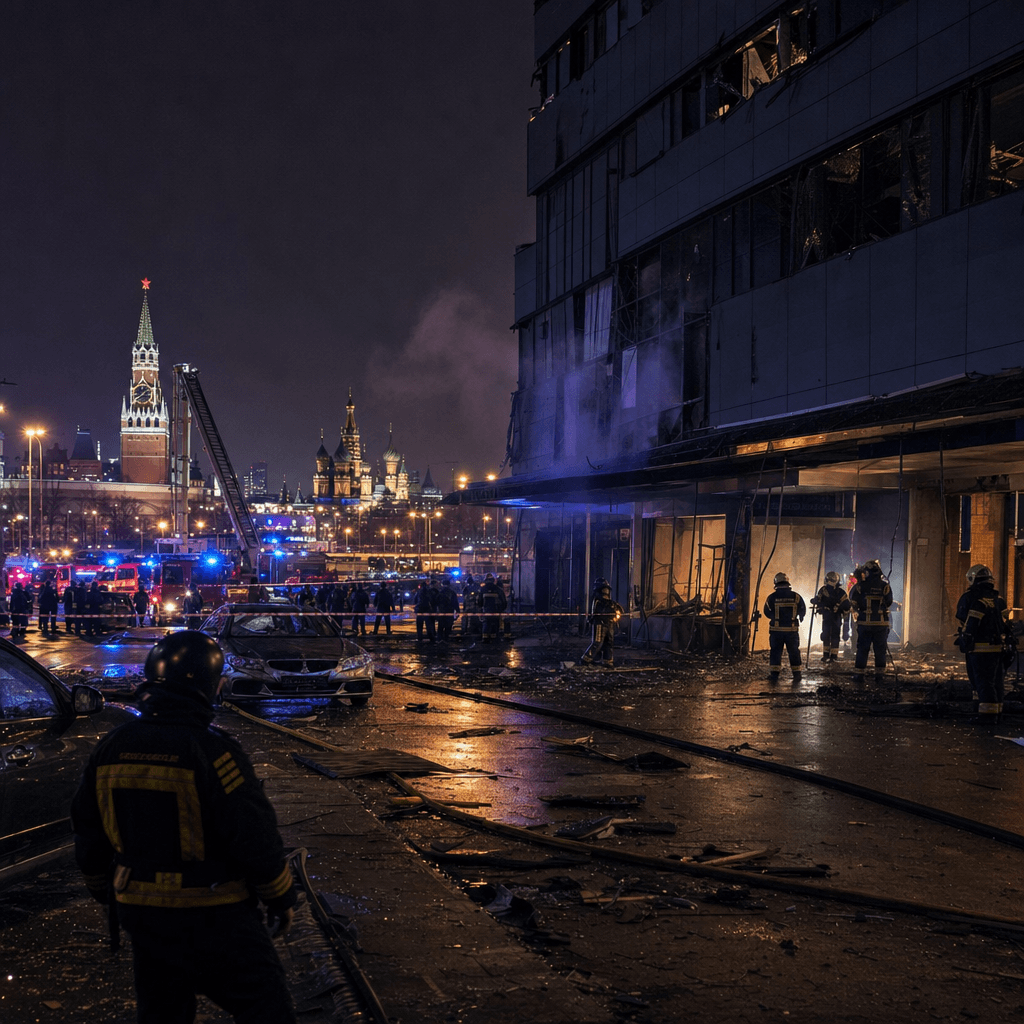
Moscow Drone Attacks Rewrite Ukraine War's Endgame
Ukraine's 2026 drone campaign against Moscow has knocked out roughly a third of Russia's refining capacity and forced Putin to concede fuel shortages — remaking the NATO summit in Ankara.
Ukraine's drone war against Moscow is no longer an act of escalation — it is the leverage. By the eve of the NATO summit that opens in Ankara on July 7, 2026, Kyiv's long-range strike campaign had knocked roughly 2.14 million barrels a day of Russian refining capacity offline, forced petrol rationing across 53 Russian regions, and extracted the first public admission from President Vladimir Putin that Ukrainian attacks were creating a domestic fuel crisis. The June 17–18 strikes on Moscow's Kapotnya refinery and the July 6 hit on the Omsk refinery in Siberia — 2,700 kilometres from the front — have done what four years of Western sanctions did not: given Volodymyr Zelenskyy a card to play across from Donald Trump this week.
From symbolic strikes to strategic coercion
The pattern that closed in on Moscow through the spring accelerated in May and June. On May 7, Russia's Defence Ministry said it downed 347 Ukrainian drones overnight after the Kremlin rejected a Kyiv ceasefire offer, in a raid that Kyiv Post described as targeting a military logistics hub near the capital. Ten days later, Russia claimed 556 drones intercepted across 14 regions in what
Al Jazeera called one of the largest aerial assaults of the war; Ukraine's SBU said it had hit an oil refinery and two pumping stations in the Moscow region.
Then came the psychological turn. On June 17 and again on June 18 — during the G7 summit in Evian-les-Bains — Ukrainian drones struck the Gazprom-run Moscow Oil Refinery in Kapotnya, on the south-eastern edge of the capital. The facility supplies about 38 percent of the Moscow region's motor fuel and jet fuel to four Moscow airports, according to Ukraine's General Staff, cited by Al Jazeera. Residents reported "oil rain" and black soot on their cars. Six Moscow-area airports temporarily shut. Russia's Defence Ministry said it had downed 992 drones and four missiles in the surrounding 24 hours.
The BBC's Moscow correspondent, watching from the ring road, saw a "giant black shroud" hang over the skyline and noted the significance of the silence that followed: Putin said nothing on the day of the strike, and state television barely covered it, per the BBC. That absence of a public rebuttal is itself an admission.
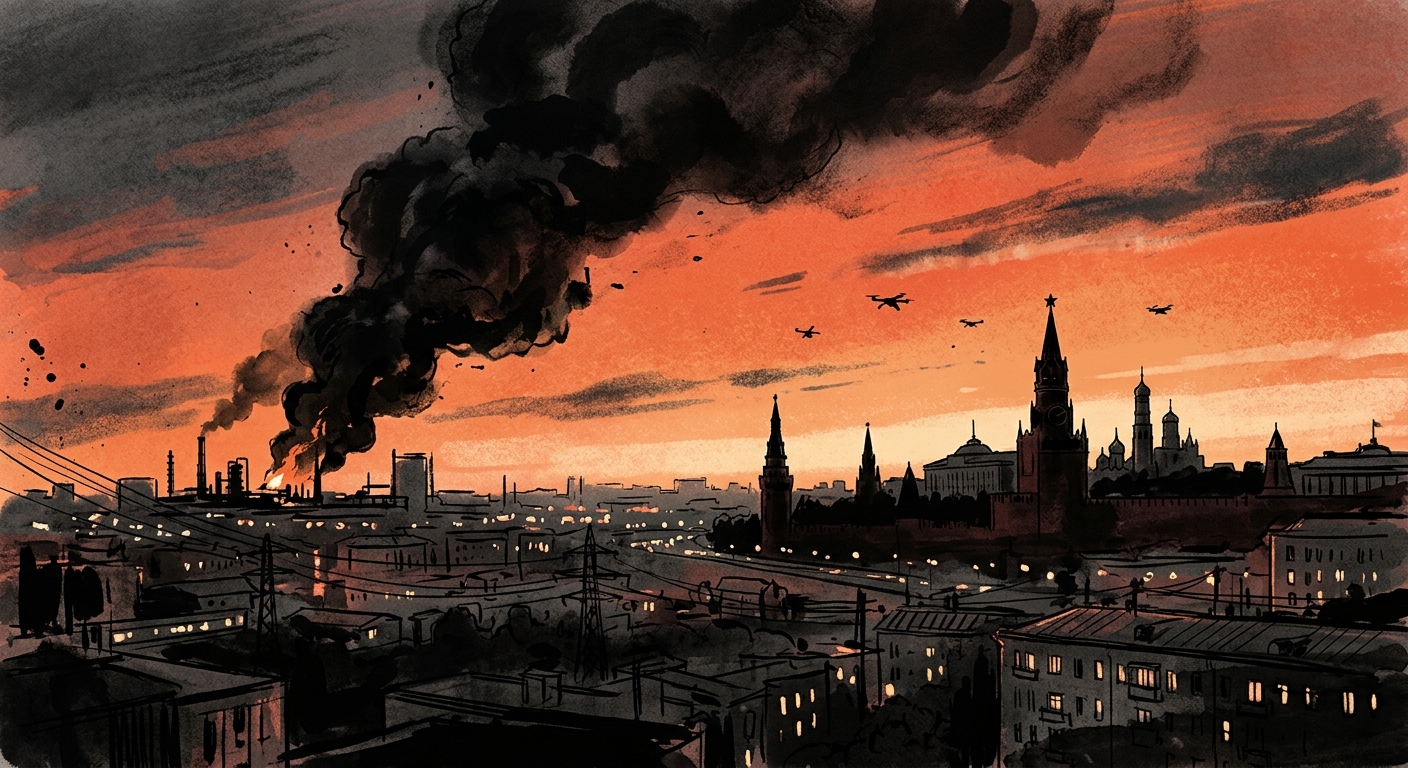
The number that rewrote the war
The stakes are not measured in downed drones. They are measured in barrels. According to Energy Intelligence, roughly one-third — 2.14 million barrels a day — of Russia's crude oil refining capacity was offline in early June because of Ukrainian drone attacks. Russian refining runs fell below 4 million barrels a day, the lowest level in 21 years. Diesel exports for June were on track for a historic low; crude exports rose because refiners had nowhere to send the barrels domestically.
The follow-on effects landed at Russian pumps. The Norwegian Institute of International Affairs' Indra Overland, quoted by Al Jazeera, said most Russian regions had introduced petrol and diesel limits and that queues in some places ran up to 12 hours. Russia's Tatneft chain capped Moscow and St Petersburg customers at 20 litres of petrol per visit. Moscow imported 60,000–80,000 tonnes of petrol from India and reportedly targeted 400,000 tonnes of monthly imports from Asian markets, per
Reuters via Al Jazeera. Russia's gasoline export ban, first imposed for April–July 2026 by decree, was widened as more refineries went dark, according to
Energy Intelligence.
On June 29, Putin broke his own script. "We are currently seeing a certain shortage," he told Russian state television, "but it's not critical," per the BBC. It was the first time in the war that the Kremlin's leader had publicly conceded that Ukrainian strikes were causing measurable pain at home — a rhetorical concession Western sanctions never produced.
The weapon Kyiv built itself
The decisive detail is who built the drones. Footage from the June 18 Moscow raid, analysed by FlightGlobal, identified the Ukrainian-made FP-1 kamikaze drone from Fire Point — base range 1,650 kilometres, extendable past 2,700 kilometres with an optional wing tank — alongside the An-196 from Antonov and Ukroboronprom and the Behemoth Shahed-style system from Culver Aerospace and GLEFA. The Kapotnya strikes were achieved, per FlightGlobal, "using Ukrainian-made weapon systems, rather than those donated by Western allies."
That matters for two audiences. It removes Washington's escalation veto: Ukraine no longer needs a US permission slip to hit Moscow. And it means the campaign continues regardless of what Trump agrees with Putin. The Omsk refinery strike on July 6, reported by Al Jazeera, reached 2,700 kilometres from Ukrainian-held territory — one of the longest-range hits of the war, near Russia's border with Kazakhstan.
The doctrinal shift was set out publicly last year. After the June 2025 Operation Spiderweb strike on Russian long-range aviation, The Soufan Center assessed that Ukraine had damaged or destroyed 41 aircraft — Tu-95 and Tu-22M3 bombers plus A-50 surveillance planes — inflicting an estimated $7 billion in losses and rendering roughly 34 percent of Russia's strategic cruise-missile carriers inoperable. Ukraine had proved that "strategic depth," Russia's oldest defensive asset, was now a fiction.
The Ankara table and Trump's shifting card count
Trump enters the NATO summit having spent a nearly 90-minute call with Putin on July 5, in which the Kremlin's aide Yury Ushakov said the US president "confirmed his readiness to work towards a rapid end to the fighting," per Al Jazeera. Trump is due to meet Zelenskyy on the summit's sidelines on July 7–8 in Ankara, and told reporters a resolution was "getting closer than people realise."
The February 2025 Oval Office scene — Trump telling Zelenskyy "you don't have the cards" — has been overtaken by events. Ukrainian journalist Sergey Bratchuk's line after Spiderweb, quoted by Breaking Defense, was that "Zelensky played the King of Drones." A year later, Kyiv is playing that card at scale. E5 leaders — Germany, France, Britain, Italy, Poland — pledged in Berlin on June 24 to "further substantially support Ukraine," with an explicit focus on "sanctions and economic pressure on Russia," per
Al Jazeera.
The sanctions arithmetic reinforces the drones. The EU's 18th package, adopted in July 2025, cut the Russian crude oil price cap from $60 to $47.60 per barrel and introduced an automatic downward mechanism, according to the European Council. Under that formula, Brussels'
Commission Implementing Regulation 2026/124 further reduced the cap to $44.10 per barrel from February 1, 2026. The primary document tightens the vice on Kremlin oil revenue at the exact moment Ukrainian drones are shutting off the refining side of the balance sheet.
Who wins, who loses
The obvious beneficiary is Zelenskyy: he arrives in Ankara with proof that Ukraine can inflict costs Moscow cannot conceal. The less obvious beneficiary is Trump. His preferred narrative — that only he can deliver a deal — is strengthened when Putin has a domestic reason to accept one. The Russian president is losing on three axes simultaneously: refining capacity, popular consumer patience, and the fiction of home-front insulation.
The clear loser inside Russia is the technocratic bloc around Deputy Prime Minister Alexander Novak, tasked with juggling export bans, price caps, refinery repairs and imports. Duma member Vyacheslav Markhaev wrote on June 11 that "attacks on our cities do not stop, their geography is expanding" — the rare public admission from inside the system, quoted by Al Jazeera. Belarus is the second-order loser: Zelenskyy has accused Moscow of trying to pull Minsk into the war to relieve pressure, per
Al Jazeera, a claim Belarus denies.
The other quiet loser is the global diesel market. Energy Intelligence flagged that Russia's May–June refining plunge sent diesel exports "to a historic low in June," further tightening a market already squeezed by the near-closure of the Strait of Hormuz during the February 2026 US-Israeli war on Iran. Middle distillate consumers from Turkey to Brazil will feel the arithmetic of Kapotnya.
What to watch next
- July 7–8, Ankara. The Zelenskyy–Trump sideline meeting at the NATO summit. If Trump publicly credits Ukrainian pressure — rather than only US mediation — for bringing Putin to the table, that is the tell that the drone campaign has reshaped White House framing. Watch for language on whether Patriot interceptors and licences to produce them, promised at the G7, materialise.
NPR previews Trump's enforcement of last year's spending pledges as the summit's other axis.
- The next dynamic cap step. The EU's automatic mechanism recalibrates every six months against Urals crude averages. The next adjustment window arrives in August 2026; a further cut below $44.10 tightens the fiscal squeeze on Moscow just as domestic fuel imports rise.
- Refinery repair cycles. Watch weekly Energy Intelligence throughput numbers. If runs stay below 4 million b/d into August, Putin's "not critical" framing collapses. The July 6 Omsk strike suggests Kyiv's target list is now nationwide.
Diplomat View
The drone campaign has crossed from tactical harassment into strategic coercion, and it did so on Ukrainian-built platforms rather than Western ones — which means it will continue whether or not Trump extracts a ceasefire in Ankara. The forecast: expect a partial energy-infrastructure truce to emerge as the near-term deliverable of Trump's mediation, because it is the one concession that gives Putin domestic cover without requiring territorial movement. Falsification conditions: if Russia's refining runs recover above 5 million b/d by September, or if Trump publicly threatens to withhold Patriot interceptor deliveries to force Kyiv to halt strikes, the coercion thesis fails and Moscow re-establishes its escalation dominance. Watch the Kapotnya restart date and the wording of any Trump statement on "long-range weapons" — those are the two signals that will confirm or kill this call.
The Bottom Line
Ukraine's drone attacks on Moscow have converted a war Kyiv was losing on the ground into a war it can now shape at the negotiating table. With about a third of Russian refining offline, petrol rationed in 53 regions, and Putin publicly conceding shortages for the first time, the Kapotnya and Omsk strikes have manufactured the leverage that four years of Western sanctions did not. The Ankara summit on July 7–8 is the first test of whether Trump prices that leverage into his diplomacy — or tries to trade it away.
Discover more

Global Politics
US Seizes Iranian Ship, Tensions Surge
The US seizure of the Iranian ship Touska highlights a shift in control over the Strait of Hormuz, favoring Iran's strategic position.

Conflict & Security
Drone Warfare Killing Aid Workers at Unprec
Over 1,000 humanitarian workers killed in three years as cheap armed drones collapse legal protections. Gaza, Sudan, Ukraine, and DRC see deliberate targeting of aid convoys and hospitals with zero prosecutions.

Global
World Normalises Taliban as Afghan Women Eras
UN data shows Afghan women erased from public life as Russia recognises the Taliban, EU hosts officials in Brussels, and ICC warrants for gender persecution go unenforced.
Conflict & Security
West Africa Food Crisis: Three Shocks in 2026
Conflict, climate extremes, and the Strait of Hormuz closure drive a severe food crisis in West and Central Africa, with fertilizer prices surging 80% and millions displaced.