DRC Ebola Crisis: Workforce Decimated
Ebola outbreak leads to healthcare collapse in DRC.
Model Diplomat3 min readAfrica
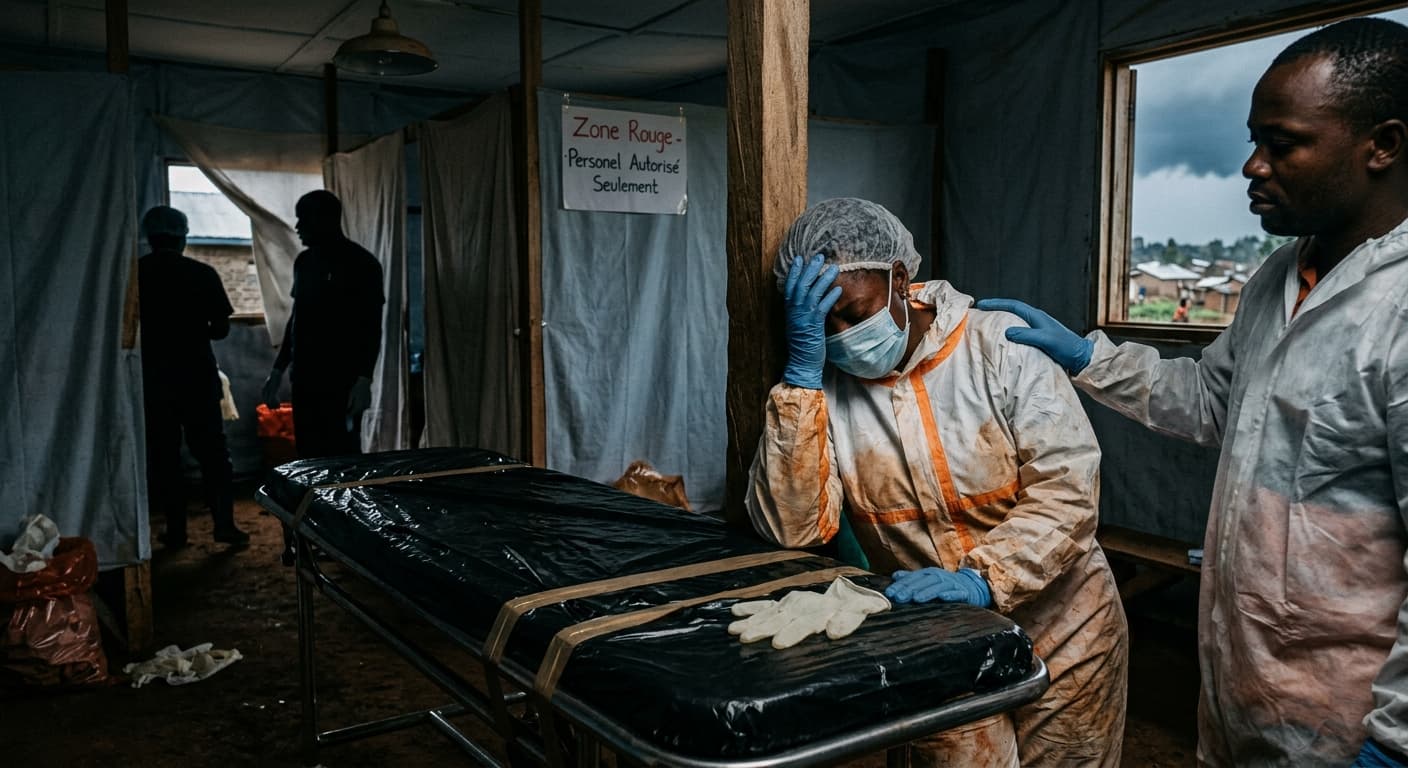
DRC Ebola Decimates Workforce as Response Hits Ceiling
Healthcare system collapses as 75 medics contract rare virus with no vaccine, spreading faster than capacity to trace contacts.
The DRC's Ebola outbreak has mutated from a public health crisis into a systemic collapse. Over 896 confirmed cases and 232 deaths as of June 19—including 75 healthcare workers, 17 of them dead—now threaten the entire disease containment apparatus in eastern Africa. The outbreak is evolving so fast that WHO emergency director Marie Roseline Belizaire warned the system itself is paying an unprecedented price: DRC has only 11 health workers per 10,000 people,
among the world's lowest ratios. Each medic who falls is irreplaceable.
The virus responsible is the rare Bundibugyo strain, for which no approved vaccines or treatments exist. That advantage—unavailable in previous outbreaks—has inverted response calculus: staff can only manage symptoms, not contain the disease pharmacologically. Basic protective gear is already in short supply.
The outbreak was spreading for months before authorities declared it on May 15, leaving frontline workers exposed before they knew the threat existed. Now
contact tracing is "still too low" to ensure control, with teams losing track of over 26,000 people across three provinces.
The Geography of Collapse
Spread is fastest in displacement camps. At Kigonze camp in Ituri province—home to over 15,000 people—at least 30 have died since early May, a rate camp officials call unprecedented. The DRC harbors over five million internally displaced people, many in camps with shared toilets serving hundreds, making Kigonze a template for what happens next. The outbreak now spans
31 health zones across three provinces, and cases are identified in new areas near-daily. Uganda has confirmed
19 cases and two deaths, signaling the outbreak is crossing borders.
Containment is hamstrung by armed conflict. M23 rebels control territory in eastern DRC, preventing safe access to entire zones. Attacks on health facilities make tracking contacts nearly impossible, and communities are sometimes actively hostile—angry residents torched treatment tents in early June rather than accept new burial restrictions.
Why It Matters—And What's Not Happening
The Africa CDC director warned that this could be the worst Ebola outbreak in history. The 2014–2016 West African crisis killed over 11,000; the 2018 DRC outbreak infected 3,400. Compare that to the current trajectory: the International Federation of Red Cross warned the epidemic could take a year to bring under control if transmission continues at current rates.
Aid is drying up. US funding for water, hygiene, and sanitation programs halved between 2024 and 2025 under the Trump administration, falling to $38 million. This year's $80 million appeal is only 21 percent funded. Meanwhile,
African Union members pledged nearly $1 billion—a commitment that matters only if it flows quickly. China and Uganda are deploying teams, but neither has the Cold War-era logistical machinery anymore.
What to Watch
The next inflection point is whether Kigonze camp becomes a mass-casualty event. If deaths spike there and panic triggers flight to other camps, contact tracing collapses entirely. Watch the Uganda border: if cases reach Kampala, international aid mobilizes. Watch DRC government announcements on isolation capacity—experts say beds are far below anticipated need. And watch the funding tracker. If the $80 million appeal remains under 25 percent funded by month-end, the outbreak has already won.
Sources cited:
Al Jazeera: "More than 70 medics infected with Ebola"
The Energy Tribune: "Ebola outbreak in Congo: death toll surpasses 200"
BBC: "Ebola outbreak: How health workers are treating patients"
Saptashwa TV: "DR Congo Ebola Outbreak 2026"
Discover more
India
Romanian Coalition Party Demands PM Resign
Romania's Social Democrats withdrew from coalition, joining far-right AUR to topple PM Bolojan, risking €10 billion in EU funds by August 2026.

Global Politics
US Seizes Iranian Ship, Tensions Surge
The US seizure of the Iranian ship Touska highlights a shift in control over the Strait of Hormuz, favoring Iran's strategic position.
Global Politics
Trump's Conflicting Messages on Iran War
Trump's mixed messages on Iran reflect a strategy of audience management, benefiting Tehran amid a complex geopolitical landscape.

Conflict & Security
Drone Warfare Killing Aid Workers at Unprec
Over 1,000 humanitarian workers killed in three years as cheap armed drones collapse legal protections. Gaza, Sudan, Ukraine, and DRC see deliberate targeting of aid convoys and hospitals with zero prosecutions.