Doval's Message: India Signals Sensitivity
India and China discuss border tensions and bilateral relations.
Model Diplomat3 min readAsia
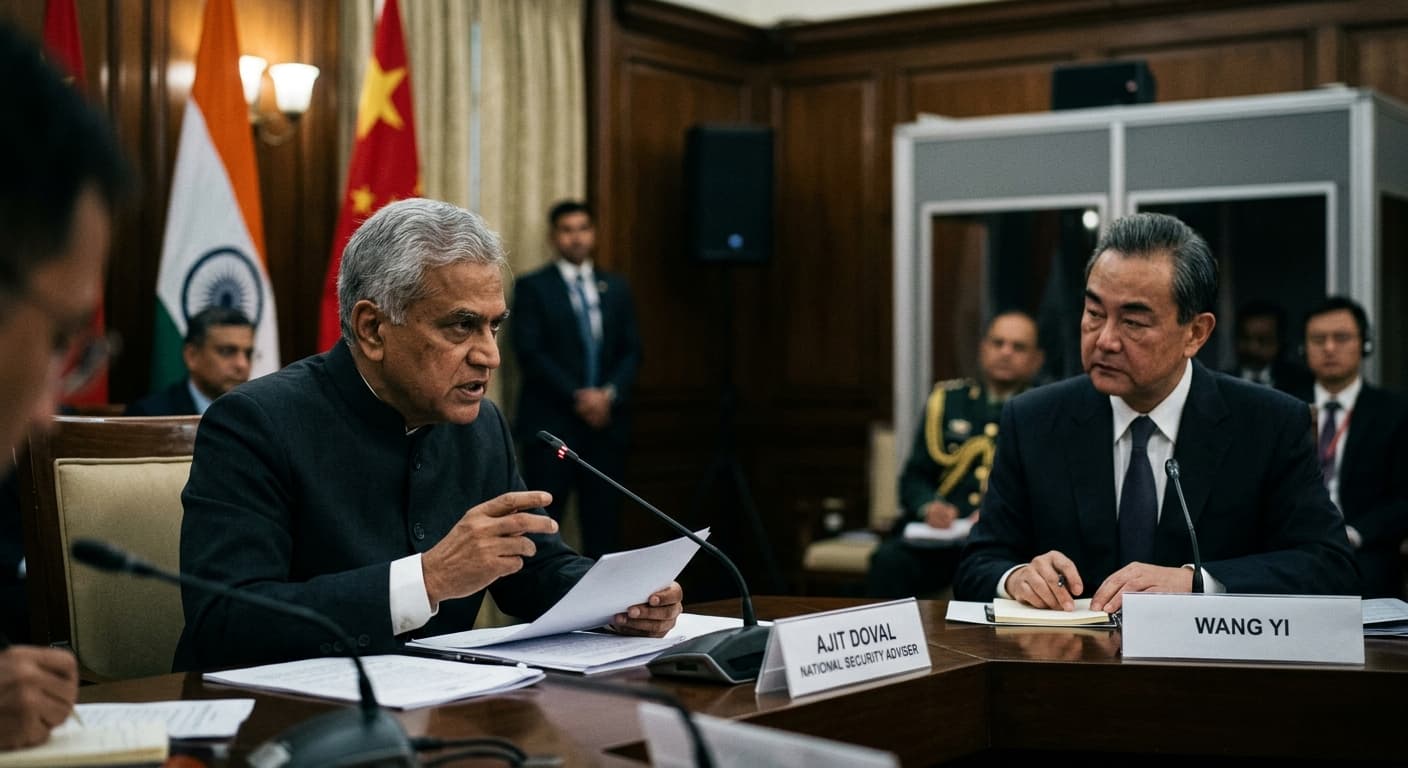
Doval's Message: India Signals 'Sensitivity' to China on Border and Beyond
National Security Adviser Ajit Doval meets Chinese Foreign Minister Wang Yi in Delhi, pressing for mutual restraint on "core concerns" as both powers test a fragile detente.
India's National Security Adviser Ajit Doval met Chinese Foreign Minister Wang Yi in New Delhi on June 23, 2026, framing the encounter as a test of whether both countries can sustain engagement on contested issues—above all, their disputed border. The meeting, held on the sidelines of a BRICS security officials conclave, carried a specific message: India will stabilize ties only if China shows consistent sensitivity to Indian core interests, not just border restraint.
This is calibrated language. Doval did not announce new agreements, did not declare victory, and did not pretend that underlying disputes had dissolved. According to India's External Affairs Ministry, the NSA "underlined that stable, predictable and constructive bilateral relations will contribute to enhanced trust and deeper understanding," signaling that India sees stability as a means to protect its leverage, not as an end in itself.
The meeting occurs 8 months after India and China reached a landmark disengagement agreement in October 2024, which allowed troops to resume patrolling separate sections of the Line of Actual Control in Ladakh after a four-year standoff. That breakthrough—their first major de-escalation since the 2020 Galwan Valley clash that killed at least 20 Indian soldiers—opened a window for dialogue. But it settled nothing. The border remains militarized, the underlying territorial claims remain unresolved, and neither side has withdrawn forces.
The Unfinished Reckoning
Both sides entered this meeting with different asks. According to China's official readout via Chinese Ambassador Xu Feihong, Wang Yi called for respect of "core interests" and urged India to place the border dispute in "appropriate position, so that it doesn't affect the overall situation of bilateral relations." This is Beijing's standard formula: compartmentalize the border, expand trade and investment, move forward together. Wang framed cooperation as the path to "revitalization of the Global South" and called for restored dialogue mechanisms and expanded people-to-people exchanges.
Doval's message was narrower and harder. India demanded "consistent sensitivity to each other's issues of core concern," according to the External Affairs Ministry. This is India's way of saying: China cannot treat border restraint as a wedge to pry open other sectors—technology, investment, defense partnerships—that India has tightened since 2020. India has remained cautious about Chinese investment in critical infrastructure and continues de-risking from overdependence on Beijing. That stance will not change because Wang Yi smiles at a BRICS meeting.
The divergence is sharp. As Brookings analysts have noted, India follows "border before broader"—peace on the frontier is a prerequisite for other improvements. China follows "broader before border"—larger cooperation should not be blocked by specific disagreements. Neither side has moved on this fundamental asymmetry.
What Comes Next
Both officials described the talks as "constructive and forward-looking," the diplomatic equivalent of "let's talk again soon." No fresh agreements emerged—the readouts carefully avoided claiming progress on substantive issues. The real test is implementation. India will watch whether China honors its October 2024 patrolling commitments on the ground. According to reporting from Chatham House analysis, China has tested Indian resolve with border transgressions even after formal agreements; future skirmishes cannot be ruled out.
The meeting also signals India's broader calculus under Trump's second term. With U.S. commitment to allies less certain and Washington focused on its own trade wars, New Delhi is hedging by maintaining multiple channels. But India's engagement with Beijing is tactical, not strategic. Watch whether Doval and Wang schedule another Special Representatives meeting by year-end, and whether the October disengagement holds through winter when border tensions have historically spiked. If it does, gradual resumption of bilateral dialogue mechanisms may follow. If not, the détente collapses and the two countries reset to military stalemate.
The phrase Doval left in the room was about sensitivity. In diplomatic code, that means: prove you can be trusted before asking India to open doors.
Discover more

India
India-South Korea $50B Trade Expansion Plan
India and South Korea target $50 billion in bilateral trade by 2030, focusing on industrial cooperation and strategic alignment amid US pressures.
India
UN Expert Albanese: India Violates Law
UN Rapporteur Francesca Albanese accuses India of breaching international law, spotlighting human rights concerns in Kashmir and prompting diplomatic pushback.
India
CPI(M) Calls to Decouple Quota from Delimita
CPI(M) advocates for a 33% women's quota in Lok Sabha by 2029, removing the need for delimitation and census linkage.

Conflict & Security
Drone Warfare Killing Aid Workers at Unprec
Over 1,000 humanitarian workers killed in three years as cheap armed drones collapse legal protections. Gaza, Sudan, Ukraine, and DRC see deliberate targeting of aid convoys and hospitals with zero prosecutions.