Democrats Push for Israel's Nuclear Acknowled
House Democrats challenge US silence on Israel's nuclear arsenal.
Model Diplomat8 min readNorth America
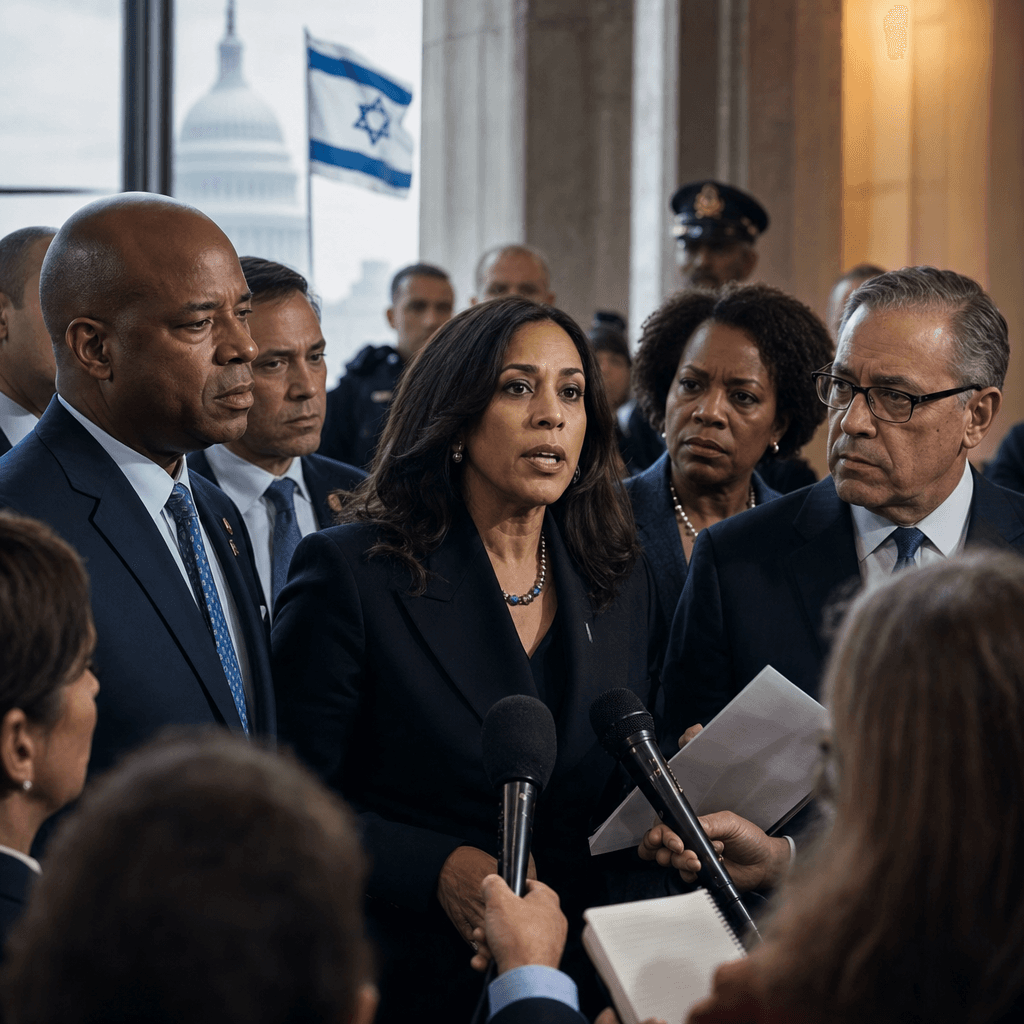
Democrats Push to End US Silence on Israel's Nuclear Arsenal
In a May 5, 2026 letter, 30 House Democrats told Marco Rubio to end 57 years of "official ambiguity" on Israel's estimated 90 nuclear warheads — the first real crack in the Nixon-Meir bargain.
Thirty House Democrats led by Texas Representative Joaquin Castro sent Secretary of State Marco Rubio a letter on May 5, 2026 demanding that the United States end a 57-year policy of refusing to acknowledge Israel's nuclear weapons — a bargain struck between Richard Nixon and Golda Meir in September 1969 that has survived every administration since. The letter is not really about disclosure. It is about wresting a wartime information monopoly back from the executive branch while the US is co-belligerent with a nuclear-armed, non-NPT partner in a hot war against Iran — and it lands as the Non-Proliferation Treaty's review conference has just collapsed over precisely this double standard.
That is why this small letter matters more than the wire copy suggests: it is the first congressional attempt in the modern era to reopen the Nixon-Meir accord, and it drew from Rubio the closest thing to an on-the-record admission any sitting Secretary of State has offered.
The letter, and what Rubio actually said
Castro's letter, published on his House website, tells Rubio that Congress "cannot develop coherent nonproliferation policy for the Middle East… while maintaining a policy of official silence about the nuclear weapons capabilities of one party central to the ongoing conflict in which the United States is a direct participant," according to Rep. Castro's office. The signatories include Sara Jacobs, Pramila Jayapal, Ilhan Omar, Alexandria Ocasio-Cortez, Rashida Tlaib, Ro Khanna and Jim McGovern — a coalition that fuses the Foreign Affairs Committee's second bench with the progressive caucus.
The operative sentence is constitutional, not moral:
"Congress has a constitutional responsibility to be fully informed about the nuclear balance in the Middle East, the risk of escalation by any party to this conflict, and the administration's planning and contingencies for such scenarios. We do not believe we have received that information."
One month later, on June 3, 2026, Castro cornered Rubio at a House Foreign Affairs hearing. Asked directly whether Israel has nuclear weapons, Rubio replied "most of the world assesses that they do," according to Al Jazeera's transcript of the exchange. He called refusing to say more "a feature" of US policy and offered a classified follow-up. That half-step is unprecedented: previous Secretaries of State have refused even that formulation. The Trump State Department has, in effect, ceded the descriptive question ("do they have them?") while holding the line on the operative one ("will we say so?").
Why this letter is different from the ones that failed
Congress has attempted this before — briefly under Rose Gottemoeller's 2009 NPT universality speech, and in scattered letters after Ehud Olmert's 2006 slip in which the Israeli prime minister listed his own country beside "America, France, Russia" as nuclear powers. None dented the policy. What is different in 2026 is the war.
The US struck Iranian nuclear sites alongside Israel on February 28, 2026, killing Supreme Leader Ali Khamenei, according to BBC News. At least 3,468 Iranians have been killed, per Iran's Martyrs Foundation. A fragile ceasefire signed June 17, 2026 has already been breached twice, with US Central Command striking Iranian coastal radar sites on June 27 in response to attacks on shipping in the Strait of Hormuz,
Al Jazeera reported.
That is the context Castro is exploiting. The Democrats' argument is not that Israel should disarm — the letter never says so — but that Congress cannot execute its war-powers or authorization role when it does not know the escalation ladder of the ally it is fighting alongside. Senator Ed Markey put the same point on the Senate floor on July 23, 2025, warning that "nuclear-armed Israel conducted unilateral strikes on facilities in Iran. That war didn't go nuclear this time," according to the Congressional Record. "This time" is doing all the work in that sentence.
The arsenal Washington won't name
SIPRI's 2025 Yearbook, the most cited open-source estimate, puts Israel's stockpile at approximately 90 warheads as of January 2025, unchanged from 2024, and notes ongoing modernization including a 2024 test of a propulsion system "possibly related to its Jericho family of missiles" and an upgrade to the plutonium reactor at the Negev Nuclear Research Center near Dimona. Israel's fissile inventory could in theory support 185–273 warheads; SIPRI's lower figure reflects tritium constraints and force-structure analysis.
Delivery is triadic. Roughly 50 warheads are assigned to land-based Jericho ballistic missiles at Sdot Micha Airbase near Zekharia, about 45 km west of Jerusalem. Around 30 are gravity bombs for F-15 and F-16 aircraft. And Israel's five Dolphin-class submarines, plus a sixth boat (INS Drakon) with a vertical launch system, give it a sea-based leg through nuclear-capable cruise missiles — a survivable second-strike capability rare among mid-sized powers.
None of this is speculative in the intelligence community. It is speculative only in the State Department briefing room. That gap is what the Castro letter is prying at.
The Nixon-Meir bargain, in operational terms
The formal doctrine is called amimut — Hebrew for "opacity." Its origin is a private meeting in September 1969 between Nixon and Meir at which, according to declassified documents analyzed by Avner Cohen and by Hans Kristensen and Robert Norris in the Bulletin of the Atomic Scientists, the two agreed that Israel would keep its weapons "untested, undeclared, and in low political salience" while Washington would drop pressure for NPT accession and end American inspections of Dimona.
The linguistic sleight of hand is worth understanding. Israel's public formula is "we will not be the first to introduce nuclear weapons into the Middle East." A 1969 White House memo prepared for Nixon by Henry Kissinger concluded that the Israelis "interpreted that to mean they could possess nuclear weapons as long as they did not test, deploy, or make them public." Kissinger told Nixon: "This is one program on which the Israelis have persistently deceived us — and may even have stolen from us."
That understanding has never been renegotiated. It has survived Carter, Reagan, both Bushes, Clinton, Obama, Biden and now a second Trump term. The reason is structural, not sentimental: acknowledging Israel's arsenal would trigger US law. The Symington and Glenn Amendments to the Foreign Assistance Act cut off military and economic aid to non-NPT states that acquire nuclear weapons, and the Glenn provisions have no presidential waiver for detonation or receipt of a device. Formal acknowledgment would, absent a bespoke congressional carve-out, endanger the $38 billion, ten-year US Memorandum of Understanding on security assistance to Israel — a figure logged in the March 12, 2026
Congressional Record alongside a $209 million bomb transfer that same week.
That is the cliff. It explains why Rubio would rather offer a classified briefing than say the word.
The non-obvious angle: the NPT is dying in the room next door
The Democrats' timing is not incidental. On May 22, 2026 — 17 days after Castro sent his letter — the 11th NPT Review Conference concluded without a consensus outcome, according to a Carnegie Endowment analysis by Ariel (Eli) Levite and colleagues. The proximate cause was Iran. The deeper cause was the resolution on the Middle East, an unresolved 1995 commitment that has helped tank the 2015, 2022 and now 2026 review cycles.
The Manohar Parrikar Institute's pre-conference assessment noted starkly that "all the warring countries (except Israel) are members of the NPT," and that a "full-scale pre-emptive war premised on the possibility of nuclear proliferation" was being waged by a nuclear-weapon state and a non-signatory against an NPT member, per IDSA's brief. Non-aligned states use Israel's undeclared status as their standing grievance against Western enforcement; the collapse of the RevCon just handed Riyadh, Ankara and Cairo a fresh rhetorical justification for hedging on their own civil nuclear programs.
The Castro letter's real audience, then, may not be Rubio. It is the Gulf. The Democrats are trying to hand a future administration a rhetorical tool to say to Riyadh: we hold everyone to the same standard. Right now the US cannot say that. Saudi Crown Prince Mohammed bin Salman knows it. So does Recep Tayyip Erdoğan.

Who benefits, who loses
Benefits: The progressive caucus gains a rare foreign-policy vehicle that reframes the Israel debate away from Gaza and toward legal-procedural terrain, where they are on firmer ground with moderates. Rubio himself gains some room — the "classified format" line is a real concession that expands what future briefings can cover. And the arms-control bureaucracy, which has quietly resented amimut for decades, gets a citation it can use.
Loses: The Israeli government, which relies on the ambiguity architecture for both deterrent value (adversaries must assume the worst) and international cover (allies can pretend nothing is there to sanction). The Trump White House, which does not want a subsidiary front opening on its Iran diplomacy. And Saudi Arabia's argument for a nuclear "right" — because if ambiguity ends, so does the deniability that lets Washington look the other way at Riyadh's enrichment ambitions.
The letter has zero legislative force. It will not pass. But it has already produced a public exchange that alters what a Secretary of State can plausibly deny in a hearing room. That is the entire point.
What to watch
- September 2026 UN General Assembly: Arab states are expected to table a Middle East WMD-Free Zone resolution referencing the RevCon failure. Watch whether the US abstains rather than votes no — a shift that would signal the Castro letter has moved the interagency.
- FY27 State-Foreign Operations appropriations markup: Castro sits on Foreign Affairs, not Appropriations, but Barbara Lee's successors on the subcommittee could attach a reporting requirement compelling State to brief the Gang of Eight quarterly on Israeli nuclear posture. Precedent exists from the 2004 A.Q. Khan disclosures.
- Any Iran ceasefire breach that triggers Israeli escalation: The June 27 CENTCOM exchange shows how thin the ice is. A serious Israeli reprisal that referenced strategic deterrence — even obliquely — would force Rubio back before Foreign Affairs, and the "classified format" concession would become a demand.
Diplomat View
The Castro letter will not end Israeli nuclear ambiguity. It was never going to. But it has done something more consequential: it has forced the executive branch to concede, on the record, that the policy is a choice — Rubio called it a "feature" — rather than a factual necessity. Once ambiguity is a policy choice defended by a Secretary of State in open session, it becomes negotiable. The forecast: within two administrations, the "will not confirm or deny" formula will be replaced by a Congressional Gang-of-Eight carve-out, modeled on the intelligence-oversight compromises of the late 1970s, that lets Congress see what the executive knows without triggering Symington-Glenn sanctions. The condition that would revise this forecast: a Saudi enrichment breakout, or a Turkish one, that makes formal US acknowledgment of Israel's arsenal politically radioactive again. If Riyadh moves, the Nixon-Meir bargain gets another decade. If it does not, Castro's letter will be cited as the inflection point.
The Bottom Line
The 30-Democrat letter is not a disclosure demand — it is a jurisdictional move, wresting nuclear oversight back from the executive branch during a live war with a nuclear-armed non-NPT partner. Rubio's "most of the world assesses that they do" is the first crack in a 57-year bipartisan silence, and the Non-Proliferation Treaty regime cannot survive many more Iran-war-shaped stress tests with that silence intact. Watch the September UNGA vote on the Middle East WMD-Free Zone — a US abstention, not a no, is the signal that amimut is entering its endgame.
Discover more

US Politics
House Ethics Committee Pushes Sexual Miscond.
The House Ethics Committee has shifted responsibility for sexual harassment settlement records to the Office of Congressional Workplace Rights, complicating disclosure efforts.

Global Politics
US Seizes Iranian Ship, Tensions Surge
The US seizure of the Iranian ship Touska highlights a shift in control over the Strait of Hormuz, favoring Iran's strategic position.
Global Politics
Trump's Conflicting Messages on Iran War
Trump's mixed messages on Iran reflect a strategy of audience management, benefiting Tehran amid a complex geopolitical landscape.

Conflict & Security
Drone Warfare Killing Aid Workers at Unprec
Over 1,000 humanitarian workers killed in three years as cheap armed drones collapse legal protections. Gaza, Sudan, Ukraine, and DRC see deliberate targeting of aid convoys and hospitals with zero prosecutions.