DeepSeek's Custom Silicon Strategy
Beijing's AI stack integration challenges Huawei's dominance.
Model Diplomat7 min readAsia
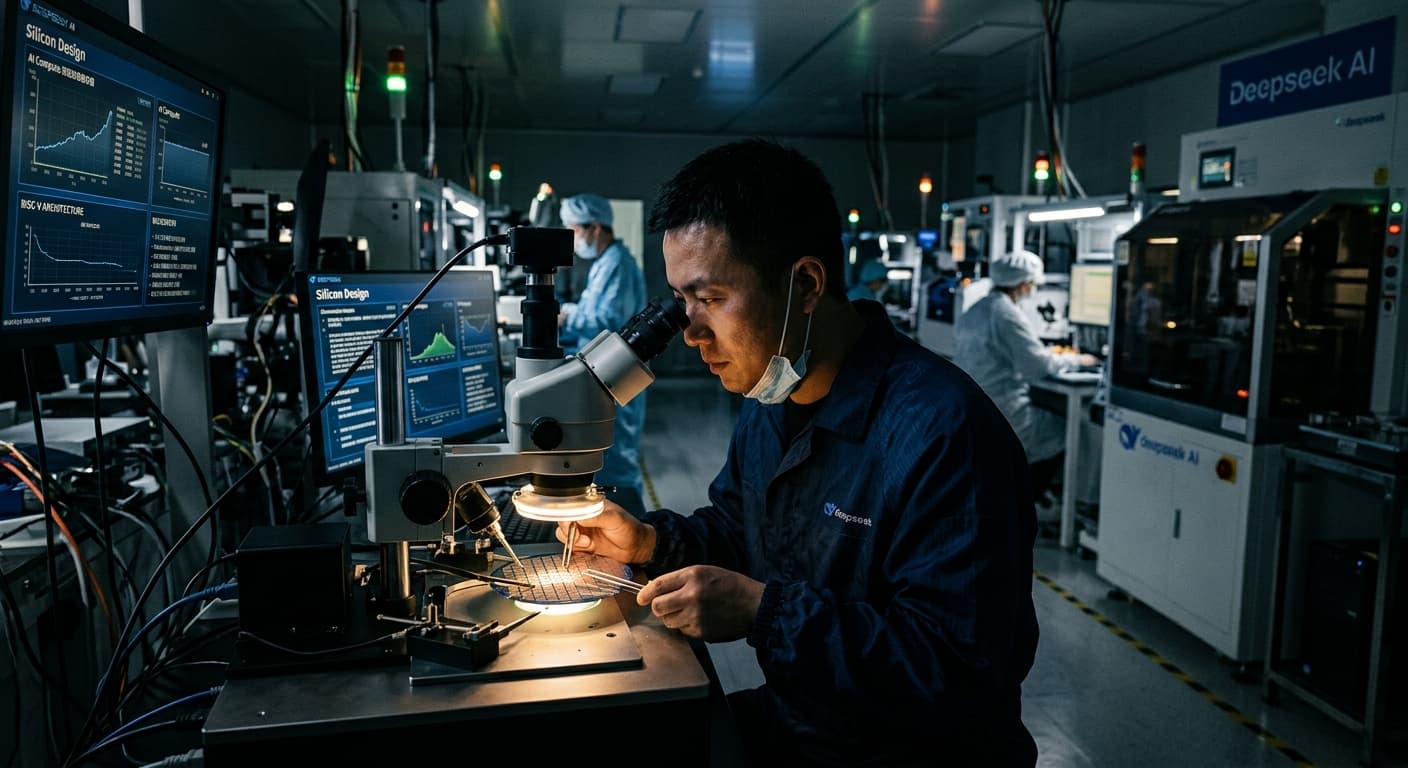
DeepSeek Bets on Custom Silicon as Beijing Vertically Integrates China's AI Stack
DeepSeek's move into custom inference chips signals Beijing's forced integration of China's AI stack — and quietly puts Huawei's domestic dominance on notice.
DeepSeek is designing its own inference chip and has begun engaging chip-design houses, foundries and memory suppliers, Reuters and CTech reported on July 7, 2026. The move — described by three people familiar with the project as roughly a year in gestation — is the clearest sign yet that Beijing's semiconductor self-reliance drive is now pulling model developers into the silicon layer, and the real casualty may not be Nvidia but Huawei's near-monopoly over China's estimated $50 billion AI accelerator market. It also complicates a Washington bet, running since the January 15, 2025
BIS AI Diffusion rule and softened by Donald Trump's December 2025 H200 approval, that keeping Chinese labs hooked on second-tier U.S. silicon would forestall a domestic hardware ecosystem.
What DeepSeek is actually building
The chip is scoped for inference — running trained models — not training, according to the Reuters/CTech account. That is a deliberate choice. Barclays estimates 70% of AI compute demand will come from inference by 2026, up from a training-heavy split just three years earlier — a figure CSIS analyst Gregory C. Allen cites in his
export-controls assessment. Huawei's own Ascend 910C, DeepSeek's most-used domestic option, delivers roughly 60% of the performance of Nvidia's H100 in inference — a gap DeepSeek's engineers have publicly documented and are now presumably trying to close with a bespoke design tuned to their own model architectures.
The commercial trigger is a compute shortage. DeepSeek's April 24, 2026 release of V4-Pro and V4-Flash was praised algorithmically — a hybrid attention architecture delivering a one-million-token context window at a fraction of V3's inference cost, per the Council on Foreign Relations — but the company admitted it could not serve V4-Pro to most customers because it lacked the chips to run it. That is the load-bearing fact behind today's news. Owning the inference layer is the fastest way to break the compute bottleneck without queuing behind Huawei's Ascend production, which is bottlenecked at SMIC's roughly 20% yield on 7-nanometre wafers, as
CSIS has documented.
DeepSeek is also, for the first time, taking outside capital. The Financial Times reported in June 2026 that the Hangzhou lab is nearing a $45 billion-plus valuation, with Tencent among interested investors. A Reuters-reported $7 billion raise at a $52–59 billion range would give founder Liang Wenfeng the balance-sheet room a chip program requires. Custom silicon is not a garage project — a competitive AI accelerator typically runs multiple years and hundreds of millions to a billion dollars in R&D before a single wafer is fabbed.
Why this is really about Huawei, not Nvidia
The framing that dominates Washington coverage — DeepSeek walking away from Nvidia — is half the story. The more consequential shift is that a marquee Chinese AI lab, one Beijing has effectively anointed, no longer wants to be a captive customer of Huawei either.
Huawei has ridden export controls to roughly half of China's AI chip spend, and it has leveraged that position with SMIC to squeeze out domestic rivals. As CSIS puts it, Huawei's status as SMIC's most important customer gives it the ability to "restrict the share of SMIC manufacturing capacity that goes toward its domestic competitors." A DeepSeek chip — designed by DeepSeek, fabbed presumably at SMIC or a smaller domestic foundry, running DeepSeek's own models — is precisely the kind of dis-intermediation Huawei has spent three years preventing. Beijing appears content to let it happen. Alibaba has already shipped more than 100,000 units of its Zhenwu 810E accelerator, and at least nine Chinese chip designers have crossed the 10,000-unit threshold, per a
CSIS localization study. Cambricon's Shanghai-listed shares have more than doubled in three months, and Goldman Sachs forecasts its revenue growing 3.7 times to 5.5 billion yuan, per
RAND.
The political direction matters here. DeepSeek's V4 was optimized for Huawei's Ascend "reportedly at Beijing's direction," according to CFR. The same state hand that pushed DeepSeek toward Huawei is now, evidently, comfortable with DeepSeek moving one layer further down the stack — because the alternative is a China where a single vendor gates access to every domestic model. TrendForce, cited by
CSIS, projects the domestic share of China's AI-chip market will hit 50% in 2026. Diversifying suppliers below that threshold is now the priority.
The Washington bet that isn't paying
Trace the U.S. side and the picture darkens. The January 15, 2025 AI Diffusion rule imposed a worldwide license requirement on advanced computing ICs classified under ECCNs 3A090.a and 4A090.a, according to the Federal Register text. A companion foundry due-diligence rule issued a day later tried to close the shell-company loophole that had let TSMC produce hundreds of thousands of AI chip dies for Huawei, per the
BIS interim final rule. And in April 2026, BIS extended the approved IC-designer deadline to December 31, 2026 via a
final rule — a tacit admission that enforcement is running behind the calendar.
The Trump administration reversed course in mid-2025, then again in December, when it approved Nvidia H200 sales to China. The theory, as Brookings' John Villasenor summarised it, was "to get Chinese companies hooked on less powerful Nvidia chips, thereby assuring that they would not bother to develop their own." Beijing killed the plan at the demand side: Chinese authorities told domestic AI companies not to buy H200s, and as of mid-May 2026, per Brookings, not a single H200 had been sold. Nvidia never produced any H20s after the ban either. Chinese regulators, including the Cyberspace Administration, had already ordered tech firms to justify H20 purchases and prioritize domestic silicon,
the Financial Times reported. That antitrust probe, launched in December 2024,
Al Jazeera reported at the time, has become the enforcement lever behind the boycott.
The result is a market Washington unilaterally departed. U.S. chipmakers' share of the Chinese AI accelerator market is effectively zero, per Brookings, even though Nvidia CEO Jensen Huang told U.S. officials the company's China market share fell from 95% to 50% before the collapse, per
RAND. Every DeepSeek chip that tapes out is one more customer permanently outside the American compute perimeter — and one more data point for CFR's argument that the current export regime is
strategically incoherent and unenforceable whether operated loosely or tightly.
The historical parallel: Huawei 2019, DeepSeek 2026
The playbook DeepSeek is reaching for was written by Huawei in 2019. When Washington cut Huawei off from Google's Android services and TSMC's advanced nodes, Huawei responded by building its own OS (HarmonyOS), its own chip design pipeline (HiSilicon Kirin, then Ascend), and — via SMIC — its own manufacturing. It emerged with a domestic 7-nanometre chip in the September 2023 Mate 60 Pro, per Brookings, and today runs what SemiAnalysis' Dylan Patel called "an unprecedented effort to develop every part of the AI supply chain domestically," per the
Financial Times. DeepSeek is applying the same vertical-integration logic four rungs up: from smartphones to frontier AI models.
The second-order effect is software. DeepSeek migrating its CUDA workloads to Huawei's CANN environment "would likely be a multiyear project," CSIS's Allen writes, but if the open-source community pulls it off, "it would have major implications for U.S. AI competitiveness both inside and outside of China," according to CSIS. A DeepSeek chip with its own toolchain — designed to run DeepSeek's models optimally, then offered as open-source reference silicon — could break Nvidia's CUDA moat at the ecosystem level rather than the transistor level. That is the Huawei-2019 lesson: don't out-manufacture the incumbent, out-substitute them.
Winners, losers, watch
The winners are legible. DeepSeek obtains supply security and a hedge against Beijing's next directive. SMIC and CXMT/XMC get another anchor customer, spreading capacity risk. Cambricon, Alibaba's T-Head, and small-cap design houses benefit from the political message that Huawei is not the only permissible option — Cambricon's stock action shows the market already pricing it in, per the BBC.
The losers are equally clear. Huawei loses its exclusive claim on the "national champion" mantle in AI silicon, at a moment when it is also building three chip-manufacturing sites in Shenzhen's Guanlan district, per an FT investigation. Nvidia loses a data point it needed — DeepSeek's continued dependence on CUDA — to argue that engagement was working. And the Bureau of Industry and Security, whose
own rule had to be extended eight months to December 31, 2026 to process approved IC-designer applications, faces an enforcement environment where the entities it seeks to gate are becoming their own designers.
Diplomat View
DeepSeek's chip will not, in its first generation, match Nvidia — RAND, CSIS and CFR all note China remains constrained by SMIC's yield problem and by high-bandwidth memory controls. The forecast is narrower: DeepSeek's inference silicon ships in limited volume in 2027, targets the lab's own serving workloads first, and pressures Huawei's Ascend pricing in China's mid-tier inference market by 2028. What would change that forecast is a successful CANN-equivalent open software layer around DeepSeek's chip, or a serious HBM breakthrough at CXMT — either would compress the U.S.-China gap CFR currently pegs at seven months. What would kill it is another U.S. tightening on foundry access to non-Huawei Chinese designers, which BIS has telegraphed but not delivered. Watch the money and the metal, not the models.
What to watch next
- December 31, 2026 — extended BIS deadline for approved IC-designer applications under the January 2025 foundry rule.
- Q4 2026 — DeepSeek's expected V5 release, and whether it is optimized for a third silicon target beyond Nvidia and Ascend.
- Late 2026 — completion of Huawei's Guanlan self-operated fab, per the FT; the domestic capacity ceiling for any DeepSeek tape-out depends on it.
The Bottom Line
The bottom line: DeepSeek's chip project is not a bet against Nvidia — that bet was placed by Beijing months ago, when regulators quietly killed the H200 market. It is a bet against Huawei's monopoly on being China's national champion, blessed by a state that has decided vertical integration inside China matters more than a single flagship supplier. If the chip tapes out, the story of China's AI stack in 2027 will be told in accelerators, not models.
Discover more

US Politics
SNAP Food Assistance Faces Legal Challenges
In 2026, SNAP faces stricter eligibility rules and mounting legal challenges, threatening food assistance for the millions of Americans who rely on the program.

India
Congress Accuses Modi of Stalling Women's Law
Congress accuses Modi of stalling women's reservation law by linking it to delimitation, revealing a deeper electoral strategy.

India
700 Activists Accuse PM Modi of MCC Breach
Over 700 activists allege PM Modi breached election code with a televised address attacking opposition parties just before state elections.

Economics
Fed's Amex AML order puts correspondent banking on notice
Federal Reserve's Amex AML order requires board-level controls and a 90-day plan; OCC fined the bank $350 million over enterprise-wide deficiencies.