DeepSeek's AI Chip: China's Power Play
DeepSeek designs its own AI inference chip to boost China's tech independence.
Model Diplomat8 min readAsia
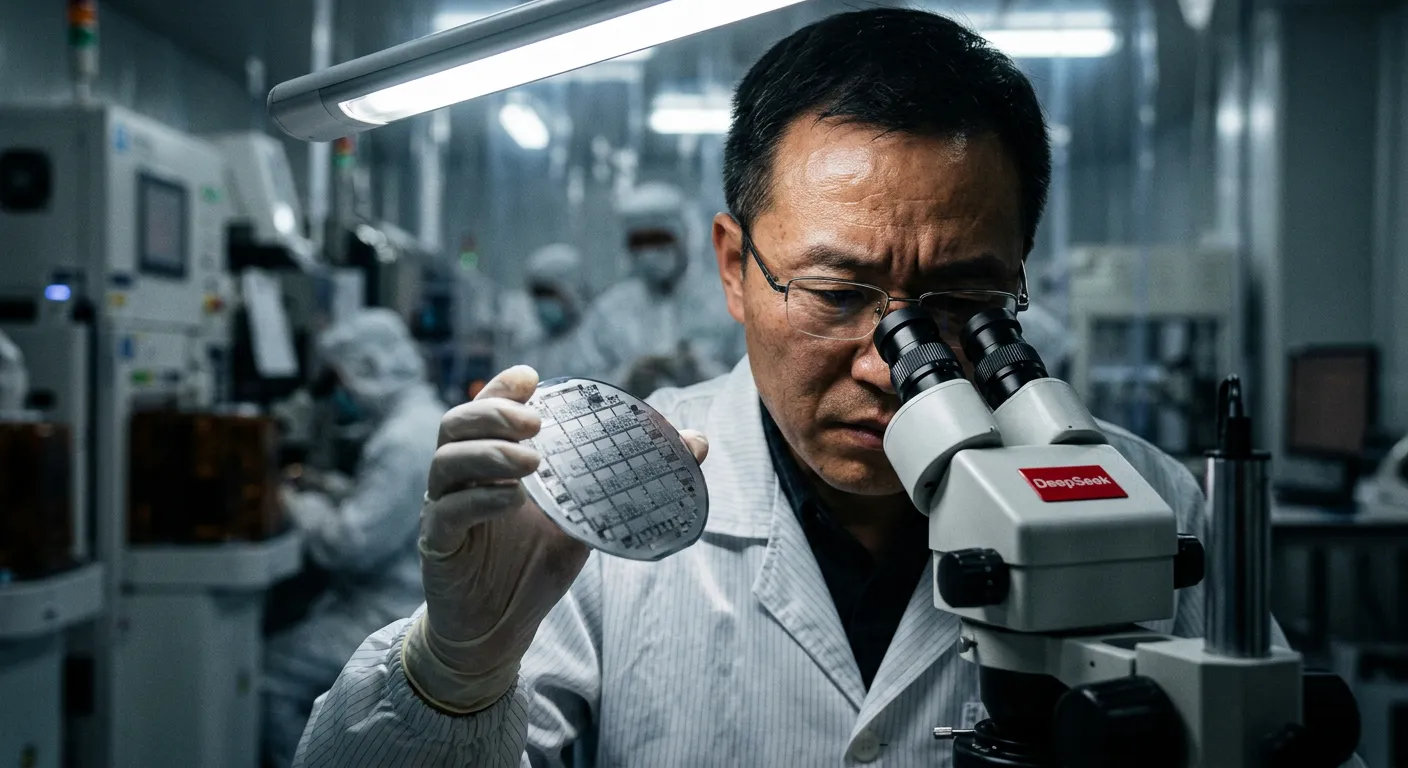
DeepSeek's Own AI Chip: China's Inference-Era Power Play
DeepSeek is designing its own inference chip with Chinese foundry and memory partners — a bid to lock in Beijing's post-Nvidia AI stack.
Chinese startup DeepSeek is designing its own AI inference chip, according to a July 7, 2026 Reuters report citing three people familiar with the matter — a move that, if it ships, converts DeepSeek from a software house running on other companies' silicon into the anchor tenant of a fully domestic Chinese AI stack. The strategic point is not that DeepSeek will out-engineer Nvidia. It is that inference — not training — is where China can win, and the DeepSeek-SMIC-CXMT alliance now has the model, the fab, and the memory to make Nvidia optional inside China's borders. That is the exact outcome U.S. export controls were designed to prevent.
The news, first reported by Reuters and syndicated through the
Taipei Times, lands as DeepSeek prepares a roughly $7 billion maiden external funding round valuing the Hangzhou lab at $52–59 billion. The chip is at an early stage, with talks under way with chip-design, foundry, and memory partners. Hiring of chip-design engineers has quietly accelerated. Crucially, the design targets inference — the runtime stage where trained models answer user queries — rather than training, according to the
Mobile World Live summary of the Reuters reporting.
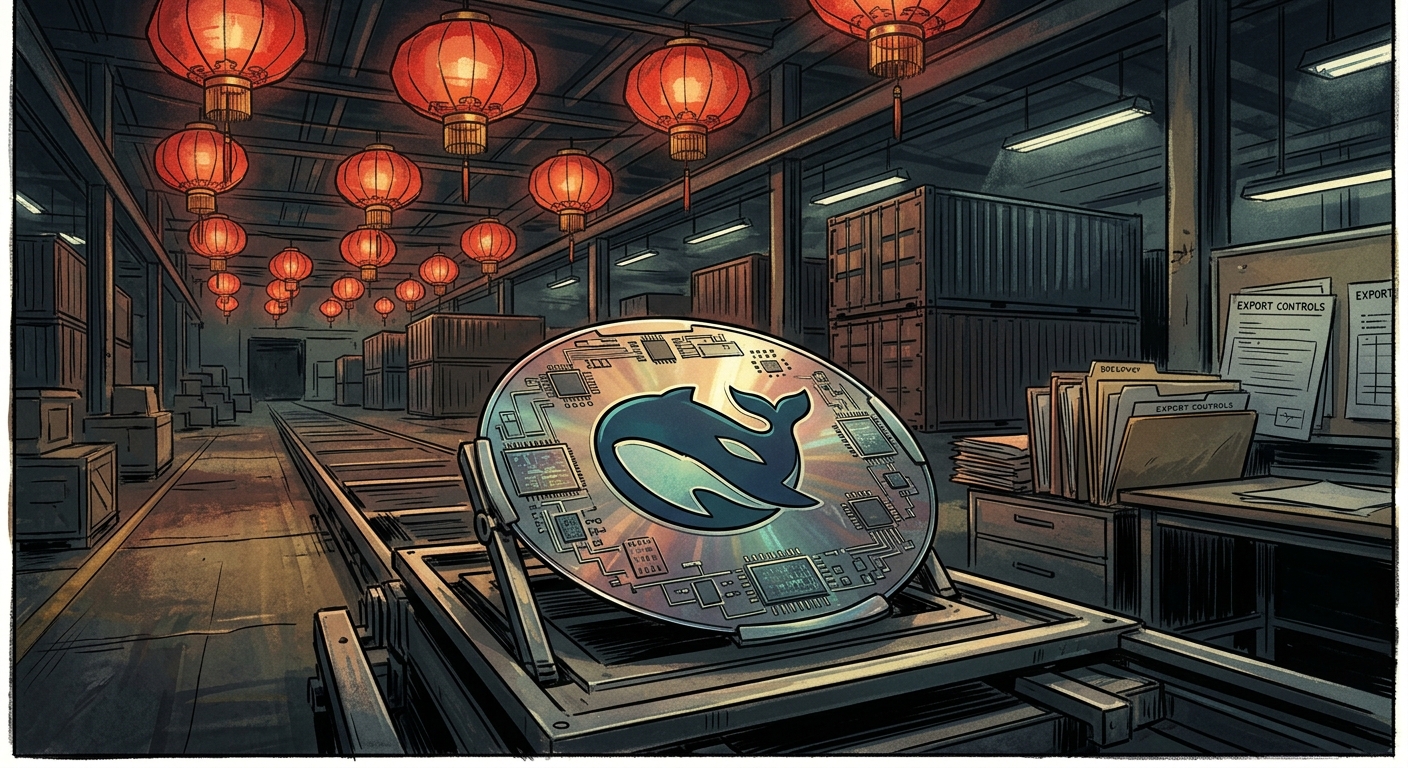
Why inference — and why now
The choice of workload is the tell. Barclays, cited in CSIS analyst Gregory Allen's April 2025 House testimony, estimates that 70% of AI compute demand will come from inference by 2026. Nvidia's own CEO Jensen Huang put the current utilization split of its GPUs at "40 percent inference, 60 percent training," inverting a training-dominated market from 2016. Every additional user query DeepSeek serves — and its chatbot is one of the ten most-used AI apps globally — pushes that curve further toward inference.
Inference is also where China's hardware disadvantage matters least. Training frontier models rewards raw floating-point performance and vast, tightly-networked GPU clusters — the exact combination locked up by Nvidia's Blackwell and TSMC's leading-edge nodes. Inference rewards memory bandwidth, energy efficiency, and cost-per-token. Huawei's Ascend 910C, manufactured on SMIC's 7 nm "N+2" node, already delivers roughly 60% of the H100's inference performance, according to CSIS. On a per-dollar basis inside China — where Ascend chips enjoy state procurement mandates and Nvidia H20s have been discouraged — the arithmetic already favors the domestic stack.
DeepSeek has been telegraphing this for a year. Its April 2026 model, DeepSeek-V4, was explicitly optimized for Ascend inference "at Beijing's direction," according to the Council on Foreign Relations. The V4 technical paper on
arXiv notes that DeepSeek-V4-Pro requires only 27% of the single-token inference FLOPs and 10% of the KV cache of V3.2 at million-token context — precisely the kind of memory-bandwidth-friendly design a domestic inference ASIC can exploit.
What DeepSeek's silicon actually buys Beijing
The prize is not the die itself. It is the software.
Huawei's Ascend line has been held back for two years by a threadbare software ecosystem — its CANN framework is the intended competitor to Nvidia's CUDA, but sits years behind in maturity. As CSIS's Allen put it in his DeepSeek Deep Dive testimony, "migrating all AI workloads from CUDA to CANN would likely be a multi-year project." Whoever finances that migration — and whichever open-source community adopts it — will define the shape of China's AI compute for the next decade.
A DeepSeek-designed inference chip solves the collective-action problem. DeepSeek's models are open-weight and among the most-forked on Hugging Face. If those models ship with kernels tuned to a DeepSeek ASIC — or to a DeepSeek-Ascend co-optimized runtime — every Chinese cloud provider, every enterprise deployer, and every developer building on DeepSeek weights inherits the domestic software stack by default. That is how CUDA won in the first place: not with better silicon, but with a decade of libraries that made switching prohibitively expensive.
The Stanford Freeman Spogli Institute's assessment notes that DeepSeek already "relied on Huawei's Ascend 910C chips for inference to generate responses" for users worldwide — meaning American consumers hitting the DeepSeek app are already, unwittingly, generating utilization data and revenue for the Chinese chip ecosystem. An in-house chip formalizes that flow.
The manufacturing constraint is real — but shrinking
The obstacle DeepSeek must clear is physical. Any advanced Chinese AI ASIC must be fabricated at SMIC, since TSMC access was foreclosed by the January 2025 "Foundry Rule," a Biden-era interim final rule that moved advanced chip production to a whitelist system. That rule, published in the Federal Register on January 15, 2025, imposed a worldwide license requirement for advanced computing ICs and, as the Congressional Research Service
summarised, placed China under a "presumption of denial."
SMIC's 7 nm capacity is expanding but contested. CSIS puts SMIC's advanced-node output at roughly 45,000 wafers per month by end-2025, with plausible expansion to 60,000. Yields at N+2 are estimated at about 20%, though independent teardown analysis from SemiAnalysis suggests SMIC's third-generation 7 nm process (N+3), shipping in the Huawei Kirin 9030, has closed the gap on Intel 18A on some metal-pitch metrics. High-bandwidth memory remains the tighter chokepoint: CXMT is ramping HBM production, but Commerce added HBM to controlled items in December 2024, per the
Federal Register.
Every wafer SMIC devotes to a DeepSeek chip is a wafer not producing Huawei Ascend, Kirin phone SoCs, or telecoms silicon. That is the real internal Chinese negotiation now under way — one Beijing will arbitrate, given DeepSeek's central role in the state's AI-industrial policy.
Trump's chip diplomacy has changed the equation
Washington's posture is no longer the coherent denial regime it was 18 months ago. On January 14, 2026, President Trump signed Proclamation 11,002, invoking Section 232 to impose a 25% tariff on advanced computing chips including the Nvidia H200 and AMD MI325X — while simultaneously permitting their sale to "approved customers" in China with the U.S. government collecting a revenue share. In August 2025, per CRS, BIS had already approved Nvidia's H20 and AMD's MI308 for sale in China "under terms that the U.S. government would receive 15% of proceeds."
That arrangement has generated its own backlash inside China. Beijing has reportedly ordered domestic tech firms to boycott Nvidia's China-bound chips and prioritise indigenous alternatives, according to the BBC. The result: even where Nvidia is legally available, DeepSeek and its peers face political incentives to build on domestic silicon. That is the demand signal a DeepSeek chip is designed to answer.
Brookings researcher John Villasenor's January 2025 assessment — that export controls may be accelerating rather than impeding Chinese AI progress by forcing efficient design — looks more prescient every quarter. "Scarcity fosters innovation," Villasenor wrote. "As a direct result of U.S. controls on advanced chips, companies in China are creating new AI training approaches that use computing power very efficiently. When, as will inevitably occur, China also develops the ability to produce its own leading-edge advanced computing chips, it will have a powerful combination of both computing capacity and efficient algorithms."
Who benefits — and who quietly loses
The winner is not DeepSeek. It is the SMIC-CXMT-Cambricon supply chain that gets a marquee customer whose open-weight models pull the entire Chinese developer community onto a domestic stack. Cambricon shares are up more than 500% year-on-year on Shanghai's STAR Market on similar in-house-chip speculation. Alibaba's T-Head and Baidu's Kunlun teams gain political cover to accelerate their own designs. Huawei, paradoxically, both wins and loses: DeepSeek chose Ascend for V4 inference, but a DeepSeek-designed chip competes directly with future Ascend generations for the same SMIC wafers.
Nvidia is the obvious loser in the addressable-market sense — but only inside China. Its global position remains dominant, and the Trump administration's decision to permit H200 sales to China at a 15% revenue share is a rearguard action to keep some Chinese demand on U.S. silicon. The subtler loser is the credibility of the U.S. export-control regime itself. The Bureau of Industry and Security's May 2025 guidance that any use of Huawei Ascend chips violates U.S. controls has not been meaningfully enforced abroad. On June 1, 2026, BIS issued a further clarification — after questions arose — reaffirming that licensing requirements apply to Chinese-headquartered firms' overseas subsidiaries. That the clarification was necessary is itself the story.
DeepSeek is not omnipotent. The Economist called the April V4 release "a shrug," noting stiffening competition from Alibaba's Qwen and ByteDance's Doubao and "a meddling state." CFR notes DeepSeek admits it cannot serve V4-Pro to most customers because of compute shortages, and that U.S. officials allege V4 was trained on smuggled Blackwell chips. A homegrown inference chip does not solve DeepSeek's training bottleneck — but it does move the compute-shortage story from "unable to serve" to "serving on domestic silicon," which is worth more to Beijing than to DeepSeek's user base.
What to watch
Three concrete catalysts will determine whether this is a genuine strategic pivot or a corporate positioning story:
- December 31, 2026 — BIS "authorized IC designer" deadline. BIS extended by eight months, in an
April 2026 Federal Register rule, the deadline for foundries to identify approved IC designers under ECCN 3A090.a. Any TSMC-manufactured hedge DeepSeek might attempt via shell arrangements closes hard on this date.
- DeepSeek's $7 billion funding close (Q3–Q4 2026). Whether Chinese state-owned banks, the Big Fund III, or foreign LPs participate will signal how much of the chip effort is corporate versus explicitly state-directed.
- SMIC N+3 volume ramp and CXMT HBM3 qualification. The chip cannot ship in volume until both fab and memory partners deliver at yield. Any credible DeepSeek silicon before H2 2027 would be a strategic surprise.
Diplomat View
The Reuters scoop is not really about a chip. It is about the emergence, in real time, of a parallel AI stack — DeepSeek models, running on DeepSeek-designed silicon, fabricated at SMIC, memory from CXMT, orchestrated by a CANN-derived software layer that DeepSeek's open-source community makes stick. That stack does not need to beat Nvidia globally to succeed. It needs to be good enough inside China, and good enough for the developing-world markets where Chinese AI diffusion is already outpacing American exports. Our forecast: DeepSeek tapes out a first-generation inference chip on SMIC N+2 by mid-2027, ships limited internal-use volumes by end-2027, and — if HBM supply holds — commercial availability follows in 2028. This forecast fails if (a) Beijing forces DeepSeek to consolidate onto Huawei's Ascend roadmap rather than build in-house, or (b) a Trump-Xi deal materially expands Nvidia's Chinese market, reducing the political premium on domestic silicon. Both are live risks. Neither is the base case.
The Bottom Line
DeepSeek's decision to design its own inference chip is the moment China's AI-industrial policy stopped being defensive. The U.S. export-control regime bet that denying leading-edge silicon would slow Chinese AI; instead it has forced the emergence of a vertically integrated Chinese stack that increasingly does not need American components at all. If the chip ships, the DeepSeek-SMIC-CXMT axis becomes the second credible AI supply chain on the planet — and the Nvidia-TSMC monopoly on inference economics ends inside China's borders before it ever really began.
Discover more

US Politics
SNAP Food Assistance Faces Legal Challenges
In 2026, SNAP faces stricter eligibility rules and mounting legal challenges, threatening food assistance for the millions of Americans who rely on the program.

India
Delhi CM Rekha Gupta Blasts Opposition's Delm
Delhi CM Rekha Gupta's remarks on women's quota defeat reveal BJP's strategy for the 2029 Lok Sabha elections, focusing on delimitation.

Global Politics
Xi Jinping Calls China-Russia Ties 'Precious'
Xi Jinping's description of China-Russia ties as 'precious' reflects a strategic imbalance, with Beijing dictating terms in the partnership.

Economics
Fed's Amex AML order puts correspondent banking on notice
Federal Reserve's Amex AML order requires board-level controls and a 90-day plan; OCC fined the bank $350 million over enterprise-wide deficiencies.