DeepSeek's AI Chip Bid Redefines China
DeepSeek's move reshapes China's semiconductor landscape.
Model Diplomat8 min readAsia
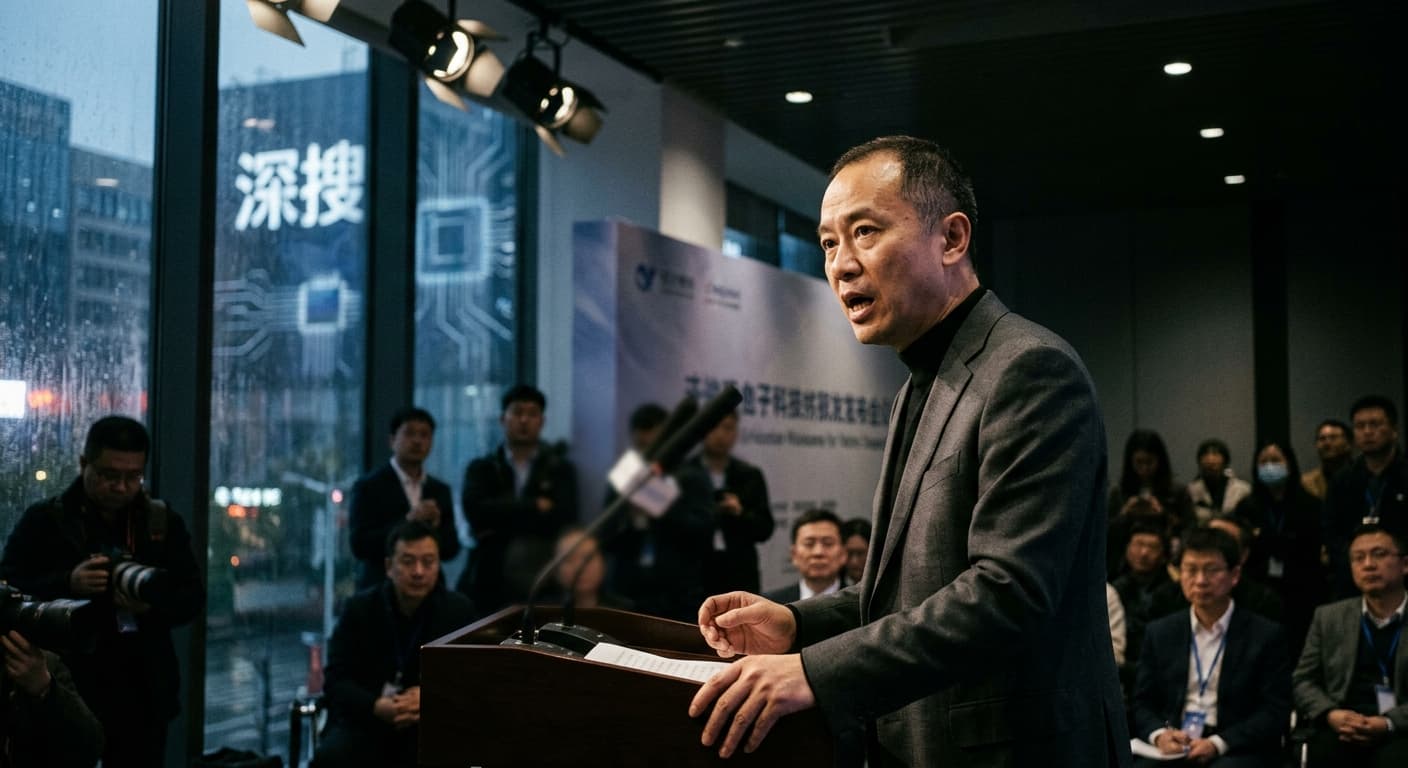
DeepSeek's Silicon Bid Signals China's AI Stack Is Closing
DeepSeek is designing its own AI inference chip — a move that quietly redraws China's semiconductor map, squeezes Huawei, and tests the limits of US export controls.
DeepSeek, the Hangzhou lab that erased more than half a trillion dollars off Nvidia's market cap in January 2025, is now trying to build the silicon its models run on — and the second-order effect is not what Washington expects. The most consequential loser is not Nvidia, which has already been pushed to zero market share inside China, but Huawei, whose Ascend line has spent the past year filling the vacuum. Reuters, via Taipei Times, reported on July 8, 2026, that DeepSeek is talking to chip-design, foundry, and memory partners for an inference-only accelerator, has been quietly hiring silicon engineers for roughly a year, and is doing so in parallel with a maiden US$7 billion funding round that values the company between US$52 billion and US$59 billion. The push is the clearest sign yet that China's AI stack — models, chips, memory, and software — is trying to close into a self-contained loop.
Why an inference chip, and why now
DeepSeek is not chasing Nvidia's Blackwell. It is chasing the segment where the money actually is: inference — the token-by-token serving of trained models to users. Barclays estimates that by 2026, roughly 70 percent of AI compute demand will come from inference rather than training, a shift that CSIS argues favors chips like the Ascend 910C, which delivers only about 60 percent of an Nvidia H100's training performance but is competitive enough for serving. Inference silicon can also be built on older, denser process nodes — a critical concession to reality when China's most advanced logic foundry, SMIC, is stuck on a 7 nm (N+2) node with yields that MERICS reports have climbed from
20 to 40 percent on the 910C, still well below the roughly 60 percent global leaders achieve for comparable dies.
The commercial logic is sharpened by DeepSeek's own admission. In its V4 technical paper released in April 2026, the company conceded its flagship trails Western frontier models "by approximately 3 to 6 months" and, according to CFR, currently cannot even serve the model to most customers because it lacks the chips to do so. That is the vulnerability an in-house inference part is designed to fix: DeepSeek's economic future rests on serving tokens cheaply at scale, and every Ascend chip it queues for is a chip Huawei's own cloud, government customers, or Ant Group are competing to take first.

The Huawei squeeze
Huawei's Ascend franchise is the biggest immediate casualty of DeepSeek's decision — a point most Western coverage has missed by framing this only as an anti-Nvidia move. According to the Taipei Times report, Huawei captured roughly half of China's US$50 billion domestic AI chip market in 2026, largely because Washington's April 2025 ban on Nvidia's H20 chip cleared the field. That grip is already loosening. Brookings, citing IDC data, notes that Chinese-designed accelerators reached
nearly 41 percent of China's AI chip market in 2025, with about half of that Huawei — meaning Alibaba's T-Head unit (which CSIS says has shipped
over 100,000 Zhenwu 810E units), Cambricon (500,000 planned in 2026), Baidu's Kunlun line, and now DeepSeek are collectively bidding down Huawei's share.
The bottleneck all these designers face is the same: SMIC's 7 nm capacity and CXMT's high-bandwidth memory. Huawei is estimated to have privileged access to as much as 70 percent of SMIC's advanced node capacity, according to MERICS. Every wafer DeepSeek reserves is a wafer Huawei loses, and Beijing has both the leverage and the strategic interest to reallocate — DeepSeek is now a national champion in its own right, not a Huawei customer. Ren Zhengfei told Xi Jinping at a February 17, 2025 symposium, per
CSIS, that his concerns about the semiconductor gap had "eased" — a statement that reads differently now that his largest software customer is trying to route around him.
The export-control ceiling DeepSeek cannot design its way past
The harder wall is memory. AI inference chips are memory-bound, not logic-bound: throughput per query depends on how fast weights and key-value caches can be moved to the arithmetic units. That is why the December 5, 2024 Bureau of Industry and Security rule added country-wide controls on high-bandwidth memory (HBM) with "memory bandwidth density greater than 2 gigabytes per second per square millimeter" — a specification aimed squarely at the HBM3/HBM3E stacks Nvidia, Huawei, and now DeepSeek all need. The follow-on January 16, 2025
interim final rule tightened the transistor-count presumptions that trigger a license, capping packaged ICs at 30 billion transistors unless attested otherwise. Congressional Research Service analysis notes BIS also imposed "China wide-controls for advanced packaging SME, high-bandwidth memory (HBM), and dynamic random-access memory (DRAM)," extending the reach of the Foreign Direct Product Rule to
South Korean firms operating in China — an unusually aggressive extraterritorial move.
The Observer Research Foundation flags the structural exposure bluntly: China's local HBM supplier, CXMT, "has not yet met the necessary global standards," and Huawei's Ascend production has depended on roughly 13 million HBM units previously imported from Samsung — enough for around 1.6 million Ascend chips. Once that stockpile depletes, every Chinese AI silicon roadmap — DeepSeek's included — narrows to whatever CXMT can actually ship. A CSIS memory analysis warns that HBM supply is so constrained globally that SK Hynix's
entire 2026 production slate is sold out, meaning DeepSeek cannot even quietly source workarounds through third countries the way it did with Nvidia H800s in 2023.
The historical parallel: Apple's A-series, not Huawei's Kirin
The right analogy for what DeepSeek is attempting is not Huawei's Kirin — a defensive act of a hardware company being sanctioned — but Apple's move to design its own A-series silicon in 2010. Apple did not build fabs; it specified silicon tightly co-designed with its software, then paid TSMC to make it. DeepSeek is trying the same play in a compute-constrained environment: co-designing an inference part around its own mixture-of-experts architecture, where DeepSeek's V3/R1 technical work already documented that up to 20 of an H800's streaming multiprocessors were being burned on communication overhead rather than compute. An accelerator designed from scratch around Multi-head Latent Attention and DeepSeekMoE — architectures the company itself invented — could plausibly extract 2–3x the effective throughput per wafer that a generic Ascend die achieves on the same workload.
That is also why OpenAI's move last month to unveil "Jalapeno," its custom inference chip built with Broadcom, matters here: it validates the thesis that model-labs-turned-chip-specifiers is the new default. The Peterson Institute notes OpenAI's inference spending alone jumped from about US$2 billion in 2024 to US$7 billion in 2025 — a 3.5x rise that clarifies why every serious lab now wants to own the silicon economics of serving.
Who benefits, who loses
Winners. SMIC gains a second anchor customer whose volumes are large enough to justify further N+2 capacity expansion — CSIS estimates 50,000 wafers per month by end-2025, en route to a target of 100,000 per year across the SMIC/Hua Hong/Huawei-linked network. CXMT gains a captive design partner willing to co-develop around whatever HBM density it can actually ship. The Chinese state gains a diversified AI hardware base that is less dependent on Huawei's single point of failure — a strategic hedge Beijing has been signaling since Zhejiang province, DeepSeek's home base, published its January 2026 target to indigenize
7 nm to 3 nm nodes within five years.
Losers. Huawei is the sharpest loser, both in wafer allocation and in its bid to have CANN — its CUDA competitor — become the default Chinese AI software layer. If DeepSeek ships its own silicon with its own compiler stack, Huawei's software ecosystem play loses its most credible open-source anchor. Nvidia is not directly hurt — Radio Free Mobile analyst Richard Windsor told Reuters "Nvidia is at zero in China and staying there" — but the strategic implication is corrosive: every new Chinese design that ships proves the export-control ceiling is a floor for domestic substitution. Brookings' John Villasenor called the endpoint plainly in June 2026: US chip firms now have
"exactly zero market share" of China's AI chip market.
Diplomat View
DeepSeek's chip project will not tape out competitive silicon before late 2027 at the earliest, and even then it will run into the same HBM ceiling as Huawei. That is the base case. What makes this announcement strategically significant is not the chip itself but the signal: China's leading model lab now believes the fastest path to serving its models cheaply is to specify its own silicon rather than wait for Huawei's roadmap. That is the moment a national AI ecosystem crosses from "coping with sanctions" to "designing around them." The forecast that would revise this view: if DeepSeek's first tape-out slips past 2028, or if the BIS extends HBM controls to cover CXMT output directly, the project collapses back into a Huawei-dependent hedge. If it ships on schedule with domestic HBM, US export controls will have produced exactly the vertically integrated Chinese AI stack they were designed to prevent — and the seven-month model gap CFR identifies will start to compress on the hardware side, not just the software side.
What to watch:
- Q4 2026: DeepSeek's US$7 billion funding round closes. Watch for state-linked anchor investors (Big Fund III, provincial vehicles) — a tell for how much of the chip effort is state-directed.
- Early 2027: SMIC's N+2 capacity target of 50,000 WPM should be verifiable through Huawei's Ascend 950PR shipments; a shortfall means DeepSeek's foundry slot is imaginary.
- Any BIS rulemaking in 2026–27 that extends HBM performance thresholds downward or names CXMT to the Entity List. That is the single regulatory move that could still kill this project on paper.
The Bottom Line
DeepSeek's decision to design its own inference chip is not a bid to replace Nvidia — Nvidia is already gone from China. It is a bid to route around Huawei, the domestic incumbent whose Ascend line has become both China's AI backbone and its single point of failure. If DeepSeek succeeds, US export controls will have produced their intended opposite: a vertically integrated Chinese AI stack in which the country's best model lab specifies the silicon, SMIC manufactures it, and CXMT supplies the memory — the exact loop Washington spent five years trying to prevent from closing.
Discover more

US Politics
SNAP Food Assistance Faces Legal Challenges
In 2026, SNAP faces stricter eligibility rules and mounting legal challenges, threatening food assistance for the millions of Americans who rely on the program.

India
Delhi CM Rekha Gupta Blasts Opposition's Delm
Delhi CM Rekha Gupta's remarks on women's quota defeat reveal BJP's strategy for the 2029 Lok Sabha elections, focusing on delimitation.

India
Congress Accuses Modi of Stalling Women's Law
Congress accuses Modi of stalling women's reservation law by linking it to delimitation, revealing a deeper electoral strategy.

Economics
Fed's Amex AML order puts correspondent banking on notice
Federal Reserve's Amex AML order requires board-level controls and a 90-day plan; OCC fined the bank $350 million over enterprise-wide deficiencies.