De la Espriella Halts Colombia's Transition
Political rupture signals a new governance model in Colombia.
Model Diplomat7 min readLatin America
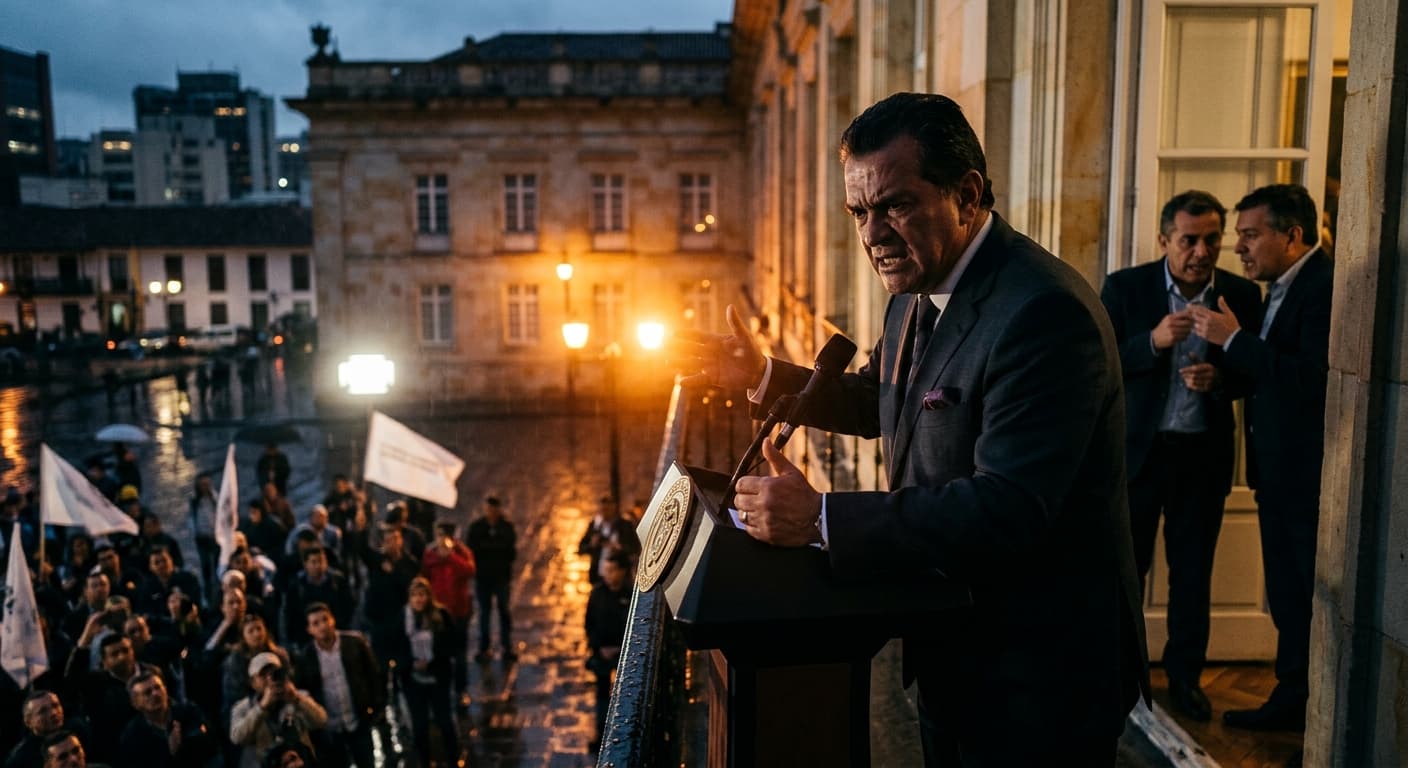
De la Espriella halts Colombia's transition, weeks before inauguration
Colombia's president-elect suspended the empalme with Petro on July 7, 2026, accusing an outgoing "gobierno corrupto" — a preview of governance by rupture.
Colombia's president-elect Abelardo de la Espriella suspended the constitutional government-transition process on July 7, 2026, exactly one month before his August 7 inauguration, accusing outgoing President Gustavo Petro of running a "gobierno corrupto" that "pretends to destroy Colombia." The rupture, reciprocated within hours by the Casa de Nariño, is not a procedural spat. It is the first hard signal that De la Espriella intends to govern the way he campaigned — by unilateral decree and open conflict with the state he is about to inherit — and it hands the region its second consecutive Bukele-Milei-style handover in which the new right rejects the legitimacy of the outgoing left before taking office. The empalme was the last institutional guardrail between two administrations that do not recognise each other's authority. What replaces it is now the story.
According to El Tiempo, De la Espriella posted the order to his vice-president-elect, José Manuel Restrepo, on his social channels on Tuesday night:
"Acabo de darle instrucciones al señor vicepresidente electo de la República para que suspenda de manera inmediata el proceso de empalme con el gobierno corrupto que termina su período, un gobierno que, con sus decisiones y su conducta, pretende destruir a Colombia."
By Wednesday, Petro's team confirmed it had suspended its side too. By Thursday morning, Caracol Radio reported that outgoing ministers were recording video briefings alone in the Salón Azul of the Casa de Nariño, opposite the empty chairs where De la Espriella's team should have sat — a piece of political theatre both sides will use for the next month.
The empalme is not a courtesy — it is a legal transfer
The transition process Colombians call the empalme is not a soft handover. It is the formal, sector-by-sector transfer of state information — budget execution, defence intelligence, health-system interventions, foreign-treaty commitments — designed to prevent policy blackouts on August 7. The Departamento Administrativo Nacional de Estadística (DANE), which sits at the centre of that data pipeline, publicly reaffirmed on July 8 that it would deliver all statistical information for the empalme "de forma abierta y transparente" regardless of the political rupture — a rare institutional pushback against both camps.
That the country's official statistics agency felt compelled to issue a communiqué reminding both sides of its legal obligations tells you where Colombia's technocracy is quietly positioning itself. It is a signal to bondholders, to the IMF, and to the Contraloría General that the numbers will keep flowing even if the politics have collapsed.
The US Congressional Research Service, in its June 2026 briefing on Colombia's election, flagged the transition as the pivot point for the bilateral relationship: De la Espriella will inherit an economy the CRS describes as fiscally constrained after four years of "de-emphasis of coca eradication" that "coincided with record cocaine production," and a US relationship that reached its lowest post-Plan-Colombia point when Washington and Bogotá recalled envoys in July 2025.
The economic hole is real — and now weaponised
The suspension has to be read against the fiscal picture. In 2025, according to the Atlantic Council, the International Monetary Fund suspended Colombia's US$9.8 billion Flexible Credit Line over concerns about the Petro government's "persistent deficits, public spending, suspension of the fiscal rule, tax-revenue shortfalls," and two of the three major rating agencies pushed Colombia into high-yield territory. The Atlantic Council's analyst network warns De la Espriella's shock plan — cutting the state apparatus by 40%, resuming fracking, eliminating some taxes — cannot be delivered without technical handover data his team is now refusing to receive.
The BBC, citing DANE, notes that Petro leaves office with monetary poverty at 31.8% in 2024 — the lowest since the current methodology began — and a minimum wage that rose 23% in late 2025. Reversing that without triggering social conflict is a matter of political sequencing that the empalme was supposed to protect. Cutting the process short shifts the entire cost of the transition onto the new government's first 100 days.

The parallel transition: governors, not ministers
While the national empalme collapsed, De la Espriella did something more interesting. On July 8, in Cúcuta, on the Venezuelan border, he opened what his team calls the empalme regional — direct bilateral handovers with the mayors and governors of Colombia's 32 departments. According to Canal Tropical, he framed it as necessary because "el proceso no puede continuar con un Gobierno que no reconoce al presidente electo."
Read cynically, this is a workaround: build a subnational operating picture that bypasses the outgoing cabinet entirely. Read strategically, it is a template. In a country where the Pacto Histórico remains the largest bloc in the new Senate seated on July 20 and De la Espriella's Movimiento de Salvación Nacional holds only three seats, subnational coalitions are the coalition. It also mirrors Nayib Bukele's early tactic of routing around a hostile legislature by leveraging territorial politics — a comparison the president-elect welcomes.
The same day, per El Tiempo's live coverage, De la Espriella instructed his defence-minister-designate, retired general Eduardo Mora, to prepare capture operations against "alias bendito menor," head of the paramilitary Autodefensas Conquistadores de la Sierra Nevada, declaring him a "high-value target" of the incoming administration. He is issuing operational orders through a chain of command he does not yet control.
What Petro loses, what he gains
The Petro camp calculates that a broken empalme lets it hand De la Espriella a poisoned inheritance while claiming clean hands. According to Al Jazeera, Sergio Guzmán of Colombia Risk Analysis noted after Cepeda's concession that "Petro's term is sunsetting, [but] Cepeda will likely become the leader of the opposition" — meaning the incoming right has a functioning left-wing opposition already installed in the Senate on day one.
Petro has also spent the post-election weeks doubling down on his claim, without evidence per BBC, that the vote was compromised by Israeli and US interference. The empalme suspension gives him a platform to argue, over the coming weeks, that the transition was never legitimate to begin with — an argument that will resurface every time De la Espriella invokes a state of exception or overrides a Constitutional Court ruling.
The regional pattern is not coincidence
The Colombian rupture is the fourth in an eighteen-month regional sequence. Milei took office in Argentina in December 2023 refusing to sit with outgoing Peronist officials on economic files. Bukele restructured El Salvador's institutions before formal handovers were complete. Trump's second-term transition to Biden in January 2025 dispensed with several long-standing protocols. What Colombia now imports is not simply the ideological alignment BBC Mundo documents between De la Espriella and Trump, Bukele, and Milei — it is the operational grammar: legitimacy claimed through electoral victory alone, delegitimising every institution that predates you.
The historical parallel that matters is not 2018, when Iván Duque succeeded Juan Manuel Santos with a normal empalme despite deep policy differences. It is 2002, when Álvaro Uribe entered office promising to shatter the paradigm of his predecessor — and used emergency powers repeatedly in his first year. The International Crisis Group has documented how each such transition compounded institutional erosion. De la Espriella has publicly declared he wants to be "el Uribe del 2002, pero costeño y más bacán."
What to watch
- July 20, 2026 — the new Congress is seated. Pacto Histórico will be the largest bloc. Whether De la Espriella's team engages with committee leadership before August 7 will indicate whether the coalition-building the Atlantic Council flagged as essential is even on the table.
- August 7, 2026 — inauguration in Bogotá. Watch which outgoing ministers physically attend and whether the Constitutional Court president administers the oath without incident.
- First 30 days — De la Espriella has telegraphed a "state of exception" and executive decrees to launch his 90-day US-backed campaign against armed groups. The Constitutional Court, according to Al Jazeera's
June 19 profile, has previously struck down proposals like life imprisonment. Its first ruling on a De la Espriella decree will define the balance of power for the term.
- Shield of the Americas signature — De la Espriella
told the BBC he will accept the US-led regional security initiative. Timing and terms matter for Colombia's position in the Venezuela-facing security architecture Trump is assembling.
Diplomat View
The empalme suspension is not the story — it is the tell. De la Espriella has told his own team, and Colombia's institutional class, that the four-year term begins now, not on August 7, and that the state's job is to conform, not to inform. The bet from Bogotá to Washington's Latin America desk should be that his first six months look less like Duque 2018 and more like Bukele 2019: emergency powers, subnational alliances, direct confrontation with the Constitutional Court, and an intelligence-security package co-signed with the Trump administration. Watch three falsifiable conditions. First, if De la Espriella accepts a formal empalme with the Contraloría and Banco de la República (both technocratic, both indispensable to bond markets) even while boycotting the presidential process, the rupture is theatre. Second, if the Constitutional Court rules against his first state-of-exception decree and he complies, the Bukele analogy is overstated. Third, if the Pacto Histórico's Senate bloc breaks internally — Cepeda drifting from Petro's harder line — the opposition De la Espriella is counting on to legitimise his combativeness will fragment, and the whole confrontation logic loses its foil. Absent those three revisions, this is not a transition. It is the opening act of a governance model in which the state is the enemy.
The Bottom Line
Colombia's aborted empalme is the first stress test of a new-right governance template — legitimacy by ballot, hostility to every institution the ballot did not create. De la Espriella is not preparing to inherit the Colombian state on August 7; he is preparing to override it. If the Constitutional Court and the country's technocratic core hold, the Bukele comparison flatters him. If they do not, Colombia becomes the region's largest test case for democratic backsliding executed entirely within electoral rules.
Discover more
Economics
US Tariffs on Brazil: A Political Play
US imposes 25% tariff on Brazil but exempts 66% of exports, targeting manufactured goods ahead of Brazil's October election. Analysis of the political calculus, exemptions, and Brazil's response options.
Elections & Campaigns
Petro's Farewell: Blueprint for Opposition-in
Colombia's Gustavo Petro refuses to recognize the June 21 election result, calls the incoming government a US-imposed 'viceroyalty', and mobilizes supporters for a general strike, setting the stage for a turbulent transfer of power.
Economics
Brazil Becomes Trump's Section 301 Guinea Pig
Brazil faces a 25% US tariff from July 22, 2026, as the first test of Trump's post-IEEPA Section 301 regime. Exemptions covering 65% of exports reveal US industrial dependence.
Global
Fujimori Pre-Inauguration World Bank Deal
Peru's president-elect Keiko Fujimori secures pre-approved World Bank credits for El Niño prevention before taking office, using multilateral financing as political armor against impeachment.