Fujimori Pre-Inauguration World Bank Deal
Eleven days before swearing-in, Peru's president-elect meets World Bank to lock in credits.
Model Diplomat8 min readLatin America
Keiko Fujimori Is Already Governing — and the World Bank Is Her First Ally
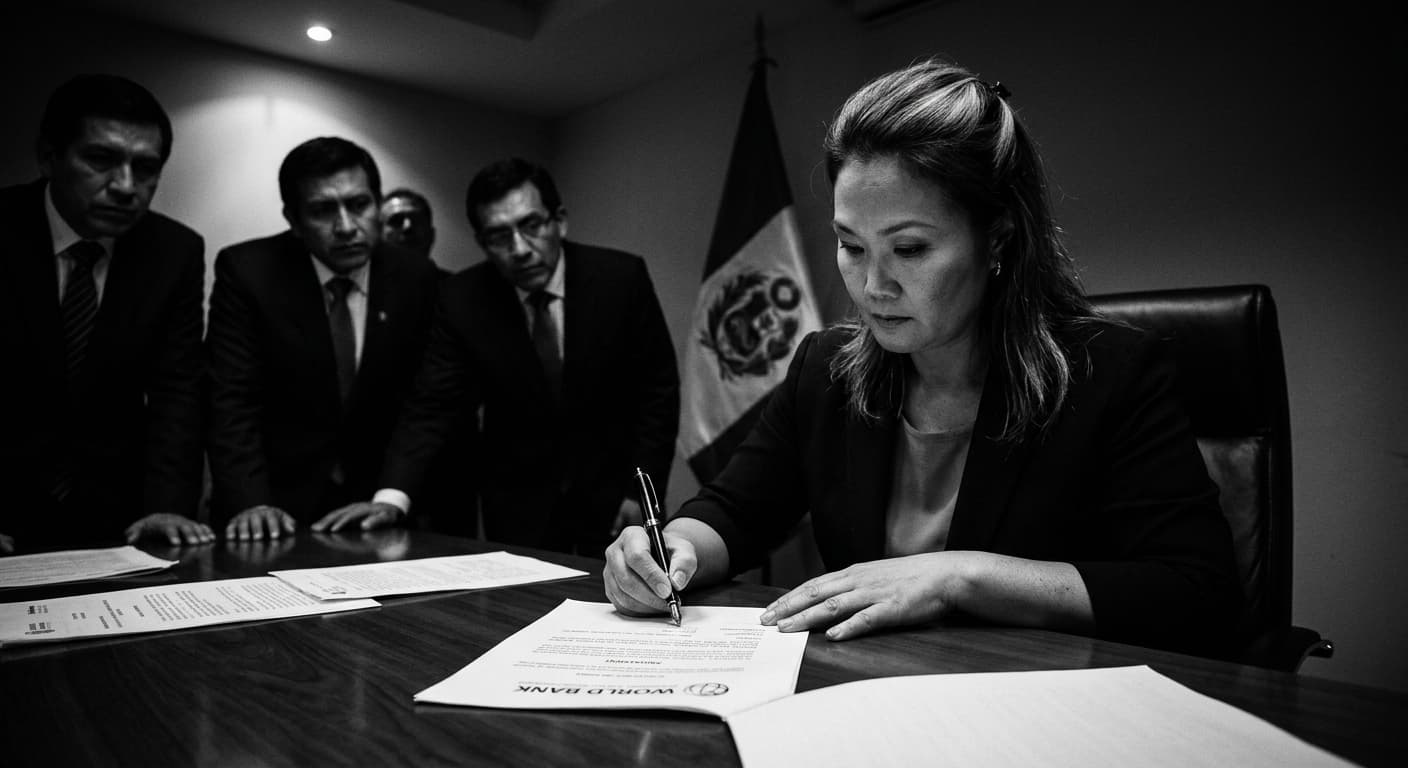
LIMA — Eleven days before her swearing-in, Peru's president-elect bypassed the sitting government to negotiate directly with the World Bank. The meeting reveals her survival strategy: lock in multilateral financing before Congress can lock her out.
On Friday, July 17, 2026, Keiko Fujimori sat across from the World Bank's vice president for Latin America and the Caribbean, Susana Cordeiro, to map out the next five years of lending. She will not be sworn in as Peru's president until July 28. The meeting was not ceremonial. It was a working session with her transition chief, Marco Vinelli, and vice president-elect Luis Galarreta, aimed at activating pre-approved credits for El Niño prevention and fast-tracking infrastructure projects before her government's first crisis hits.
The encounter, reported by La Primera, represents more than routine transition work. For a president-elect who won by 49,641 votes out of 18.4 million cast, a margin of 0.27 percentage points, and who inherits a country that has chewed through eight presidents in ten years, the World Bank relationship is not aid. It is armor.
A Mandate So Thin It Barely Exists
The numbers are brutal. Fujimori secured 9,223,396 votes to left-wing rival Roberto Sánchez's 9,173,755, according to the National Office of Electoral Processes (ONPE), certified by the National Jury of Elections (JNE) on July 3, BBC News reported. Sánchez conceded only on July 6 after weeks of fraud allegations and a threat to launch "a movement of popular and patriotic resistance," as
Al Jazeera documented.
Fujimori's fourth presidential bid succeeded where 2011, 2016, and 2021 failed. The victory leaves her with the weakest popular mandate of any Peruvian president this century. The Ipsos exit poll in May showed 62% of voters believed whichever candidate lost would cry fraud, according to the Instituto de Estudios Peruanos. They were right.
Political scientist Mauricio Zavaleta offered a counterintuitive warning in an Al Jazeera profile: "If she wins, Peru will have a president until 2031. In a country where so many presidents have been impeached, she's the only one with enough power to finish her term." The logic is cold: her Fuerza Popular party controls enough seats in the newly reconstituted bicameral Congress — a Senate and Chamber of Deputies restored after her father Alberto Fujimori dissolved the Senate in the 1990s — to block the two-thirds impeachment threshold that felled her predecessors.
But survival is not governing. And governing requires money.
The Impeachment Machine She Inherits
Peru's political system has become a case study in constitutional self-destruction. The mechanism is Article 113 of the 1993 Constitution, which permits Congress to declare a president "permanently morally or physically incapacitated." The Inter-American Commission on Human Rights formally warned in 2021 that this standard "risks undermining the separation of powers and democratic institutions."
The body count is staggering. Pedro Pablo Kuczynski resigned in 2018 under the shadow of a second impeachment vote tied to Odebrecht. Martín Vizcarra was removed in 2020 on corruption allegations. Pedro Castillo attempted a self-coup in December 2022 and is now serving 11 years and five months. Dina Boluarte survived eight impeachment attempts before finally being ousted in October 2025 over the "Rolexgate" scandal and a brutal protest crackdown. José Jerí lasted four months before Congress voted 75-24 to remove him for undisclosed late-night meetings with a Chinese businessman, as documented by the Council on Foreign Relations.
José María Balcázar, the left-wing former judge currently warming the presidential chair, told Congress in February that democracy in Peru was "not working," per Al Jazeera. He was right. He is also the ninth president in a decade.
This is the machine Fujimori is walking into. Her congressional bloc may protect her from removal, but it cannot generate the investment or jobs that keep a presidency politically viable. For that, she needs external ballast — and she needs it before the honeymoon ends.
The World Bank Play: Financing as Political Fortification
Fujimori's meeting with Cordeiro was not a courtesy call. La Primera reported that the session covered "obras de prevención que se tienen que hacer para la llegada del Fenómeno El Niño," water infrastructure, and international financing mechanisms. Crucially, Fujimori stated: "Hay un crédito preaprobado para poder ayudar al Gobierno del Perú de cara a todo el trabajo de prevención para la llegada del Fenómeno El Niño."
The pre-approved credit is almost certainly drawn from the World Bank's deep and growing portfolio in Peru. In January 2026, the Bank approved a second $500 million Development Policy Financing with a Deferred Drawdown Option (DPF-DDO) to strengthen fiscal management and advance OECD accession, according to a World Bank press release. [Link to primary document: https://www.worldbank.org/en/news/press-release/2026/01/26/banco-mundial-respalda-reformas-fortalecer-la-gestion-fiscal-y-construir-una-economia-mas-productiva-peru] That followed a $500 million Green and Resilient Development DPF-DDO approved in March 2025, focused on disaster risk management, climate adaptation, and decarbonization — the very pillars of the July 17 meeting.
A separate $200 million loan for water and sanitation in the Lake Titicaca and Lurín River basins was signed this year, as reported by TVPerú. Peru's Ministry of Economy and Finance is managing a strategic project portfolio exceeding $66 billion, with an estimated $4.7 billion in execution for 2026 alone, according to an
MEF release.
Fujimori's transition chief Marco Vinelli is the linchpin here. La Primera described him as "estableciendo los puentes institucionales necesarios para coordinar las capacidades del Gobierno central, los gobiernos regionales y los organismos internacionales." In plain terms: Vinelli is wiring the new administration into the multilateral financing architecture before July 28, so that on Day One, the government has projects ready to break ground — and a narrative of competent delivery to sell to an exhausted electorate.
The Climate Wager
The El Niño emphasis is strategic. The 1997–98 El Niño cost Peru an estimated $3.5 billion, according to World Bank program documents. The 2017 El Niño Costero triggered a $70 million disbursement from the Bank's Cat DDO II facility. Peru's Finance Ministry has since built a layered financial protection strategy including $500 million in World Bank Cat DDOs, $300 million from CAF, $300 million from the IDB, and a $200 million Pacific Alliance catastrophe bond — a total of roughly $1.3 billion in contingent credit lines, per a World Bank completion report.
Climate forecasts for 2026 are ambiguous. A January 2026 study by Ludescher et al. using climate network and complexity-based methods gives a 37.5% probability of an El Niño onset in late 2026, with NOAA's Climate Prediction Center putting the odds higher at 61%. Either way, Peru's coast remains exposed. The country ranks among the 20 most climate-vulnerable economies globally, with the World Bank estimating 87% of its population lives in areas exposed to seismic, volcanic, flood, or El Niño-related risks.
For Fujimori, this is political cover. If El Niño strikes and she has already activated prevention credits, she can claim foresight. If it does not, she has still deployed infrastructure spending in regions that voted against her. Either outcome strengthens the presidency.
Who Wins, Who Loses
Winners:
-
Regional governors and mayors, especially in the north and coastal zones most exposed to El Niño, who gain a direct pipeline to multilateral financing before the new president even takes office. Fujimori explicitly referenced "sumar las maquinarias de los gobiernos regionales" in her remarks to La Primera.
-
The World Bank itself, which secures continuity with a market-friendly administration after years of Peruvian political chaos that made long-term program implementation nearly impossible. Issam Abousleiman, the Bank's division director for Bolivia, Chile, Ecuador, and Peru, has publicly framed Peru as a country with "significant potential to accelerate economic growth" — language that signals the Bank is eager to re-engage.
-
Construction and engineering firms, both domestic and international, positioned to bid on the prevention and water infrastructure projects Vinelli is fast-tracking. The MEF's $66 billion project portfolio is a procurement bonanza waiting for a stable counterparty.
Losers:
-
The outgoing Balcázar administration, now definitively side-lined. The optics of a president-elect negotiating directly with the World Bank while a sitting president occupies the palace are extraordinary — and deliberate. Fujimori is signaling that the interregnum is over.
-
The Sánchez coalition and Peru's left, which campaigned on renegotiating the terms of foreign investment and questioned the market-led growth model. Fujimori's pre-inauguration embrace of the World Bank confirms that the 1990s economic architecture — the one her father helped build — will remain intact.
-
China's infrastructure lenders, who have invested heavily in Peruvian ports and energy but will now face a president visibly anchored to Washington-based institutions. The
Atlantic Council noted that Fujimori is "positioned to work with the Trump administration to attract strategic investment" — a sharp pivot from the Boluarte/Jerí era's opaque dealings.
Diplomat View
Keiko Fujimori's pre-inauguration World Bank meeting is not a transition nicety — it is the opening move of a presidency that understands its own fragility. She won with no mandate, inherits a constitutional impeachment machine that has devoured eight predecessors, and faces a population in which only 17% believed the election was conducted cleanly, according to IEP polling.
Her answer is to make herself indispensable to an external constituency — multilateral lenders — before she is vulnerable to an internal one. If the World Bank, BID, and CAF are disbursing hundreds of millions into Peruvian infrastructure by December 2026, impeachment becomes costlier for everyone: Congress, business, the regions. The financing pipeline is the political shield.
The forecast: Fujimori survives her first two years not because she is popular, but because she is useful. The bicameral Congress, with her Fuerza Popular bloc holding a blocking minority in at least one chamber, raises the impeachment threshold. Combined with the multilateral money spigot, this gives her something no Peruvian president since the 1990s has had: a plausible path to completing a term.
What would change the forecast: (1) A severe El Niño event that overwhelms the prevention infrastructure she has promised, exposing the gap between credit lines and on-the-ground execution. (2) A split within Fuerza Popular's congressional caucus — the party has held together through four presidential campaigns, but governance stresses coalitions differently than campaigning does. (3) An Odebrecht-related or money-laundering legal escalation that revives the criminal cases against Fujimori that Peruvian courts dismissed as "flawed" before the election. The cases are dormant, not dead.
Upcoming catalysts:
- July 28, 2026 — Inauguration Day. Watch the composition of her first cabinet, particularly the finance and infrastructure portfolios, for signals on how closely she will hew to the World Bank agenda.
- September–October 2026 — Peak of the ENSO forecast window. NOAA's August update will sharpen the El Niño probability; if it climbs above 70%, expect accelerated credit disbursement.
- December 2026 — The first major test: whether the pre-approved credits have translated into visible groundbreakings, or whether the gap between multilateral promise and Peruvian execution has widened.
The Bottom Line
Keiko Fujimori is not waiting for July 28 because she cannot afford to. Her presidency begins with the thinnest popular mandate in modern Peruvian history and the structural guarantee that Congress can remove her the moment she loses political utility. Her countermove — locking in World Bank financing before taking office — is an attempt to make herself too valuable to impeach. If the money flows, the math works. If it stalls, Peru will be shopping for its tenth president in a decade.
Discover more
US Politics
Congress Targets AI Chatbot Access for Terror
The House passed the Generative AI Terrorism Risk Assessment Act, focusing on AI's role in terrorism and potential surveillance implications.
India
Rajnath Singh's Durga Squad for 2026 Polls
Rajnath Singh's Durga Squad promised women's safety in Bengal but has since disappeared from the agenda, revealing BJP's true priorities.

US Politics
House Ethics Committee Pushes Sexual Miscond.
The House Ethics Committee has shifted responsibility for sexual harassment settlement records to the Office of Congressional Workplace Rights, complicating disclosure efforts.

Economics
Fed's Amex AML order puts correspondent banking on notice
Federal Reserve's Amex AML order requires board-level controls and a 90-day plan; OCC fined the bank $350 million over enterprise-wide deficiencies.