Cuba's Economic Siege: Pressure Backfires
Exploring the paradox of U.S. sanctions on Cuba's regime stability.
Model Diplomat8 min readAmericas
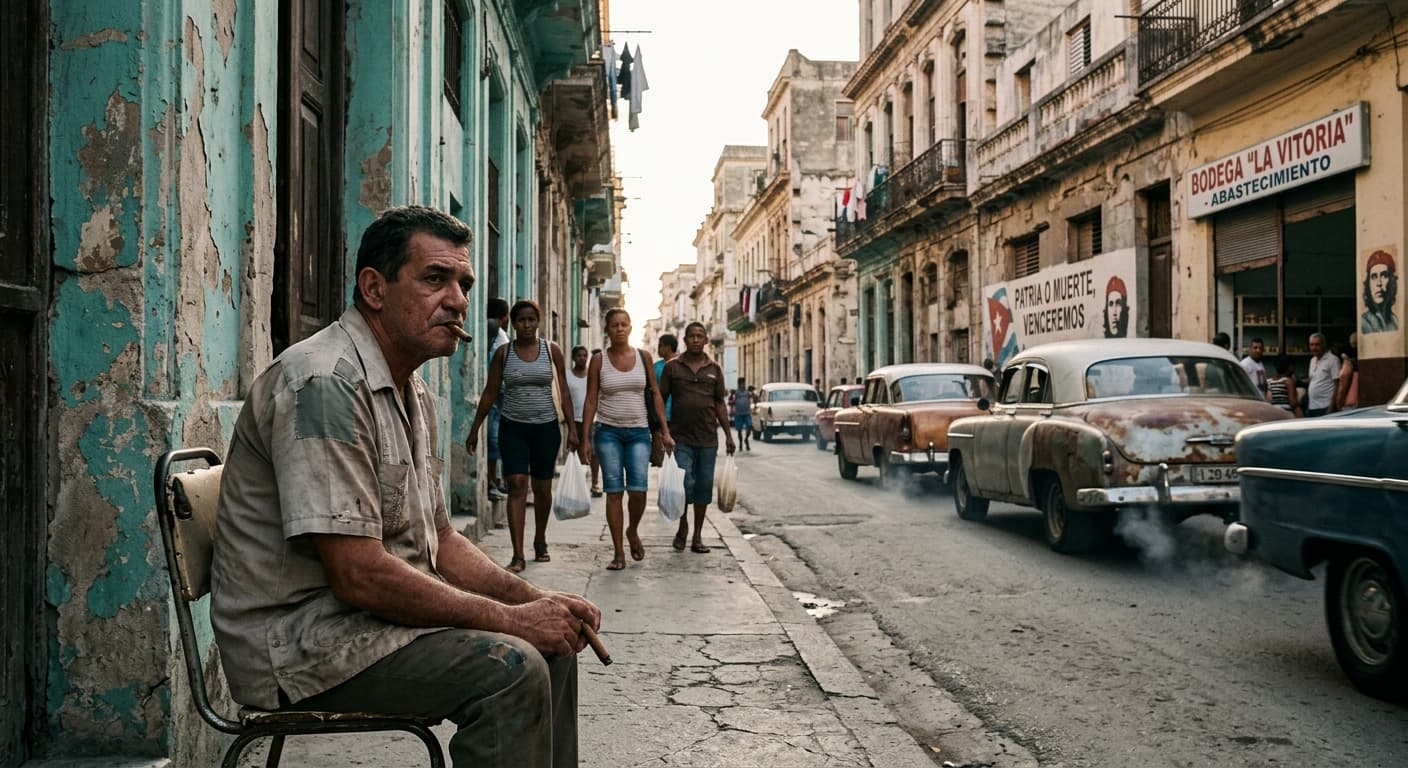
Cuba Under Maximum Pressure: The Economic Siege That May Backfire
Trump's EO 14404 sanctions, Raúl Castro's indictment and a de-facto oil blockade have crashed Cuba's economy. Regime collapse looks close — and unwinnable.
On May 1, 2026, President Donald Trump signed Executive Order 14404, layering a new International Emergency Economic Powers Act (IEEPA) sanctions regime on top of the 1960s Cuban embargo — and giving Washington, for the first time, the legal architecture to sanction any foreign bank that clears a dollar for Havana. The maximum-pressure campaign is now succeeding on its stated economic terms and failing on its political ones: Cuba's GDP is contracting for a fifth consecutive year, its grid is dark for most of the day, and yet Miguel Díaz-Canel and the military conglomerate GAESA are more entrenched, not less — and quietly closer to Beijing than at any time since the 1990s. That gap between economic effect and political result is the story.
The lede is the leverage. According to Cuba's national statistics office, foreign tourist arrivals fell 58.4% year-on-year in the first five months of 2026, per BBC News. The Economist Intelligence Unit forecasts a further
7.2% GDP contraction in 2026, on top of a 23% cumulative decline since 2019. And on paper, the White House is winning — Cuba is out of oil, out of tourists, and out of allies willing to challenge the tariff threat that keeps tankers away.
But the political dividend has not arrived. Díaz-Canel remains in Havana; Raúl Castro, now under a U.S. murder indictment, made a defiant public appearance in June; and Beijing, not Miami, is filling the humanitarian gap. That is the paradox the Trump administration has yet to answer — and the one this piece dissects.
The legal architecture: how EO 14404 changed the game
The pre-2026 embargo, run under the Cuban Assets Control Regulations (CACR) and the 1917 Trading with the Enemy Act, was a jurisdictional regime — it applied to U.S. persons and dollar-based transactions. Executive Order 14404, by contrast, is built on IEEPA and gives Treasury and State the authority to designate any foreign person "operating in" Cuba's energy, defence, mining, financial or security sectors, and to hit foreign financial institutions that facilitate "significant transactions" with blocked persons. The text of the executive order, published by the U.S. Office of Foreign Assets Control, reads more like the Iran or Russia templates than the traditional Cuba playbook.
Per OFAC's own FAQ 1251, EO 14404 "broadens U.S. sanctions on Cuba to include authorizing sanctions on non-Cuban foreign persons for providing support to Cuba and on foreign financial institutions for conducting or facilitating significant transactions." In plain English: this is the first Cuba sanctions program with real secondary-sanctions teeth. It is what turned the January 2026 fuel embargo — announced under EO 14380 — from an aspiration into a working blockade.
The mechanism was demonstrated in June. On June 5, Treasury designated Díaz-Canel personally, an unprecedented step against a sitting head of state outside a war context, Al Jazeera reported. Six days later, Rubio's State Department blacklisted the state oil company
Unión Cuba-Petróleo, effectively locking Havana out of any refined-products market that touches the U.S. banking system.
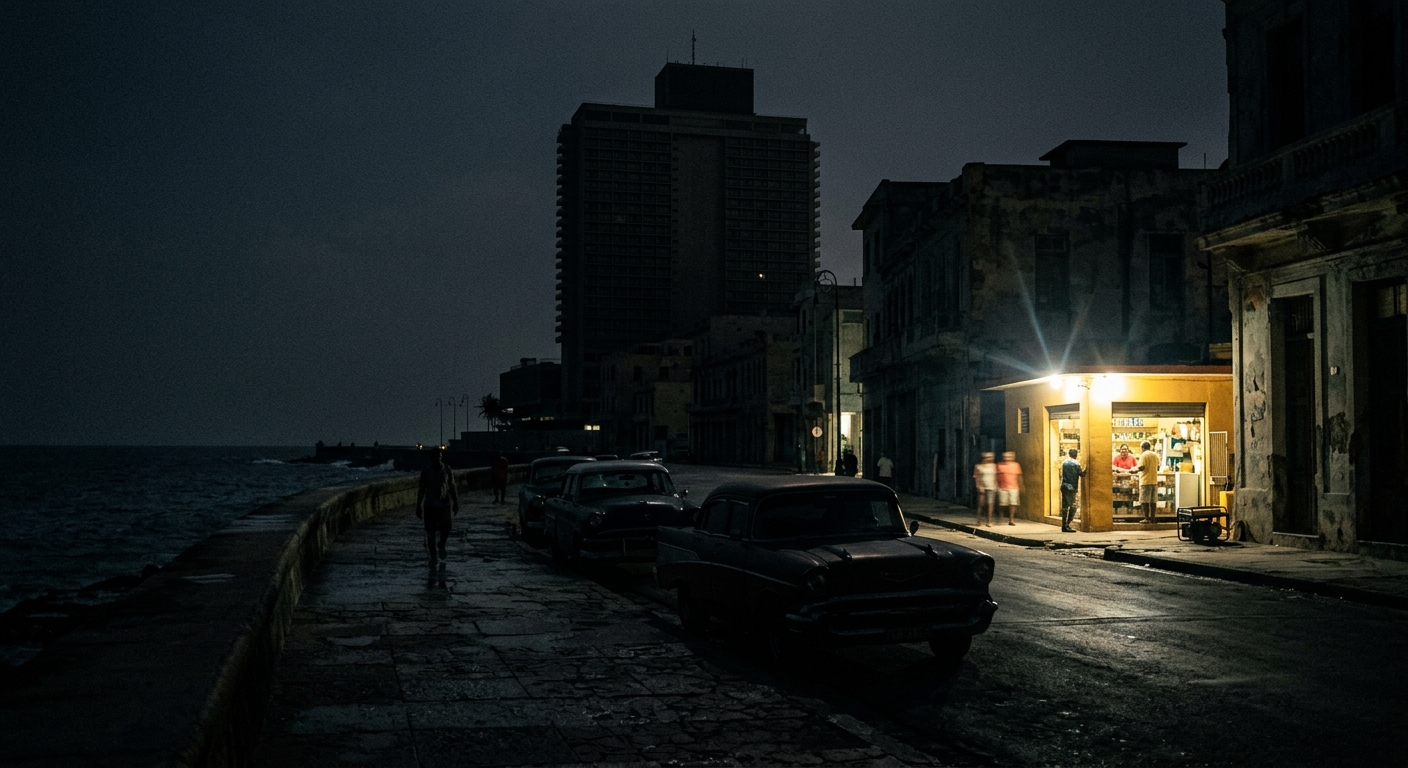
The economic result: a slow-motion Special Period
The macro damage is real and measurable. Since the January 3, 2026 removal of Nicolás Maduro cut off Cuba's roughly 30,000-barrel-per-day Venezuelan crude lifeline, only a single Russian tanker has reached the island, Al Jazeera reported. Black-market petrol has spiked to roughly $12 per litre in Havana —
400% above pre-blockade levels. The state has shifted much of its workforce to a four-day week; universities have gone hybrid; entire provinces experience 16-hour blackouts.
The Council on Foreign Relations frames the moment as Cuba's worst crisis since the Special Period of the 1990s: the population has fallen from over 11 million in 2021 to under nine million, according to Economist estimates it cites. Foreign income, per Western officials cited by
The Economist, came in at just $9 billion in 2025 — roughly a quarter of what Honduras earned. Restoring the grid would cost $8–10 billion and take three to five years, per estimates compiled by the
Future Center.
The knock-on effects extend to the sacraments. AFP found nuns in a Havana monastery rationing communion wafers because their electricity supply is often cut to two hours a day, per BBC. Cuban state media Cubadebate, cited in the same BBC dispatch, reported that childhood cancer survival rates fell from 85% to 65% between January and June 2026 — a figure Diplomat cannot independently verify and which carries the caveat that it originates with a state propaganda outlet.
Who benefits: Beijing, cautiously
Here is the second-order effect the "maximum pressure" architects underweight. Every ton of pressure Washington applies compresses Cuba further into China's orbit — because Beijing is the only capital with both the balance sheet and the political incentive to keep Havana upright.
On May 24, Díaz-Canel publicly thanked Beijing for a 60,000-tonne rice shipment, the first of what he called a strengthening "cherished bonds of friendship." China has also donated solar panels to help Cuba pivot its 60%-import-dependent energy mix off oil. In a joint statement, the Chinese foreign ministry has called for the U.S. to stop "coercion" against Havana, per BBC News.
That is not sentimentality. Cuba sits 90 miles from the U.S. mainland, controls the choke point between the Gulf and the Caribbean, and hosts existing Russian and Chinese signals-intelligence facilities. For Beijing, propping up Havana at marginal cost — a few rice ships, a few solar arrays — buys strategic real estate and a live demonstration case that U.S. sanctions can be blunted. Chatham House warned in May that Trump's maximum-pressure sanctions risk sliding into military action precisely because they do not, on their own, force capitulation.
Russia's response has been more limited but symbolically potent. Kremlin spokesman Dmitry Peskov, cited by Al Jazeera, said the pressure on Cuba "borders on violence." Moscow ran the one tanker that reached the island in six months.
Who loses: ordinary Cubans, and the Caribbean basin
The migration numbers are the leading indicator no policymaker in Washington wants to talk about. Brazilian federal police intercepted 108 Cubans in a single smuggling operation on June 10, Al Jazeera reported, and Brazil's Ministry of Justice reports that Cuban asylum claims exceeded 40,000 in 2025 — for the first time overtaking Venezuelan filings. CARICOM's chair, Jamaican Prime Minister Andrew Holness, warned in February that prolonged crisis conditions "will affect migration, security, and economic stability across the Caribbean basin," per CFR.
The Council on Foreign Relations also flags an awkward internal contradiction inside the White House: the same administration whose 2024 mandate was built on ending irregular migration is running the policy most likely to trigger the largest Caribbean exodus since Mariel.
The International Crisis Group was bluntest. Writing in June, it warned: "the path toward ever greater use of coercive power by the U.S. risks weakening state institutions without producing a viable transition, as well as provoking a violent breakdown of political order on the island." CSIS, in an April scenario paper, warned that regime collapse would trigger "a major exodus from the island" and leave roughly 300,000 elderly Cubans living alone with even more acute shortages.
The diplomatic isolation of the pressure campaign
The world does not endorse this policy. On October 29, 2025, the UN General Assembly adopted its 33rd consecutive resolution demanding an end to the U.S. embargo, by 165 votes to seven, with 12 abstentions. Only Argentina, Hungary, Israel, North Macedonia, Paraguay, Ukraine and the United States voted against. The "no" bloc grew — up from just two votes (U.S. and Israel) in previous years — reflecting what Cuban Foreign Minister Bruno Rodríguez
described from the UN rostrum as "brutal and unprecedented" State Department pressure to flip votes.
But the vote is non-binding, and Rubio has made clear it does not constrain policy. In late May, per Al Jazeera, Rubio told reporters that the prospect of a diplomatic settlement was "not high" and that Cuba's "economic system doesn't work. It's broken, and you can't fix it with the current political system that's in place."
That is the doctrine in one line: pressure until the political system breaks. The evidence so far suggests the economic system breaks first — and the political one doesn't follow.
What the administration actually wants — and doesn't
The New York Times and Al Jazeera report that the White House has floated Díaz-Canel's removal as a precondition for sanctions relief; Cuba has publicly rejected the demand. CFR's Will Freeman argues the more probable near-term outcome is "regime management" rather than wholesale change — pushing GAESA aside in favour of a military-linked technocracy more open to private and diaspora investment. Rubio has offered $100 million in humanitarian aid conditioned on "meaningful reforms," which Havana has partly accepted in principle while rejecting the demand that aid bypass GAESA.
The military dimension raises the stakes further. The USS Nimitz arrived in the Caribbean in May; Defense Secretary Pete Hegseth visited Guantánamo the same month; and Axios, citing classified intelligence, reported that Cuba had acquired 300 drones and was discussing strikes on Guantánamo and Key West — a claim Havana denies and which no independent analyst has corroborated. Trump himself said on May 22 he was "happy" to be "the one that does it," per Al Jazeera.
Diplomat View
The economic siege is working on impact and failing on strategy. Cuba is running out of everything except leverage-holders willing to keep the regime alive at low cost — chiefly Beijing, secondarily Moscow. The specific, falsifiable call: Díaz-Canel will still be in office on January 20, 2027, and Cuba's oil imports will be higher, not lower, than in July 2026 — because China's solar-and-food subsidy, combined with intermittent Russian tanker calls that Washington tolerates to avoid a Russia crisis, will stabilise the floor short of collapse. What would revise this forecast: a genuine internal coup within the Cuban armed forces, a second island-wide protest wave large enough to fracture GAESA, or a U.S. secondary-sanctions action against a major Chinese state bank over Cuba transactions — the last of which would force Beijing to choose. Absent those, maximum pressure delivers humanitarian catastrophe and a strategic gift to China, without the political transition it was designed to force.
What to watch
- August–October 2026: Hurricane season stress-test on Cuba's fuel-starved grid. A single major storm could trigger the collapse scenario CSIS is modelling.
- October 2026: The 34th UN General Assembly embargo vote — watch whether the U.S. "no" bloc expands further, especially among EU accession states.
- November 3, 2026: U.S. midterm elections. The Cuban-American vote in Florida is the political constituency this policy is built for; a Republican underperformance would shift the calculus on the military option.
- January 20, 2027: One year into EO 14380. If Díaz-Canel is still in Havana, the "maximum pressure" theory of change has failed on its own terms.
Cuba is the test case for whether IEEPA-era secondary sanctions can move an entrenched adversary 90 miles from Miami. The evidence so far says they can starve it, isolate it, and push it eastward — but not, on their own, overthrow it. Which leaves Washington with the same choice every previous administration faced, only sharper: negotiate with a weakened regime, or move to the military option the White House now openly floats. The last administration to face that choice blinked. This one is still deciding.
Discover more
Global Politics
US-Iran Tensions Rise
Tensions escalate in the Strait of Hormuz as Iran and the US clash over maritime control, with a ceasefire hinging on a contested MoU paragraph.

Global Politics
US Proposes Pakistan for Iran Talks Amid Ties
The US-Iran negotiations are now mediated by Pakistan, highlighting Islamabad's strategic role and the implications for regional diplomacy.
Global Politics
Xi Jinping Calls China-Russia Ties 'Precious'
Xi Jinping's description of China-Russia ties as 'precious' reflects a strategic imbalance, with Beijing dictating terms in the partnership.

Conflict & Security
Drone Warfare Killing Aid Workers at Unprec
Over 1,000 humanitarian workers killed in three years as cheap armed drones collapse legal protections. Gaza, Sudan, Ukraine, and DRC see deliberate targeting of aid convoys and hospitals with zero prosecutions.