Critical Mineral Supply Chains More Concentr
IEA data shows concentration deepening despite $200B in commitments
Model Diplomat8 min readGlobal
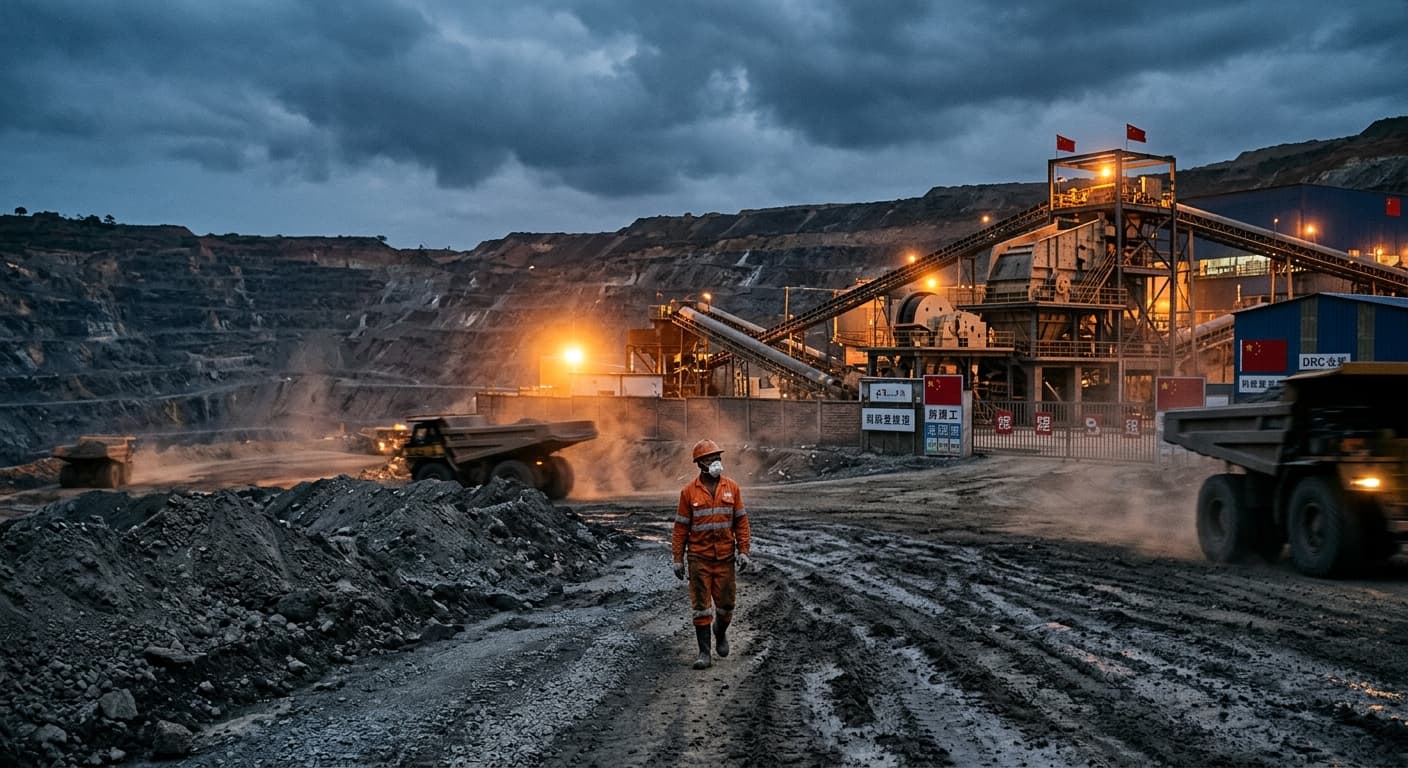
Four Years of De-Risking Later, Critical Mineral Supply Chains Are More Concentrated Than Ever
The IEA's 2026 outlook finds the top three refining nations now control 86% of key mineral processing, up from 82% in 2020. Low prices, not geology, are locking in China's dominance — and there is no quick policy fix.
Move the sentence starting 'On July 17...' to the very beginning of the piece. Despite an estimated $200 billion in government commitments, 55 bilateral minerals agreements, and the creation of multiple new multilateral forums, concentration in critical mineral supply chains has deepened since 2020. The top three refining nations now account for 86% of key energy mineral processing, up from 82% four years earlier, according to the IEA's 2026 data. Markets alone, the report concludes, will not deliver the diversification that governments have promised — and the window for orderly diversification is narrowing.
The growth of China's grip is most visible at the processing stage, not in mining. That distinction matters enormously.
The Midstream Chokehold
Mining gets the headlines. Processing holds the leverage. The IEA found the average processing market share of the top three refining nations reached 86%, up from 82% in 2020. Among the top three producers specifically, concentration rose to nearly 90% for copper, lithium, nickel, cobalt, graphite, and rare earths — even accounting for all planned projects worldwide.
The IEA's earlier Congressional testimony frames the structural problem precisely:
For lithium, cobalt and rare earth elements, the world's top three producing nations control well over three-quarters of global output. In some cases, a single country is responsible for around half of worldwide production. The level of concentration is even higher for processing operations, where China has a strong presence across the board.
China refines approximately 90% of rare earth elements, 74% of lithium and cobalt, roughly 100% of graphite, and 35% of nickel — a figure that rises sharply when Chinese-owned operations in Indonesia are counted European Parliament. For 19 of the 20 strategic minerals analyzed by the IEA, China is the leading refiner, with an average market share of roughly 70%
Atlantic Council.
This is not an accident of geology. China holds relatively modest reserves of many minerals it dominates — it simply invested decades in building the separation technology, the solvent-extraction infrastructure, and the skilled workforce that turns ore into usable metal. The Royal United Services Institute notes that China accounts for approximately 91% of global rare earth separation and metal production, and around 94% of sintered neodymium-iron-boron permanent magnet manufacturing — a share that has actually increased over the past decade even as its mining share declined RUSI.
The Trap of Low Prices
Here is the central paradox of the 2026 outlook: the market appears well-supplied. Prices for lithium, cobalt, and nickel have slumped from their 2021–2022 peaks. Lithium dropped over 80% in 2023 alone. That should be good news for clean-energy deployment. It is also the mechanism locking in concentration.
Low prices deter investment in new projects — and the projects most affected are precisely the ones that would diversify supply. New entrants face capital costs roughly 50% higher than incumbent Chinese refiners, the IEA found Financial Times. Projects in the pipeline cannot secure financing at current spot prices. As one CSIS analysis put it, "investors will not finance expensive new mines and processing facilities unless they can see credible, long-term buyers on the other end"
CSIS. And at present, the United States represents a thin sliver of demand for the very minerals it has labeled strategic — just 4.5% of global nickel consumption, 3.6% of cobalt, and 1.7% of rare earths.
The demand-supply mismatch has a second effect: China's state-backed firms are the only players able to operate through a down cycle. While Western juniors shelve projects and private capital retreats, Chinese state-backed production continues — effectively consolidating market share by default. The CSIS has documented how Chinese government-backed ramp-up of Indonesian nickel production forced mine closures in Australia and New Caledonia CSIS.
The lead times make this dynamic self-reinforcing. The average mine now takes roughly 18 years to move from discovery to first production, according to IEA data cited by the Brookings Institution — and that timeline has been lengthening, not shortening Brookings. Every year that investment is deferred pushes diversification further into the future, well past the dates when demand spikes from electric vehicles, data centers, and grid buildout will arrive.
The Numbers That Should Alarm Policymakers
The IMF's April 2026 World Economic Outlook modeled what it would take to reduce U.S. downstream rare-earth dependence to 25% self-sufficiency by 2035. The conclusion: 'Sizable interventions would be needed to attain the 25 percent self-sufficiency target...'
; for example, in the unilateral scenario, the investment subsidy must cover 77.2 percent of total investment costs.
The fiscal cost under that scenario reached 141% of the annual U.S. rare-earth market — roughly $1.2 billion — over the first decade IMF. Coordinated action among importing countries reduced the cost but did not eliminate it. Processing, not mining, was the binding constraint.
Now consider that this figure covers only rare earths, a market worth roughly $6 billion globally. Extrapolate to lithium, cobalt, graphite, nickel, gallium, and germanium — each with its own unique chemistry, processing requirements, and geopolitical footprint — and the scale of the financing gap becomes visible. The IEA itself has estimated that global investment in critical mineral mining needs to reach $360–450 billion by 2030, and processing investment $90–210 billion. Currently anticipated investments cover only about half of the mining need CSIS.
Who Wins, Who Loses
China is the unambiguous beneficiary of the current trajectory. Its export control posture tells the story: since July 2023, Beijing has imposed restrictions on at least 16 key minerals and alloys. The December 2024 controls were the most stringent yet — explicitly targeting the United States with a ban on gallium, germanium, and antimony shipments, and asserting long-arm jurisdiction that made re-export through third countries illegal CSIS. Chinese exports of unwrought gallium fell 94% in 2025 and have not recovered.
Resource-rich developing economies — the Democratic Republic of Congo for cobalt, Indonesia for nickel, Argentina and Chile for lithium, Mozambique and Tanzania for graphite — face a fork. Without Western offtake commitments and processing investment, their raw minerals will continue flowing to Chinese refineries by default, according to data compiled by the Brookings Institution Brookings. The IEA estimates that if African countries could successfully move up the value chain, the continent's mineral market value would increase by nearly three-quarters from today's $120 billion by 2040
Brookings. That outcome depends on infrastructure, governance, and capital that is currently absent.
U.S. and European manufacturers of electric vehicles, wind turbines, semiconductors, and defense systems remain the most exposed downstream. The EU Parliamentary Research Service concluded that China's midstream bottleneck "allows dominant nations to threaten downstream manufacturing across strategic sectors such as defence, semiconductors, space, and electromobility" European Parliament. In April 2025, when China restricted seven heavy rare earth minerals, Japanese automakers Nissan and Suzuki reported supply disruptions — Suzuki suspended production of its Swift model.
The FORGE Architecture and Its Limits
The policy response has been vigorous but asymmetric. At February's Critical Minerals Ministerial, 55 allied delegations launched the Forum on Resource Geostrategic Engagement (FORGE), succeeding the Minerals Security Partnership. The G7, at its June 15 summit in France, endorsed a measurable target: reducing rare earth and permanent magnet dependence on any single non-G7 supplier to below 60% by 2030, with a longer-term goal of 50% CSIS.
The IEA's 2026 report implicitly questions whether these timelines are achievable. The policy architecture has focused overwhelmingly on supply — on permitting mines, subsidizing processing, stockpiling materials. What is missing, the CSIS argues, is the demand side: "the United States has treated critical minerals primarily as a supply problem, when it is equally a demand problem" CSIS. Without pooled offtake commitments from FORGE members, without price floors or contracts-for-difference that make diversification projects bankable, the supply announced in communiqués will not materialize on the ground.
The IEA's own recommendations point toward price-stabilization mechanisms, demand guarantees, and incentives tied to environmental and social standards. Targeted incentives for cleaner nickel production alone could reduce global market concentration by 7% within a decade, the 2026 outlook found Financial Times. These are technically feasible interventions. They are also politically expensive — requiring governments to guarantee prices above spot-market levels for years, essentially asking taxpayers to pay a premium now to avoid a much larger disruption later.
Merge the 'What to Watch' bullets into the preceding 'Diplomat View' analysis and end on the current final sentence: 'Without it, 2030 will arrive with concentration higher than it is today — and no amount of diplomatic communiqués will matter.'
- October 2026 U.S.-China trade truce review: The one-year suspension of the December 2024 gallium/germanium ban expires this fall. Chinese exports to the U.S. have not resumed meaningfully despite the truce. A re-imposition would immediately stress semiconductor and defense supply chains.
- FORGE demand-aggregation framework: The Forum is expected to deliver concrete offtake coordination mechanisms by year-end. Whether participating governments agree to binding sourcing commitments — modeled on NATO's defense-spending pledge — will determine whether FORGE is a talking shop or a market-moving institution.
- Indonesia's nickel export policy: Jakarta's evolving restrictions on raw nickel exports continue to shape global refining geography. Any tightening would accelerate the scramble for alternative processing capacity.
- Mid-2027 G7 dependency review: The June 2026 summit tasked ministers with establishing clear dependency-reduction targets for all critical minerals. Those numbers, when published, will be the first measurable benchmark against which to judge whether the diversification effort is working.
Diplomat View
The IEA's 2026 report confirms what the data have been signaling quietly for two years: the West is losing the diversification race, and losing it not on geology or technology but on market structure. Low prices — the very condition that makes the energy transition affordable — are starving the alternative supply chains that would make it secure. Breaking that cycle without distorting markets beyond recognition is the hardest policy problem in the minerals space. It will not be solved by more bilateral agreements or more mining permits. It requires governments to become credible buyers of last resort — to guarantee demand at a scale that makes private capital move. China did this over three decades through state-directed purchasing and integrated industrial policy. The West is four years into its attempt to replicate that architecture. The gap is widening. The specific condition that would change the forecast: a coordinated FORGE offtake mechanism with price-floor provisions, in place by mid-2027. Without it, 2030 will arrive with concentration higher than it is today — and no amount of diplomatic communiqués will matter.
The bottom line: Critical mineral supply chains are more concentrated now than when the IEA first raised the alarm in 2021, because low prices have deterred the very investment needed to diversify them. The refiners that dominate the market — overwhelmingly Chinese — can operate through a down cycle that Western entrants cannot survive. Until allied governments pool their purchasing power and commit to binding offtake at prices that justify new processing capacity, the strategic vulnerability will keep growing, regardless of what is announced at summits.
Discover more

US Politics
House Ethics Committee Pushes Sexual Miscond.
The House Ethics Committee has shifted responsibility for sexual harassment settlement records to the Office of Congressional Workplace Rights, complicating disclosure efforts.
India
700 Activists Accuse PM Modi of MCC Breach
Over 700 activists allege PM Modi breached election code with a televised address attacking opposition parties just before state elections.

US Politics
SNAP Food Assistance Faces Legal Challenges
In 2026, SNAP faces stricter eligibility rules and mounting legal challenges, threatening food assistance for the millions of Americans who rely on the program.

Economics
Fed's Amex AML order puts correspondent banking on notice
Federal Reserve's Amex AML order requires board-level controls and a 90-day plan; OCC fined the bank $350 million over enterprise-wide deficiencies.