Coupang penalty tests Korean sovereignty vs.
Seoul's record penalties on Coupang trigger US trade retaliation
Model Diplomat8 min readEast Asia
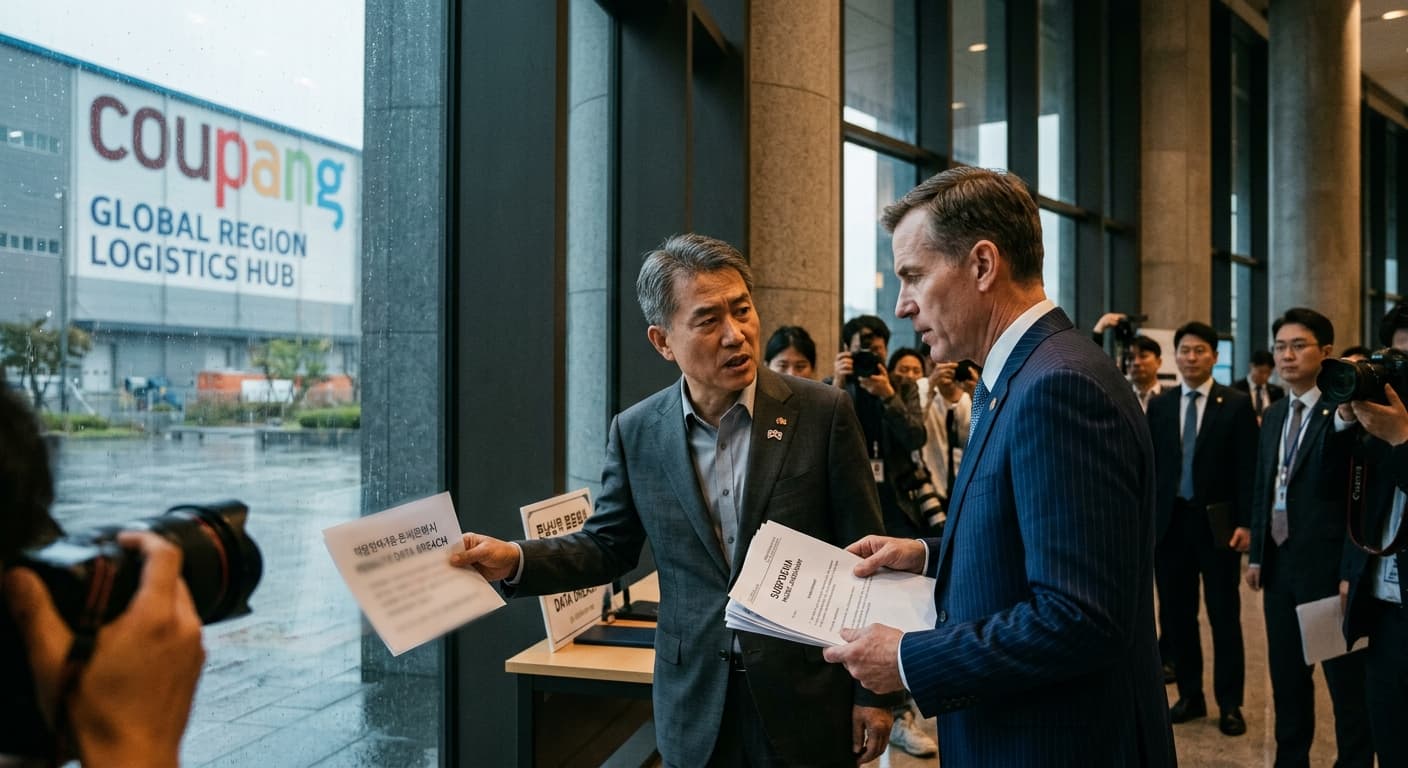
Coupang's near-trillion-won penalty stack tests the limits of Korean regulatory sovereignty against US trade leverage
South Korea has stacked a record 624.7-billion-won privacy fine, a 300-billion-won special tax assessment, and pending antitrust action on Coupang—totals approaching 1 trillion won and triggering a House Judiciary subpoena and a Section 301 review from Washington that together redefine the boundary between domestic digital enforcement and cross-border trade leverage.
South Korea's National Tax Service notified Coupang on July 9, 2026, of approximately 300 billion won in back taxes after a six-month special audit examining related-party transactions between Coupang and its fulfillment subsidiary, as well as cross-border dealings with US parent Coupang Inc., according to Edaily. That figure compounds an already extraordinary penalty exposure: the Personal Information Protection Commission's 624.68 billion won fine imposed on June 11, 2026—the largest data-breach penalty in Korean history—and a Fair Trade Commission antitrust case on Coupang's Wow Membership bundling that lawmakers estimate could reach hundreds of billions more, according to
Edaily. The cumulative effect approaches 1 trillion won, roughly equal to Coupang's entire 2025 operating profit of 679 billion won. This is not merely a corporate compliance reckoning; it is the most aggressive assertion of digital regulatory sovereignty Seoul has mounted against a US-listed company, and Washington has already moved from rhetoric to subpoenas and trade-policy retaliation.
The case sits at the intersection of three pressure points defining the current tech-policy order: aggressive domestic data enforcement, antitrust scrutiny of platform bundling, and the Trump administration's willingness to treat foreign regulatory actions against American companies as trade barriers. The outcome will shape how much regulatory latitude middle powers retain when their enforcement targets happen to be incorporated in Delaware.
The penalty architecture
The PIPC's June 11 decision broke down into two components: 423.58 billion won for the data breach itself, which exposed personal information of approximately 37.55 million users including names, emails, phone numbers, and delivery addresses, and 201.17 billion won for the unauthorized collection of roughly 11.17 million users' online activity records from third-party websites and apps, according to BBC News. The regulator found the breach resulted from basic security failures—"poor management of authentication signing keys and access controls"—not sophisticated hacking, as PIPC Chairperson Song Kyung-hee told a briefing reported by
Al Jazeera. Song said Coupang "delayed breach notifications," depriving affected individuals of the chance to prevent secondary harm.
The breach began as early as June 2025 through an overseas server, according to Coupang's own SEC disclosure, but was not detected until November 18, when the company initially reported only 4,500 affected accounts. By December 16, 2025, Coupang filed a Form 8-K acknowledging up to 33 million accounts were compromised, according to the securities class action complaint filed January 6, 2026, in the US District Court for the Western District of Washington. The Ministry of Science and ICT's joint public-private investigation team later confirmed 33.67 million records were leaked through a vulnerability in Coupang's "My Info" edit page, according to BBC Korean. A former employee, identified as a Chinese national, allegedly stole a security key to gain unauthorized access, according to
Al Jazeera.
The tax assessment, confirmed July 9, stems from the National Tax Service's special audit covering three years of financials, examining whether related-party pricing between Coupang and Coupang Fulfillment Services constituted improper profit shifting, and whether cross-border transfers involving the US parent involved offshore tax evasion, according to Edaily. The approximately 300 billion won figure exceeds what industry sources described as typical for large-enterprise tax investigations.
The third pillar—the FTC antitrust case—remains pending but is politically charged. The KFTC is investigating Coupang's Wow Membership program and the bundling of Coupang Eats and Coupang Play, practices the commission has characterized as potentially anticompetitive self-preferencing. A 2025 academic survey of Korean competition law noted the KFTC's Coupang case as an example of "deceptive self-preferencing" enforcement, part of a broader platform-competition agenda modeled on the EU's Digital Markets Act, according to SSRN.
The bilateral escalation
What transforms this from a corporate compliance story into a geopolitical one is the speed and intensity of the US response. On February 5, 2026, the House Judiciary Committee—led by Republicans—issued a subpoena to Coupang's Chief Administrative Officer and General Counsel Harold Rogers, demanding communications with the Korean government and a deposition. The committee's letter accused South Korea of "discriminatory treatment, unfair enforcement practices, and even the threat of criminal penalties" against Coupang, and cited President Lee Jae Myung's call for aggressive penalties as evidence of political motivation, according to the House Judiciary Committee.
The committee's framing is pointed: it characterizes Korea's regulatory actions as part of a "campaign against innovative American-owned companies," explicitly invoking the Trump administration's position that it "will not tolerate foreign efforts to go after digital service providers that are more burdensome and restrictive on US companies." The letter references a recent US-South Korea trade agreement provision requiring non-discriminatory treatment, arguing Seoul is violating that commitment. It also notes that the Korean government sent 400 investigators across 11 agencies to conduct 150 face-to-face meetings, 200 interviews, and over 1,100 document requests—"despite the fact that the breach only resulted in limited, non-sensitive information being retained for around 3,000 customers that has since been recovered."
The Congressional Research Service confirmed in a February 2026 briefing that "USTR reportedly is preparing to launch broad unfair trade practices investigations under Section 301 of the Trade Act of 1974 and is likely to include South Korea's digital trade policies," according to CRS. The KORUS joint committee meeting scheduled for December 2025 was cancelled by USTR over concerns about the Coupang investigation and has not been rescheduled.
A December 16, 2025 House Judiciary Committee hearing titled "Anti-American Antitrust: How Foreign Governments Target U.S. Businesses" featured testimony highlighting what witnesses characterized as an enforcement disparity: Korean regulators issued relatively minor fines to Chinese firms AliExpress ($1.4 million) and Temu ($978,000) for illegal data transfers to China, while mounting what one witness called an "all-out assault" on Coupang for a non-intentional leak, according to House Judiciary Committee QFRs. On July 1, 2026, the committee released an investigative report accusing Seoul of exceeding "the usual scope of commercial and legal cooperation" in its Coupang probe, according to
VNA.
The corporate identity question
A central tension runs through the entire dispute: Is Coupang a Korean company or an American one? The answer determines whether Seoul's actions constitute domestic regulation or cross-border discrimination. Coupang was founded in Seoul by Korean-American entrepreneur Bom Kim, moved its headquarters to Seattle in 2022, and is listed on the New York Stock Exchange—but generates the overwhelming majority of its revenue in Korea and controls roughly 40 percent of Korean e-commerce logistics, according to IM Securities data cited by Al Jazeera.
Korean lawmakers have pushed back firmly against US pressure. In April 2026, nearly 100 National Assembly members sent a joint letter warning against "undue pressure" from US politicians regarding Seoul's investigation. Representative Kim Hyun-jung of the Democratic Party stated on July 7, 2026, that the penalties were not excessive given the breach's scale and social impact, according to Sankyung Today. The National Assembly's Legislation and Judiciary Committee conducted hearings calling Coupang representatives to testify, and the National Assembly Research Service published a June 2026 report analyzing the Coupang case through the lens of platform market structure and competition policy, according to
NARS.
The Financial Times has noted that Coupang "once called itself a 'proud Korean company' but lately, it is emphasising it is an American" entity, leveraging its US domicile to lobby Washington against Korean probes, according to FT. This jurisdictional arbitrage is precisely what Korean regulators find objectionable—and what US lawmakers cite as evidence of discriminatory targeting.
Financial and operational fallout
The penalties have already eroded Coupang's profitability. Q1 2026 results showed a $242 million operating loss, reversing a $154 million operating profit in the same quarter a year earlier, according to FT. Coupang increased its information-security investment by 51 percent year-over-year to 134.9 billion won in 2025, adding 75 percent more dedicated security personnel, according to
LiveBiz. Chairman Bom Kim issued his first verbal apology on the Q4 2025 earnings call on February 27, 2026, saying the company had failed to meet customer expectations, according to
DDaily.
Coupang has signaled it will challenge the PIPC fine in court, saying its "proactive measures to prevent secondary harm" and "explanations based on clear facts were not sufficiently reflected" in the decision, according to Al Jazeera. A securities class action filed January 6, 2026, in the Western District of Washington alleges Coupang made false and misleading statements about its cybersecurity practices between May 7 and December 16, 2025, according to the
court filing.
The broader regulatory trajectory
The Coupang case has accelerated a broader tightening of Korea's data-protection regime. In June 2026, the National Assembly passed amendments to the Personal Information Protection Act raising the maximum fine for data breaches from 3 percent of revenue to 10 percent, effective September 2026. The amendment will not apply retroactively to the Coupang case, but it signals Seoul's intent to escalate penalties for future violations, according to BBC Korean. The PIPC also issued a presidential decree strengthening CPO independence requirements and breach-prevention obligations.
The KFTC's parallel push for DMA-style platform competition legislation, which would target market-dominant platforms with thresholds of 15 trillion won market capitalization, 3 trillion won annual revenue, and 10 million monthly users, would capture Coupang alongside Google, Meta, Microsoft, Apple, Naver, and Kakao, according to CSIS. The National Bureau of Asian Research, cited by the House Judiciary Committee, concluded that "it is clear that U.S. firms are the ones South Korea seeks to target" because "the KFTC exempts smaller firms and, in effect, Chinese rivals," according to the
House Judiciary Committee.
The Bottom Line
South Korea's multi-regulator penalty stack against Coupang represents a deliberate assertion of digital regulatory sovereignty that has collided directly with the Trump administration's trade-enforcement framework. The decisive question is not whether the penalties are proportionate—it is whether a middle-power regulator can enforce its data and competition laws against a US-domiciled company without triggering Section 301 retaliation. If USTR proceeds with the investigation, the Coupang case will become the template for how Washington treats all foreign digital regulation of American platforms. If Seoul holds and the penalties survive judicial review, it will signal that regulatory sovereignty over domestic data remains enforceable even against trade-pressure countermeasures.
What to watch:
- USTR's Section 301 investigation decision, expected by fall 2026
- Coupang's court challenge of the PIPC fine, filing deadline within 90 days of June 11 decision
- KFTC's antitrust ruling on Wow Membership bundling, expected Q3–Q4 2026
- Rescheduling of the cancelled KORUS joint committee meeting
Discover more

US Politics
SNAP Food Assistance Faces Legal Challenges
In 2026, SNAP faces stricter eligibility rules and mounting legal challenges, threatening food assistance for the millions of Americans who rely on the program.
US Politics
Congress Targets AI Chatbot Access for Terror
The House passed the Generative AI Terrorism Risk Assessment Act, focusing on AI's role in terrorism and potential surveillance implications.
Global Politics
Trump's Conflicting Messages on Iran War
Trump's mixed messages on Iran reflect a strategy of audience management, benefiting Tehran amid a complex geopolitical landscape.

Economics
Fed's Amex AML order puts correspondent banking on notice
Federal Reserve's Amex AML order requires board-level controls and a 90-day plan; OCC fined the bank $350 million over enterprise-wide deficiencies.