Colombia's Localization Strategy Faces Crisis
Colombia's humanitarian strategy is tested by rising displacement and funding cuts.
Model Diplomat7 min readLatin America
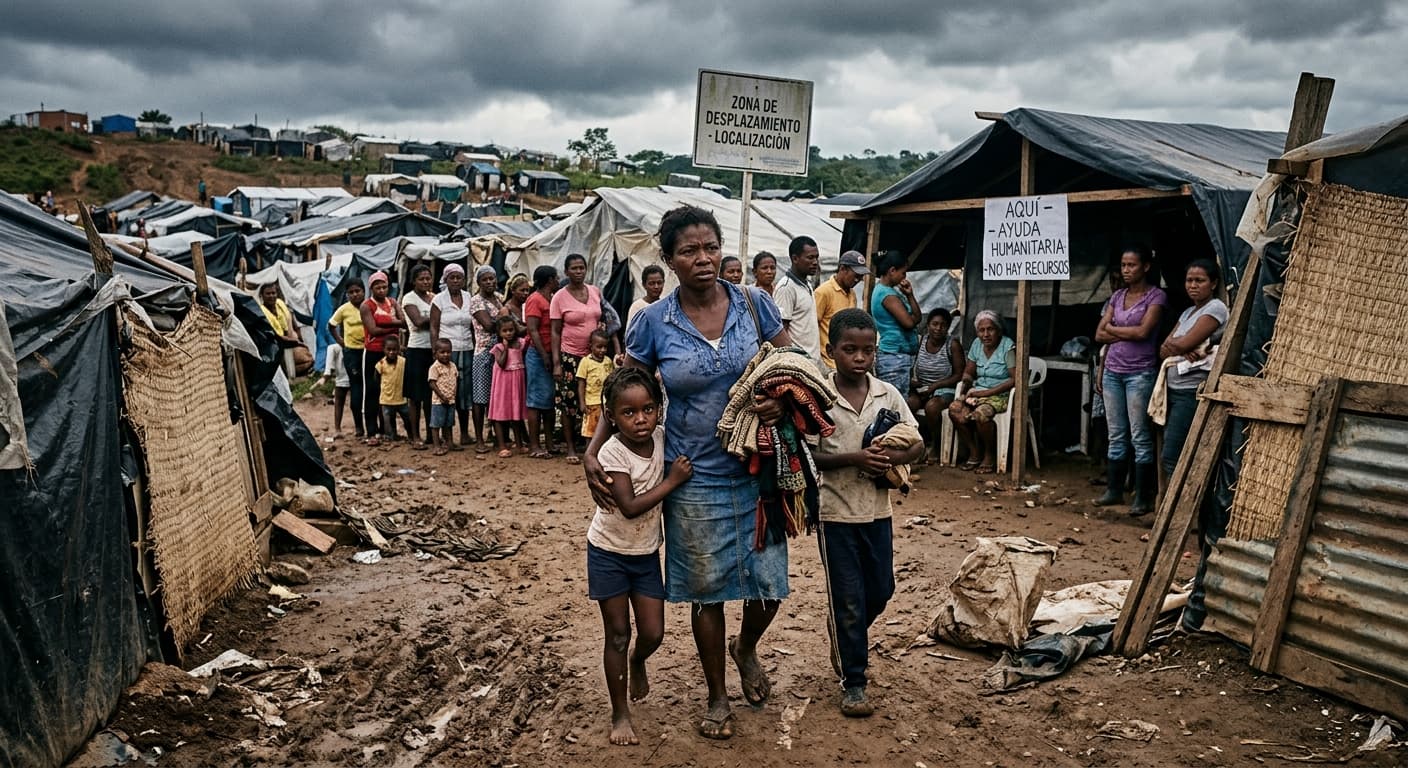
Colombia's localization bet meets a doubled displacement crisis
Colombia's humanitarian Localization Strategy is being stress-tested by a 2025 displacement surge and a 28%-funded appeal. Who actually benefits?
The EVIDEM Consortium's new Impact Report: Localization Strategy in Colombia, published in early July 2026 with European Union humanitarian funding, lands at the moment the strategy it evaluates is being asked to do something no localization pilot has done before: absorb a doubling of conflict displacement while its own donor base shrinks by more than half. The report's central claim — that Colombian NGOs, once equipped with information-management tools and coordination access, deliver faster and cheaper than the international system — is now less a policy preference than a budgetary necessity. In practice, the winners are a shortlist of Colombian NGOs cleared by UN due diligence; the losers are international implementing partners who spent a decade as the default intermediary between Brussels, Washington and Norte de Santander.
The evidence base — and what it actually claims
The Impact Report is the flagship deliverable of the EVIDEM Consortium — 3iS, IMPACT Initiatives and ACAPS — a 2023–2026 project financed by DG ECHO to make Colombia's humanitarian response evidence-based. According to 3iS, the report puts "hard evidence behind what field teams advocate for every day: empowering the national ecosystem of local actors is the fastest, most cost-effective strategy to mitigate human suffering." Its three operational findings are narrow but consequential: information deliverables built locally are more relevant and coordinated; trust inside Local Coordination Teams (ELCs) is the precondition for recognition of local NGOs; and community-driven primary data collection using free, low-bandwidth tools produces assessments the international system can actually use.
The document sits on top of a larger architecture. Colombia was chosen in 2023 as one of four pilot countries for the Inter-Agency Standing Committee's Flagship Initiative, and its Humanitarian Country Team (HCT) built a four-pillar Localization Strategy around it, as summarised on ReliefWeb. The July 2025
Flagship results publication from OCHA reported a "substantial increase in the number of national and local organizations participating in the humanitarian architecture" and declared the pilot a new operating model rather than an experiment.

The numbers behind the shift
The concrete data from OCHA's own primary tracking is more telling than any strategy document. The October–December 2024 Flagship update recorded 24 Colombian NGOs cleared through OCHA due diligence for the Colombia Humanitarian Fund, two Colombian Humanitarian Fund allocations totalling USD 3.5 million disbursed to 11 local-organization projects, a 50% increase in local NGO participation in the 2025 response plan, and a 160% jump in local participation in consultative workshops compared to 2023.
By 2025, the Regional Humanitarian Pooled Fund's Colombia window reached a symbolic milestone. According to OCHA's PRPC 2025 year-end financial summary, the fund financed six active projects, "100% led by national and local organizations," reaching roughly 12,000 people in territories where Local Coordination Teams had thin capacity. This is the pointed exception to a global picture in which — as
Development Initiatives figures cited by ORF show — direct funding to local actors fell to 1.2% of humanitarian assistance in 2022, the lowest since the Grand Bargain took effect.
The financial trap the strategy now has to escape
The problem is that the pool it draws from is collapsing. OCHA's FTS dashboard for the Colombia HRP shows the 2025 plan closed the year at USD 95.9 million against USD 342.3 million in requirements — coverage of 28%. Its own accompanying summary is blunt: the figure fell from 62% in 2024, a contraction that has forced organizations "to reprioritize the response and focus assistance on the most critical needs." Only 34% of emergencies tied to armed conflict and disasters were covered — a 45% year-on-year drop in response capacity.
That squeeze is the reason the HCT's Roadmap for the Humanitarian Reset, issued on 29 August 2025, matters more than any earlier strategy paper. It adds a fifth localization pillar — advocacy — and rewrites the 2026 Humanitarian Response Plan around a five-page national skeleton with local plans underneath. In 2026, the roadmap states, "national NGOs will take the lead in knowledge management and promote stronger local participation in coordination mechanisms." It also commits to a new mapping of NGOs — "including women's organizations" — to widen the pool of eligible recipients.
Read alongside the DG ECHO 2026 Humanitarian Implementation Plan for Colombia, the direction is unambiguous. Brussels is directing partners to prioritise "recently affected populations experiencing extreme vulnerability," remote ethnic and indigenous territories, and demonstrable access strategies — precisely the terrain where large internationals struggle and where trusted local NGOs already work. Every euro that shifts from an INGO overhead to a Colombian NGO grantee is a euro the shrinking envelope can still deliver on.
The demand side: 2025 was the worst year in a decade
The strategy is being tested against a genuine emergency, not an abstraction. The International Committee of the Red Cross in its May 2026 annual report called 2025 the year with the "worst humanitarian consequences" of the past decade. Individual displacement doubled to 235,619 people, with 42% concentrated in Norte de Santander. Mass-displacement events also doubled to more than 87,000 affected. Approximately 965 people were killed or injured by explosive devices, a 33% year-on-year increase. Community lockdowns imposed by armed groups nearly doubled.
The Catatumbo crisis, which erupted on 18 January 2025 when the ELN and the FARC dissident Frente 33 broke into open war over cocaine corridors, sits at the centre. Colombia's Fundación Ideas para la Paz reported in January 2026 that Norte de Santander's unified command counted 166 dead — six signatories of the 2016 peace accord and ten minors among them — and roughly 92,000 people forced from their homes over the first twelve months of the crisis. The Unidad para las Víctimas registered 105,203 new victims from Catatumbo alone between January and December 2025, per the Defensoría del Pueblo. A single UN pooled-fund allocation of USD 3.5 million cannot answer that; but a locally-led response mesh sitting inside those same municipalities, with data flows already wired to OCHA and DG ECHO, can absorb whatever donor money still arrives, faster.
The non-obvious angle: the reset is quietly writing INGOs out
The politically uncomfortable reading of the Impact Report is that Colombia is where the humanitarian sector is finally forced to do what the Grand Bargain has promised since 2016 — and the trigger is not conscience but bankruptcy. The
Carnegie Endowment framed the global picture in December 2025 as a "moment of truth" in which the collapse of the 2025 Global Humanitarian Overview appeal — priced at USD 29 billion — is forcing UN Emergency Relief Coordinator Tom Fletcher's "brutal choices" and a systemic pivot toward pooled funds and direct local grants.
Colombia is now the cleanest test case for that pivot. It has an organised Localization Working Group (GTLo) that has mapped more than 300 Colombian organizations, roughly 56% classified as national. It has a Regional Humanitarian Pooled Fund window channelling 100% of active allocations to national and local partners. It has a Reset Roadmap that formally reassigns knowledge management to Colombian NGOs. And it has an EU-funded evidence architecture — EVIDEM — designed specifically to certify that the resulting response is fast, cost-efficient and community-driven, according to the 3iS consortium page.
The counter-view is worth stating plainly. As IRIS's February 2026 interview with ALIMA's Moumouni Kinda argues, the share of humanitarian aid delivered directly to national actors has hovered between 1.5% and 4.7% globally since 2019 and dropped again in 2024–25. The reason is structural: donors trust actors who share their "cultural referents," and indirect costs are still routed to control mechanisms rather than institutional strengthening. Colombia's Country-Based Pooled Fund figures are impressive, but CBPFs remain 4% of total humanitarian aid worldwide. Localization works where donors both mandate it and accept the risk profile — and where a domestic NGO ecosystem is thick enough to absorb the money, as the Council on Foreign Relations has warned in the context of
Colombia's own state-capacity gaps.
There is also a political horizon. Colombia's 8 March 2026 legislative elections and the presidential race that follows will replace Gustavo Petro; the BBC's May 2026 coverage notes forced displacement rose 300% between 2024 and 2025, and Petro's advisor Isabelita Mercado Pineda called the surge unprecedented in two decades. Whichever coalition takes the presidency in August 2027 will inherit a humanitarian architecture in which Colombian NGOs — not Bogotá, not the UN — hold the operational relationships in the conflict-affected periphery.
What to watch
- Colombia HRP 2026 launch (Q1 2026, if not already published): whether the promised five-page national plan with local plans underneath materialises, and what share of the appeal is designated for direct or pooled-fund local allocation.
- Regional Humanitarian Pooled Fund allocation reports (rolling, 2026): whether the 100%-local project ratio in the Colombia window holds as the fund seeks new donors beyond Spain, ECHO and Sweden.
- New NGO mapping under the Reset Roadmap (2026): the size and composition of the updated GTLo registry, especially the count of women-led organizations formally eligible for direct funding.
- 8 March 2026 legislative elections and the CITREP special peace seat for Catatumbo: the political vehicle through which any successor administration will inherit, or contest, the localization framework.
The Bottom Line
Colombia's Localization Strategy is no longer a Grand Bargain aspiration — it is the operating system of a humanitarian response that lost half its funding in a year and doubled its displacement caseload. The EVIDEM Impact Report matters because it is the evidence file donors will cite when they redirect money from international intermediaries to a specific list of Colombian NGOs that OCHA has already vetted. If the model survives the 2025–26 funding trough and a change of government in Bogotá, Colombia will have become the first country where localization stopped being a slogan and started being a budget line.
Discover more
US Politics
Virginia's Redistricting Referendum
Virginia's redistricting referendum is drawing a flood of dark money, shaping future elections and the fight for congressional control amid party stakes.

US Politics
US Military Funding Request for Iran Looms
The White House Budget Director signals a formal funding request for military operations against Iran, foreshadowing rising tensions and congressional clashes.
International Relations
Economist Impact Sustainability Week 2026
Economist Impact Sustainability Week 2026 spotlights the energy transition, AI in clean technology, and supply chain resilience as themes for global leaders.

Economics
Fed's Amex AML order puts correspondent banking on notice
Federal Reserve's Amex AML order requires board-level controls and a 90-day plan; OCC fined the bank $350 million over enterprise-wide deficiencies.