Chip Supercycle and Regulatory Challenges
AI memory shortages and export controls reshape the market
Model Diplomat9 min readGlobal
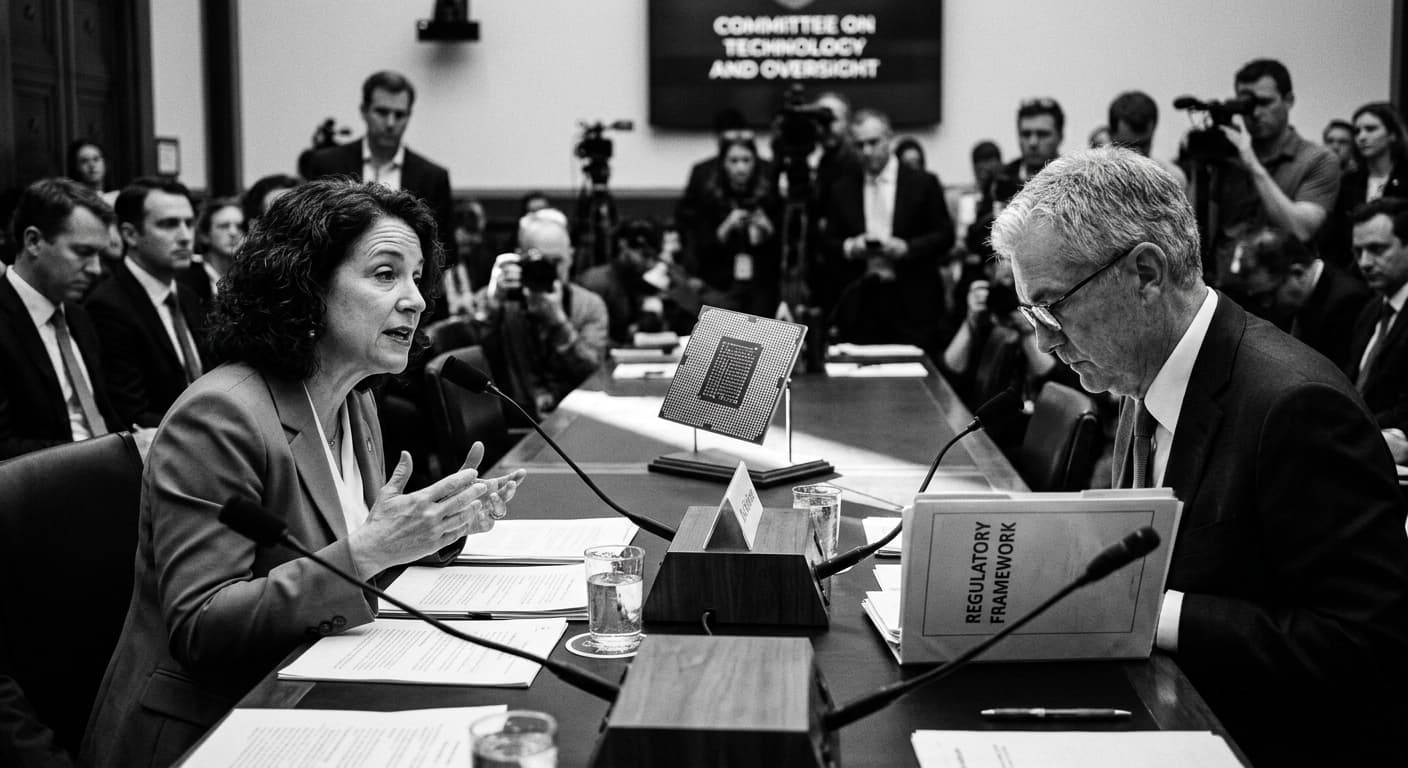
The Chip Supercycle Meets the Regulatory State
How AI-driven memory shortages, HBM export controls, China's Nvidia antitrust probe and DOJ smuggling cases are converging into a single policy problem in mid-2026.
Samsung Electronics on July 3, 2026 told customers it would raise average Q3 DRAM contract prices by up to 20% — the third consecutive double-digit quarterly hike, bringing the cumulative year-to-date surge to roughly 340%, according to BigGo Finance. The AI-driven semiconductor supercycle has stopped being a market story and become a regulatory one: the same shortage of high-bandwidth memory (HBM) and advanced-packaging capacity that is inflating prices from CPUs to consoles is now the single variable driving U.S. export licensing, Chinese antitrust retaliation, Dutch counter-intelligence policy, and DOJ smuggling prosecutions. Scarcity has turned regulation into the pricing mechanism — and every jurisdiction with a lever is now pulling it. The four instruments that matter — BIS's HBM rule, China's SAMR ruling on Nvidia, the SDNY diversion indictment, and Taiwan's National Security Act sentencing — were all deployed inside the last ten months, and each one raises the effective clearing price of AI compute.
The price signal that regulators cannot ignore
The numbers now travel faster than the policy. Data centers are projected to consume roughly 70% of global memory output in 2026, according to the Center for Strategic and International Studies, with SK Hynix's entire 2026 HBM production reportedly sold out and OpenAI having secured agreements for up to 900,000 DRAM wafers per month for its Stargate project — around 40% of global DRAM output. Memory now accounts for as much as 75% of total server cost, up from a historical 15–20%, per
BigGo Finance's supply-chain analysis. One striking translation of that ratio: TechInsights told Apple, per
Al Jazeera, that maintaining margins on the iPhone Pro would require a $270 price increase on a single model.
That concentration is what makes this cycle politically combustible. Three companies — Samsung, SK Hynix and Micron — control more than 95% of global DRAM output, the American Enterprise Institute's Shane Tews warned in late June, calling the shortage "an active, ongoing constraint" that the Commerce Department has yet to price into policy. Apple's outgoing CEO Tim Cook told The Wall Street Journal that memory increases were a "hundred-year flood" and "unavoidable," and Apple then raised MacBook and iPad prices by nearly 20% while Microsoft's Xbox division added $100–$150 to console pricing effective August, per the
BBC. Global smartphone average selling prices are on track to hit an all-time high, rising roughly 20% in 2026, according to Omdia data cited
by the BBC.
The historical parallel is uncomfortable. Three-firm 95% concentration plus 340% price moves plus multi-year sold-out inventories is the market structure the European Commission litigated in the 2000s DRAM cartel case, in which Brussels fined nine chipmakers €331 million in 2010 for coordinating prices on major PC and server OEMs, per the European Commission's Official Journal notice. Academic work by Danial Asmat of the DOJ's Antitrust Division
documented how the cartel operated most stably on older DRAM generations where learning-by-doing had flattened out — precisely the generations now being cannibalised for HBM. Nothing in current data proves collusion — hyperscaler demand is genuine — but the industrial-organisation preconditions are back.
Export controls become the pricing regime
The U.S. Bureau of Industry and Security has, through 15 CFR §740.25, effectively made high-bandwidth memory a licensed commodity: exports of HBM above a memory-bandwidth density of 3.3 GB/s/mm² to China and 24 other Country Group D:5 destinations require a license reviewed under a "presumption of denial," per the Cornell Legal Information Institute's e-CFR text. CSIS's Gregory Allen
noted in December 2024 that the threshold cuts off HBM2e and every generation above it — HBM3, HBM3e, HBM4 — precisely the memory that Nvidia's Hopper and Blackwell chips require to function.
The rule matters because it extends U.S. jurisdiction offshore. A Congressional Research Service report by Karen Sutter documents how the December 2024 expansion of the Foreign Direct Product Rule to SME and chips extended controls to South Korean firms operating in China and closed gaps around advanced-packaging tools — the same CoWoS bottleneck now driving TSMC allocation fights. The
Government Accountability Office has separately flagged that BIS lacks the audit capacity to enforce the three key 2022–2024 rules at pace with new rulemaking, a compliance gap that becomes existential when licensed chips carry six-figure margins per unit.
Then, on January 15, 2026, BIS added a case-by-case license path for Nvidia H200 and AMD MI325X-class chips destined for China — coupled with a 25% Section 232 import tariff on those chips as they enter the U.S. from Taiwan fabs. A Congressional Research Service legal sidebar by Christopher Zirpoli and Jennifer Elsea calls the arrangement legally novel and possibly inconsistent with the Export Control Reform Act's prohibition on charging fees "in connection with" export licenses, and notes the Constitution's separate bar on export tariffs. The Council on Foreign Relations' Chris Miller argued the rule is
strategically incoherent: it allows chips 13 times more powerful than previously permitted, caps China volumes at 50% of U.S. shipments, and requires exporters to certify no diversion of foundry capacity — an impossible certification when HBM supply is globally inelastic.
On May 31, 2026, BIS issued guidance clarifying that the license requirement extends to any subsidiary of a China-headquartered firm, wherever located, Al Jazeera reported. Former State Department official Chris McGuire told the outlet the loophole had allowed Blackwell-class shipments to flow to China-headquartered entities offshore "very likely at scale" before the clarification. Read together, the licensing rule and the tariff have moved Washington from denying advanced compute to rationing and taxing it — with revenue accruing to Treasury and pricing power accruing to Nvidia, whose margins expand with every regulatory bottleneck downstream of it.
Beijing's antitrust weapon, aimed at the shortage
The pricing pressure has given China a lever it did not have during earlier rounds of the tech war. On September 15, 2025, the State Administration for Market Regulation announced a preliminary finding that Nvidia had violated the country's Anti-Monopoly Law in connection with commitments made under its 2020 acquisition of Mellanox, per Al Jazeera. Under that statute, penalties can reach 10% of prior-year global sales. The Takshashila Institution's analysis of the SAMR playbook
describes how the regulator has been used to extract concessions across Qualcomm–Autotalks, Intel–Tower, Broadcom–VMware and other deals — with nearly 30% of concluded SAMR cases involving two foreign parties, and information selectively released in Mandarin only.
The Trump administration's December 2025 decision to authorise H200 exports to China, and BIS's January 15, 2026 codifying rule, were meant to reset the commercial relationship. It has not worked. Brookings' John Villasenor wrote in June 2026 that as of mid-May, "not a single H200 chip had been sold to Chinese companies" — Beijing's Cyberspace Administration told Alibaba and Tencent to stop buying, and state data-center projects are now barred from using foreign chips in facilities less than 30% complete, according to the
Observer Research Foundation. The
Merics analysis frames the same shift as Beijing's decisive turn toward Huawei Ascend, SMIC and Cambricon — with H20 sales having peaked at over one million units in 2024.
The second-order effect is the one the wire coverage misses. Beijing's refusal to buy H200s has re-routed every diverted wafer of production capacity back into a supply chain already 40% consumed by OpenAI's Stargate offtake. That tightens HBM further, feeds Samsung's next 20% hike, and raises the effective tariff-inclusive cost of every H200 that does clear licensing. The Chinese antitrust threat then functions as a shadow price on top of that: Nvidia cannot fully use its restored China licence without exposing itself to a SAMR fine, and its shareholders know it. The winner is the incumbent U.S. hyperscaler with a fixed offtake — Microsoft, Google, Meta, OpenAI — whose 2026 capex is projected to reach roughly $600 billion across the four firms, per CSIS. The losers are second-tier AI companies, sovereign clouds in the Gulf and Southeast Asia, automakers, medical device manufacturers and defence primes now competing against them for the same wafers.
The enforcement tail: DOJ, Singapore, Taiwan
Enforcement is now catching up to the arbitrage the price surge has created. On March 20, 2026, the U.S. Department of Justice unsealed an indictment in the Southern District of New York against Super Micro Computer co-founder Yih-Shyan "Wally" Liaw and two associates, alleging a $2.5 billion scheme to divert Nvidia-equipped servers to China using dummy hardware and hair-dryered serial-number labels, Al Jazeera reported. The
BBC noted that Liaw's arrest followed the August 2025 detention of two Chinese nationals connected to ALX Solutions on similar charges. Singapore, which DOJ has flagged as a diversion hub, seized a S$55 million ($42.5 million) mansion in July 2026 tied to Aperia Group CEO Wei Zhaolun, and charged four Singapore-based corporate entities — a first under those provisions —
per the BBC.
The cyber and trade-secret dimension is thicker still. On April 27, 2026, Taiwan's Intellectual Property and Commercial Court in New Taipei sentenced five defendants — including a former TSMC engineer — to prison terms of up to 10 years in the Tokyo Electron trade-secret case, Al Jazeera reported, the first major sentencing under the amended National Security Act covering "core technologies." The Council on Foreign Relations'
Cyber Operations Tracker attributes to the PRC-linked Chimera group multi-year intrusions into Taiwanese chip firms, and ISPI's analysis of Taiwanese cyber posture
documented how APT41 (dubbed "Amoeba") successfully intruded into critical infrastructure serving foundries. On July 3, 2026, the Hague Centre for Strategic Studies published
Beyond Borders, a report identifying the Dutch semiconductor sector as the country's highest-strategic-risk industry for Chinese foreign interference across cyber espionage, talent recruitment and supply-chain influence.
Each of these enforcement actions reads as a discrete event. Together they describe a single dynamic: as the licensed price of AI compute rises, the black-market premium rises with it, drawing corporate insiders, state-linked APTs and freight forwarders into the arbitrage. Seoul, for its part, is not waiting to see how the four-jurisdiction squeeze resolves. President Lee Jae-myung's government on June 29, 2026 announced a roughly $1 trillion AI-and-chip investment plan, per the BBC — a hedge that acknowledges Korean memory oligopolists cannot forever be squeezed between U.S. licensing and Chinese antitrust.
Diplomat View
The prevailing analytical frame — "AI supercycle drives chip prices up, regulators react" — has the causation backwards. Regulation is now the primary price-setter for advanced compute: BIS's 3.3 GB/s/mm² HBM threshold, the 25% Section 232 tariff, and SAMR's preliminary Nvidia finding together define who can buy what, and at what margin, more decisively than any hyperscaler purchase order. The forecast: expect Samsung's Q4 DRAM hike to land at 15–25% and expect a SAMR settlement extracting China-facing concessions from Nvidia before year-end — a package that formalises the shadow-pricing regime rather than dismantling it. What would falsify this view: a genuine HBM4 capacity breakthrough from Micron's Idaho fab pulled into 2026 rather than 2027, a bipartisan Congressional revolt against the Section 232 chip tariff on Constitutional grounds, or a SAMR closure of the Nvidia probe without penalty. Absent one of those three, memory scarcity is now a policy input, not an output.
What to watch next:
- Q3 2026 memory contract negotiations (July–September): whether SK Hynix and Micron match Samsung's 20% hike or undercut it — the tell for whether cartel-like coordination is emerging.
- SAMR next filing on Nvidia (expected by end-Q3 2026): a formal finding vs. a negotiated settlement will signal whether Beijing wants leverage or revenue.
- U.S. Court of International Trade docket on Section 232 chip tariffs: any challenge citing the CRS legal-sidebar argument on ECRA fee prohibition would test the January 15 rule's foundation.
The Bottom Line
The AI chip supercycle is no longer a market phenomenon — it is a regulatory equilibrium in which BIS licensing, a 25% Section 232 tariff, SAMR antitrust leverage, and DOJ diversion prosecutions jointly set the price of advanced compute. The immediate winners are Nvidia and the three memory oligopolists, whose margins expand with every enforcement action taken above them; the losers are every downstream industry — autos, medical devices, defence, consumer electronics — now competing against hyperscalers for the same wafers. Read Samsung's 340% year-to-date price move as the market's report card on the policy: scarcity is now the instrument, and no jurisdiction has an incentive to relax it first.
Discover more
US Politics
SNAP Food Assistance Faces Legal Challenges
In 2026, SNAP faces stricter eligibility rules and mounting legal challenges, threatening food assistance for the millions of Americans who rely on the program.

India
Delhi CM Rekha Gupta Blasts Opposition's Delm
Delhi CM Rekha Gupta's remarks on women's quota defeat reveal BJP's strategy for the 2029 Lok Sabha elections, focusing on delimitation.
India
700 Activists Accuse PM Modi of MCC Breach
Over 700 activists allege PM Modi breached election code with a televised address attacking opposition parties just before state elections.

Economics
Fed's Amex AML order puts correspondent banking on notice
Federal Reserve's Amex AML order requires board-level controls and a 90-day plan; OCC fined the bank $350 million over enterprise-wide deficiencies.