China's Rare-Earth Chokehold Has a Ceiling
China controls mining, but Japan and US own key patents.
Model Diplomat9 min readAsia
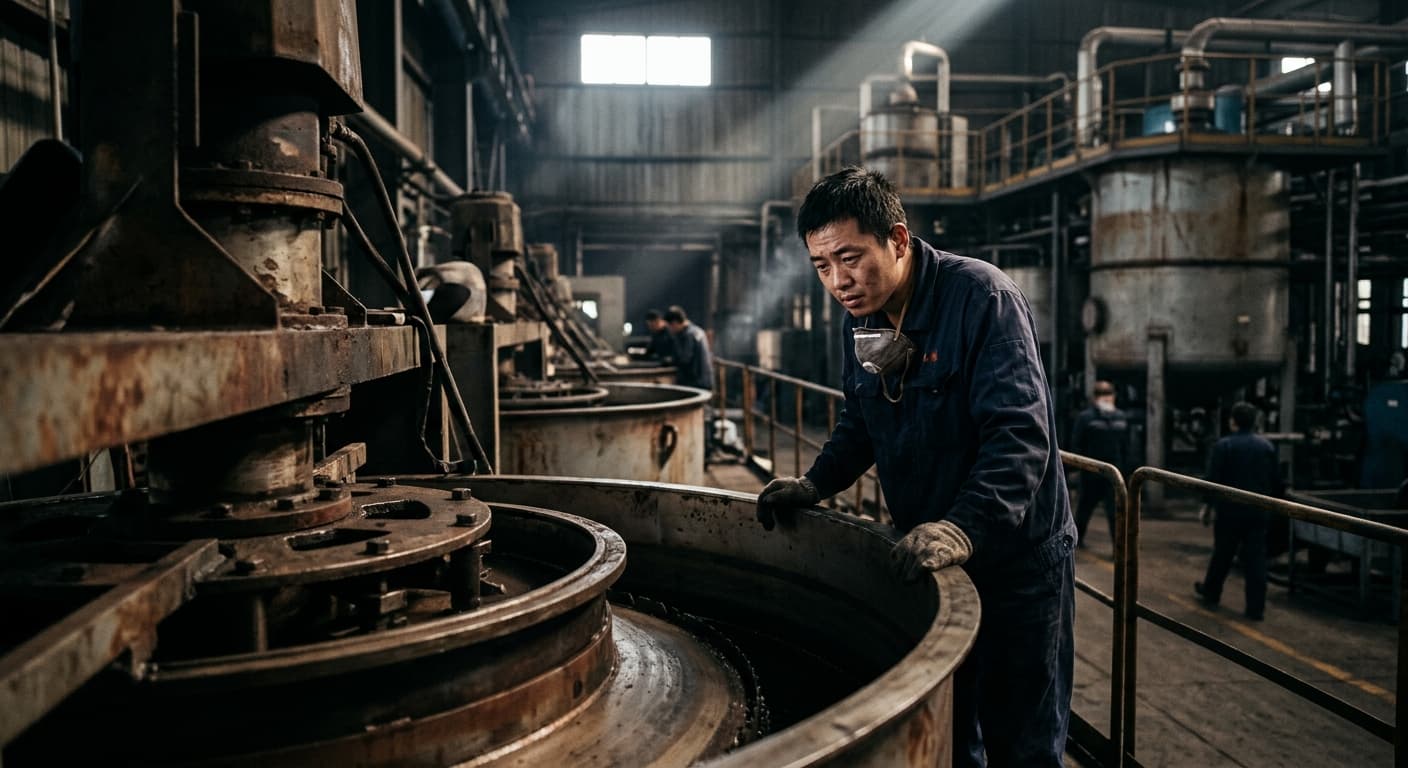
China's Rare-Earth Chokehold Has a Ceiling — and Japan Owns It
China mines and refines the rare earths, but the US and Japan still own the patents that turn them into magnets, catalysts and chips. That gap is now the West's clearest lever — and Beijing's own researchers just said so.
China controls roughly 60–70% of rare-earth mining and about 90% of refining, but a July 2026 study by researchers at the University of Science and Technology of China, published in the Bulletin of the Chinese Academy of Sciences, concludes that the country still trails the United States and Japan on the patents that actually turn those metals into money — permanent magnets, catalysts, phosphors and polishing powders. That is the real balance of power in the rare-earth war of 2025–26: Beijing owns the mine, Tokyo and Washington own the machine that uses what the mine produces. The next four months, ending with the November 10, 2026 expiry of China's suspended second-wave export controls, will determine whether that IP edge translates into an actual industrial base — or lapses into a subsidised American mine and a Japanese patent library with no volume behind either.
The Diagnosis Comes From Inside China
The finding making headlines this week is that the vulnerability is being flagged from inside China. The USTC team's patent analysis, summarised by India Today and originally reported by the South China Morning Post, argues that China is "not in a leading position" on advanced rare-earth functional materials, with Japan dominating permanent-magnet patents and the United States dominating catalytic, luminescent and polishing-material IP. The
New Indian Express summary of the same study notes that Chinese universities file large volumes of rare-earth patents domestically, but relatively few make it into commercially valuable international portfolios, and coordination between labs, industry and IP management is weak.
That is not new to specialists. A 2023 patent-mapping paper in Resources Policy by Zhou, Xiao and Yan analysed 42,932 rare-earth patent applications and found that the US "is promoting science and technology in the entire rare earth industry" while Japan "is primarily driven by technology" and China is strong only in mining and smelting, per IDEAS/RePEc. A separate social-network analysis in the same journal described China's rare-earth innovation network as "strong upper and weaker lower," concentrated in extraction and smelting nodes rather than downstream functional materials, as summarised on
RePEc. What is new is that a state-affiliated Chinese institution is publishing the diagnosis just as Beijing is trying to weaponise the upstream.
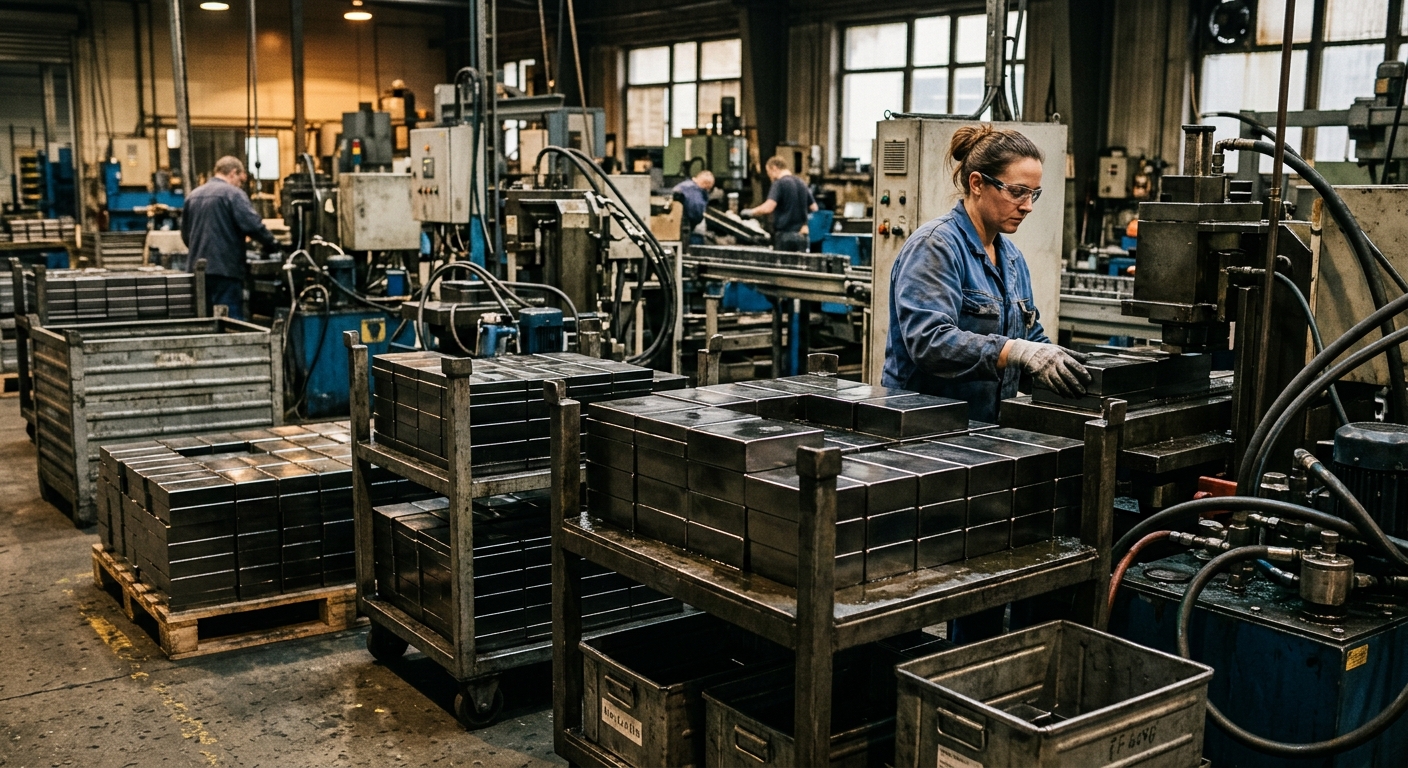
Where the moats actually sit
The Japanese moat is a specific one, and it did not vanish when the original Sagawa composition patents lapsed. Neodymium-iron-boron magnets were invented in 1982 by Japan's Masato Sagawa and America's John Croat working weeks apart, using the same Nd₂Fe₁₄B intermetallic phase, according to the Honda Foundation via Nature Research. Sagawa's sintered process — now the industry standard used in EV traction motors, wind turbines and MRI scanners — is documented in a US Supreme Court cert petition filed by
Hitachi Metals, which describes the hydrogen-pulverisation and fine-particle-removal techniques that separate a defence-grade magnet from a hobby-grade one. The compositional patents are gone; the process patents, coatings, dysprosium-diffusion techniques and heavy-rare-earth-reduction methods held by Proterial (formerly Hitachi Metals), Shin-Etsu and TDK are what actually gate high-coercivity, temperature-stable output.
The American moat looks different. It is thickest in adjacent chemistries — three-way auto catalysts, LED phosphors, and cerium-oxide polishing slurries used in semiconductor CMP — and in the recycling patents that a 2024 SEEDS working paper on rare-earth circular-economy IP found were "more oriented to protect their inventions internationally" than their Chinese equivalents, per the study's RePEc listing. The Yonsei-authored patent-text analysis in Scientometrics similarly found that USPTO rare-earth filings show materially different technology profiles from Chinese and Japanese offices, with nanotechnology and materials-manufacture technologies concentrated in the US and Japan, according to
IDEAS/RePEc.
The Alfaro thesis: coercion breeds substitution
The most consequential recent finding comes from an NBER working paper that quantifies what happens after China pulls the lever. Using patent data classified by a large language model, the authors show that China's 2010 rare-earth export shock caused REE-related patenting to rise sharply outside China — particularly in Japan, Europe and the United States — with a one-standard-deviation increase in REE sensitivity producing roughly 7.4% more downstream patents in exposed foreign industries, per the NBER paper. Downstream Chinese industries did not benefit from cheaper feedstock; the innovation was diverted to substitution and efficiency abroad. A
CEPR VoxEU column summarising the same work notes that in Japan alone, a one-standard-deviation rise in REE exposure translated into a 0.5 percentage-point higher annual TFP growth rate and 0.3 points of extra export growth per year through 2018.
The 2010 embargo is thus not the West's cautionary tale — it is Beijing's. It taught downstream users to design around Chinese inputs, and it produced the patent stockpile the USTC study now catalogues.
What Beijing tried this time, and what changed
The second act is unfolding in real time. On April 4, 2025, in response to the Trump administration's tariffs, China imposed licensing controls on seven heavy REEs — samarium, gadolinium, terbium, dysprosium, lutetium, scandium and yttrium — plus related compounds, magnets and metals, according to the European Parliamentary Research Service. Suzuki halted production of the Swift and Nissan reported supply disruptions, according to
CSIS. A second wave on October 9, 2025 added five more elements, related equipment and technologies, and — for the first time — asserted extraterritorial jurisdiction over any foreign-made magnet containing 0.1% or more of Chinese-sourced REEs, or produced using Chinese process IP, per the same EPRS briefing. Beijing suspended that second wave on November 7, 2025 until November 10, 2026, as part of the Trump–Xi truce.
The price impact was severe but not paralysing. The EPRS, citing the International Energy Agency, reports that European rare-earth prices rose to as much as six times pre-restriction levels, and that European Central Bank analysis found more than 80% of large European firms sit within three intermediaries of a Chinese rare-earth producer. Yet the second wave lasted only weeks before Beijing pulled it back — a signal that the RSIS analyst Janet Fung Wui Mang, in a RSIS commentary, reads as "precisely calculated" statecraft rather than a sledgehammer, designed to sting without accelerating de-Sinicisation. A February 2026
RSIS follow-up argued Japan had already cut REE dependence on China from 90% to 60–70% over the past decade, with the remaining vulnerabilities concentrated in heavy rare earths and magnet manufacturing — exactly the segments Beijing hit and exactly the segments where Japanese process IP still matters.
The American answer: buy the mine, subsidise the magnet
Washington's response is to convert Japanese and American patents into physical throughput on US soil, and to do so with capital that looks nothing like free-market orthodoxy. On July 10, 2025, the Department of Defense took a $400 million equity stake in MP Materials — 15%, making the US government the company's largest shareholder — and guaranteed a $110/kg price floor on neodymium-praseodymium output for a decade, per the BBC. The Office of Strategic Capital added a $150 million loan for heavy-rare-earth separation at Mountain Pass, and the DoD committed to buying 100% of magnets from a planned "10X Facility" for ten years, according to a February 2026
IFRI analysis. Apple layered on a $500 million magnet purchase agreement and co-funding for a recycling facility.
That was the opening move. A CSIS progress report tallies roughly $7.6 billion in non-equity US federal capital support announced for rare-earth projects between January 2025 and June 2026, a 321% increase over the 2020–2024 baseline. The One Big Beautiful Bill Act, enacted in July 2025, appropriated $7.5 billion for critical minerals, created a $5 billion Industrial Base Fund and a Critical Minerals Loan Program of up to $500 million per project. In November 2025, the Pentagon's Office of Strategic Capital extended a $620 million loan to North Carolina magnet-maker Vulcan Elements and an $80 million loan to ReElement Technologies in Indiana, targeting 10,000 metric tons of NdFeB magnet output — still only a fraction of the ~230,000 tons produced globally in 2024, according to
NPR.
The Pentagon's own industrial-base office has spent more than $439 million since 2020 on "mine-to-magnet" nodes — including $288 million to Lynas USA for a second commercial oxide plant, $94.1 million to E-VAC Magnetics, and $28.8 million to Noveon Magnetics in San Marcos, Texas. No named Pentagon official has been quoted confirming the 2027 domestic-supply-chain target on the record in this piece. The 2027 target for a sustainable domestic supply chain covering all defence requirements is now the operational benchmark against which every subsequent Chinese export-control move will be measured.
The second-order winners
Two beneficiaries deserve naming. The first is Japan's magnet oligopoly. Proterial, Shin-Etsu Chemical and TDK sit on the process patents that any credible non-Chinese magnet supply chain has to license, and Tokyo is now pairing that IP with frontier extraction — deep-sea rare-earth mining tests around Minamitori Island scheduled for January 2026 at depths of roughly 6,000 metres, per CSIS. The second is Southeast Asia, particularly Malaysia, which — because it can restrict raw feedstock exports while attracting midstream processing — is positioned as the third-country node that Japanese de-risking will actually flow through, per the RSIS February 2026 commentary.
The clear loser inside China is the closed-loop model itself. China accounts for 69% of production, nearly 90% of refining and over 90% of magnet manufacturing, per the CSIS Industrial Base progress report — and yet from 2021 to 2024 the US still sourced 71% of its REE imports from China. That is the number Beijing is trying to preserve. Each additional coercive round accelerates the very substitution the USTC researchers now warn about — and the
NBER analysis already quantified.
Diplomat View
The evidence points to a specific forecast. If MP Materials, Vulcan Elements and E-VAC hit their announced 2026–2027 magnet-throughput targets under DoD offtake, and if Japan's Proterial and Shin-Etsu continue licensing grain-boundary-diffusion process IP into US and Malaysian lines, China's rare-earth leverage will peak in 2026 and decline structurally thereafter — not because Beijing loses the mines, but because the marginal ton of magnet-grade output no longer has to pass through Chinese hands. The USTC study, published inside the Chinese Academy of Sciences ecosystem, is best read as an implicit warning to Beijing that further escalation past November 10, 2026 will accelerate the very decoupling it has spent a decade trying to slow-walk. The forecast reverses if two things happen: the $110/kg NdPr price floor is repealed under a future administration, collapsing MP Materials' economics; or China issues compulsory licences on domestic use of foreign process patents, blunting the IP moat. Absent those moves, the West's leverage from patents will finally start converging with China's leverage from mines.
What to watch
- November 10, 2026: Expiry of China's suspended second-wave export controls. Reimposition would trigger the extraterritorial 0.1% rule on foreign-made magnets.
- End of 2026: ReElement Technologies' target date to become the largest US rare-earth oxide producer; Vulcan Elements' first magnet-line commissioning.
- 2027: DoD's stated deadline for a sustainable domestic "mine-to-magnet" supply chain covering all US defence requirements.
- China's 15th Five-Year Plan (2026–2030): Whether the "dual controls" emissions framework and industrial-policy chapters formally address downstream rare-earth IP gaps identified by the USTC study.
The Bottom Line
China's rare-earth dominance is a mile wide and, on the patents that matter, an inch deep. The July 2026 USTC study is the first admission from inside the system that Beijing's mines cannot compensate for Tokyo's and Washington's downstream IP — and every additional coercive cycle since April 2025 has widened that gap by pushing Japan, the EU and the US to convert patents into physical plant. If the November 10, 2026 deadline passes without a new escalation, it will be because Beijing has read its own researchers.
Discover more

US Politics
House Ethics Committee Pushes Sexual Miscond.
The House Ethics Committee has shifted responsibility for sexual harassment settlement records to the Office of Congressional Workplace Rights, complicating disclosure efforts.

US Politics
SNAP Food Assistance Faces Legal Challenges
In 2026, SNAP faces stricter eligibility rules and mounting legal challenges, threatening food assistance for the millions of Americans who rely on the program.

India
BJP's Misunderstanding of Women's Quota Needs
The BJP's linking of the Women Reservation Bill to delimitation risks delaying women's empowerment in India, misreading the aspirations of female voters.

Economics
Fed's Amex AML order puts correspondent banking on notice
Federal Reserve's Amex AML order requires board-level controls and a 90-day plan; OCC fined the bank $350 million over enterprise-wide deficiencies.