China’s Leverage Over Russia Is the Real Glue
Sanctions, trade asymmetry and shared resistance to U.S. power keep Moscow tied to Beijing — but on China’s terms, not Russia’s.
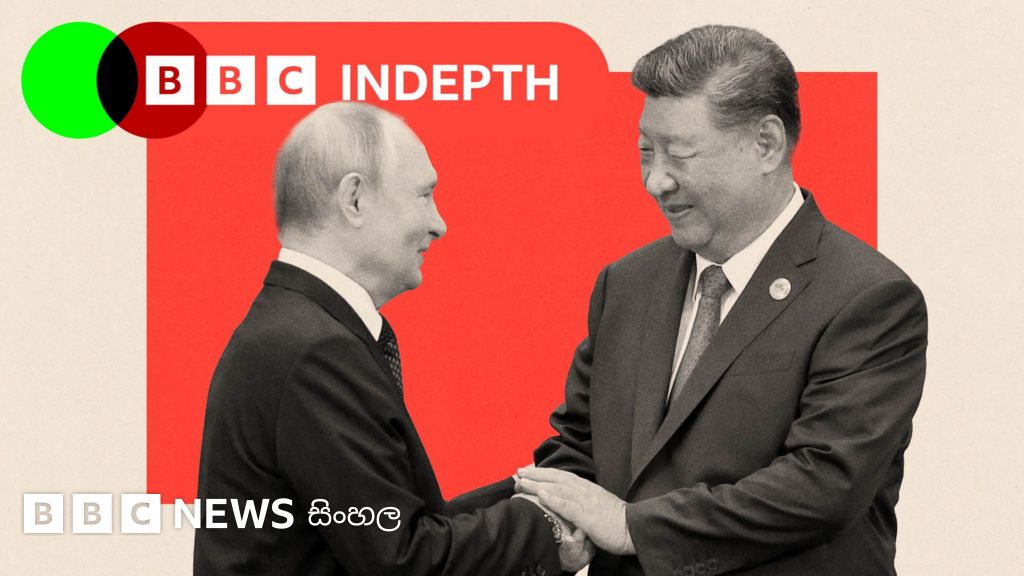
China holds the leverage in this relationship. The BBC Sinhala report argues that the “hidden force” keeping Beijing and Moscow close is not ideology or trust, but a hard strategic bargain: Russia needs a market, technology and diplomatic cover after Western sanctions, while China gets discounted energy and a partner useful against U.S.-led pressure ( BBC News සිංහල). The result is a partnership that looks symmetrical from a distance and deeply unequal up close.
The sanctions effect has become the binding agent
Russia’s dependence on China is the key fact. China is now Moscow’s largest trading partner, while Russia accounts for only about 4% of China’s international trade, the BBC report notes (BBC News සිංහල). That imbalance matters because it gives Beijing room to dictate terms. The BBC quotes Carnegie’s Alexander Gabuev saying Russia is “fully in China’s pocket,” a blunt assessment of where the bargaining power sits (BBC News).
This is not just about commerce. Since Russia’s full-scale invasion of Ukraine, sanctions have pushed Moscow deeper into Chinese supply chains for components used in telecoms, industry and the war economy (BBC News). Al Jazeera likewise reported this week that Russia is sourcing more than 90% of its sanctioned technology imports from China, including dual-use parts relevant to drones and defense production ( Al Jazeera). That means Western pressure has had a second-order effect: it has not isolated Russia from great-power support, but redirected it eastward.
Beijing benefits from a weaker, more compliant Moscow
China’s gain is straightforward: secure access to oil, gas and raw materials at favorable prices, plus a geopolitical partner that helps complicate U.S. strategy. The BBC Sinhala piece highlights the scale advantage: China’s economy is vastly larger, and Russia has few alternatives if it wants to keep exporting on a large scale (BBC News සිංහල). That is why Beijing can keep the relationship “close” without locking itself into Russia’s agenda.
Chatham House’s latest analysis makes the same point from another angle: the relationship is durable because it is pragmatic and transactional, not because the two states trust each other or want the same end state ( Chatham House). Beijing wants strategic autonomy and flexible access to energy; Moscow wants escape from isolation. Those are overlapping goals, not identical ones. China will support Russia politically, but it is careful not to become overdependent on Russian energy or tied too closely to Moscow’s confrontation with the West (Chatham House).
Watch the next bargaining point, not the rhetoric
The next decision point is whether China keeps deepening this dependence or starts using it more aggressively. Watch for three indicators: new trade concessions from Moscow, progress on long-stalled energy projects such as Power of Siberia 2, and any tightening of Chinese enforcement against exports that could trigger secondary sanctions pressure (Chatham House;  CFR).
CFR).
For policymakers, the implication is simple. The China-Russia alignment is not a bloc built on equal commitment. It is a hierarchy, and China is setting the terms. That makes the relationship resilient in the short run, but also more brittle than the public rhetoric suggests.