China's EV Battery Tech Lock-In
Western tariff walls accelerate Chinese localization, but Beijing's LFP export controls keep the highest-value technology at home.
Model Diplomat10 min readAsia
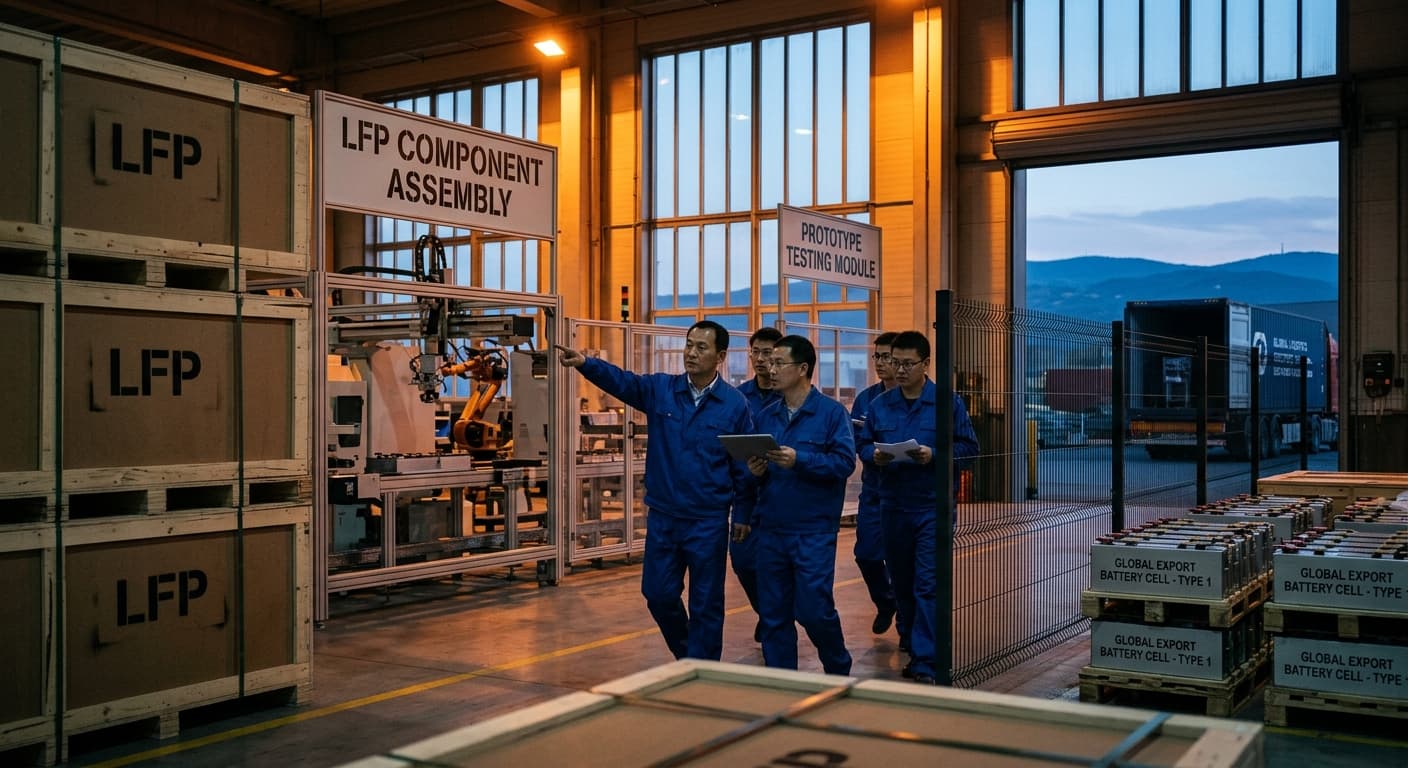
Chinese EVs Go Global, But Beijing Keeps the Best Batteries at Home
Mining.com.au's coverage of Wood Mackenzie's mid-year outlook frames 2026 as the year Chinese EVs "go global" with 15% battery-market growth. The real story is how Western tariff walls are forcing Chinese firms to localize inside the very markets trying to shut them out — while Beijing's LFP export controls ensure the highest-value technology never leaves home.
The battery market is on track for 15% demand growth in 2026, and Wood Mackenzie's mid-year outlook declares this the year Chinese EVs "go global" — with over 75% of EV sales across the Middle East, Latin America, Africa, and Oceania originating from China, according to Mining.com.au. But the decisive dynamic is not export volume — it is that Western tariff walls have paradoxically accelerated Chinese localization inside the markets trying to shut them out, while Beijing's July 2025 export controls on lithium iron phosphate cathode technology ensure the highest-value know-how stays in China. The result is a two-tier global battery order: the West gets the factories, but not the chemistry.
China manufactured about 75% of all EVs produced globally in 2025, with exports doubling to a record 2.5 million units, according to the International Energy Agency. BYD overtook Tesla as the world's largest EV seller, with battery-powered car sales rising nearly 28% to more than 2.25 million in 2025, while Tesla's deliveries fell 9% to 1.64 million,
BBC News reported. Ford CEO Jim Farley has publicly warned that Western carmakers are "in a fight for our lives" as Chinese rivals expand globally,
BBC News reported. The IEA estimates that global EV sales will hit 23 million in 2026, accounting for nearly 30% of all auto sales worldwide.
Tariffs as a Localization Catalyst
The EU's countervailing duties, finalized in October 2024, added 17.4% for BYD, 19.9% for Geely, and 35.3% for SAIC on top of the standard 10% import tariff — a combined ceiling of 45.3%, Al Jazeera reported. Rhodium Group estimated that tariffs would need to reach 45–55% to make the European market commercially unappealing for Chinese manufacturers; only SAIC's combined rate crosses that threshold, meaning BYD and Geely remain profitable even after duties,
CSIS noted. The tariffs did not stop Chinese EVs — they redirected the strategy.
Rather than retreating, Chinese automakers have poured over $100 billion into overseas factory investments since 2019, outpacing US peers by roughly four-to-six times in international activity, according to Yahoo Finance. The playbook is "make it here, sell it here": BYD is building in Hungary, CATL in Germany, Chery in Barcelona, and the Stellantis–Leapmotor joint venture is distributing Chinese-designed EVs through European dealer networks,
DailyAlpha reported. The European Parliament's research service confirmed that close to 50% of Chinese electric cars sold in Europe are now produced on European soil,
European Parliament. The strategy converts factory jobs into political capital: every plant built in Hungary or Spain creates a local constituency that makes future tariff hikes politically costly.
The JRC's analysis underscores the scale of the dependency. In 2024, more than 85% of batteries imported into the EU originated in China, a level above the threshold to activate the resilience contribution under the EU's Net-Zero Industry Act, the European Commission Joint Research Centre found. The WTO's 2025 report on global EV value chains confirmed that China contributed over 80% of global EV battery production capacity, with Chinese manufacturers holding 1,600 GWh — 3.9 times the capacity of second-ranked South Korea, the
WTO reported. Ten manufacturers accounted for 93% of the global EV battery market in 2023; six are Chinese, with CATL commanding the largest share at 36%.
The named losers are already visible. Northvolt, Sweden's battery champion, filed for bankruptcy in early 2025 after relying heavily on Chinese equipment and struggling to keep production lines running, Merics noted. SAIC faces the highest EU duties and the narrowest margins among major Chinese exporters. European battery startups ACC and BMZ Germany have struggled with scaling and cost competitiveness against Chinese imports. The UK Parliament's Business and Trade Committee warned that growing Chinese overcapacity "creates a risk of flooding the UK market with cheap imports that jeopardise the development of the UK battery supply market,"
UK Parliament reported.
The Asymmetric Chemistry Control
Tariffs push Chinese firms to build factories abroad. China's export controls ensure the most valuable technology does not follow.
On July 15, 2025, China's Ministry of Commerce placed LFP cathode technology — the dominant battery chemistry, accounting for over half of global EV demand — on its catalog of prohibited and restricted exports, requiring licenses for overseas technology transfers, the German Council on Foreign Relations documented. The threshold targets fourth-generation LFP at compaction densities of 2.58 g/cm³ or above — the latest, highest-performance chemistry. Three months later, in September 2025, CATL unveiled its Shenxing PLUS line based on fourth-generation LFP, marketed specifically for Europe, promising longer lifespan and better safety as an alternative to nickel-manganese-cobalt chemistries.
Beijing then expanded controls on October 9, 2025, adding third-generation LFP technology in a sweeping package covering large parts of the battery value chain, DGAP detailed. The October package also included military-use and proliferation considerations in LFP technology transfer. After the Trump-Xi meeting in Busan on October 30, 2025, on the sidelines of APEC, the third-generation controls were suspended — but the fourth-generation licensing requirements remain in force.
Merics senior analyst Alexander Brown assessed the implications bluntly: "The EU's plan to partner with Chinese firms to boost battery manufacturing in Europe has its limits. The new restrictions on battery technology exports indicate that Chinese firms will be constrained in their ability to share skills and know-how. To achieve battery supply chain security, Europe will need to strengthen the innovation capabilities of local players and foster collaboration with other leading, non-Chinese partners," Merics wrote.
The Carnegie Endowment reached the same conclusion: export restrictions suggest "battery giants are to develop lower-end factories abroad while maintaining best-in-class production in mainland China," the Carnegie Endowment found. If Europe and the United States build LFP plants using licensed Chinese technology, they risk being uncompetitive against the latest Chinese LFP imports while locking themselves into lower-quality, trailing-edge chemistry — potentially four years behind the Chinese state of the art.
The UK Parliament's committee confirmed the structural dimension: over half of global raw material processing for lithium, cobalt, and graphite occurs in China, with 78% of cathode production and 91% of anode production in 2022, UK Parliament reported. The HCSS strategic assessment found that LFP batteries have the highest supply vulnerability score because they depend on processed phosphate and graphite — materials with the highest associated geopolitical concentration risks,
HCSS reported.
In the United States, the barriers are even higher. The Pentagon added CATL to its list of "Chinese military companies" in January 2025, effectively restricting CATL to arm's-length licensing deals — the Ford Michigan LFP plant, where Ford owns the facility and CATL supplies only technology, equipment, and know-how to avoid triggering Foreign Entity of Concern rules, the Observer Research Foundation documented. Ford has pivoted from LFP to LMR chemistry, while General Motors has separately announced a cheaper long-range battery,
Mining.com.au reported. South Korean giants LG Energy Solution, Samsung SDI, and SK On have all pivoted toward energy storage system batteries in North America, where policy incentives favor non-Chinese suppliers.
The Global South Bypass
While the US and EU erect barriers, the Global South is absorbing Chinese EVs at extraordinary rates — and this is where Western de-risking strategy faces its sharpest test.
In April 2026 alone, Chinese EV exports surged 40% year-on-year to 278,081 units, with Asia importing 110,613, Europe 83,813, and Latin America 52,897, Al Jazeera reported. Brazil saw the biggest rise among the top 10 destinations, with imports surging 221% to 38,144. South Korea, Germany, and Australia also saw imports rising between 100% and 190%. North America imported just 4,422 — effectively locked out by tariffs exceeding 100%.
BYD executive vice president Stella Li told the BBC that the company is thriving without US market access: "We survive and are successful without the US market today. Actually, we are now suffering [insufficient] capacity. Our demand is much higher than what we can supply," BBC News reported. BYD's domestic sales fell for seven straight months, but European sales were up 156% in the first quarter of 2026. BYD is betting on its new "flash charging" technology — promising 400 km of range in five minutes — to overcome the biggest barrier to EV adoption globally.
The historical parallel is precise. BYD's Stella Li herself drew the comparison to the rise of Japanese automakers in the 1970s and South Korean brands more recently: "History suggests not all will survive," she said, referring to consolidation cycles that culminate in a few dominant global players. The trajectory is similar — low-cost entry, quality improvement, then technology leadership — but compressed into a fraction of the timeline. The CSIS estimates Beijing spent approximately $231 billion developing its EV industry from 2009 to 2023, BBC News reported. That investment yielded a 20-year head start in battery manufacturing that no Western competitor has meaningfully closed.
The Royal United Services Institute assessed that Chinese EV expansion into the Global South creates dependency pathways through financing, after-sales infrastructure, charging networks, and local manufacturing ecosystems that reinforce Beijing's global leadership in clean transport, RUSI argued. The ECFR warned that China is strategically widening its EV footprint through investments in the Middle East and North Africa, potentially bypassing Western tariffs via regional hubs and eroding Europe's geoeconomic influence in its southern neighbourhood,
ECFR reported.
The ESS Inflection Point
The Wood Mackenzie report identifies a second shift that complicates every tariff calculation: energy storage systems have overtaken EVs as the prominent market focus in 2026.
Growth in AI data centres and government energy security initiatives has made ESS the dominant battery demand driver, with additional upside from robotics, shipping, and industrial equipment entering electrification, Mining.com.au reported. Nomura revised ESS demand up approximately 25% in its June 2026 report, projecting 17% annual growth through 2030 to roughly 926 GWh — about half the size of the EV battery market but rising faster, according to
China Biz Insider. Korean battery giants are converting EV production lines to LFP for ESS, signaling a structural shift in growth engines. China's Q1 2026 ESS lithium battery shipments rose approximately 139% year-on-year to 215 GWh.
This matters because ESS demand intersects with the same Chinese supply chains that Western de-risking targets. The Atlantic Council assessed that CATL and BYD's combined global EV battery market share reached 54.3% through April 2026, while LG Energy Solution and SK On collectively held just 12.6% — down 1.2 percentage points from the previous year, the Atlantic Council reported. Chinese domestic battery production rose 46% from 2023 to 2024, with production capacity 60% higher than total demand — a deliberate overcapacity strategy that floods export markets and pressures global competitors.
Key Takeaways
- Tariffs redirected, not blocked, Chinese expansion. EU duties of 17.4–45.3% pushed Chinese automakers to invest over $100 billion in overseas factories, localizing production inside the very markets trying to shut them out.
- Beijing's LFP export controls create a two-tier system. Fourth-generation LFP cathode technology — the highest-value chemistry — requires licenses for overseas transfer, meaning Western factories get lower-end chemistry while best-in-class production stays in China.
- The Global South is the bypass. Over 75% of EV sales in the Middle East, Latin America, Africa, and Oceania in 2026 originate from China, creating dependency pathways that Western de-risking cannot reach.
- ESS has overtaken EVs as the battery market's growth engine. AI data centre demand, grid storage, and industrial electrification are driving 15% battery-market growth, with Chinese suppliers holding 54.3% of global market share.
- The named winners are CATL, BYD, and Stellantis-Leapmotor. The named losers are Northvolt, SAIC, and European battery startups that cannot compete on cost or technology.
What to Watch
- Q4 2026: Wood Mackenzie's full-year battery outlook will reveal whether ESS demand growth has structurally overtaken EV demand, and whether Chinese overcapacity is pressuring global cell prices below profitability for non-Chinese producers.
- EU-China minimum price negotiations: Brussels and Beijing continue discussing a minimum EV import price as an alternative to tariffs. Any agreement would set a precedent for managing Chinese EV access — but would not address the LFP technology transfer restrictions.
- CATL's European gigafactory ramp: CATL's German and Hungarian plants are scheduled to scale production in late 2026–2027. Watch whether output uses fourth-generation LFP chemistry or is limited to third-generation under the export controls.
- South Korea–US battery cooperation: The Atlantic Council recommends Washington and Seoul coordinate on solid-state and lithium-sulfur chemistries to leapfrog Chinese LFP dominance. Any Pentagon-backed offtake agreements through the BEACONS facility at the University of Texas at Dallas would signal a deliberate technology-skip strategy.
The Bottom Line
China's EV globalization is not a story about cars crossing borders — it is about who controls the chemistry inside them. Western tariffs have forced Chinese firms to build factories in Europe and license technology in the United States, but Beijing's export controls on fourth-generation LFP ensure the highest-value know-how never leaves home. The West gets the jobs; China keeps the edge. If Europe and the US cannot close the four-year technology gap in LFP — or leapfrog it with solid-state or sodium-ion — no tariff wall will change the underlying balance of power. The decisive question is not whether Chinese EVs go global, but whether anything the West builds can compete with what China keeps at home.
Discover more
India
700 Activists Accuse PM Modi of MCC Breach
Over 700 activists allege PM Modi breached election code with a televised address attacking opposition parties just before state elections.

US Politics
House Ethics Committee Pushes Sexual Miscond.
The House Ethics Committee has shifted responsibility for sexual harassment settlement records to the Office of Congressional Workplace Rights, complicating disclosure efforts.
India
Congress Accuses Modi of Stalling Women's Law
Congress accuses Modi of stalling women's reservation law by linking it to delimitation, revealing a deeper electoral strategy.

Conflict & Security
Drone Warfare Killing Aid Workers at Unprec
Over 1,000 humanitarian workers killed in three years as cheap armed drones collapse legal protections. Gaza, Sudan, Ukraine, and DRC see deliberate targeting of aid convoys and hospitals with zero prosecutions.