China's Economy Grows 5% in Q1 2026
GDP growth driven by exports and state investment
Model Diplomat7 min readChina
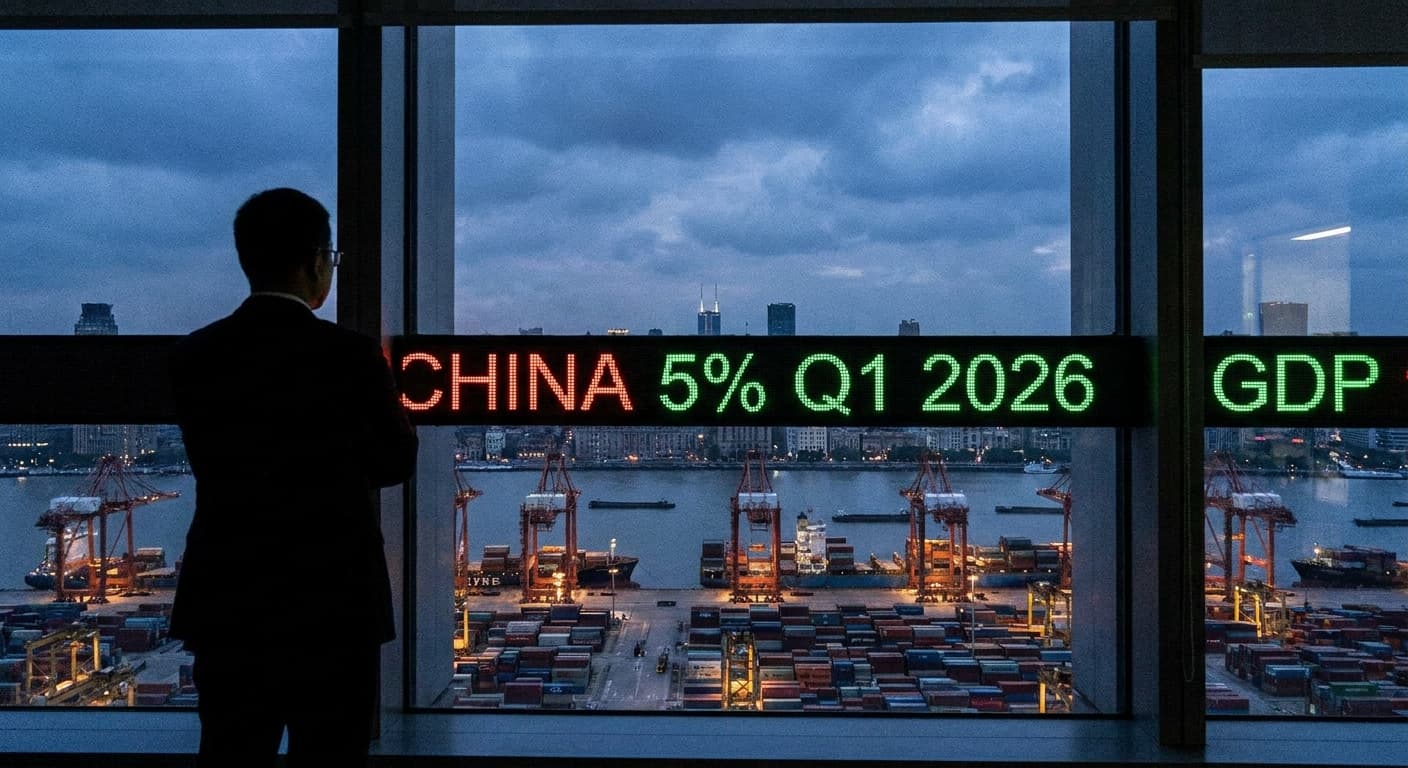
China's Economy Grows 5% in Q1 2026 — Before the Iran War Bill Arrives
China's GDP rose 5.0% year-on-year in Q1 2026, beating forecasts on front-loaded exports and state-led investment. The Iran-war hit lands in Q2.
China's economy expanded 5.0% year-on-year in the first quarter of 2026, the National Bureau of Statistics reported on April 16, hitting the top of the 4.5–5.0% band Beijing set at the March National People's Congress. The headline flatters the underlying story. The print was manufactured by a 14.7% export surge and a state-directed rebound in infrastructure spending — both largely booked before the US–Israeli war with Iran shut the Strait of Hormuz on February 28. The number that matters is not 5.0%. It is the Q2 release on July 15, which will be the first to fully absorb the war's trade and energy shock, and which the IMF already expects to drag full-year growth to 4.4%.
What actually printed
GDP reached 33.42 trillion yuan (about $4.87 trillion), up 1.3% quarter-on-quarter on a seasonally adjusted basis, according to Xinhua citing NBS data. The State Council's own release framed it as a "good start" to the 15th Five-Year Plan period, crediting "more proactive and effective macro policies" led by "Comrade Xi Jinping at [the] core," per the
English-language government portal.
Underneath, the composition is unbalanced. Value-added industrial output rose 5.7% in March, the manufacturing PMI jumped to 50.4 from 49.0 in February, and high-tech categories exploded — lithium-ion batteries up 40.8%, industrial robots up 33.2%, 3D printers up 54.0% — MERICS reported in its Q1 tracker. Fixed-asset investment turned positive at +1.7% year-to-date, reversing a 3.8% full-year contraction in 2025 — the first annual FAI decline since records began, per Warsaw's
OSW Centre for Eastern Studies. State Grid's announcement of a 4-trillion-yuan grid-upgrade program for 2026–2030, a 40% increase on the prior plan, is doing much of the heavy lifting.
Consumption did not participate. Retail sales grew a meager 2.4% in Q1, barely improved from 0.9% in December 2025. Real estate investment contracted 10.6%. Surveyed urban unemployment ticked up to 5.4% in March, and youth unemployment reached 16.9% — its highest March reading on the revised series, per MERICS indicators. This is a manufacturing-and-exports growth model with the household side flat on its back.
The number is a lagging indicator
The Q1 data captured exports loaded largely before the shooting started. In the January–February window, Chinese crude imports were up 16% as buyers stockpiled ahead of an anticipated Middle East crisis, Bruegel documented. Russia's shipments to China rose 40.9% year-on-year in the first two months, per Chinese customs data cited by
Al Jazeera. Exports to the EU grew 21.0% and to ASEAN 20.2%; imports from Australia rose 50.7%, from Brazil 36.7%, from South Korea 44.3%.
That surge is unrepeatable. By March, export growth had already slowed to 2.5% from 39.6% in February — a base effect, but also a warning. China's crude imports from the Gulf fell 25% year-on-year in March, the Brookings Institution's Ryan Hass and Patricia Kim noted, even as headline crude imports dipped only 2.8% because pre-war cargoes were still arriving. Beijing's approximately 1.2-billion-barrel strategic reserve — roughly 109 days of seaborne import cover, according to
US congressional analysis cited by Al Jazeera — is buying time, not immunity.
The IMF, in its April 14 World Economic Outlook, titled the report "Global Economy in the Shadow of War" and projects Chinese growth of 4.4% in 2026, down from an earlier 4.5% baseline set in the January
Article IV consultation. The Fund is explicit about what it wants:
"The key policy priority for China is to transition to a consumption-led growth [model]… a comprehensive and more forceful policy response is urgently needed."
The Peterson Institute's modeling of a Middle East war scenario is starker: in a case where oil prices sit near $120 for a year, PIIE estimates China's 2026 GDP ends up 1.8% below baseline — a worse hit than the United States takes at 1.2% — because slowing global growth cuts demand for the Chinese exports that produced today's headline.
Who benefits from the 5% print — and who pays
The immediate winner is the Politburo Standing Committee. A 5% Q1 gives Beijing political room to keep withholding the demand-side stimulus the IMF, Bruegel, MERICS and Carnegie all say the model requires. MERICS' Alexander Brown puts it plainly: "Experience suggests that, in times of stress, Beijing's instinct is not to unleash consumption-led stimulus but to double down on industrial policy, supply-chain resilience and technological self-sufficiency." The 15th Five-Year Plan, formally approved at the March NPC, allocates a 10% central-government increase in science-and-technology spending for 2026 alone, per MERICS budget analysis — reinforcing the industrial-policy channel, not the household one.
The second winner is Russia. Carnegie's Alexander Gabuev network argues that with Iranian and Venezuelan supply compromised by US actions, Moscow — already 17.5% of Chinese oil imports in 2025 — is best positioned to fill the gap. "Every such victory over a resource supplier to China will strengthen the position of Russia," the analysis notes, precisely because Russia can guarantee volume under a nuclear umbrella.
The loser is the Chinese household. Carnegie's Michael Pettis frames the mechanism directly: "China meets these targets in part by transferring resources from households to subsidize state and corporate investment." The 5% print required an 8.9%-range acceleration in infrastructure investment, funded through channels that suppress the consumption share of GDP — the very imbalance the IMF flagged. The Congressional Research Service's
March 2026 China brief confirms the arithmetic: gross capital formation is 43% of Chinese GDP versus 22% for the United States; the trade surplus hit $1.2 trillion in 2025 on the way to what will be a record if Q1's pace holds.
The third-order loser is the Global South export destination. China's Q1 export surge to ASEAN (+20.2%) and the EU (+21.0%) reflects diversion from a US market that took a 20% cut in 2025 under Trump's tariffs. The pushback is coming: the IMF's Article IV notes that effective US tariffs on Chinese goods are already 23 percentage points above 2024 levels, and Canada and the EU have added duties on Chinese EVs. If Brussels and ASEAN capitals see 20%-plus surges in Chinese shipments repeat through 2026 while their own oil bills rise, anti-dumping actions will follow.
The Trump variable
Complicating Beijing's calculus is a scheduled Trump–Xi summit in China in May — the meeting the October 30, 2025 truce was designed to enable. US Treasury Secretary Scott Bessent said on April 15 that pre-Supreme-Court tariff levels could be restored by July, the
BBC reported. Chatham House's Yu Jie told the BBC that Beijing "does not want to irritate Trump" and that securing the summit is dampening China's rhetoric on Iran. The 5% print, in that sense, is also a diplomatic asset: it lets Xi arrive in May from a position of apparent domestic strength.
That strength is thinner than the number suggests. Retail-sales growth of 2.4% during a Lunar New Year quarter is a warning. Youth unemployment at 16.9%, with 12.2 million university graduates entering the labor market this summer per MERICS 2025 data, is a warning. And Kenneth Rogoff and Yuanchen Yang's
Brookings paper argues that with roughly 70% of Chinese household wealth in housing, the sixth consecutive year of property-price decline is producing a wealth-effect drag that no infrastructure package can offset.
Diplomat View
The consensus reading — that China "shrugged off" the Iran war in Q1 — is the wrong lesson. Q1 measured the exports and investment already locked in; the war's effects on Chinese margins, export volumes to inflation-squeezed customers, and refinery economics show up in Q2 and Q3. Our call: full-year 2026 GDP prints between 4.3% and 4.6%, close to the IMF's 4.4%, with Beijing missing the low end of its own 4.5–5.0% band for the first time since it began setting bands — unless a ceasefire in the Gulf lands before September or Beijing reverses course and rolls out a household-transfer package larger than anything since the pandemic. Neither is our base case. The forecast revises higher if (a) the Trump–Xi May summit produces a further US tariff reduction, (b) the Politburo announces a genuine consumption-transfer program at July's mid-year meeting, or (c) Iranian oil resumes at pre-war volumes. It revises lower if the Strait of Hormuz stays effectively closed into Q4 or if the EU launches a formal anti-dumping investigation on Chinese exports before year-end.
What to watch:
- July 15, 2026 — Q2 GDP release. First clean read on Iran-war impact.
- Late July 2026 — Politburo mid-year economic policy meeting; watch for language shift from "gradual" to "forceful" on consumption.
- May 2026 — Trump–Xi summit in China; tariff outcome sets Q3–Q4 export baseline.
- November 2026 — Expiry of the current US–China tariff truce; Chinese rare-earth export controls scheduled to snap back.
The Bottom Line
China's 5% Q1 2026 growth is a lagging indicator dressed up as resilience: exports front-loaded before the Iran war, state-led infrastructure paid for by transfers from households whose spending grew just 2.4%. The number bought the Politburo political cover to keep withholding the consumption stimulus the IMF, Bruegel and Carnegie all argue the model now requires — and gave Xi Jinping a stronger hand for the May summit with Donald Trump. The bill from the Strait of Hormuz arrives with the Q2 release on July 15.
Discover more
Global
Vindman's Call for U.S. Response to China
Rep. Eugene Vindman highlights the urgent need for a U.S. strategy to counter China's gray-zone tactics against Taiwan, emphasizing economic stakes.
Global
Taiwan's Civil Defense: Deterrence Strategy
Taiwan's National Security Council emphasizes civil defense drills as a deterrent against Chinese military aggression, amid budget cuts and rising tensions.
Global
Taiwan Premier's Historic Tokyo Visit
Taiwan Premier Cho Jung-tai's visit to Japan breaks a 54-year precedent, signaling a shift in Indo-Pacific dynamics amid China's coercion.

India
Lipulekh Pass Reopens: India-China Trade
India and China reopen the Lipulekh Pass for cross-border trade, signaling a cautious thaw in relations after years of frozen frontier and diplomatic tensions.