China's Atemoya Pledge Exposes Taiwan's Trap
Taiwan's farmers face pressure amid China's fruit import offer.
Model Diplomat3 min readAsia
China's Atemoya Pledge Exposes Taiwan's Market Trap
Beijing's fruit purchase offer echoes a coercion playbook—but Taiwan's farmers face conflicting pressures from officials and economics.
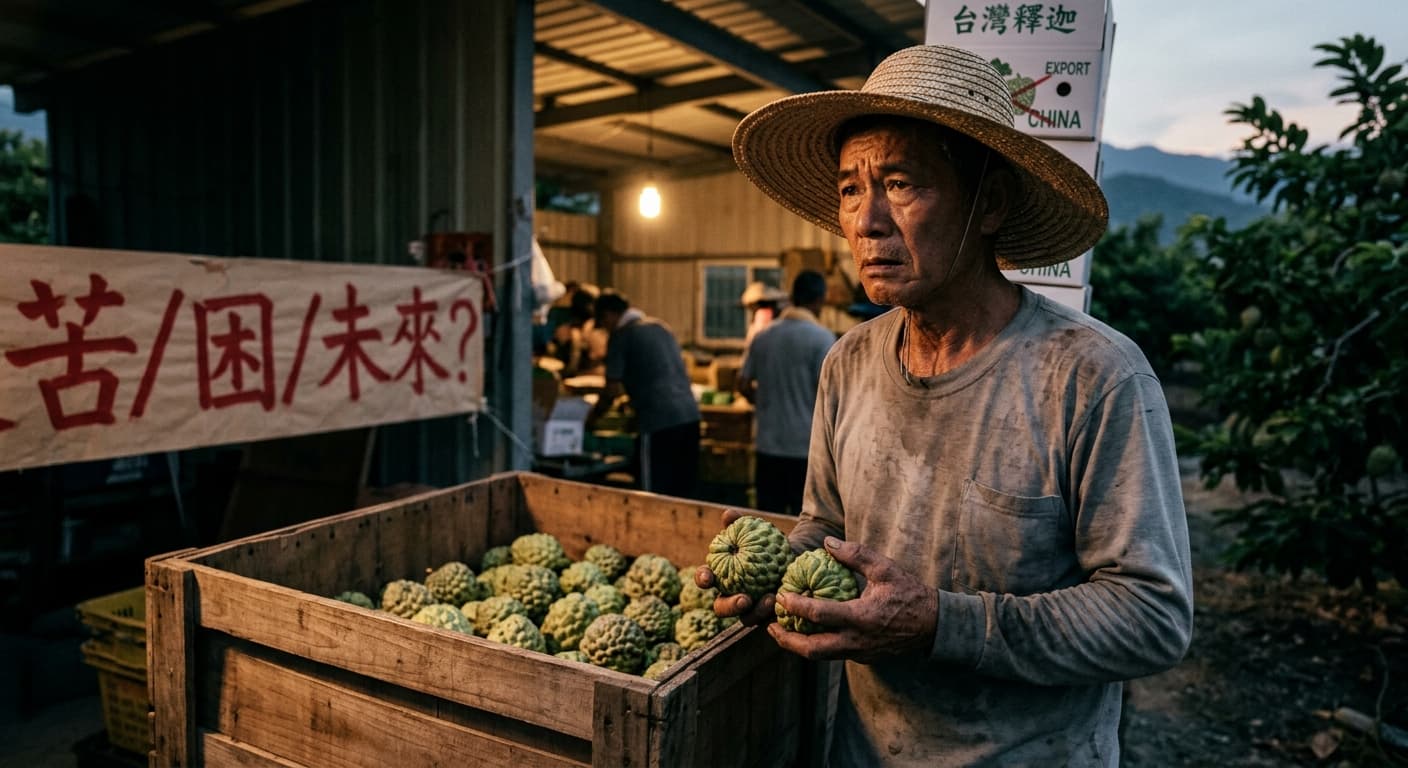
A scaly, heart-shaped fruit has become the latest flashpoint in cross-strait politics. China pledged to expand imports of Taiwanese atemoyas at the Straits Forum in Xiamen on June 13, a move that Taiwan's Ministry of Agriculture immediately labeled a trap—and not merely a trade story. The fruit is a test case for Beijing's weaponization of agricultural markets, and it exposes deep fractures between Taiwan's government and its farmers over whether to embrace or shun the Chinese economy.
The atemoya, a hybrid custard apple specialty of Taiwan's Taitung county, has been caught in this cycle before. After accounting for 95 percent of Taiwan's atemoya exports and generating NT$1.5 billion annually around 2020, China suspended all imports in September 2021 on quarantine grounds, reopened selectively in June 2023, and then slapped a 20 percent tariff plus 9 percent value-added tax in 2024. Each disruption devastated individual farms. Taiwan's agriculture ministry now argues that
Beijing's latest purchase pledge is textbook "raise, trap, kill"—create dependence, then weaponize market access as coercion.
The credibility of that warning rests on a paper trail. Taiwan's fruit exports to China and Hong Kong collapsed from US$30.49 million in 2024 to US$14.62 million in 2025, before stabilizing slightly to US$13.15 million in the first five months of 2026. Meanwhile exports to Japan remained steady at roughly US$30 million annually. The arithmetic is inescapable: China remains a dominant buyer despite its unreliability because no other market yet absorbs the volume Taiwan produces.
What complicates Taiwan's warnings, however, is the political fault line they have exposed. Taitung County Commissioner Yao Ching-ling, a member of the opposition Kuomintang party, promoted atemoyas at the forum via prerecorded video despite an explicit government ban. Taipei Mayor Chiang Wan-an, also Kuomintang, called the government's investigation of Yao a move to "bully and oppress" farmers, arguing that atemoya is "the TSMC of the fruit world"—a uniquely Taiwanese product that needs markets wherever they can be found. The Mainland Affairs Council's warning that officials who attended the forum faced investigation sparked accusations that the government was weaponizing its own agriculture sector for political theater.
The opposition has a point worth acknowledging. Taiwan's recent success diversifying fruit exports—mangoes entered the French market for the first time this month, following two years of EU quarantine negotiations—proves alternatives exist, but they move slowly and don't yet match Chinese demand.
The government's own data show that China and Hong Kong accounted for 56 percent of Taiwan's fresh fruit exports between 2020 and May 2026. Telling farmers to abandon that market is easier for policymakers than for a Taitung grower deciding whether to plant atemoya next season.
What to Watch
The next pressure point is enforcement. The Mainland Affairs Council is investigating officials who attended the Straits Forum; watch whether Taiwan's government follows through on those investigations or allows them to fade. A prosecution signals the government is serious about decoupling agriculture from China; a quiet end signals political weakness. Simultaneously, monitor how quickly Taiwan can redirect atemoya exports to Japan, Southeast Asia, or Europe—success there would validate the government's diversification narrative and undercut the opposition's "we're shutting out farmers" argument.
Most critically, watch what Yao does next. If she defies the central government and attends a subsequent cross-strait forum in person, she signals that local political incentives now outweigh Beijing's threats—a sign that China's coercion playbook is losing its grip on Taiwan's politics, even if it still grips its farmers' economics.
Discover more

India
Women’s Reservation Bill 2026
The Constitution (131st Amendment) Bill, 2026 was defeated in Lok Sabha, revealing deeper political conflicts over women's reservation and delimitation.

India
CPI(M) Calls to Decouple Quota from Delimita
CPI(M) advocates for a 33% women's quota in Lok Sabha by 2029, removing the need for delimitation and census linkage.

Global Politics
US Seizes Iranian Ship, Tensions Surge
The US seizure of the Iranian ship Touska highlights a shift in control over the Strait of Hormuz, favoring Iran's strategic position.

Conflict & Security
Drone Warfare Killing Aid Workers at Unprec
Over 1,000 humanitarian workers killed in three years as cheap armed drones collapse legal protections. Gaza, Sudan, Ukraine, and DRC see deliberate targeting of aid convoys and hospitals with zero prosecutions.