China-Russia: a partnership built on asymmetry
Russia needs China’s markets and technology; China needs Russia’s energy and strategic alignment, but Beijing holds the stronger hand.
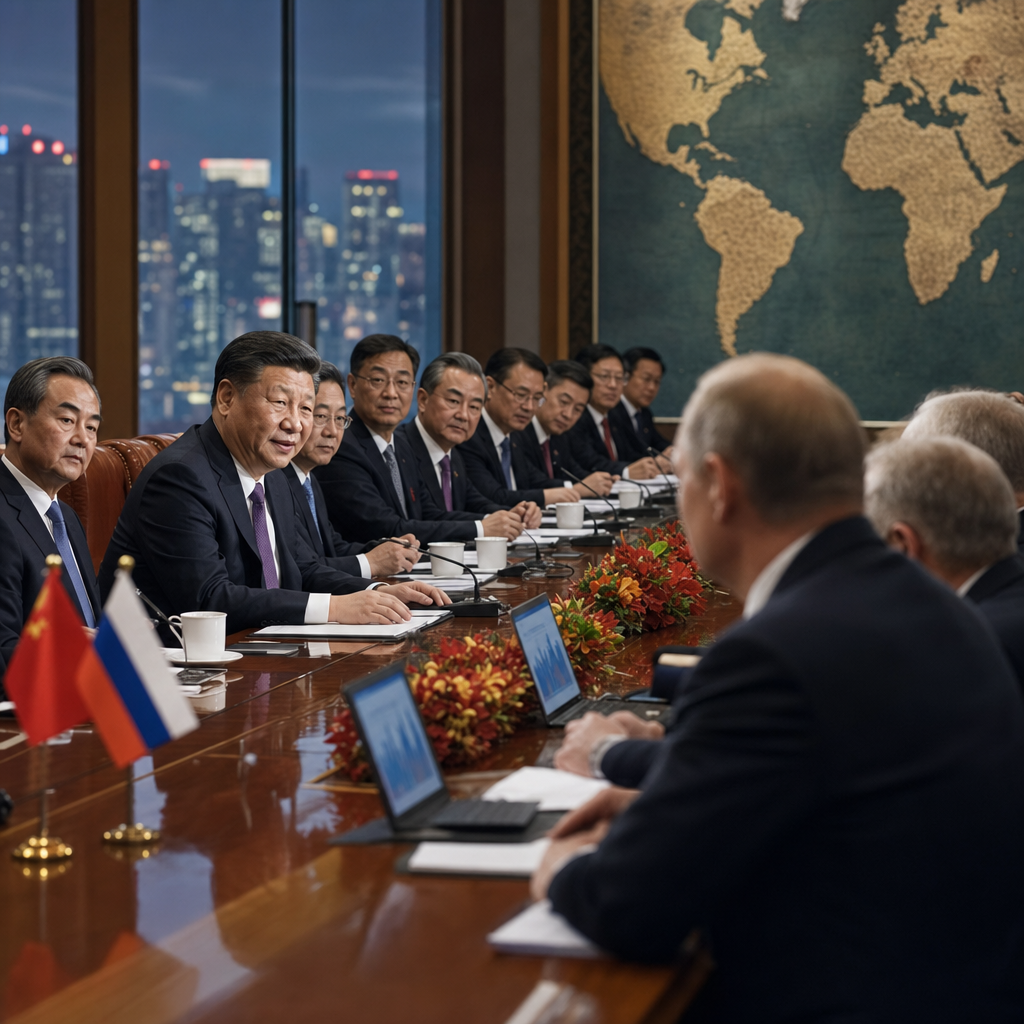
The China-Russia relationship is not a true alliance of equals. China has the leverage: Russia is now dependent on Chinese trade, Chinese components, and Chinese political cover, while Beijing gets cheap energy and a partner useful in its challenge to U.S. power, the BBC’s analysis of Vladimir Putin’s May 2026 visit to Beijing argues ( BBC News Afrique). That imbalance matters because it turns the relationship into a transaction, not a shared strategic project.
What actually binds them
The binding force is practical, not ideological. China is Russia’s largest trading partner, while Russia accounts for only about 4% of China’s international trade, a mismatch that gives Beijing far more room to set terms (BBC News Afrique;  Al Jazeera). Since Russia’s full-scale invasion of Ukraine in 2022, that dependency has deepened: Bloomberg, cited by BBC and Al Jazeera, found Russia was sourcing more than 90% of the technology targeted by Western sanctions from China, including dual-use inputs relevant to drones and other military production (BBC News Afrique; Al Jazeera).
Russia, in return, offers China what it values most: energy and strategic depth. Beijing has become a crucial buyer of Russian oil and gas as European markets have closed, and the two sides are still discussing the long-delayed Power of Siberia 2 pipeline, which would expand Russian gas flows to China via Mongolia (Al Jazeera). For China, that is not just commerce; it is insurance against disruption in vulnerable maritime routes.
Why Beijing is winning this bargain
This is the real power dynamic: Russia needs this relationship more urgently than China does. The BBC notes that any deal between the two is likely to be on Chinese terms, with analyst Alexander Gabuev saying “la Russie est entièrement dans la poche de la Chine” — Russia is entirely in China’s pocket (BBC News Afrique). That is why Beijing can keep political distance while still collecting economic gains. Xi Jinping does not need to match Putin’s rhetoric about “brotherhood”; he only needs the relationship to remain useful.
That usefulness is also geopolitical. The two governments share opposition to a U.S.-led order and coordinate in the UN, BRICS, and the Shanghai Cooperation Organisation, according to both BBC and Al Jazeera (BBC News Afrique; Al Jazeera). But they are not building a formal bloc. They are building a flexible alignment that lets each resist Western pressure without signing up to mutual obligations that would constrain either capital.
For policymakers following  Global Politics, the implication is clear: sanctions on Russia now have a built-in China problem. The harder Moscow is pushed westward, the more it turns east for finance, trade, and technology, and the more leverage Beijing gains over the Kremlin’s war economy (
 Council on Foreign Relations).
What to watch next
The next decision point is whether Beijing will convert this asymmetry into a more explicit energy and infrastructure deal, especially around the Siberia 2 pipeline and wider yuan-ruble settlement mechanisms (Al Jazeera). Watch for any language on pricing, financing, or implementation dates. That will show whether China is simply keeping Russia afloat — or locking in a long-term dependency that Moscow can no longer reverse.