China-Russia Joint Sea-2026 Drill Signals
Naval exercise raises Indo-Pacific security tensions
Model Diplomat8 min readIndo-Pacific
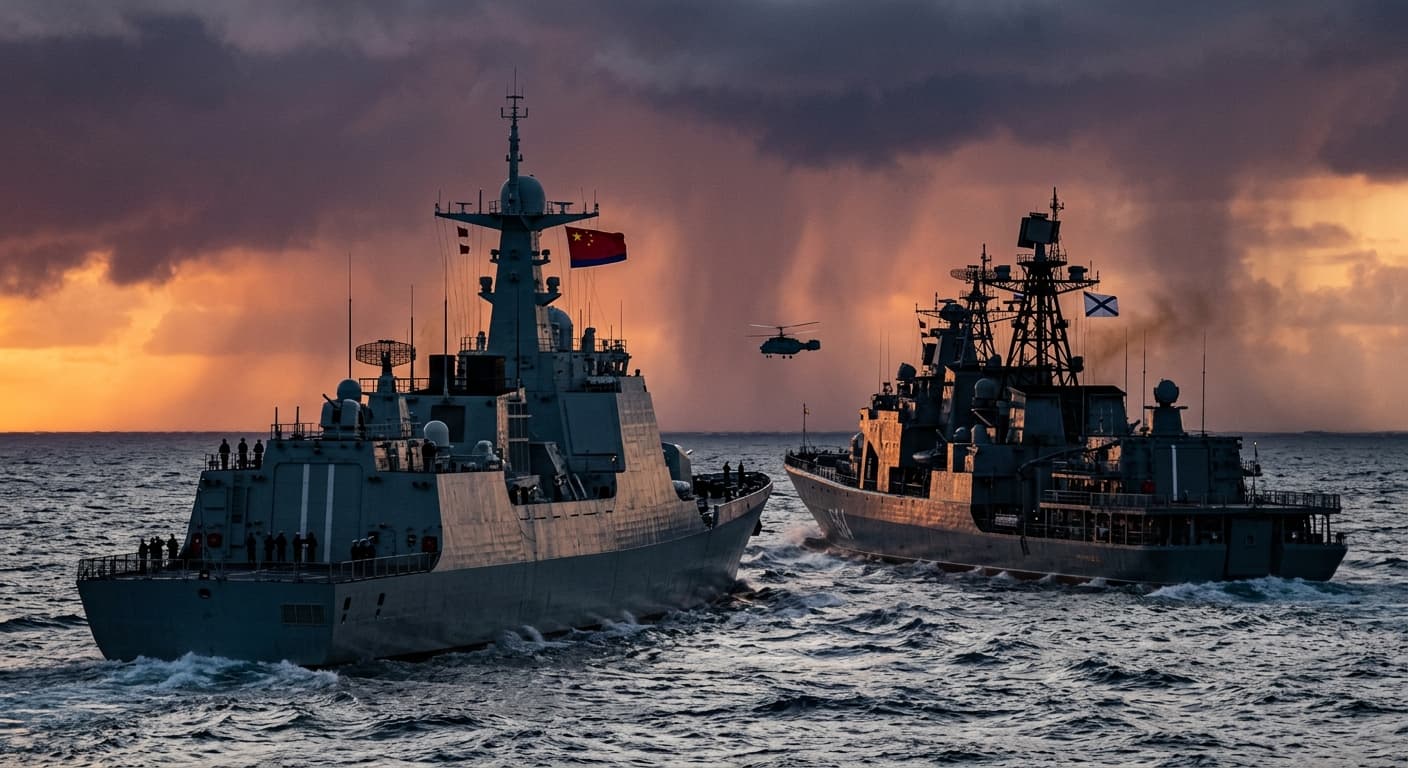
Joint Sea-2026: China–Russia Yellow Sea Drill Sets Indo-Pacific on Edge
China and Russia launched the Joint Sea-2026 naval exercise off Qingdao on July 6, hours after a PLAN submarine-launched ballistic missile test into the Pacific — a coordinated signal reshaping Indo-Pacific security.
Beijing and Moscow launched their eleventh Joint Sea exercise off Qingdao on July 6, 2026, and paired it with something the region has not seen in over 40 years: a Chinese submarine-launched ballistic missile flying into the Pacific with a dummy warhead. The pairing is the story. Joint Sea has always been theater; this iteration is theater bolted to a strategic-nuclear signal, and it lands the same week Australia signs its first-ever mutual defence pact with Fiji. The message the two capitals want registered from Suva to Seoul is that the maritime approaches to Asia are now jointly contested — and that the price of an American-led Indo-Pacific is going up.
According to the USNI News report published on July 6, the PLA Navy fired the SLBM around noon local time from a strategic nuclear submarine in the South China Sea, and the missile flew east of Luzon toward a designated area in the Pacific. The exercise itself runs July 6–13 in Yellow Sea waters and airspace near Qingdao under a "Joint Response to Maritime Security Threats" theme, per the Chinese Ministry of National Defense; after conclusion, elements of both fleets will proceed to a joint patrol in the Pacific.
The signal underneath the drill
Joint Sea by itself is routine. Since 2012 the two navies have run these exercises annually, and the Chinese Ministry of National Defense on August 8, 2025 characterized the series as "an institutionalized cooperation program" that has been "held 10 times" and is a "key platform for China-Russia military cooperation," in a MND press release walking back what it called "groundless speculation" that the drills target third parties.
What is not routine is the pairing. China's SLBM test is its first announced launch of a submarine-launched ballistic missile into the open Pacific in more than four decades — a signal the PLA Rocket Force and PLAN can shoot from under the surface into the ocean the United States must cross to defend Taiwan, Japan, or the Philippines. The BBC noted the previous Chinese ICBM test into the Pacific occurred in September 2024 with a land-based DF-31AG; this one came from a boomer. Analyst Joseph Trevithick at
The War Zone argued the test is "a big deal" because it demonstrates a working sea-based leg of China's nuclear triad in the very ocean U.S. planners assume as sanctuary.
That the launch coincided — to the hour — with a joint drill involving Russia's most powerful Pacific surface combatant is what turns a training event into a signaling event.
Who is participating, and what it says
The order of battle, as detailed by USNI News and confirmed in Russian Pacific Fleet and Chinese MND releases, is heavier on undersea warfare than on surface muscle. The PLA Navy is sending destroyers Kaifeng and Anshan, frigate Wuhu, oiler Kekexilihu, submarine rescue ship Yangchenghu, and a Yuan-class conventional attack submarine. Russia's Pacific Fleet contributes the Slava-class cruiser Varyag, corvette Rezkiy, submarine rescue vessel Igor Belousov, and the improved Kilo-class attack submarine Ufa. The Russian Ministry of Defence, cited by Anadolu Agency, said the maritime phase will "improve joint rescue operations, as well as practice anti-submarine and air defence missions and conduct joint artillery fire."
Two boats and two rescue ships tell you where the training is: under the waves. That matters because the Yellow Sea is not remotely as good a submarine playground as the Sea of Japan or the Philippine Sea — its shallow, silty water is punishing for boats. The choice of venue suggests the exercise is less about tactical realism than about political geometry: parking a Russian submarine and cruiser inside China's near seas, roughly 500 nautical miles from Seoul and 700 from Sasebo, while a Chinese SSBN fires a missile out toward Guam. As Al Jazeera reported last summer, Japan's 2024 defence white paper already flagged China's growing military cooperation with Russia as posing "serious security concerns."
The regional fallout has already started
Reactions across the Indo-Pacific arrived within hours, and the alignment matters more than the language. Australian Foreign Minister Penny Wong, on the ground in Suva to sign a new bilateral treaty with Fiji, told reporters that China's test was "destabilising" and occurred "in the context of a rapid military build-up by China, which is lacking in the transparency and reassurance as to intent that the region expects," according to Al Jazeera.
Japan's government said it was notified only 90 minutes before the launch, expressed "grave concern," and warned that debris could fall within its Exclusive Economic Zone south of Cape Shionomisaki. New Zealand Foreign Minister Winston Peters, per the same report, called it "an unwelcome and concerning development," adding that Pacific countries "have no interest in China using the South Pacific as a testing site for missile capability." South Korea and Japan scrambled fighters in December 2025 when Russian and Chinese aircraft entered Seoul's air defence zone during a joint air patrol, per Al Jazeera — a reminder that the pattern is now annual and multi-domain.
The unspoken subtext in Suva: Australia signed the "Vuvale Partnership" defence treaty with Fiji within hours of the Chinese launch, making Fiji Canberra's fourth formal defence partner after the United States, New Zealand and Papua New Guinea. Prime Minister Anthony Albanese called it one of "the most important" agreements Australia has ever concluded. The choreography — Beijing's missile arcing across the Pacific as Canberra locks in an ally in Fiji — captures the new equilibrium: every Chinese signal now generates a matching Western counter-move in the island chain.
What Washington's own documents say
The June 9, 2026 Congressional Research Service report, "Russian Military Activities in Asia: Combined Military Exercises and Patrols," released by USNI News, quotes Admiral Samuel Paparo, Commander of U.S. Indo-Pacific Command, telling Congress in April 2026: "Russia is expanding its Indo-Pacific footprint even as the war in Ukraine continues to strain Russian capacity." The Defense Intelligence Agency's 2026 worldwide threat assessment, cited in the same report, judges that "Russia relies on China as its key partner in countering the United States in the Indo-Pacific region, and almost certainly will advance ties in 2026 by continuing military technical cooperation, combined patrols, and sharing lessons learned from its war in Ukraine."
That is the operative primary document. It reframes Joint Sea-2026 not as a bilateral exercise but as one recurring instrument in a portfolio of coordinated signaling.
The interoperability question — and why it still matters
Skeptics of a "Sino-Russian axis" point, correctly, to the limits of these drills. A RAND assessment led by Mark Cozad, published in 2023, concluded that "despite building closer ties, the level of integration and interoperability between the two militaries remains limited," and that any wartime cooperation would fall "well below" the fused C4ISR and doctrine of a NATO-style coalition. A
CSIS analysis reached a compatible verdict: the drills institutionalize the partnership "without establishment of a formal alliance" and lean heavily on geographic deconfliction rather than integrated combat.
That is true, and largely beside the point. The value of Joint Sea to Beijing and Moscow is not that they could fight together tomorrow. It is that U.S. Indo-Pacific planners must now allocate ASW, ISR and surface assets against the possibility they might — while managing simultaneous Chinese pressure on Taiwan and Russian escalation in Europe. Every ship dedicated to shadowing the joint patrol is a ship not available for the Taiwan Strait or the South China Sea. RAND's 2019 study on China-Russia cooperation made the point plainly: "Chinese-Russian cooperation in a security crisis on the Korean Peninsula is a reasonable possibility and raises the specter of combined efforts to limit U.S. freedom of action in the event of such a crisis."
The commercial angle everyone is missing
There is a second-order beneficiary that rarely gets named in these stories: China's shipbuilders. CSIS analyst Paul Schwartz has documented how Russian technology "has been, is, and will likely continue to be important for the development of China's surface warfare capabilities." That relationship has now reversed direction. The Slava-class Varyag, commissioned in 1989, is now the elderly ship in a formation whose youngest Chinese destroyer is arguably more capable than anything Russia can put to sea in the Pacific.
The CSIS assessment observed that "the PRC already produces more advanced unmanned aerial vehicles (UAV) and IT systems than the Russian industry and has surpassed Russia in its shipbuilding capacity" — meaning "in the future [Russia] might turn to more Chinese sources to compensate for shortfalls in domestic technologies." Every Joint Sea drill doubles as a showroom. The Ufa's participation in Chinese waters is as much about advertising Russian conventional submarines to third markets — India, Algeria, Vietnam — as it is about ASW training. And the Yangchenghu's role hints at where China wants Russian help next: submarine rescue and long-endurance boat operations, both prerequisites for a credible undersea deterrent patrolling the deep Pacific.
What to watch next
- July 13, 2026 — Scheduled conclusion of the Yellow Sea phase; watch whether the joint Pacific patrol tracks toward the Aleutians, as in August 2023, or south toward Guam and Australia.
- Late July — Australia's formal ratification of the Fiji "Vuvale Partnership" treaty and any Chinese Foreign Ministry retaliation on Suva.
- August–September 2026 — Japan's revised National Defense Strategy update, in which Tokyo is expected to cite Sino-Russian joint operations as a formal planning assumption.
- Fall 2026 — Whether the PLAN discloses the SLBM type (JL-2 vs. JL-3); the JL-3, showcased at the 2024 Victory Day parade, would extend China's undersea reach to the continental United States from bastions in the South China Sea.
Diplomat View
The forecast: Joint Sea-2026 will be remembered less for what happened in the Yellow Sea than for what happened simultaneously in the Pacific and in Suva. The pairing of a routine drill with a rare submarine-launched ballistic missile test, on the same day Australia locked in Fiji, marks the moment the Indo-Pacific security architecture split cleanly into two coordinating blocs — with the island states no longer neutral ground. Expect Japan and Australia to formalize new submarine-detection and P-8 basing arrangements before year-end, and expect Beijing to run one more high-profile SLBM test within 18 months, this time from a JL-3-capable Type 094A or Type 096 boat.
The call is falsifiable. It would be revised if: (1) the post-exercise joint patrol is unusually short or geographically constrained, suggesting Moscow's Pacific Fleet cannot sustain the tempo Beijing wants; (2) China's Foreign Ministry publicly walks back the SLBM test as "unplanned" or "technical"; or (3) Fiji's Rabuka government softens the Vuvale treaty's defence provisions under Chinese economic pressure before ratification. Absent those, the trajectory is set: the Yellow Sea is now the front porch of a partnership that is not an alliance, but no longer needs to be one to change the map. This story sits at the center of Global Politics for the rest of 2026.
Discover more
Global Politics
Xi Jinping Calls China-Russia Ties 'Precious'
Xi Jinping's description of China-Russia ties as 'precious' reflects a strategic imbalance, with Beijing dictating terms in the partnership.

India
Delhi CM Rekha Gupta Blasts Opposition's Delm
Delhi CM Rekha Gupta's remarks on women's quota defeat reveal BJP's strategy for the 2029 Lok Sabha elections, focusing on delimitation.

US Politics
SNAP Food Assistance Faces Legal Challenges
In 2026, SNAP faces stricter eligibility rules and mounting legal challenges, threatening food assistance for the millions of Americans who rely on the program.

Economics
Fed's Amex AML order puts correspondent banking on notice
Federal Reserve's Amex AML order requires board-level controls and a 90-day plan; OCC fined the bank $350 million over enterprise-wide deficiencies.