Chandrababu Naidu's 'Double Engine' Growth in
Tamil Nadu rejects Naidu's growth model in recent elections.
Model Diplomat6 min readTamil Nadu
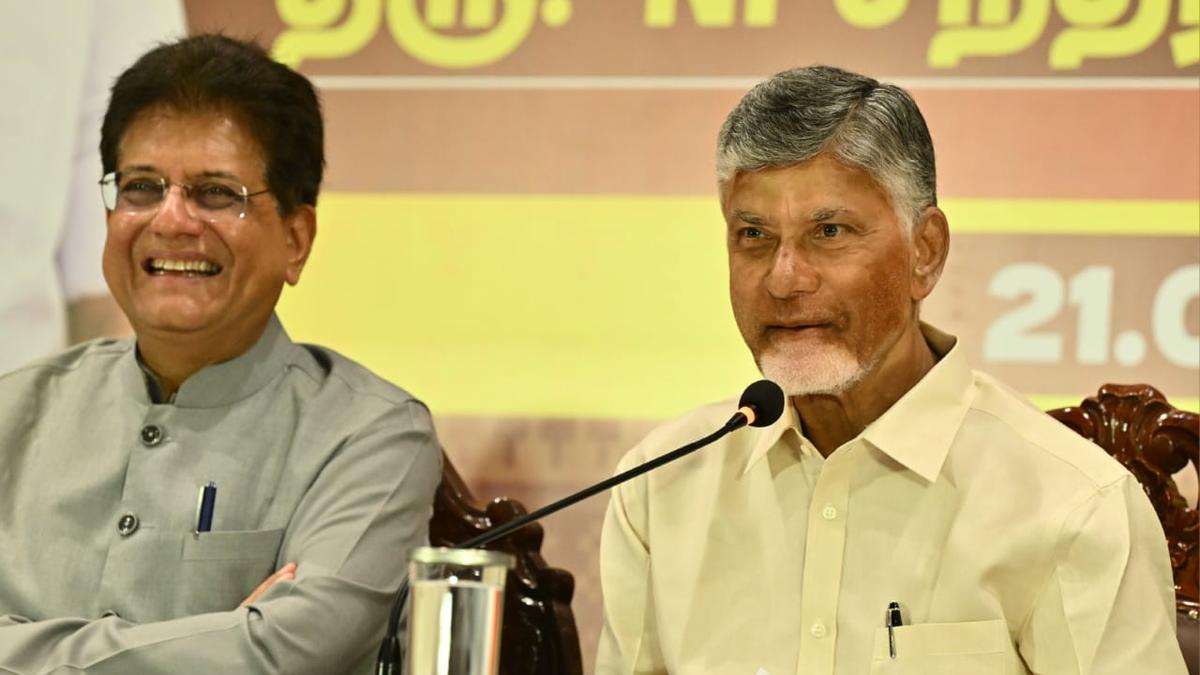
Naidu's 'Double Engine' Pitch Hits a Tamil Nadu Wall
Chandrababu Naidu sold Andhra Pradesh's aligned Centre-state model as the fast lane to growth. On May 4, 2026, Tamil Nadu voted the other way — and exposed the pitch's real audience.
Chandrababu Naidu spent the last week of April 2026 stumping across Tamil Nadu, promising that only a "double-engine sarkar" could deliver "bullet-speed growth" to the state, as reported by The Hindu on April 21, 2026. Twelve days later, Tamil Nadu buried the argument: film star Joseph Vijay's two-year-old Tamilaga Vettri Kazhagam won 108 of 234 seats — neither Dravidian, nor BJP, nor "double-engine" — leaving the AIADMK-BJP alliance in disarray,
per the BBC. The lesson from Chennai is that "double engine" is no longer a growth theory sold to voters — it is a bargaining posture Naidu uses in Delhi, and Andhra Pradesh is where its true costs and beneficiaries sit.
The pitch, and who is actually buying it
Naidu's slogan has three moving parts. The rhetorical part — that BJP-aligned states get faster clearances, better central transfers and more marquee investment — is what he took to Tirunelveli and Chennai. The fiscal part is that Andhra Pradesh, saddled with a bifurcation-era revenue deficit, needs Delhi to underwrite its expenditure. The political part is the leverage: the Telugu Desam Party's 16 Lok Sabha seats, alongside Nitish Kumar's 12, are the reason Narendra Modi's Bharatiya Janata Party — reduced to 240 seats in June 2024 — governs at all, as the U.S. Congressional Research Service documented in its post-election brief.
That third part is doing all the work. Modi's BJP fell 32 seats short of a majority, and its NDA majority of 293 rests on regional partners "whose interests are firmly rooted in their respective states," the CRS notes drily. In 2019, Naidu had publicly called Modi a "terrorist," as the BBC recalled after the 2024 result; by 2024 he was indispensable. That inversion — from insult to indispensability inside five years — is the platform on which everything else rests.
What the double engine has actually delivered in Andhra Pradesh
The showcase is real. In October 2025, Alphabet announced a $15 billion AI data centre in Visakhapatnam — its single largest India investment and part of a state plan to build 6 GW of data-centre capacity by 2029, according to the BBC's coverage of the deal. ArcelorMittal is expanding at Vizag; TCS and IBM signed on to the Amaravati Quantum Valley, where the state has approved a Quantum Computing Policy for 2025–30 and is chasing 1,000 logical qubits by 2029,
Observer Research Foundation reports. The World Bank and Asian Development Bank are jointly financing $1.59 billion of the $1.78 billion first phase of Amaravati as a "growth hub,"
per the World Bank's fact sheet. At Raisina 2026, Naidu pitched Amaravati as a "Quantum Valley" to global investors,
Observer Research Foundation notes.
The macro record is more equivocal. NITI Aayog's March 2025 Macro-Fiscal Landscape of Andhra Pradesh shows real GSDP growing at a decadal average of 6.5%, above the national 5.6% — but manufacturing growth had already slowed to 3.6% in 2022-23, and headline GSDP growth to 7.0%, per the NITI Aayog report. Naidu himself now claims the state is doing "double-digit growth,"
The Hans India reports from a Collectors' Conference. That number does not yet appear in any NITI Aayog or Ministry of Statistics dataset — it is a projection, not a print.
The fiscal small print
The uglier half of the ledger is where the "double engine" argument frays. NITI Aayog's Fiscal Health Index 2026, published in March 2026, classifies Andhra Pradesh as an "Aspirational" state — its polite term for fiscally stressed — alongside Punjab, West Bengal and Kerala. These states, the report says, share "persistent revenue and fiscal deficits often breaching FRBM norms, elevated debt levels of roughly 35–45% of GSDP, committed expenditure accounting for about 50–60% of revenue receipts… and relatively low developmental spending," per the FHI 2026 report.
Andhra Pradesh's debt-to-GSDP ratio hit 32.5% in 2022-23 — above the 30.7% median for large states — with contingent liabilities of 10.4% "significantly higher" than peers, the NITI Aayog macro-fiscal report finds. Its capital-expenditure-to-GSDP ratio of 1.4% is one of the lowest among major states, and its FHI score has slid from 32.3 in 2014-17 to 21.7 in 2023-24. An IMF working paper in November 2024 placed Andhra Pradesh among "high increase in debt" states over the last decade,
Rajan Govil and Khyati Chauhan write for the Fund. Naidu's growth story is being financed, in significant part, by borrowing that Delhi has quietly waved through.
That is what "double engine" actually looks like from inside the machine. Not accelerated transfers — the 15th Finance Commission cut Andhra Pradesh's tax devolution share from 4.3% to 4.0%, NITI Aayog notes — but higher tolerance for slippage, backing for showcase capital projects like Amaravati, and Union-ministry doors that swing open, as when Naidu personally lobbied Union Minister Jitendra Singh for a supercomputing facility at Tirupati and inclusion in the National Quantum Mission,
per a Press Information Bureau readout.
Why Tamil Nadu punctured the pitch
Tamil Nadu was supposed to be the sales demo. Instead, it became the counter-example. The state that stayed defiantly "single engine" under DMK Chief Minister M.K. Stalin was already India's fastest-growing large economy, recording 11.2% growth in 2024-25 with strong manufacturing and social indicators, the BBC reported. On May 4, 2026, voters tossed out both the Dravidian incumbents and the AIADMK-BJP challenger; Vijay's TVK, which had explicitly cast the BJP as its ideological adversary, took 108 seats with a 34.92% vote share and was sworn in the next weekend,
BBC Tamil reported. The AIADMK managed 53 seats; the BJP-led NDA effort collapsed into third place.
Stalin himself framed the contest as "Tamil Nadu versus New Delhi" and accused the Modi government of withholding federal funds, Al Jazeera reported during the campaign. That framing survived his own party's defeat. Vijay's victory,
Al Jazeera argued in a post-result analysis, was engineered largely through social media, bypassing both established Dravidian machines and the double-engine sales pitch. If a promise of aligned growth cannot land in India's most industrialised, best-networked state, its uses elsewhere become obviously political rather than economic.
The BJP did retain Assam, secured Puducherry and made its first serious gains in West Bengal on the same May 4 count. So the "double engine" line still travels in the Hindi belt and the northeast — where it is really a claim about who runs the state, not about growth rates. In the South, it is a receipt: Andhra Pradesh takes the money and the marquee announcements; Tamil Nadu preserves its autonomy and outgrows it anyway.
Diplomat View
Naidu's "double engine" is not, on the evidence, an economic doctrine. It is a coalition-management device dressed as one. The Google, ArcelorMittal and Quantum Valley wins are consistent with Andhra Pradesh's pre-existing manufacturing strengths and Naidu's investor-relations record from Hyderabad in the 1990s — they would likely have come to some Indian state regardless of the political configuration. What Naidu specifically extracts from alignment is fiscal indulgence — the space to run a "high increase in debt" state that NITI Aayog now flags as fiscally stressed. That trade is defensible so long as the growth catches up before the interest bill does, and so long as Modi needs the TDP's 16 MPs to hold Parliament. Both conditions are conditional.
Our forecast: the pitch will quietly disappear from South Indian campaigns after Tamil Nadu, survive in the Hindi belt through the 2027 UP local cycle, and be revised when either (a) Naidu's Fiscal Health Index score slides another five points, forcing a Centre bailout that ends the pretence of state-driven growth, or (b) a delimitation exercise after 2026 shifts parliamentary weight north, ending the TDP's leverage. The forecast changes if Google's Vizag build-out triggers a genuine second wave of AI-infrastructure FDI into Andhra Pradesh by mid-2027 — that would validate the argument retroactively.
Watch these dates:
- August 15, 2026 — Andhra Pradesh's Independence Day fiscal statement, where a mid-year growth print above 10% would substantiate the "double-digit" claim for the first time in official data.
- Late 2026 — the constitutionally required delimitation exercise, which the CRS and BBC both flag as the moment southern states' leverage in Delhi is either preserved or gutted,
per the BBC's coalition analysis.
- 2027 — Google's Visakhapatnam AI campus first phase, tied to the state's 6 GW data-centre target for 2029; slippage here would expose the showcase.
The bottom line: Naidu's "double engine" is a leverage instrument, not a growth model. It buys Andhra Pradesh fiscal indulgence and marquee announcements in exchange for propping up a minority Modi government — and Tamil Nadu's May 4 verdict, along with NITI Aayog's own fiscal scorecard, shows the economic case cannot stand on its own.
Discover more
India
CPI MP Accuses PM Modi of MCC Violations
CPI MP P Sandosh Kumar alleges PM Modi breached the Model Code of Conduct in Tamil Nadu, raising election integrity concerns before the 2026 Assembly polls.
India
Rajnath Singh's Durga Squad for 2026 Polls
Rajnath Singh's Durga Squad promised women's safety in Bengal but has since disappeared from the agenda, revealing BJP's true priorities.
India
Modi's Women’s Convention in Varanasi
Modi's Varanasi rally frames women's reservation as a national mission, targeting the 2027 Uttar Pradesh elections with a strategic narrative.

Conflict & Security
Drone Warfare Killing Aid Workers at Unprec
Over 1,000 humanitarian workers killed in three years as cheap armed drones collapse legal protections. Gaza, Sudan, Ukraine, and DRC see deliberate targeting of aid convoys and hospitals with zero prosecutions.