Canada's Trail Smelter Deal: A Strategic Move
Ottawa invests in Teck Resources to counter China's export ban.
Model Diplomat8 min readNorth America
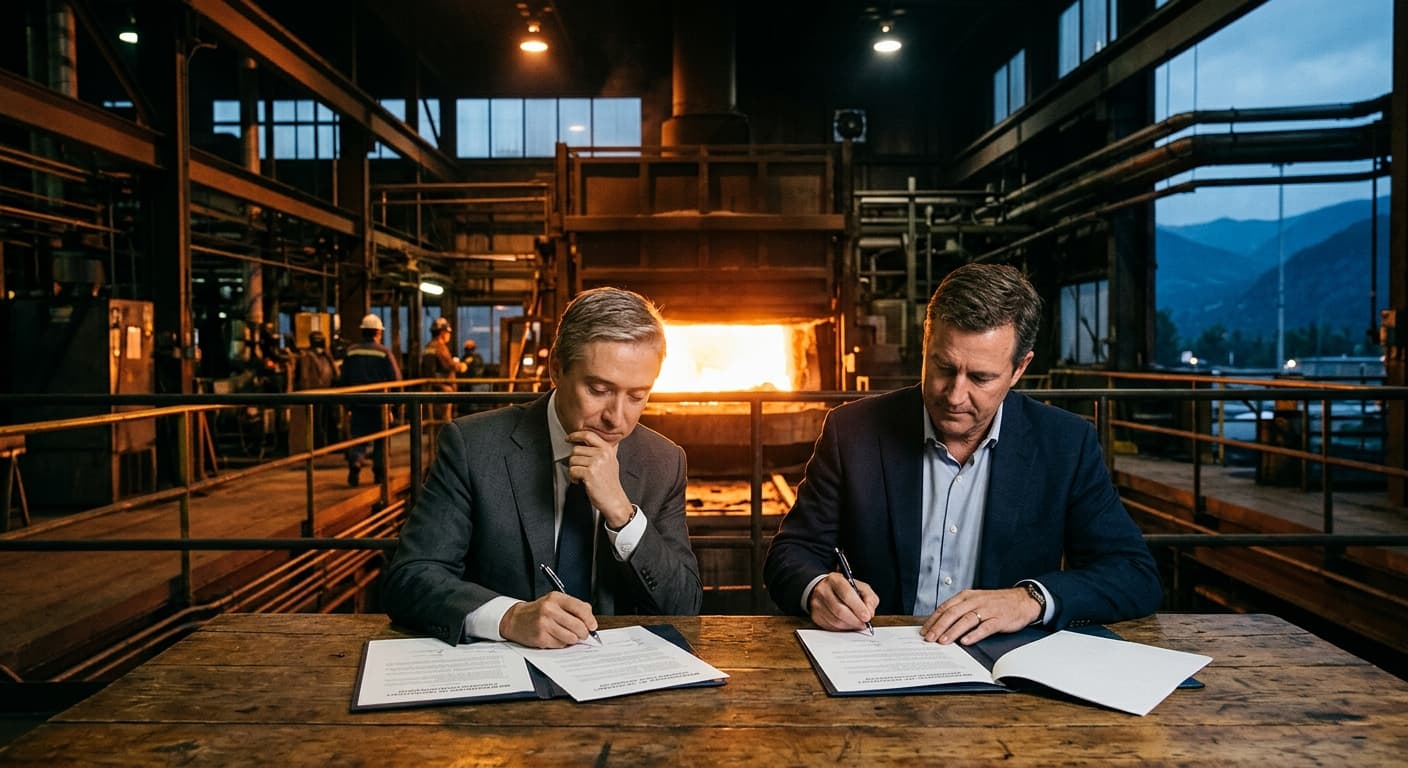
Canada's Trail smelter deal: Ottawa's first CCMA move against China's mineral chokepoint
Canada's July 7, 2026 Teck Resources agreement — up to C$400M into germanium, antimony and gallium at Trail, BC — is the West's fastest answer to Beijing's export ban.
Ottawa announced the first agreement under its new Canada Critical Minerals Accelerator on July 7, 2026, pledging up to C$400 million of Canada Growth Fund capital into Teck Resources' Trail smelter in British Columbia — and it is best read not as a mining subsidy but as the fastest hard-industrial response any G7 country has produced to China's total ban on exports of gallium, germanium and antimony to the United States. The deal doubles the capacity of the West's only integrated smelter that already produces two of those three minerals, adds the third, and — quietly — gives the Canadian government an offtake right that Washington cannot match domestically before 2028. The winner is not Teck. It is Canada's leverage over allies who now need what Beijing has cut off.
What Ottawa actually signed
The Strategic Investment Agreement — the inaugural transaction of the Canada Critical Minerals Accelerator (CCMA), an initiative introduced in Budget 2025 and delivered by Export Development Canada — commits an "equity-like" investment of up to C$400 million from the Canada Growth Fund into Teck's Trail Operations. It is part of an up-to-C$850-million total Teck spend that could double existing production of germanium and antimony and potentially add new gallium capacity, according to the Natural Resources Canada release issued from Trail on July 7.
The structure matters. The CCMA is not a grant program. It gives Ottawa the right "to enter into negotiations on the establishment of an offtake structure, including rights for a portion of future germanium, antimony and gallium produced by Trail." In effect, Canada has secured a call option on the output of the only sizable Western processor of two of these three metals — while recycling investment returns into further projects. Yannick Beaudoin, chief executive of Canada Growth Fund Investment Management, described the transaction as "a third offtake agreement that positions Canada as a reliable partner of choice for global partners seeking access to important critical minerals."
Trail already runs 19 product lines and employs more than 1,400 people. It is Canada's only germanium-producing smelter and, according to a CSIS analysis of the North American zinc supply chain, was the source of roughly 25 percent of U.S. germanium imports in 2023, with Teck as the sole Canadian supplier.
The chokepoint the deal is aimed at
The context is not domestic industrial policy. It is Beijing's decision, effective December 3, 2024, to prohibit "in principle" all exports to the United States of gallium, germanium, antimony and superhard materials — a step announced within 24 hours of Washington's third round of chip-industry export controls, as Al Jazeera/Reuters reported at the time. China accounted last year for roughly 59 percent of refined germanium output, 98 percent of refined gallium, and 48 percent of mined antimony.
The market shock has been severe and lasting. A 2025 study by the Swedish Institute of International Affairs found that Chinese wrought germanium exports fell 60 percent while European spot prices rose about 400 percent; gallium prices rose 365 percent and antimony prices 437 percent. The U.S. Geological Survey, cited by the Stimson Center, estimated that a full gallium-and-germanium ban could
reduce U.S. GDP by $3.4 billion and lift gallium prices 150 percent even before secondary effects.
Washington's own answer is running late. Perpetua Resources' Stibnite Gold Project in Idaho — described in congressional testimony submitted February 6, 2025 as "the only identified domestic reserve of antimony" — received its Final Record of Decision in January 2025 after eight years of NEPA review, but is not scheduled to reach production until 2028. The company holds a reserve of 148 million pounds of antimony, enough to cover roughly 35 percent of U.S. commercial demand in the first six years plus Department of Defense needs. Until then, the United States has no meaningful domestic mine, no domestic gallium production at all, and a National Defense Stockpile that
a 2024 GAO review found could not model requirements for more than 40 percent of the strategic materials it is supposed to hold.
That is the gap the Trail deal fills — from Ottawa, not Washington.
Why Canada moved now, and moved this way
The CCMA is Prime Minister Mark Carney's industrial-policy signature and it fits inside a wider architecture the government has stood up in less than a year. On August 29, 2025, Ottawa created a federal Major Projects Office to compress permitting for nation-building infrastructure, according to the Asia Pacific Foundation of Canada's background note on Canadian critical-minerals policy. On November 14, 2025, the office designated three critical-mineral projects — the Sisson tungsten-molybdenum mine, Crawford Nickel, and Nouveau Monde Graphite Phase 2 — as priority "nation-building" projects. On March 2, 2026, Energy and Natural Resources Minister Tim Hodgson announced at the PDAC convention in Toronto that Canada had secured
30 new critical-minerals partnerships and unlocked C$12.1 billion in project capital. The CCMA is the financing vehicle those partnerships now flow through.
The timing is not incidental. Trade talks between Washington and Ottawa restarted this spring after a months-long collapse triggered by an Ontario anti-tariff advertising campaign, the BBC reported. By mid-2026, President Donald Trump had declined to renew the USMCA on its original footing, according to
Al Jazeera; baseline U.S. tariffs on Canadian goods sat near 8 percent, with sectoral duties on steel, aluminium and autos still in place. In March 2025, Teck CEO Jonathan Price warned publicly that the company might redirect zinc — and, by extension, the germanium concentrates that flow with it — to Asian buyers if U.S. tariffs held, according to the CSIS zinc review cited above.
Carney's government has framed the CCMA as insurance against exactly that scenario. In the government's own words — quoted verbatim from the July 7 release:
"Our new Canada Critical Minerals Accelerator is about turning Canadian resource abundance into real projects by giving industry the certainty to invest and grow, even in a volatile global market."
Read carefully, this is not Team North America language. Ottawa is buying a right to route Trail's output through Canadian offtake before Washington can demand it as a matter of continental supply-chain policy. That is leverage.
The historical parallel — and why this one may hold
Analysts have often compared China's mineral controls to its 2010 rare-earth squeeze on Japan, after which Chinese dominance of rare-earth supply chains fell from 98 percent to 63 percent in less than a decade, the Eurasia Group told the BBC. That parallel is comforting and slightly misleading. Rare earths had multiple viable ex-China deposits waiting to be financed; germanium and gallium are byproducts of zinc and bauxite smelting, and the binding constraint is not geology but midstream refining capacity — precisely what Trail already has.
The Peterson Institute for International Economics noted in October 2024 that China's controls were, so far, "closer to a jab than a haymaker" for U.S. importers, in part because material was reaching Belgium and other conduits before onward re-export. Beijing has since begun tightening on third-country transhipment. In that world, the country holding the only fully integrated Western polymetallic smelter is not a supplier — it is a policy actor.
The IFRI analyst John Seaman argued in a 2023 study that Beijing's real intent was signaling rather than starvation, but warned that Western resilience-building was the predictable "spiraling effect" of continued escalation. The Trail deal is a datapoint in that spiral.

Who wins, who loses
The winners. Teck Resources first: the CGF investment de-risks a C$850-million capital program on a mature asset, and the offtake option preserves flexibility rather than locking in below-market prices. Belgium's Umicore, a major recycler of germanium from e-waste, remains a beneficiary of tight primary supply. Perpetua Resources, whose share price jumped 19 percent after China's antimony announcement, still owns the only permitted U.S. antimony reserve. Tajikistan — the world's second-largest antimony producer and increasingly Washington's preferred alternative supplier, per Heritage Foundation analysis — retains its strategic bid. And the Canadian Growth Fund itself, whose contracts-for-difference authority for critical-mineral projects was highlighted in a
Brookings analysis of North American mineral policy, now has a live template to replicate.
The losers. Nyrstar's proposed Clarksville, Tennessee gallium-germanium expansion, whose $150 million financing had stalled through 2024, faces a stronger Canadian competitor for allied offtake. U.S. defense primes reliant on antimony trisulfide for munition primers now depend on a Canadian smelter operating under a government with the legal right to steer its production. And Beijing loses the assumption that midstream refining is a Chinese monopoly on which coercive export policy can be safely built.
The subtler loser is Washington's negotiating position on the USMCA review. Every offtake right Ottawa books before the deal is signed reduces the leverage of a future U.S. tariff threat over Canadian mineral exports. Fen Hampson of Carleton University put the dynamic bluntly to the BBC: "The Canadians are very smart here. They're ragging the puck, they're running the clock down."
What to watch next
- Third quarter 2026: completion of offtake negotiations under the CCMA agreement. Watch whether Ottawa retains volume for a Canadian strategic reserve versus allocating to U.S. or European buyers, and on what price terms. British Columbia's Look West strategy and the B.C. Strategic Investment Fund will govern the provincial half of the file.
- USMCA review track, second half of 2026: any U.S. demand for national-security carve-outs on Canadian critical-mineral exports, or Canadian resistance to same. Dominic LeBlanc's Washington negotiations are the near-term venue.
- First half of 2028: Perpetua Stibnite's projected first production, and Nyrstar Clarksville's final investment decision. Both would materially change the North American antimony and gallium balance and reduce Trail's monopoly leverage. Any slippage extends Canada's window.
- Ongoing: China's enforcement against third-country transhipment. Tighter enforcement magnifies the value of the Trail expansion; laxer enforcement diminishes it.
Diplomat View
The Trail agreement is not a mining story; it is Canada asserting midstream sovereignty at the moment its two largest trading partners — the United States and China — are actively using critical minerals as coercive tools against each other. The defensible thesis: for the roughly 18 months between now and Perpetua's projected first pour, Ottawa will hold the only near-term Western answer to Beijing's ban on gallium, germanium and antimony exports to the U.S., and it will use that answer to bargain in the USMCA review rather than surrender it under continental-supply-chain language. The forecast would be revised if any of three things happen: Trump concludes a broad mineral-security carve-out that binds Canadian output to U.S. buyers on preferential terms; Beijing quietly relaxes its December 2024 ban in exchange for chip-tool concessions; or Nyrstar secures financing and pulls forward Tennessee gallium-germanium output before Trail's expansion commissions. Absent one of those triggers, expect further CCMA transactions in tungsten, graphite and rare earths before year-end — each one lowering the price at which allies can source strategic materials without going through Canada, and raising the political cost to Washington of continuing to treat its northern neighbor as a tariff target rather than a supply-chain partner.
The Bottom Line
Ottawa's first Canada Critical Minerals Accelerator deal turns a British Columbian smelter into the West's most immediate answer to Beijing's chokepoint on gallium, germanium and antimony — and hands the Canadian government an offtake right the United States cannot replicate before 2028. This is not industrial subsidy; it is midstream sovereignty, timed for a USMCA renegotiation in which Canada intends to bargain from mineral strength rather than tariff weakness. Watch the offtake terms: they will tell you whether Canada is arming its allies or pricing them.
Discover more

India
Modi's Women’s Convention in Varanasi
Modi's Varanasi rally frames women's reservation as a national mission, targeting the 2027 Uttar Pradesh elections with a strategic narrative.
India
700 Activists Accuse PM Modi of MCC Breach
Over 700 activists allege PM Modi breached election code with a televised address attacking opposition parties just before state elections.

India
Women’s Reservation in India
India's 33% women's reservation law is enacted but won't take effect until after 2029 due to political setbacks and census delays.

Economics
Fed's Amex AML order puts correspondent banking on notice
Federal Reserve's Amex AML order requires board-level controls and a 90-day plan; OCC fined the bank $350 million over enterprise-wide deficiencies.