Canada's Northern Shield Energy Corridor
A geopolitical move to secure oil independence
Model Diplomat7 min readNorth America
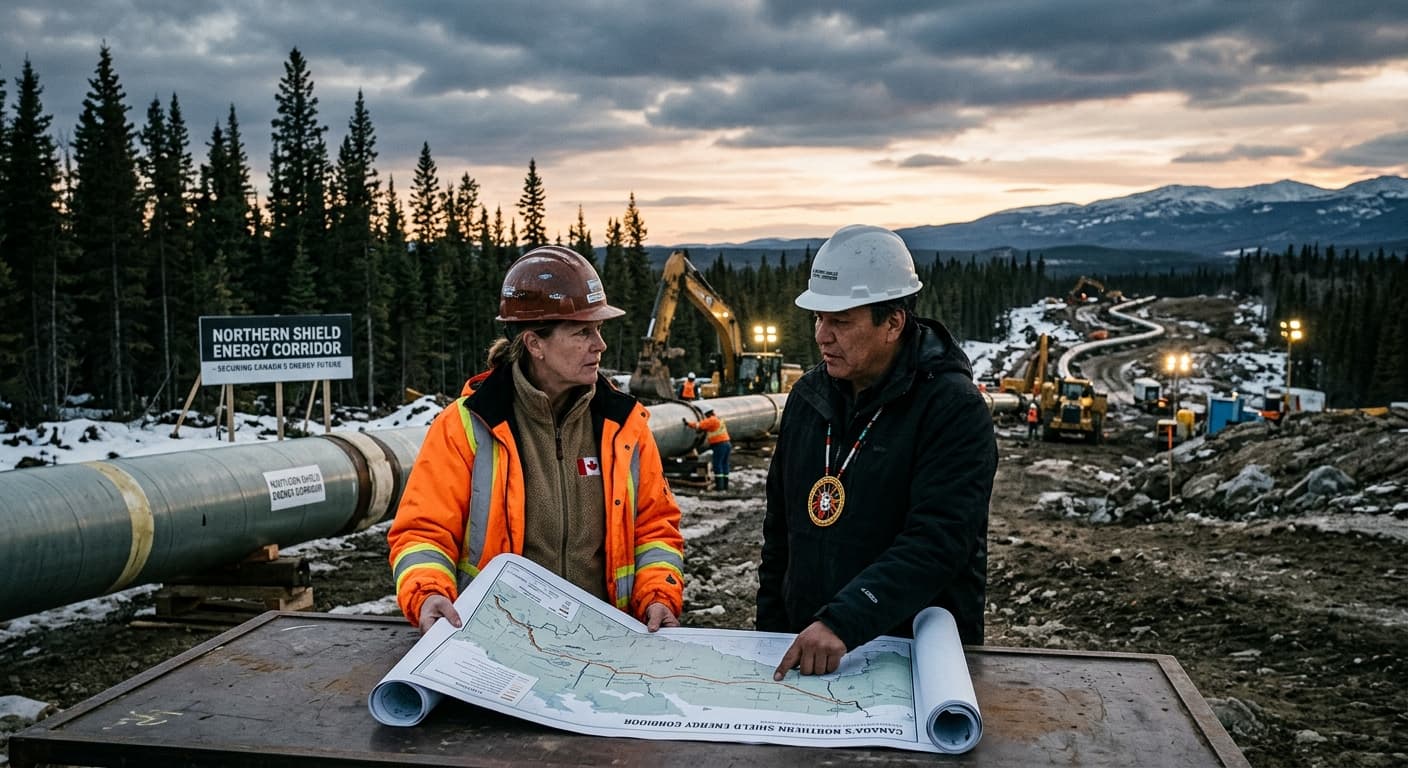
Northern Shield: Canada's 3,300-km bet on breaking free of US oil
Smith and Ford's Hardisty–Sarnia pipeline is less about barrels than about geopolitics — a hedge against Trump's tariffs, Michigan's Line 5, and Ottawa's climate cap.
The Northern Shield Energy Corridor unveiled July 6 in Calgary is not a pipeline plan so much as a sovereignty play: a 3,300-kilometre, 500,000-barrel-per-day artery from Hardisty, Alberta to Sarnia, Ontario, designed to make Canada's oil grid indifferent to who sits in the White House — and, quietly, to insure Ontario against the day Michigan finally shuts Enbridge's Line 5. It is the second west-east energy megaproject that Alberta Premier Danielle Smith and Ontario Premier Doug Ford have pushed onto the national agenda in a week, and the clearest sign yet that the Carney era has quietly buried a decade of Trudeau-era climate orthodoxy.
The announcement, in cold numbers
The corridor would run from Alberta's Hardisty storage hub, parallel Enbridge's Mainline to Regina, then follow the existing TC Energy Mainline right-of-way across the Prairies before hooking southwest into Sarnia's refining belt. Initial throughput is pegged at 500,000 bpd, expandable to 800,000. According to the Ontario government release circulated through provincial channels, the feasibility work is being run by Infrastructure Ontario overseeing an advisory team of GHD, EY Canada, Mokwateh, AtkinsRéalis, Wood PLC and Turner & Townsend, with a report due by the end of 2026. Ontario has committed to a duty-to-consult process with Indigenous partners and floated a domestic strategic petroleum reserve — Canada has none — anchored at Sarnia.
That framing matters. As Pipeline Online noted, this is "Energy East 2.0 — kinda sorta, not really": the old TransCanada scheme was a single-proponent, 1.1-million-bpd export line to Saint John. Northern Shield is a smaller, multi-government instrument aimed first at domestic supply, with a possible extension to the Port of Churchill on Hudson Bay for eventual European exports. The proposal builds on a memorandum of understanding among Ontario, Alberta and Saskatchewan tied to a planned James Bay deep-sea port, as
the deep dive reported, and Ford has volunteered that Ontario is willing to own and finance the line if the private sector balks.
Why now: Trump, Line 5, and a single-customer problem
Read the geopolitics through the trade data and the argument writes itself. According to Global Affairs Canada's State of Trade 2025, 97% of Canada's crude oil exports by value flowed to the United States over the last decade. The
Library of Parliament puts Alberta's 2024 US export share at 88.5% of a C$181.6-billion basket dominated by crude and hydrocarbon gases.
Statistics Canada reports 87% of value-added in the oil-sands extraction industry is tied, directly or indirectly, to US demand. That is not a trading relationship; that is a monopsony.
Donald Trump's second-term tariff campaign turned that dependence into a strategic vulnerability. The Bank of Canada documented Canadian goods exports to the US falling more than 15% in April 2025 after tariff shock hit; Statistics Canada logged the biggest quarterly export contraction since 2009 outside the pandemic. Prime Minister Mark Carney, elected on an "elbows up" platform against Trump, has since committed to doubling Canada's non-US exports over the next decade,
as Al Jazeera reported when Ottawa unveiled the West Coast pipeline agreement on July 3.
The second, quieter driver is Line 5. The 540,000-bpd Enbridge line that runs from Superior, Wisconsin under the Straits of Mackinac to Sarnia supplies the majority of Ontario and Quebec's crude, and Michigan Governor Gretchen Whitmer has been in court since 2020 trying to shut it. Canada invoked the 1977 Transit Pipelines Treaty to keep it flowing, as Al Jazeera reported at the time, and
the BBC called the case "a bellwether of how North America will balance its energy future with its environmental commitments." If Michigan wins — or if a future US administration weaponises Line 5 the way Trump has weaponised tariffs — Ontario, in the phrasing of Pipeline Online, would "literally find itself freezing in the dark." Northern Shield is the insurance policy.
The angle: this is a climate story dressed as an infrastructure story
The corridor's real news value is not that it exists — Energy East died in 2017 and versions have been pitched ever since — but what Ottawa has already conceded to make it plausible. According to BBC News, Carney's November 27, 2025 memorandum with Smith suspends the federal oil-and-gas emissions cap Justin Trudeau had legislated, adjusts the Pacific tanker moratorium and exempts the west-coast project from parts of the federal climate regime. Culture minister Steven Guilbeault, a longtime environmentalist, resigned that evening, citing "no consultation" with Indigenous nations and "major environmental impacts." Reuters, via
Al Jazeera, described the deal as "a shift in Canada's energy policy in favour of fossil fuel development."
The trade-off Carney extracted was an industrial carbon price of C$130 per tonne — one of the highest in the OECD — and a firm demand that any new pipeline be paired with carbon capture and storage. OilPrice.com reported that talks blew past their April 1, 2026 deadline without a signed carbon deal, and that Canadian Natural Resources deferred its US$6-billion Jackpine carbon capture project citing regulatory uncertainty. Cenovus CEO Jon McKenzie went further on the company's Q1 2026 call, calling Canada's carbon tax "unique" and warning capital was already migrating to the US and the Middle East.
That is the paradox Northern Shield sits inside. Smith wants Alberta production to rise from roughly 3.8 million barrels per day to as much as 8 million, as she told CERAWeek, and framed decarbonisation as "a transition away from emissions, not a transition away from production." Carney's Budget 2025 Climate Competitiveness Strategy accepts that framing in return for a stiffer industrial carbon price and CCS build-out. Canada is essentially betting it can double heavy-crude output while lowering per-barrel emissions fast enough to keep European and Asian buyers comfortable. That bet has never been won by any oil producer at scale.
Who benefits, who loses, and who is missing
The winners, in order: Alberta producers (a second inland customer that displaces the discount they take at Cushing), Sarnia's petrochemical complex (a captive supply that no longer depends on Line 5), the Canadian steel industry (Ford pledged Canadian-made pipe), and Saskatchewan Premier Scott Moe, who wedged himself into the trilateral MOU without having to spend a provincial dollar. The Port of Churchill and Arctic-corridor advocates get their strongest political tailwind in a generation.
The losers are less obvious. Quebec, which was to be a key Energy East customer, is not on the route — a political concession that avoids the francophone opposition that killed the earlier project but also means Quebec refineries stay tied to imported Atlantic crude. British Columbia's Premier David Eby, who has fought the west-coast line as "fictional" per BBC, now watches Alberta open a second front he cannot veto. And the Macdonald-Laurier Institute's Heather Exner-Pirot has argued in a
detailed critique that northern-corridor economics are driven by "social and political objectives, not economic ones" — a warning shot at the Churchill spur.
The missing party is the one that can kill it. Manitoba Premier Wab Kinew — a New Democrat and the country's first First Nations premier — has said his government will not sign onto large infrastructure unless Indigenous nations are partners from the outset. The pipeline must cross Manitoba to reach Sarnia. There is no legal alternative route. The Assembly of First Nations has already passed an emergency resolution opposing new pipelines, as Al Jazeera reported, and nine Ontario First Nations have launched a constitutional challenge to Carney's One Canadian Economy Act,
per BBC News. The C.D. Howe Institute's Madeleine McPherson and Peter Fairley have argued that a national electricity grid is a more productive nation-building bet than a "divisive bitumen pipeline," in a
December 2025 memo that has quietly circulated in Ottawa.
What to watch
- End of 2026: Infrastructure Ontario's feasibility study lands, with a cost estimate, a commercial model, and — critically — a preliminary Indigenous consultation record. Any number north of C$25 billion will spook private capital already stung by Trans Mountain's C$35-billion final bill.
- Manitoba's next move: Kinew is the veto. His price is likely equity ownership for affected First Nations and a formal role in Churchill port planning. Whether Ford can meet it without alienating Smith's base is the political test.
- Line 5 litigation: Enbridge's federal court battle with Michigan continues. A shutdown order upheld on appeal would flip Northern Shield from strategic option to emergency necessity, and reshape the domestic politics overnight.
- Carney–Smith carbon deal: Overdue since April 1. Without it, the industrial carbon price and CCS commitments that bought federal buy-in for west-east and west-coast pipelines will begin to fray.
Diplomat View
Northern Shield is a defensible piece of statecraft dressed as a pipeline. If Canada is serious about diversifying away from a US market that Trump has weaponised, redundant east-west heavy crude infrastructure is not optional — it is the minimum insurance for the country's largest export sector. But this project will be judged less on barrels than on two variables: whether Manitoba's Kinew is offered equity and Indigenous co-ownership meaningful enough to unlock the corridor, and whether Ottawa can hold Smith to the C$130-per-tonne industrial carbon price and CCS build-out that made the November 2025 accord politically survivable. Get both, and Northern Shield becomes the spine of a genuinely post-American Canadian energy strategy. Miss either, and it becomes Energy East's second funeral — with the added cost of having burned Ottawa's remaining climate credibility to pay for the wreath. The forecast revises if the feasibility study lands above C$30 billion, if the Line 5 case tips against Enbridge, or if Manitoba formally refuses right-of-way. Watch those three, in that order.
The bottom line: The Northern Shield Energy Corridor is Canada's most explicit bet yet that the US market is no longer a safe monopsony for Alberta crude — and the price of that bet is a climate settlement that trades Trudeau's emissions cap for a higher industrial carbon price and a Manitoba veto that nobody has yet figured out how to lift.
Discover more
Global Politics
Xi Jinping Calls China-Russia Ties 'Precious'
Xi Jinping's description of China-Russia ties as 'precious' reflects a strategic imbalance, with Beijing dictating terms in the partnership.

India
Women’s Reservation in India
India's 33% women's reservation law is enacted but won't take effect until after 2029 due to political setbacks and census delays.

India
Yamini Aiyar on Modi's Federalism Shift
Yamini Aiyar critiques Modi's shift from equity-based to performance-based federalism, highlighting implications for India's political landscape.

Economics
Fed's Amex AML order puts correspondent banking on notice
Federal Reserve's Amex AML order requires board-level controls and a 90-day plan; OCC fined the bank $350 million over enterprise-wide deficiencies.