Canada's Critical Minerals Bet in the AI Arms
Canada races to build midstream refining capacity to counter China's rare earth dominance.
Model Diplomat8 min readNorth America
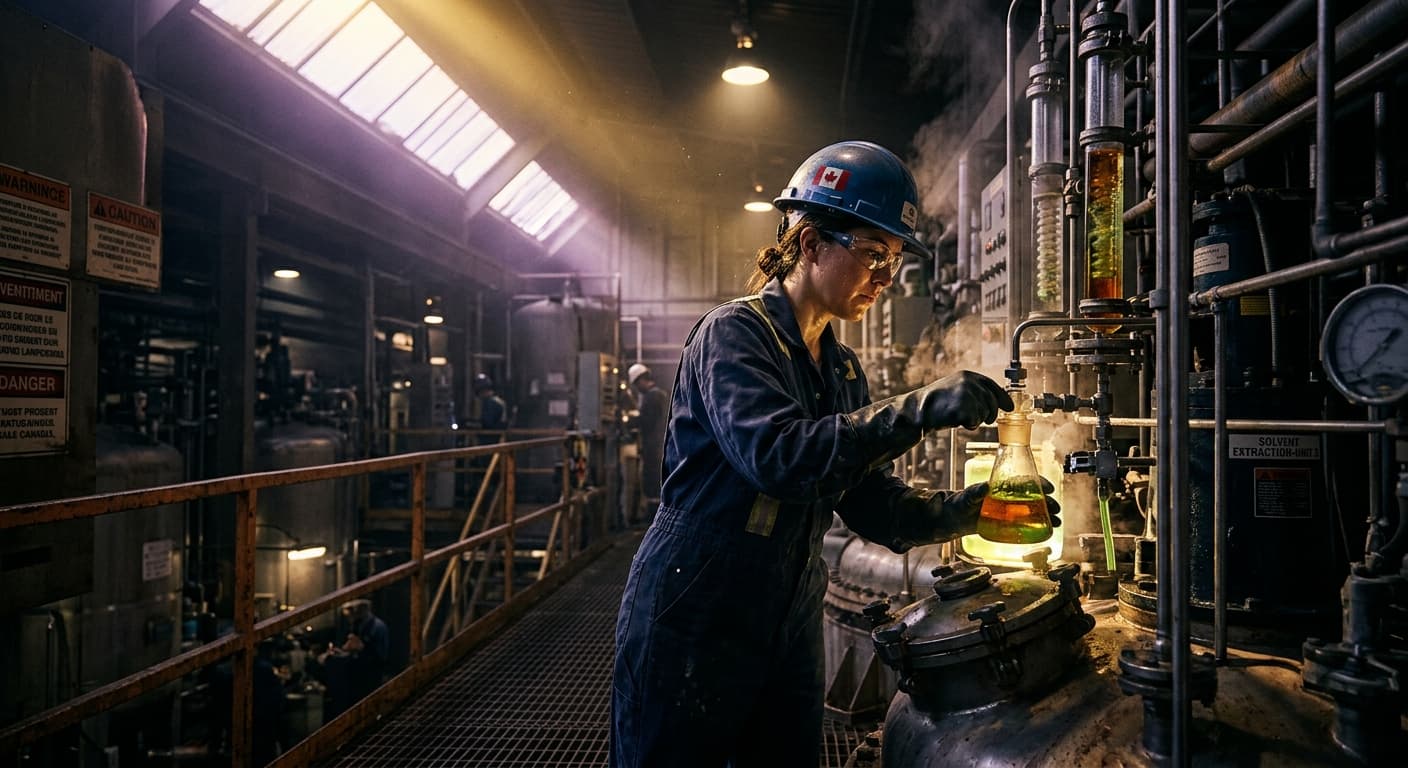
Canada's Critical Minerals Bet: The Hidden Front in the AI Arms Race
Canada is racing to convert its mineral reserves and AI expertise into midstream processing leverage — but China's 90% grip on rare earth refining means Ottawa's strategic advantage hinges on mastering the chemistry, not just the geology.
On July 7, 2026, NATO Secretary General Mark Rutte stood at the Defence Industry Forum in Ankara and announced a new High Visibility Project on critical raw materials, bringing together 12 allies, including Canada, to strengthen the resilience of defence supply chains. The move formalised what had been apparent for months: the race for critical minerals is now a core security theatre, not a niche commodities story. For Canada, which sits atop 56 active critical mineral mines, 31 processing facilities, and roughly 170 advanced projects, the convergence of AI infrastructure demand and mineral supply-chain anxiety opens a narrow, time-bound window to become the indispensable midstream processor for the Western alliance. The thesis is straightforward: Canada's real AI opportunity lies not in software or compute, but in building the refining and separation capacity that breaks China's midstream chokehold on the materials AI hardware depends on.
The midstream chokepoint
The AI economy is usually framed around chips and data centres. But every AI server, robotics platform, autonomous vehicle, and advanced defence system depends on rare earth elements, gallium, germanium, and graphite. China controls not just the mining of these materials but, decisively, the refining and separation processes that turn raw ore into usable inputs. Pierre Gratton, president of the Mining Association of Canada, told a House of Commons committee that China "maintains roughly 85% to 90% of the world's rare earth refining and separation capacity and dominates the production of rare earth magnets and other downstream components" (Parliamentary Committee report, publications.gc.ca). The IEA corroborates this, reporting that China leads refining for 19 of the 20 strategic minerals it tracks (
ORF analysis citing IEA).
China has weaponised this position with escalating precision. In July 2023, Beijing imposed export restrictions on gallium and germanium — two minerals essential for semiconductors and AI hardware (CSIS). April 2025 brought seven rare earth elements onto the control list. By October 2025, Beijing had expanded to 12 of 17 rare earths, requiring foreign firms to obtain government approval to export magnets containing even trace amounts of Chinese-origin material (
BBC News). The new rules, effective December 1, 2025, largely deny licences to any company affiliated with foreign militaries (
CSIS). A bilateral truce suspending some controls runs only until November 10, 2026: a pause, not a resolution (
ORF).
The strategic implication is an asymmetry of leverage. Beijing can target Western rare earth champions at little cost to itself; Washington and its allies have no comparable instrument. As the Observer Research Foundation put it: "Funding mines and magnet plants is necessary, however it is not sufficient. Until the middle of the supply chain is genuinely domestic, federal funding can buy progress, not independence" (ORF).
Canada's policy architecture
Ottawa's response is a multi-layered industrial strategy that explicitly links minerals to AI, defence, and energy. Since launching its Critical Minerals Strategy in December 2022, Canada has committed roughly C$4 billion to support critical mineral production, including a C$2 billion Critical Minerals Sovereign Fund to facilitate investment in mining projects with a key objective of building domestic refining and processing capacity (APF Canada background note). The First and Last Mile Fund provides up to C$1.5 billion through 2030 for upstream and midstream infrastructure, including a dedicated Indigenous capacity-building stream (
Canada.ca). The federal government has also invested C$400 million in Teck Resources Ltd., a strategic play connecting mineral supply to defence and green energy supply chains (
Surcogestion). On November 14, 2025, Ottawa designated three major critical-mineral projects — the Sisson tungsten-molybdenum mine in New Brunswick, Crawford Nickel in Ontario, and Nouveau Monde Graphite Phase 2 in Québec — as "nation-building projects" to be fast-tracked through the Major Projects Office (
APF Canada).
The architecture extends beyond extraction. The Canadian Sovereign AI Compute Strategy, launched as part of the "AI for All" five-year national strategy in June 2026, treats compute capacity as a pillar of national competitiveness, with C$926 million committed to sovereign AI computing infrastructure (C.D. Howe Institute;
Policy Options). But as Creso Sá argued in Policy Options, "sovereign infrastructure built on someone else's technological foundations and subject to someone else's laws is a narrow form of sovereignty." The chips running Canadian data centres remain governed by American export-control law (
Policy Options).
This is where the mineral-AI nexus becomes consequential. Canada's 82% non-emitting electricity grid, cold-climate cooling advantage, and mineral endowment create a compounding strategic position: clean power for AI compute, critical minerals for AI hardware, and processing capacity that could anchor a North American supply chain independent of Chinese refining (Policy Options). Vlado Vivoda of the Asia Pacific Foundation frames this as a shift "from resources to national capability," where critical minerals, energy, defence, and compute are treated as "a unified capability agenda" (
APF Canada).
AI as producer, not just consumer
A critical and underappreciated dimension: AI is not only driving demand for critical minerals — it is being deployed to find and process them. Aclara Resources, collaborating with Stanford University's Mineral-X initiative, Argonne National Laboratory, and Virginia Tech, is developing AI-driven technologies for rare earth exploration and processing, including predictive models for mineral deposits and AI-enabled digital twins that simulate and optimise complex rare earth separation processes (Digital Journal). Argonne notes that advanced computing, process modelling, and AI can accelerate the transition from pilot-scale to commercial-scale rare earth production, reducing costs and improving recovery rates (
Digital Journal).
This matters because processing rare earth elements is often more challenging than mining them. A parliamentary committee heard that Canada lacks a rare earth processing system and, while it has the ability to build hydrometallurgical facilities, it lacks "the experience to be able to run them." Mark Tory, an industry witness, pointed to China's systematic investment in universities producing chemical engineers able to run separation plants, and warned that Canada needs to "immediately build the facilities that industry will require in five, seven and 10 years' time" (Parliamentary report). The committee's Recommendation 12 calls for a "domestic mine-to-magnet strategy" — a formulation now central to Canada's industrial ambition.
Ontario is moving concretely. The province invested C$500 million in May 2025 in a Critical Minerals Processing Fund, and Errington Metals received C$700,000 in combined funding from the Critical Minerals Innovation Fund and Ontario Junior Exploration Program for metallurgical studies at its Sudbury Basin Project, targeting copper and zinc recovery from polymetallic sulphide mineralisation (FT Markets / CNW).
The geopolitical chessboard
Canada is not pursuing this alone. Under the G7 Critical Minerals Action Plan launched during Canada's 2025 G7 presidency in Kananaskis, Ottawa announced 26 investments and partnerships with nine countries by October 2025, unlocking billions in mining and refining investments (ORF). Canada, Japan, and France have begun building a trilateral alignment: Canada provides upstream scale, France contributes midstream processing and financing capacity, and Japan brings demand certainty and offtake commitments. Japan committed to sourcing nearly 20% of future rare earth demand from France-backed refining projects such as Caremag (
ORF).
Ottawa has also proposed a "buyers' club" model — coordinated purchasing among trusted partners to guarantee demand for non-Chinese suppliers, addressing the central commercial challenge that Chinese producers undercut prices and render alternative projects unviable (ORF). The first Canada–India Critical Minerals Annual Dialogue launched at PDAC in Toronto in March 2026, and a trilateral Australia–Canada–India Technology and Innovation Partnership is being operationalised (
APF Canada). Meanwhile, Prime Minister Mark Carney's July 2026 state visit to Saudi Arabia — the first in over 25 years — produced 13 agreements covering mining, energy, and AI, worth approximately $1 billion (
Al Jazeera).
On the defence side, Canada's participation in the NATO High Visibility Project on critical raw materials, launched July 7, 2026, embeds mineral security directly into alliance doctrine. Secretary General Rutte stated: "For our defence to remain ready and strong, we need our industrial base and our supply chains to be resilient" (NATO). The project focuses on acquisition, storage, transport, and management of critical raw materials essential for defence production — the same materials AI hardware requires.
The historical parallel
The 2010 Senkaku/Diaoyu rare earth embargo provides the template. When Japan detained a Chinese fishing trawler captain near disputed islands, Beijing cut off rare earth exports to Japan, sending shockwaves through Japanese manufacturing and prompting Tokyo to fund diversification efforts that continue to this day. The lesson was not lost on Canada's policy community: control over processing, not reserves, is the leverage point. China's ore deposits are not exceptional; its refining infrastructure, process knowledge, and chemical engineering talent are. As the parliamentary committee heard, the technology for extracting rare earth elements is "largely controlled or developed by China," with new developments in Germany and Europe — but not Canada (Parliamentary report).
Winners and losers
If Canada succeeds in building midstream capacity, the winners are specific: Canadian mining and processing firms with access to downstream facilities (Aclara Resources, Errington Metals, Teck Resources); provinces hosting processing hubs (Ontario, Québec, Saskatchewan); allied manufacturers seeking secure North American supply (Japanese automakers, U.S. defence contractors); and Indigenous communities positioned to benefit from the FLMF's capacity-building stream. Saskatchewan's Research Council has already established a rare-earth processing facility, positioning the province as an early player (Mining.com).
The losers are equally concrete. China loses market share and coercive leverage. Projects dependent on Chinese refining — including those of junior miners without offtake agreements — face stranded-asset risk. And the U.S., despite billions invested in MP Materials and USA Rare Earth, remains critically thin in midstream separation. MP Materials has exported its concentrate to China for separation for two decades; heavy rare earth separation remains covered by a Pentagon supply agreement, and Chinese rare earths will not be fully removed from the U.S. defence supply chain until 2027 (ORF).
Critics warn that Canada's strategy could be misallocated if heavy emphasis remains on mining without sufficient funding for processing, recycling, and skilled workforce development. The capital intensity of midstream facilities, long payback periods, and competition from entrenched Chinese supply chains all pose risks. As the Asia Pacific Foundation noted, "critical minerals are a vital diagnostic for this shift because they test whether governments can co-ordinate across jurisdictions, sectors, and time horizons" (APF Canada).
What to watch
- November 10, 2026: Expiration of the bilateral truce suspending China's rare earth export controls: the next inflection point for supply-chain risk.
- 2027: U.S. target date for removing Chinese-origin rare earths from American weapon systems: a deadline that will test allied processing capacity.
- March 2027: First Canada–India Critical Minerals Annual Dialogue follow-up at PDAC Toronto.
- March 31, 2030: First and Last Mile Fund funding deadline: the fiscal window for infrastructure investment.
The Bottom Line
Canada's bet is that the AI revolution will be won not in data centres but in refineries. The country which controls the chemistry of rare earth separation, gallium purification, and graphite processing will hold the same strategic position in the 2030s that oil producers held in the 1970s. The minerals are in the ground. Policy architecture is in place. The allies are at the table. What Canada still lacks is the process knowledge, the chemical engineering talent, and the operating experience to run midstream facilities at commercial scale. If Ottawa closes that gap before the November 2026 truce expires and the 2027 U.S. defence deadline arrives, Canada becomes the indispensable midstream hub for the Western alliance. If it does not, the strategy risks becoming another chapter in a familiar Canadian story: vast resources, insufficient value capture, and dependence on someone else's refining capacity.
Discover more
US Politics
House Ethics Committee Pushes Sexual Miscond.
The House Ethics Committee has shifted responsibility for sexual harassment settlement records to the Office of Congressional Workplace Rights, complicating disclosure efforts.
India
700 Activists Accuse PM Modi of MCC Breach
Over 700 activists allege PM Modi breached election code with a televised address attacking opposition parties just before state elections.

India
Modi's Women’s Convention in Varanasi
Modi's Varanasi rally frames women's reservation as a national mission, targeting the 2027 Uttar Pradesh elections with a strategic narrative.

Economics
Fed's Amex AML order puts correspondent banking on notice
Federal Reserve's Amex AML order requires board-level controls and a 90-day plan; OCC fined the bank $350 million over enterprise-wide deficiencies.