Canada-Germany Strategic Pact Unveiled
New partnership reshapes transatlantic defense ties
Model Diplomat8 min readNorth America
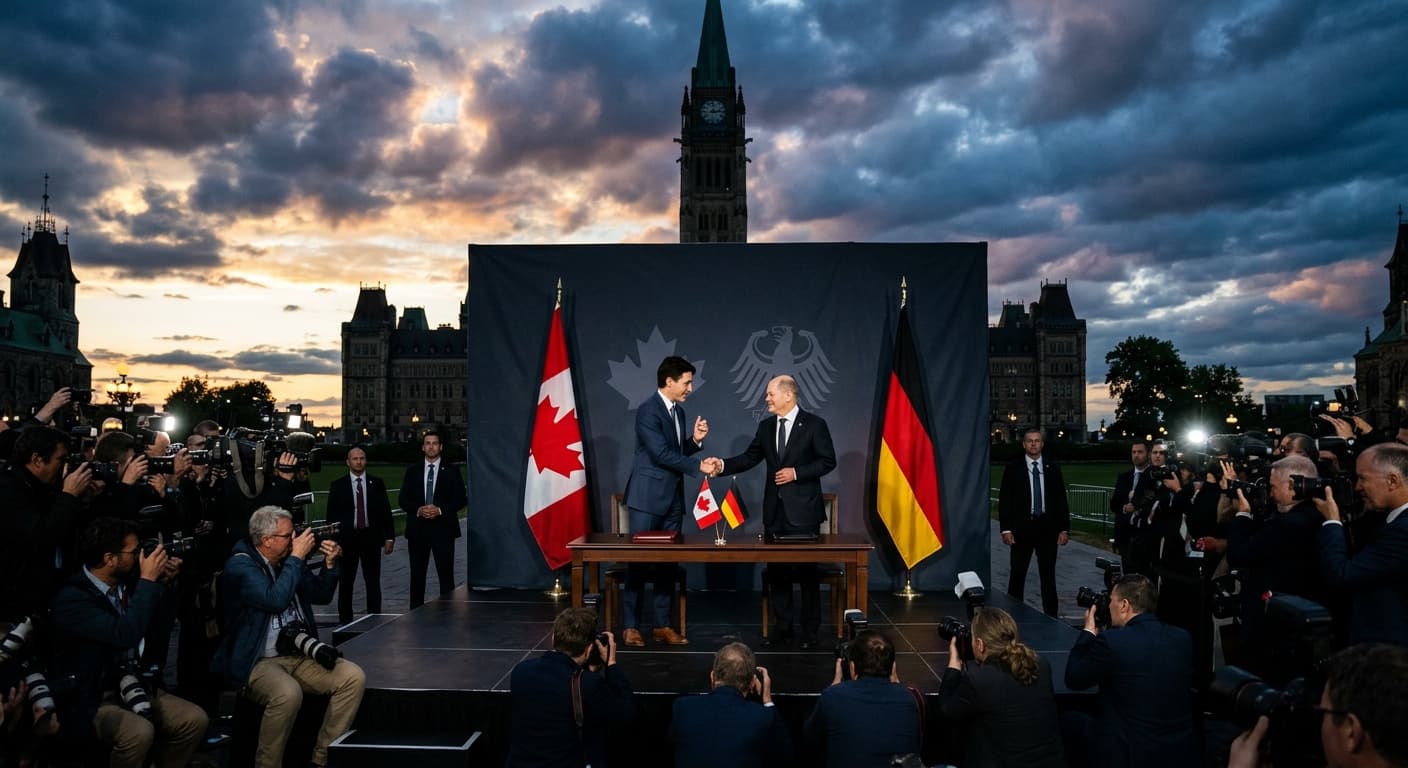
Carney and Merz launch Canada-Germany strategic pact in Ankara
Canada and Germany opened talks on a Strategic Partnership Agreement at the July 7, 2026 NATO summit — a bilateral realignment on defence, minerals and energy that reshapes the transatlantic geometry.
On July 7, 2026, on the margins of the NATO summit in Ankara, Prime Minister Mark Carney and Chancellor Friedrich Merz announced they had opened formal negotiations toward a Canada-Germany Strategic Partnership Agreement, aiming to sign before year-end. The framework, unveiled the day after Ottawa named Germany's TKMS as preferred bidder on a 12-submarine, roughly C$60 billion contract, does something a NATO communiqué cannot: it hard-wires a bilateral rearmament and critical-minerals corridor between the alliance's second-largest and fourth-largest economies at the exact moment Washington is telling Europe to defend itself. This is not a photo-op partnership. It is the operating agreement for a post-American NATO wing, and its most important effect is to move Canadian defence procurement, energy exports and industrial policy decisively out of the US orbit and into Europe's.
What the two leaders actually agreed
The joint statement issued by the Prime Minister's Office on July 7 is short and unusually specific about scope. It lists five negotiating baskets: security and defence; technology, artificial intelligence and space; supply chains and critical minerals; energy; and investment. The leaders instructed Foreign Minister Anita Anand and her German counterpart Johann Wadephul to run the negotiations, and set a deadline of end-2026 for finalisation, according to the Government of Canada release.
The bilateral readout is worth reading verbatim. In the operative paragraph, Ottawa states:
"The Partnership Agreement will serve as a flexible strategic framework through which Canada and Germany will shape and advance cooperation, and direct investment in key strategic industries, for years to come."
That formulation — "direct investment in key strategic industries" — is not treaty boilerplate. It signals a state-directed industrial policy layer on top of CETA, the 2016 EU-Canada trade agreement, which the European Council notes has driven EU-Canada goods and services trade to €125 billion in 2024. Canada-Germany bilateral trade alone runs above C$34 billion, per the
Prime Minister's Office readout.
Merz's framing at the Berlin press event with Carney last month was blunter. Germany and Canada, he said, "stand firmly by Ukraine's side" and would "jointly [secure] NATO's eastern flank," with Canada as the framework nation in Latvia and Germany's new brigade standing up in Lithuania, according to the Federal Chancellery. That is the political spine of the new agreement: two lead-nation deployments on Russia's border, welded to a shared industrial base at home.
The submarine deal reframes the pact
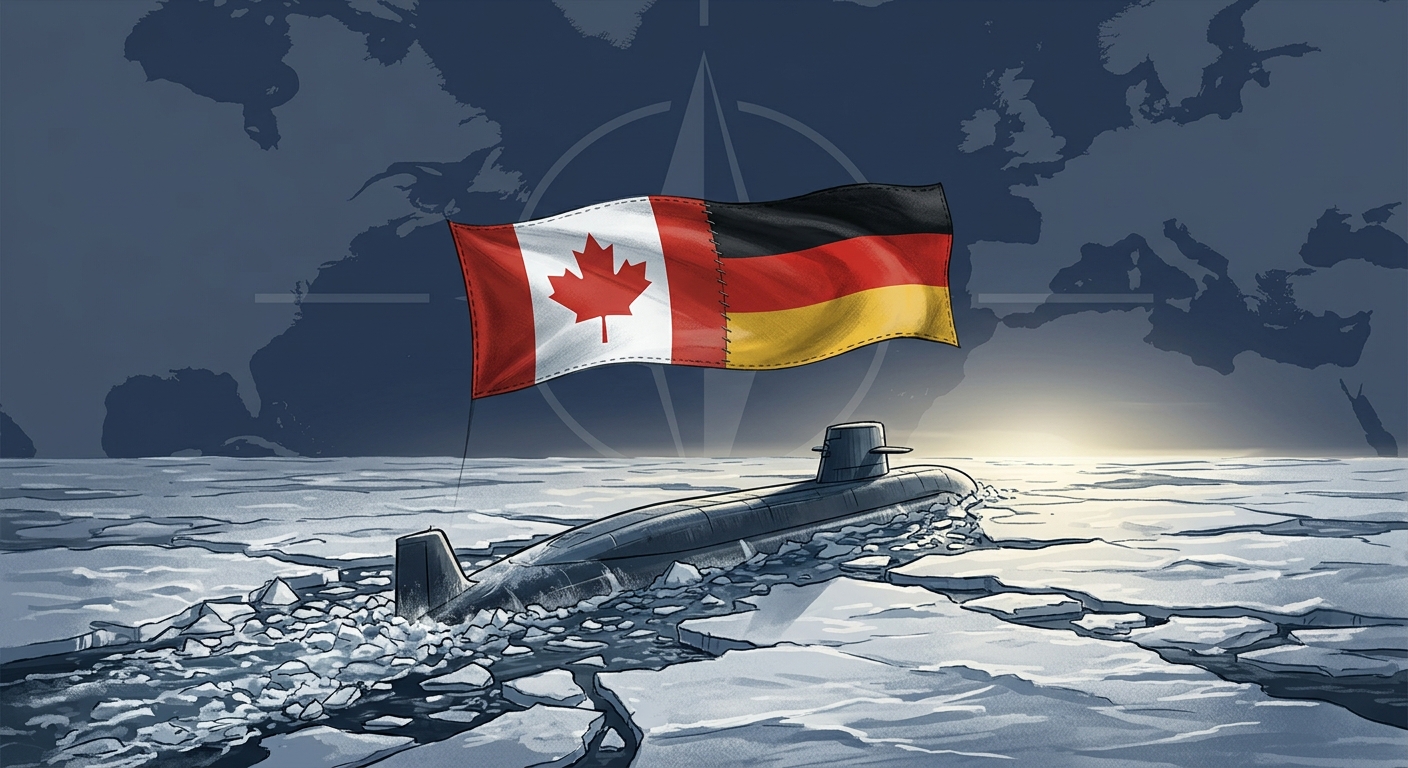
The Strategic Partnership Agreement did not appear from nowhere. It was pre-loaded by the largest defence procurement in Canadian history — announced 24 hours earlier. On July 6, Carney named TKMS, in a joint bid with Norway's Kongsberg, as preferred supplier of 12 under-ice-capable submarines to replace Canada's four ageing Victoria-class boats, only one of which is currently seaworthy, according to BBC News. The Stimson Center puts the headline value "upwards of CA$60 billion," with the full lifetime package — 30 years of sustainment, technology transfer and industrial offsets — potentially "two to three times that amount," in
analysis published June 29, 2026.
Merz called the choice "a strong signal of transatlantic and European co-operation in the defence industry," per the Financial Times. It is more than a signal. Ottawa passed over South Korea's Hanwha Ocean — the option that would have anchored Canada more tightly to the US-Japan-Korea Indo-Pacific bloc, as
the Canadian Global Affairs Institute laid out earlier this year. Choosing the German-Norwegian consortium was a deliberate vote for a NATO-European undersea ecosystem, and it gives the Strategic Partnership Agreement a concrete industrial spine measured in shipyard jobs from Kiel to Halifax for the next 30 years.
David Perry of the Canadian Global Affairs Institute, quoted by BBC News, put the operational gain plainly: the new fleet should sustain three submarines operational at any given time, versus roughly one today — a step-change in North Atlantic and Arctic undersea capability that lands squarely under German-Norwegian sustainment.
The leverage: Trump, tariffs, and the 5 percent pledge
The context Carney is operating in is a pressure cooker set by the White House. Trump arrived in Ankara demanding enforcement of the 5-percent-of-GDP defence spending pledge extracted from allies at last year's Hague summit — 3.5 percent core plus 1.5 percent related — as NPR reported. The Trump administration has simultaneously launched a six-month review of US forces in Europe and, according to CSIS, is pushing a "
NATO 3.0" doctrine in which Europe becomes the first responder for European security.
Canada is now the model Trump wants and the model that hurts him. Ottawa hit 2 percent of GDP in fiscal 2025 — years ahead of its own schedule — and pledged 5 percent by 2035, per BBC News. But every incremental dollar is being routed away from US contractors. Carney has repeated the line since April: "Seventy-five cents of every Canadian dollar of capital spending for defence goes to the United States. That's not smart," he told CBC, per
BBC News. His government has since chosen Saab's GlobalEye over Boeing's E-7 for airborne early warning, according to
Al Jazeera; joined the EU's SAFE rearmament facility, unlocking a €170 billion loan pool per
Al Jazeera; and is reviewing its F-35 order.
The result: Canada meets Trump's spending demand while quietly ending the American defence-industrial monopsony over Ottawa. Germany is the largest single beneficiary of that pivot.
Critical minerals: the second leg
Defence is the loudest part of the deal, but critical minerals may be the more durable one. Germany's industrial base — chemicals, autos, wind — depends on rare earths, lithium, cobalt, nickel and graphite, and Berlin is scrambling to break the Chinese processing chokehold that has tightened since the 2025 export controls. The economics ministries in Berlin and Ottawa signed a declaration of intent on raw materials cooperation during Carney's June Berlin visit, according to the Federal Chancellery.
The Konrad-Adenauer-Stiftung, in a February 2026 analysis of EU-Canada economic security, notes that bilateral cooperation with Germany and France is already running alongside the EU-Canada Strategic Partnership on Raw Materials, and that Brussels approved a €200 million German scheme in January 2026 to support Canadian production of renewable hydrogen for the EU market, per its policy paper. Layered on top: the Ksi Lisims LNG offtake to Germany's SEFE — 1 million tonnes per year for 20 years starting in the early 2030s, first-ever long-term Canadian LNG to Europe, per
BBC News.
Read together, the Canada-Germany channel now covers energy, minerals, hydrogen and undersea platforms. That is a full-spectrum strategic supply chain that bypasses both Washington's export leverage and Beijing's processing dominance. It is the substance the framework agreement is designed to lock in.
The angle: this is a de facto AUKUS-alternative for the Atlantic
Here is what the wires missed. For two years, the debate in Ottawa has been whether Canada should join AUKUS — the US-UK-Australia security pact with nuclear-powered submarines as its centrepiece. CSIS argued in a much-cited 2023 essay that Canadian membership was a matter of "time for action."
Carney has answered that question by building an alternative. Twelve conventional under-ice-capable submarines from Germany-Norway, plus SAFE membership, plus a bilateral strategic framework with Berlin, plus the EU security partnership, together provide a European-anchored substitute for what AUKUS offered: undersea capability at scale, industrial integration, and a security identity that does not run through Washington. The Stimson analysis was explicit about the trade-off — a European-consortium choice "could deepen NATO naval-industrial ties with Germany and Norway, but it would come at a cost" in Indo-Pacific alignment with US Asian allies.
Ottawa took that cost knowingly. The Strategic Partnership Agreement is the political vehicle that makes the choice coherent — a bilateral treaty structure between two G7 economies that gives Canada an anchor in the European defence-industrial base and gives Germany a North Atlantic partner with the world's longest coastline, Arctic access, and low-carbon energy at scale. The Financial Times' Ottawa correspondent noted that Carney and Merz specifically discussed "critical mineral supply chains for defence and automotives" during the Berlin trip.
The losers are identifiable. Boeing lost the AEW contract. Lockheed Martin's F-35 pipeline into Canada is under review. Hanwha Ocean lost the biggest export prize in South Korean shipbuilding history. And the "NATO 3.0" the Trump administration is pushing has produced its first serious side effect: an intra-alliance realignment that thickens Euro-Canadian bonds precisely because US reliability is discounted.
The risks the framework does not solve
Three constraints could still stall the Strategic Partnership Agreement or hollow it out.
First, the German fiscal picture. Germany's own economy is exposed to a US tariff conflict — the OSW Centre for Eastern Studies estimates a Washington-Berlin tariff war could cost up to 300,000 German jobs and shave 1.5 percentage points off output by 2027, per its 2024 trade analysis. If Merz has to trade German industrial concessions for tariff relief with Washington, the Canada leg becomes a bargaining chip.
Second, the Canadian domestic politics. Carney's climate wing — the Steven Guilbeault resignation over LNG expansion, flagged by BBC News — will fight the energy dimension. And the submarine contract has not yet been signed; only preferred-bidder status. Contract closure could take "several months," according to Carney's own remarks.
Third, the Indo-Pacific opportunity cost. Ottawa's 2022 Indo-Pacific Strategy commits Canada to deeper security cooperation in the Western Pacific. Choosing Germany over Hanwha weakens that vector. Tokyo and Seoul will notice.
What to watch next
- Foreign ministers' text: Anand and Wadephul are tasked with delivering a signable Strategic Partnership Agreement text before end-2026. The scope of the "investment" pillar — whether it includes binding co-investment vehicles or just consultative language — is the key indicator.
- TKMS contract signature: Public Services and Procurement Canada expects contract award by 2028 under the original CPSP timeline, per the
Canadian Global Affairs Institute, but Carney has pledged to move "astonishingly fast." Watch for a signed contract inside 12 months.
- Ksi Lisims final investment decision: Energy Minister Tim Hodgson said the German offtake would secure FID "in a matter of months." If it slips into 2027, the energy pillar of the SPA weakens.
- US response: Any tariff escalation from Washington on Canadian or German industrial goods before year-end will test whether the Strategic Partnership Agreement can absorb a genuine trade shock.
Diplomat View
The Carney-Merz agreement is the moment Canada stopped hedging. Ottawa has, in a single week, awarded Germany the largest defence contract in Canadian history and opened treaty-level negotiations to institutionalise that relationship across five sectors. This is not diversification talk — it is a structural realignment in which Canada's marginal defence dollar, marginal LNG cargo and marginal rare-earth tonne move to Europe by default rather than to the United States. The forecast: if the Strategic Partnership Agreement is signed on schedule and the TKMS contract closes inside 12 months, Canada by end-2027 will be more deeply integrated into the European defence-industrial base than any non-EU state except the United Kingdom. The forecast fails if either (a) Trump extracts a Canada-specific trade concession that reopens Ottawa's US procurement pipeline, or (b) a post-Merz German government cools on the Ukraine-anchored eastern flank posture that makes the Canada partnership strategically valuable. The next binding date is the year-end SPA signature target. Miss that, and this becomes another handshake. Hit it, and Ankara 2026 is remembered as the summit where NATO's transatlantic wing quietly reorganised itself around Berlin and Ottawa.
Discover more

US Politics
SNAP Food Assistance Faces Legal Challenges
In 2026, SNAP faces stricter eligibility rules and mounting legal challenges, threatening food assistance for the millions of Americans who rely on the program.
India
Romanian Coalition Party Demands PM Resign
Romania's Social Democrats withdrew from coalition, joining far-right AUR to topple PM Bolojan, risking €10 billion in EU funds by August 2026.

US Politics
Next Generation Republicans
A leaked survey shows 39% of Republicans under 30 do not identify as MAGA, revealing a split in the GOP's future leadership.

Conflict & Security
Drone Warfare Killing Aid Workers at Unprec
Over 1,000 humanitarian workers killed in three years as cheap armed drones collapse legal protections. Gaza, Sudan, Ukraine, and DRC see deliberate targeting of aid convoys and hospitals with zero prosecutions.