Brazil Tariff: A Legal Test Case for US Trade
US tariff on Brazil is a legal test case, not a trade dispute
Model Diplomat10 min readAmericas
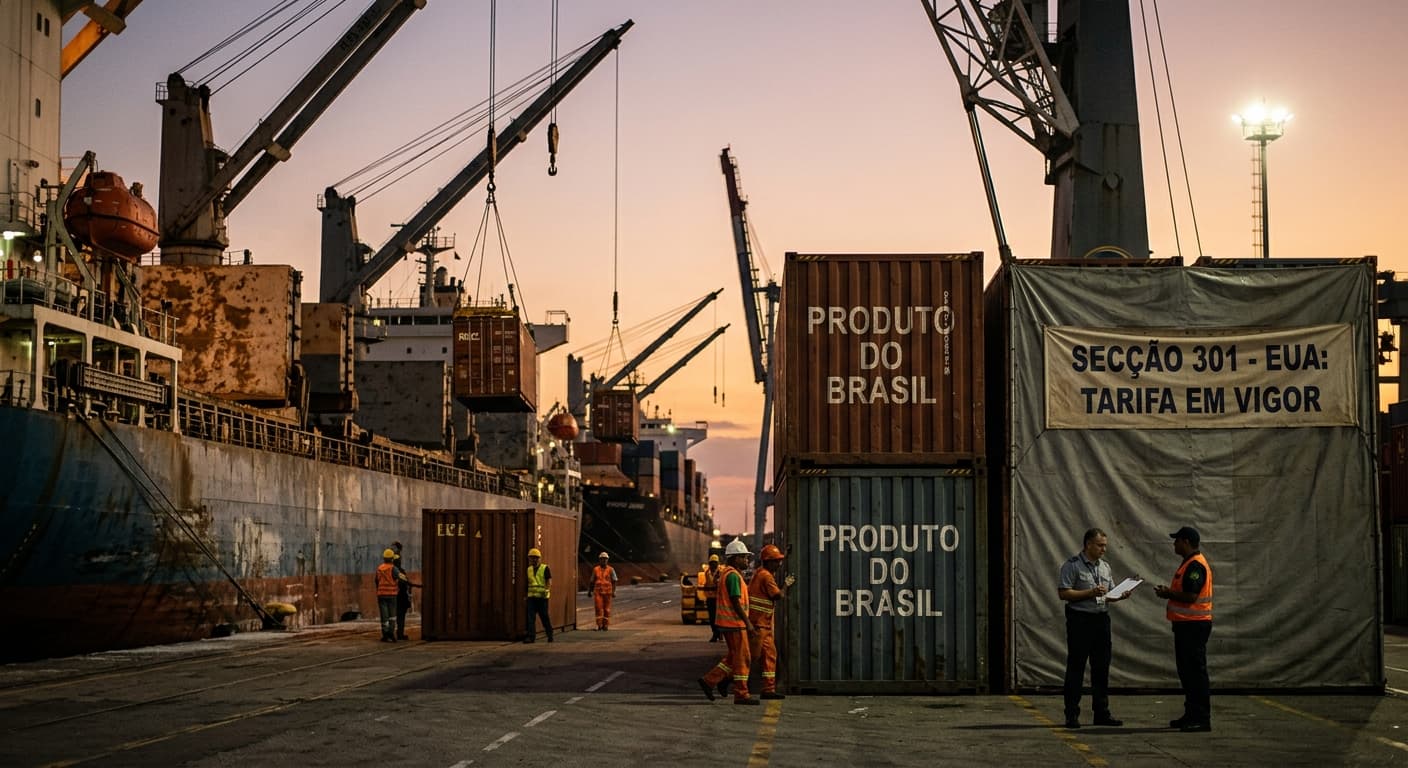
The Brazil Tariff Is a Legal Stress Test — and the Real Weapon Is Intellectual Property
On July 22, 2026, a 25% Section 301 duty hits Brazilian imports. But two-thirds of Brazil's exports are exempt, the US runs a $14.4 billion surplus with Brazil, and Brasília is loading a retaliation law that can suspend American patents. This is not about trade.
The United States will impose a 25% tariff on Brazilian goods effective July 22, 2026 — but the number that matters is not 25. It is 14.42%. That is the effective average tariff rate Brazilian exports will actually face once the exemptions are factored in, according to calculations by the Swiss-based Global Trade Alert compiled exclusively for BBC News Brasil. The gap between the headline rate and the real one exposes what this action actually is: not a trade dispute, but a legal test case for rebuilding the tariff architecture that collapsed when the Supreme Court struck down the administration's IEEPA-based duties in February 2026. And the weapon both sides are quietly stockpiling — the one that could escalate this beyond anything a tariff schedule can capture — is intellectual property.
The new duty arrives after a year-long Section 301 investigation that USTR initiated on July 15, 2025, covering Brazilian digital trade and electronic payment rules, preferential tariffs granted to Mexico and India, anti-corruption enforcement, IP protection, ethanol market access, and illegal deforestation. On July 15, 2026, Ambassador Jamieson Greer finalized the action, declaring that "extensive negotiations with Brazil over the past year have not resolved these issues," while leaving the door open to further talks, according to Al Jazeera.
Brazil's government responded within hours, issuing a statement that called July 15 a "deplorable milestone" in bilateral relations and announcing it would initiate proceedings under its Economic Reciprocity Law and file a complaint at the World Trade Organization, BBC News Brasil reported.
The Exemption List Tells the Real Story
The most revealing document is not the 107-page USTR determination — it is Annex I, the exemption schedule. More than 2,200 product categories are carved out, including beef, coffee, orange juice, aircraft and aircraft parts, energy products, rare earth minerals, and fertilizers. By the Peterson Institute for International Economics' estimate, roughly two-thirds of Brazilian exports to the United States escape the new duty entirely. Monica de Bolle, a senior fellow at PIIE, told BBC News Brasil that "the exemptions are the most revealing part of this announcement — more than the tariff itself."
This is not a coincidence of drafting. The USTR explicitly exempted goods that "could cause economy-wide disruptions" or "cannot be adequately produced or sourced domestically." Washington is taxing goods it can afford to tax — and shielding American consumers and manufacturers from the consequences.
Only about one-quarter of Brazilian products face the full 25% rate: machinery, electrical equipment, granite, gold, tires, sugar, and apparel. Of the $39.6 billion Brazil exported to the US in 2024, roughly $8.5 billion worth of goods falls under the maximum duty, according to GTA data.
The USTR's own Federal Register notice, published as a PDF and reviewed by Poder360, states plainly that products already subject to Section 232 metals duties are not covered by the 301 action — but whether the 25% stacks on top of the existing 50% Section 232 tariff for Brazilian steel and aluminum remains unclear as of this writing. Importers of Brazilian semi-manufactured steel should treat 75% combined as the working assumption until CBP publishes explicit stacking guidance.
Why Tariff a Country Where You Run a Surplus?
The United States ran a $14.4 billion trade surplus with Brazil in 2025, up from $7.7 billion in 2024, according to US government data cited by Al Jazeera. Brazil is, by some measures, the emerging economy with which the US has its largest surplus.
If this were a conventional trade dispute about market access, the surplus would be a disqualifying fact. It is not conventional.
The PIIE analysis is blunt: "Negotiations to avert the Section 301 tariffs collapsed because US authorities demanded exclusive tariff concessions that Brazil cannot legally grant one country unilaterally under its own trade law and its Mercosur and Latin American economic obligations," according to PIIE's Realtime Economics blog. The administration is, in effect, punishing Brazil for extending tariff preferences to Mexico and India — preferences that have been WTO-compliant since 1979 under the Enabling Clause for developing countries.
The Council on Foreign Relations has noted the deeper inconsistency: the USTR's complaint about Brazil's anti-corruption enforcement comes from the same administration that paused enforcement of the US Foreign Corrupt Practices Act in February 2025 because it "actively harms American economic competitiveness." The deforestation complaint sits uneasily alongside the exemption of tropical wood and wood pulp from the tariff itself.
These contradictions point to a different objective. This action is the first completed Section 301 tariff since the Supreme Court's February 20, 2026 ruling that the president lacked authority under IEEPA to impose across-the-board tariffs. As Brookings explained in March, Section 301 "will likely be the principal vehicle for the current administration's effort to rebuild tariff authority." The Brazil case is the prototype.
A Central Bank Payment System Becomes a Trade Issue
Among the six counts in the USTR's determination, the most novel — and the one with the farthest-reaching implications — concerns Pix, Brazil's central-bank-operated instant payment platform.
Pix processes $6.7 trillion in annual transaction volume and is used by two-thirds of Brazil's population. The USTR found it "fundamentally unfair" because Brazil's central bank acts as both regulator and owner-operator, allegedly creating a conflict of interest that disadvantages US payment providers like Visa, Mastercard, Apple, and Google. The Atlantic Council noted that this is "perhaps the first Section 301 case to treat a country's domestic payment system as a US trade enforcement issue."
The implications reach well beyond Brazil. The European Central Bank is developing the digital euro on policy logic that overlaps with Pix: public infrastructure, reduced dependence on private and foreign payment rails, lower costs, and broader access. If Pix is an unfair trade practice under Section 301, the digital euro may be next — and Brussels is watching.
The PIIE analysis frames the stakes sharply: "Pix was built to give Brazil monetary autonomy and a domestic alternative to foreign credit and payment networks. Whether it can remain Brazilian in governance and design, now that a US national-security frame has been layered atop the trade pressure and a tariff threat hovers above both, is the real question."
Brazil's Real Weapon: The Patent Suspension
On July 16, Brazil's government confirmed it would activate the Economic Reciprocity Law (Law No. 15,122/2025), enacted in April 2025 and regulated by Decree No. 12,551/2025. The law authorizes Brazil's executive branch to suspend trade concessions, investment obligations, and — in exceptional circumstances — intellectual property rights in response to unilateral measures by other countries.
The law's IP suspension provision is its most potent instrument, and it has a historical precedent. In 2009, the WTO authorized Brazil to retaliate against the United States over cotton subsidies. Brazil threatened to suspend pharmaceutical patents — and the US negotiated rather than face that outcome. As former Brazilian trade secretary Welber Barral told BBC News Brasil, "Brazil threatened, the United States negotiated, and Brazil never applied the measure. But it is a powerful weapon as a negotiating tool."
The law creates an Interministerial Committee on Reciprocity Measures to evaluate and recommend countermeasures. According to Baker McKenzie's Global Sanctions and Export Controls Blog, the law permits provisional countermeasures during consultations and authorizes import restrictions, suspension of trade concessions, and IP rights obligations.
For US companies, the sectors most exposed are:
- Pharmaceuticals: Patent suspension could enable Brazilian generic production of US-patented drugs without royalty payments. Brazil is Latin America's largest pharmaceutical market.
- Seeds and agriculture: IP on genetically modified seeds, plant varieties, and agrochemicals could be undermined, directly affecting companies like Bayer (which owns Monsanto's legacy operations in Brazil) and Corteva.
- Technology: Software licensing, cloud service patents, and platform IP protections could be suspended or restricted.
The Mondaq analysis warns that IP suspension would "weaponize" intellectual property, raising legal and investment risk and undermining long-term regulatory certainty for IP-intensive industries. The Brazilian law itself requires that countermeasures "minimize the impact on economic activity and avoid burdens and administrative costs" — language designed to preserve room for negotiation rather than immediate execution.
Lucas Ferraz, coordinator of the Center for Global Business Studies at the Getulio Vargas Foundation, told the BBC that IP retaliation "should only be used as an element to reinforce Brazil's bargaining power in a potential negotiation with the United States" — not as a first strike.
The Four-Day Stacking Window: July 22–26
For importers, the most urgent concern is a narrow four-day window during which the new 25% Section 301 tariff will overlap with the existing 10% Section 122 tariff. The Section 122 duty, imposed on February 20, 2026 as a stopgap after the IEEPA ruling, expires on July 26, 2026.
Between July 22 and July 26, the effective tariff rate on Brazilian goods will reach approximately 18.17%, according to GTA calculations reported by BBC News Brasil. Importers who can time their entries should clear goods before July 22 or after July 26 to avoid the stacking period — though post-July 26, the 25% Section 301 rate remains in place alone.
Separately, a 46-country Section 301 investigation into forced-labor import policies is due on July 24, proposing an additional 12.5% tariff. If applied to Brazil, the combined rate would reach 37.5% — approaching the 50% level the Supreme Court struck down in February. The PIIE noted that this sequencing "would rebuild a 37.5% trade barrier, a number closer to the unlawful 50% imposed in 2025."
The Political Subtext: Bolsonaro and October 2026
No analysis of this tariff can ignore the political calendar. Brazil holds general elections in October 2026. Flávio Bolsonaro, son of former President Jair Bolsonaro and a presidential hopeful, formally asked the Trump administration in early July to delay the tariffs until after the election, arguing that the move "would hand the current Brazilian government precisely the political victory it has been engineering," according to Al Jazeera. Secretary of State Marco Rubio responded that "substantial differences" remained — and the tariff was finalized two weeks later.
President Lula da Silva has been quick to frame the tariffs as the product of Bolsonaro-family lobbying in Washington, calling Flávio Bolsonaro's delay request "yet another act of treason against the Fatherland." The tariff thus becomes campaign material for both sides: Lula can stand up to Washington, while the Bolsonaro camp can argue that the government's strained relationship with the US is costing Brazil economically.
What to Watch
- July 22: 25% tariff takes effect. Customs entries between July 22 and July 26 face the stacking overlap with Section 122.
- July 24: The 46-country forced-labor Section 301 investigation deadline. An additional 12.5% on Brazil would push the combined rate toward 37.5%.
- July 26: Section 122 expires. The effective rate drops to 25% alone — unless the forced-labor tariff is layered on.
- August–September: Brazil's Interministerial Committee on Reciprocity Measures is expected to deliver its recommendation on countermeasures. Watch for signals on IP suspension — even a preliminary finding that it is warranted would move pharmaceutical and agricultural technology share prices.
- October 2026: Brazilian general election. The tariff will be a live political issue, and either outcome — escalation or negotiated reduction — carries electoral implications for both Lula and the Bolsonaro camp.
Diplomat View
This tariff is a legal prototype dressed as a trade dispute. The administration needed a completed Section 301 action to demonstrate that the post-IEEPA tariff architecture can deliver durable, court-resistant duties — and Brazil, as a surplus-running, commodity-exporting democracy with a left-wing government and a Bolsonaro-linked opposition, was the ideal test case. The broad exemption list proves the administration understands the economic limits of its own project: it cannot tax Brazilian goods that American supply chains and consumers actually depend on without inflicting self-harm. The Pix complaint signals that the next frontier of trade enforcement is domestic financial infrastructure — and Europe's digital euro project is already in the crosshairs.
The forecast: the tariff holds through the October election, after which the negotiation calculus shifts. If Lula wins, expect a slow-walked IP suspension threat — enough to force talks, not enough to trigger a patent crisis — and a potential deal on ethanol market access that both sides can claim as a win. If the Bolsonaro-aligned opposition prevails, the tariff becomes instantly negotiable, and the Pix complaint likely disappears from the USTR's priority list. The one outcome that is not on the table is the tariff remaining exactly as written through 2027. It is a bargaining chip — and both sides know it.
- Catalyst 1: The July 24 forced-labor Section 301 decision. If the additional 12.5% is imposed on Brazil, the combined 37.5% rate will intensify Brazilian retaliation pressure.
- Catalyst 2: The Interministerial Committee's first recommendation, expected by late August. A preliminary finding that IP suspension is warranted — even without immediate action — would move markets.
- Catalyst 3: The October 2026 election outcome, which will determine whether the tariff becomes a permanent feature of US-Brazil relations or a transitional bargaining lever awaiting a post-election reset.
The Bottom Line
The 25% Section 301 tariff on Brazil is a legal test case for the post-IEEPA tariff regime, not a conventional trade dispute. Two-thirds of Brazilian exports are exempt because Washington cannot afford to tax them. The real escalation risk lies in Brazil's Economic Reciprocity Law, which authorizes the suspension of US pharmaceutical, seed, and technology patents — a weapon Brasília has wielded once before as a negotiating threat and is now formally reloading. The tariff will hold through Brazil's October election, after which either a negotiated ethanol-market deal or a patent-IP confrontation becomes the most likely next chapter.
Discover more

US Politics
House Ethics Committee Pushes Sexual Miscond.
The House Ethics Committee has shifted responsibility for sexual harassment settlement records to the Office of Congressional Workplace Rights, complicating disclosure efforts.
Global Politics
Trump's Conflicting Messages on Iran War
Trump's mixed messages on Iran reflect a strategy of audience management, benefiting Tehran amid a complex geopolitical landscape.

US Politics
SNAP Food Assistance Faces Legal Challenges
In 2026, SNAP faces stricter eligibility rules and mounting legal challenges, threatening food assistance for the millions of Americans who rely on the program.

Economics
Fed's Amex AML order puts correspondent banking on notice
Federal Reserve's Amex AML order requires board-level controls and a 90-day plan; OCC fined the bank $350 million over enterprise-wide deficiencies.