BOJ Set for September Hike as Yen 162 Tests
Yen weakness prompts BOJ to consider rate hike
Model Diplomat8 min readAsia
BOJ Set for September Hike as Yen 162 Tests Global Markets
Ex-BOJ officials say yen weakness near 165 will force a September rate hike to 1.25%, testing the $3.6 trillion global carry trade and Takaichi's fiscal agenda.
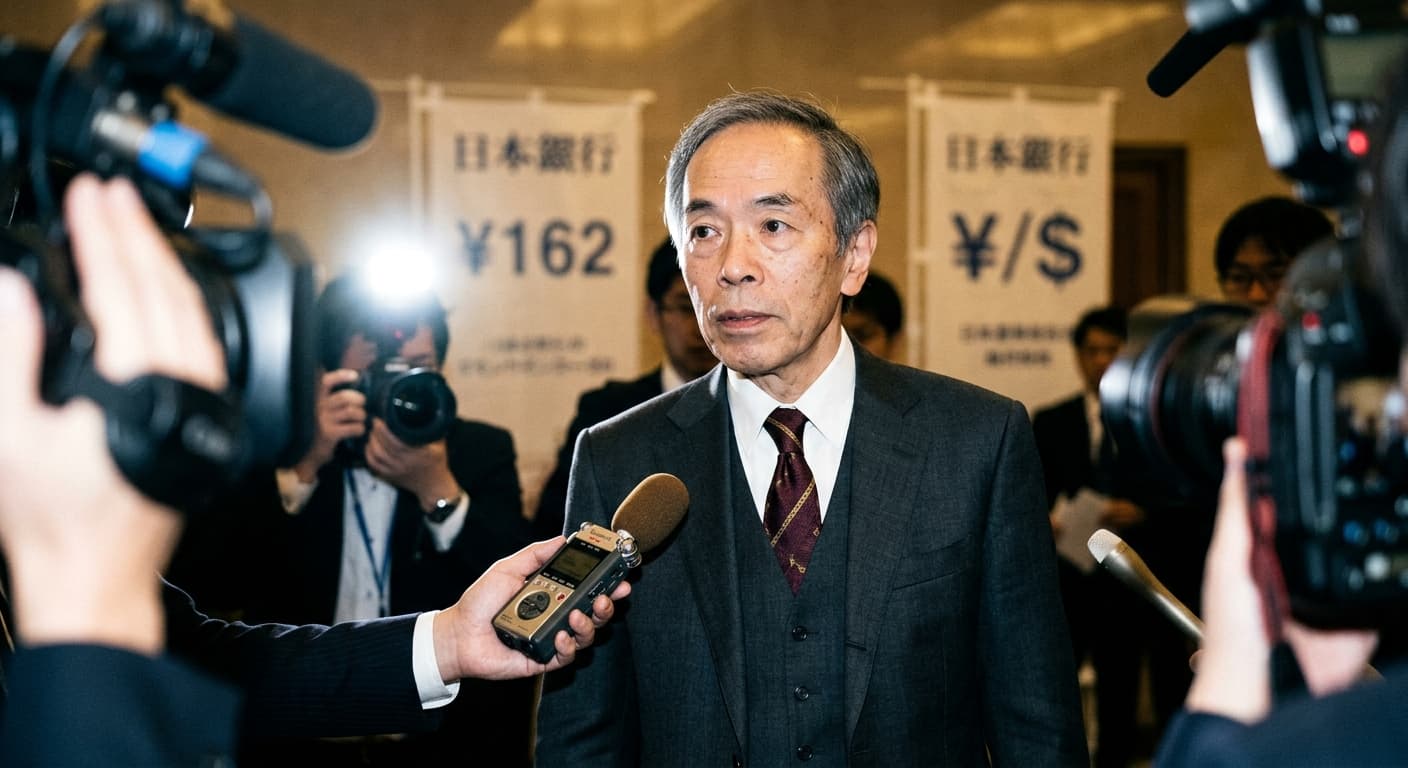
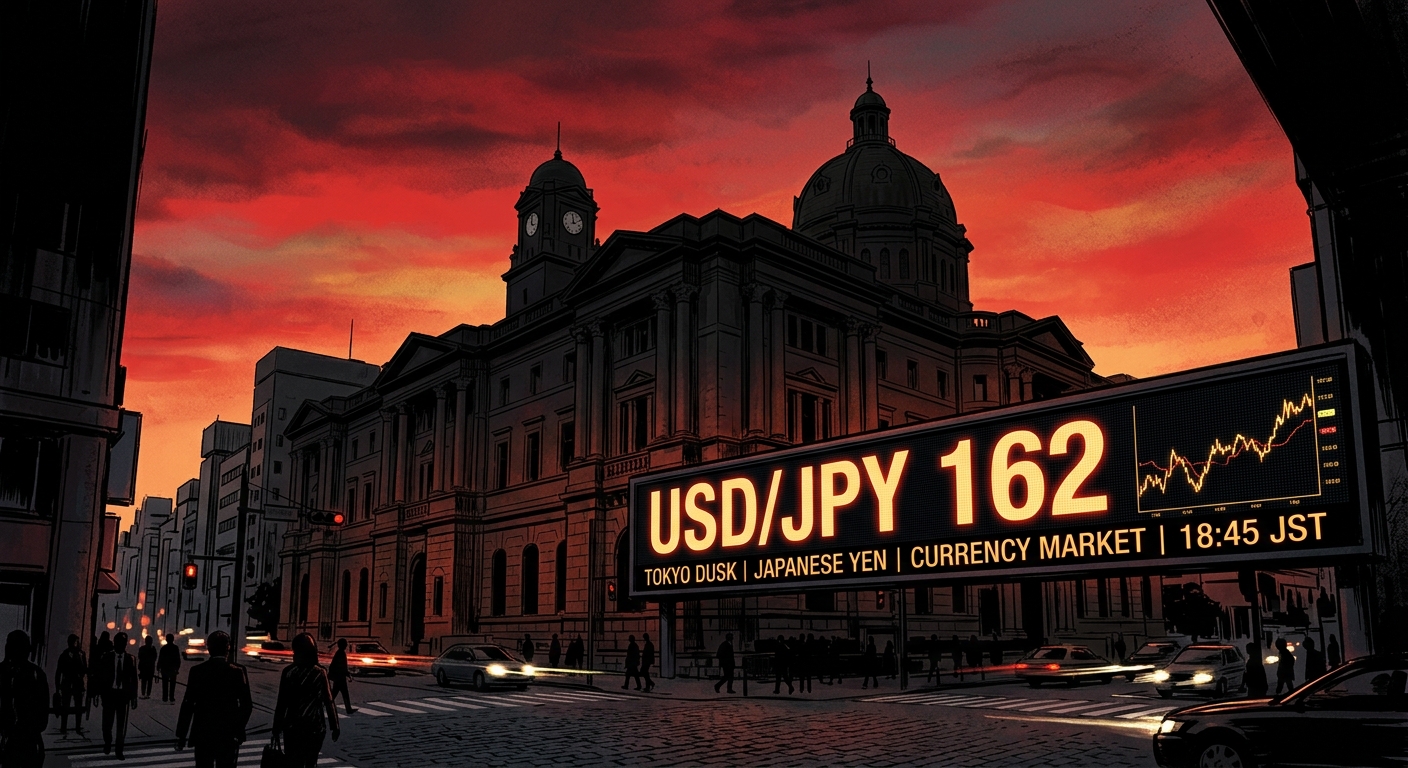
The Bank of Japan is being pushed toward a September hike to 1.25% not by wages or prices but by the yen — a currency now weak enough that three former board members, in the span of six days, have publicly said the central bank cannot wait until December. In an MNI interview published July 9, 2026, ex-BOJ board member Makoto Sakurai said a move to JPY165/USD would be sufficient trigger. That is roughly three yen away from the dollar's July 9 close of 162.38 on
FT market data. The thesis of this piece: Governor Kazuo Ueda's next hike is no longer a monetary decision — it is a geopolitical one, driven by an Iran-war oil shock, a Takaichi government committed to fiscal loosening, and a US Treasury openly demanding that Tokyo let its central bank fight the yen. What happens in Tokyo in September will reprice the carry trades that broke global equities in August 2024.
The ex-officials are coordinating a signal
Three former BOJ officials speaking in one week is not coincidence — it is how Tokyo pre-announces. On July 3, ex-board member Seisaku Kameda told MNI a September or October hike is likely if the yen approaches 165. On July 9, Sakurai followed with the same threshold and the same window. Separately, former BOJ chief economist Tsutomu Watanabe warned in remarks reported by
CoinDesk via Times42 that the terminal rate this cycle could exceed 2% — double the current setting. SMBC Nikko's economists reinforced the same window in a
research note reported July 9, pointing to October as their base case for the next move.
The current benchmark, at 1%, was set on June 16 when the policy board voted 7-1 to raise from 0.75%. Al Jazeera reported that the BOJ explicitly cited "rising oil prices" tied to the US-Israel war on Iran and warned of "underlying CPI inflation deviating upward" from its 2% target.
The BBC noted that this brought Japan's rate to a 31-year high — still far below the Federal Reserve's 4.3%, but a meaningful step in a normalisation cycle that only began in March 2024.
The gap the BOJ has to close is defined by the IMF's April 2026 Article IV report, which puts Japan's neutral nominal rate at "between 1.1 to 2.2 percent." At 1%, policy remains accommodative. At 1.25%, it grazes the lower bound of neutral. At 2%, which Watanabe now flags, the BOJ would be genuinely restrictive for the first time in a generation.
Why 165 is the line, and why the BOJ is being forced to draw it
The 165 threshold that Sakurai and Kameda both invoked is neither arbitrary nor purely economic — it is the level at which Japan's Ministry of Finance has historically intervened. In 2024, the MOF intervened when the yen touched 160.17, per Al Jazeera's tick-by-tick account. Since then, structural depreciation has reset the pain threshold higher. According to the
IMF's April 2026 staff report, "the yen has steadily depreciated despite the 10-year yield differential narrowing by over 100 bps to its lowest level since early 2022" — a decoupling that "cannot be accounted for by yield differentials or other fundamentals," with the unexplained component tracking positions in the yen futures market.
Translation: this is a speculative slide, not a fundamentals slide. The Ministry of Finance can lean against it briefly with FX intervention; only the BOJ can break it.
That is precisely the argument Brookings Institution senior fellow Robin Brooks made in an essay on yen depreciation and fiscal space, noting that MOF yen purchases and BOJ bond buying "cancel each other out" as long as the central bank remains committed to capping long-term yields. The dilemma has sharpened under Prime Minister Sanae Takaichi. Her fiscal expansion — a stimulus package described by the
BBC as record-scale and a consumption-tax pause pledged before the February 8 election — has pushed 40-year JGB yields above 4%, an all-time high per
Al Jazeera's January reporting. Fiscal loosening plus monetary caution is arithmetically a weaker yen.
Takaichi's political position complicates the calculus. The BBC's election-day coverage noted that investors expect three, not two, BOJ hikes this year, citing economist Jesper Koll — a view that hardened after Takaichi's landslide gave her a mandate but also a bond-market audit. The prime minister has publicly refrained from criticising Ueda since taking office, per the BBC, an unusual restraint for a politician who campaigned on Abenomics-style easy money.
Washington wants Tokyo to hike
The most under-reported feature of this cycle is that the United States is now publicly demanding a stronger yen. In January, Treasury Secretary Scott Bessent told Fox News he expected Japanese counterparts "to begin saying things that will calm the market down," a comment carried in Al Jazeera's January report. In
Financial Times reporting from earlier this year, Bessent explicitly called on Tokyo to let the BOJ fight inflation — a diplomatic euphemism for "hike faster." This is a reversal of the standard US posture, which for two decades treated a weak yen as Tokyo's problem to solve.
The reason is US bond math. When Japanese 40-year yields spiked in late January, 30-year US Treasury yields rose to their highest level since September, per the same Al Jazeera piece. Keio University professor Sayuri Shirai told the outlet that Japanese yield moves "nudge global yields and risk pricing" because Japanese institutions are marginal buyers of US, European, and Australian sovereign debt. A BOJ that hikes too slowly leaves the yen weak, keeps Japanese institutions overseas, and props up global term premia. A BOJ that hikes into a fiscal expansion risks the inverse: capital repatriation, higher developed-market yields, another 2024-style shock.
That 2024 shock is the historical parallel that should discipline every forecast for September. On August 5, 2024, the Nikkei 225 fell 12.4% in a single session — the worst day since Black Monday 1987 — after a 25-basis-point BOJ hike unwound a decade of yen-funded carry positioning. The Atlantic Council put the yen's rally from its 166.99 low at 10.5% in a matter of weeks, propagated by short-covering. CSIS put pre-unwind
yen-funded carry positions at roughly JPY 80 trillion, or about $500 billion, and estimated total global carry exposure — including franc- and euro-funded trades — at $3.6 trillion, or 3.5% of world GDP.
That is the scale of what a poorly telegraphed September hike could disturb. It is also why the BOJ is choosing to leak through ex-officials rather than surprise the market.
Who benefits, who bleeds
Named winners of a September hike: Japanese life insurers and regional banks whose net interest margins the IMF says have already widened as pass-through to lending rates outpaces deposit rates, lifting the total capital adequacy ratio of internationally active major banks to 17.1% as of March 2025 from 16.5% a year earlier. Japanese households importing food and energy also benefit, at least at the margin, from a stronger yen — the
FT's yen editorial called yen weakness a "negative terms-of-trade shock" for a country that imports almost all its energy and most of its food.
Named losers: hedge funds carrying short-yen positions, whose CFTC positioning Brooks documented has not materially unwound; Japanese exporters, whose overseas earnings translate less favourably; and the Takaichi government, whose debt-service arithmetic worsens with every basis point. Japan's gross government debt is far above every other advanced economy, per the same Brookings analysis, which is why the BOJ has historically been reluctant to let long-term yields rise — the interest bill would become "unmanageable." Every 25-bps step now feeds into a fiscal path Takaichi has committed to loosening.
The subtler loser is the Federal Reserve. If Japanese yields climb and Japanese institutions repatriate, US term premia rise and the Fed's own easing path narrows. This is the second-order effect that Bessent's public interventions implicitly acknowledge — Washington needs Tokyo to hike enough to stabilise the yen without hiking so much that Japanese lifers sell Treasuries. That is a very narrow window, and the BOJ has to hit it.
What to watch
The September policy meeting is now the decisive event on the global macro calendar between the Fed's September FOMC and the year-end Chinese Central Economic Work Conference. Three specific catalysts will decide whether the hike lands there or slips to October:
- USD/JPY spot: a sustained break above 165 makes September a near-certainty; a retracement to 158 pushes the decision to October or December.
- Japan July core CPI: with headline at 1.4% in April per
Al Jazeera, the BOJ needs services inflation to hold firm to justify moving above 1%.
- US Treasury commentary: Bessent's next public statement on Japan is a leading indicator of whether Washington will accept — or resist — a hike that strengthens the yen against the dollar into a US election-year Fed easing cycle.
Diplomat View
The September hike is the base case, not the risk case. Three former BOJ officials do not coordinate their messaging in a single week by accident, and Ueda's board has already voted 7-1 in June with a hawkish statement about "underlying CPI inflation deviating upward." The specific call: a 25-bps hike to 1.25% on September 18, contingent on USD/JPY holding above 160 through August, with the vote likely 8-1 or 7-2 as Takaichi-aligned board members register objections without blocking. The forecast changes if either the yen retraces below 155 on Fed dovishness — removing the currency argument — or if the Iran-war oil premium reverses sharply enough to pull Japanese headline inflation below 1%, giving doves cover to wait until October. The tail risk that matters most is not a policy mistake in Tokyo but a repeat of August 2024: a well-signalled hike that markets nonetheless mistime, unwinding a chunk of the $3.6 trillion carry stack into a thinly-liquid summer tape.
The Bottom Line
Tokyo is not deciding whether to hike; it is deciding how to hike without breaking the global carry trade a second time. The September meeting will be remembered less for its 25-bps move than for whether Ueda can execute it without another August 2024. If the ex-officials' 165 line holds as the trigger, the hike is priced. If the yen breaks it before Tokyo is ready, the trigger pulls itself.
Discover more

India
BJP's Misunderstanding of Women's Quota Needs
The BJP's linking of the Women Reservation Bill to delimitation risks delaying women's empowerment in India, misreading the aspirations of female voters.

US Politics
SNAP Food Assistance Faces Legal Challenges
In 2026, SNAP faces stricter eligibility rules and mounting legal challenges, threatening food assistance for the millions of Americans who rely on the program.

India
Women’s Reservation Bill 2026
The Constitution (131st Amendment) Bill, 2026 was defeated in Lok Sabha, revealing deeper political conflicts over women's reservation and delimitation.

Economics
Fed's Amex AML order puts correspondent banking on notice
Federal Reserve's Amex AML order requires board-level controls and a 90-day plan; OCC fined the bank $350 million over enterprise-wide deficiencies.