BOJ Rate Hike to 1% Fails to Strengthen Yen
Japan's debt crisis impacts US Treasury market after BOJ rate hike.
Model Diplomat7 min readAsia
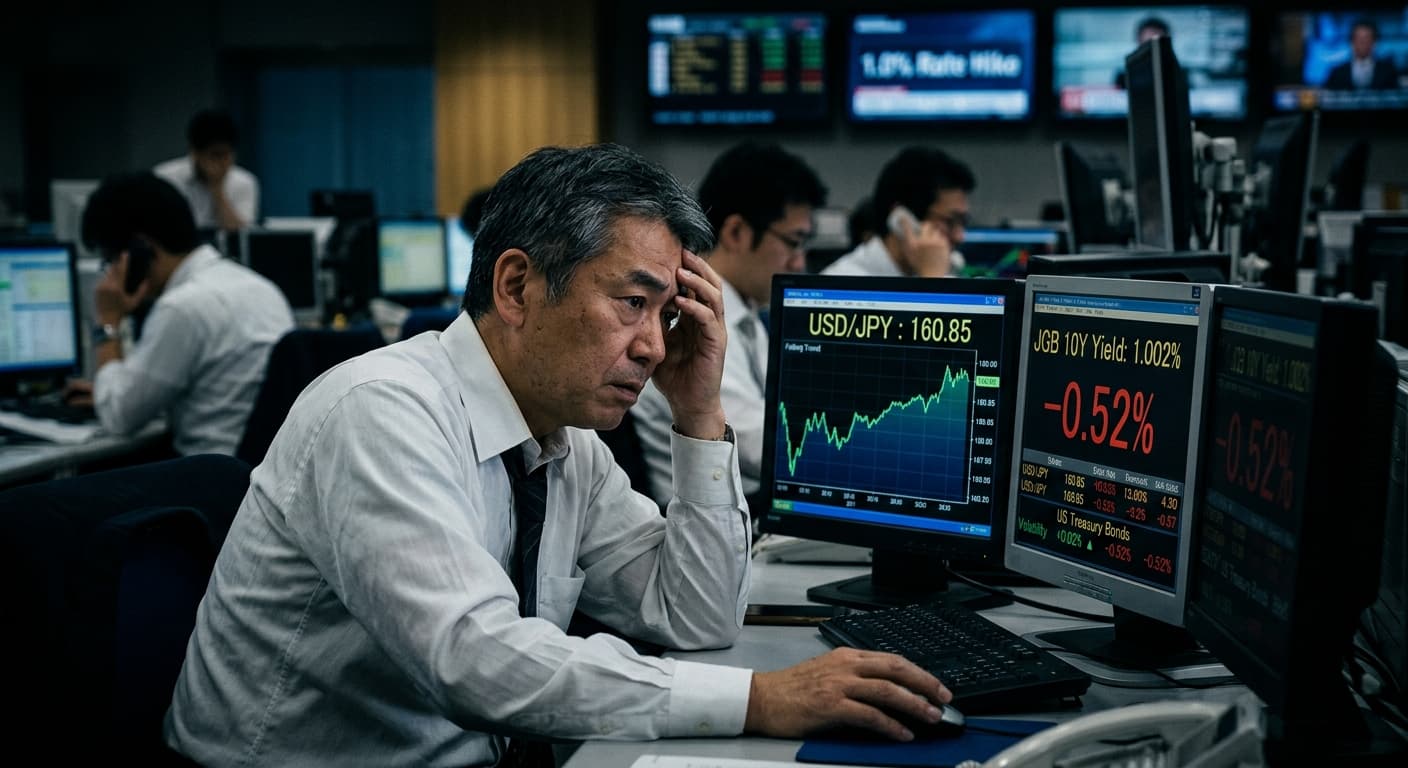
BOJ Hikes to 1% — And the Yen Just Kept Falling
The Bank of Japan raised rates to a 31-year high on June 16, 2026, but the yen sits at ¥162 — exposing a debt trap that now threatens the US Treasury market.
The Bank of Japan raised its policy rate to 1% on June 16, 2026 — the highest since 1995 — and three weeks later the yen is weaker, not stronger, trading at ¥162.38 to the dollar. That is the story. The BOJ's boldest tightening in a generation, delivered in the face of a US–Israel war on Iran and a domestic prime minister who campaigned against it, has failed to move the currency. The reason is not that Governor Kazuo Ueda blinked; it is that Japan's 230%-of-GDP debt stock now dictates monetary policy more than the policy board does — and the collateral damage will not be paid in Tokyo. It will land in the US Treasury market, where Japanese investors hold roughly $1.2 trillion and where the carry trade financed on cheap yen is now Washington's problem.
What the BOJ actually did — and what it admitted
The quarter-point move to "around 1.0 percent" passed by a 7–1 vote, with board member Toichiro Asada dissenting on growth grounds and Governor Ueda absent, hospitalised for an infected liver cyst, according to the Bank of Japan's June 16 statement. In the primary document, the board wrote that "the price pass-through stemming from the rise in crude oil prices has been progressing at a relatively fast pace in business-to-business transactions" and warned of "a risk of underlying CPI inflation deviating upward to a level above the price stability target of 2 percent."
"Accommodative financial conditions are expected to be maintained after the change in the policy interest rate, continuing to firmly support economic activity." — Bank of Japan,
Change in the Guideline for Money Market Operations, June 16, 2026
That single sentence is the tell. Even at 1%, the BOJ is signalling that policy remains loose — real interest rates in the short-to-medium zone remain negative. The Summary of Opinions from the June 15–16 meeting is blunter: one member argued "the neutral interest rate appears to be at around 2 percent" and that the BOJ should move toward it "with intervals of a few months in mind." A former BOJ official told CNBC that borrowing costs could push above 2% faster than the market expects, according to
BizToc's aggregation of the CNBC interview.
Al Jazeera's John Power reported that the June decision was framed explicitly around imported inflation from the "United States-Israel war on Iran," which sent crude sharply higher into an economy that, Al Jazeera notes, sourced roughly 95% of its crude oil from the Middle East before the conflict. The BBC put the political stakes plainly: this was the second hike since
Sanae Takaichi took office, and she had "previously dismissed the idea of hiking interest rates."
Why the yen kept falling anyway
Currency intervention and rate hikes were supposed to work together. They have not. According to the Atlantic Council, the Ministry of Finance burned roughly $73 billion propping up the yen in recent months. It briefly rallied to ¥156, then slid back through ¥161. On July 9, 2026,
FT Markets Data showed the pair at ¥162.38 — inside the 52-week trough of ¥162.83, and up nearly 11% against the yen year on year.
Brookings' Robin Brooks laid out the deeper mechanic in a diagnostic that has aged uncomfortably well. On the surface, yen weakness is monetary-policy divergence with a Fed still at 3.5%. Underneath, it is Japan's debt burden forcing the BOJ to keep buying Japanese government bonds to cap yields — which, Brookings argues, "indirectly weakens the yen" and cancels out the finance ministry's purchases. The BOJ still absorbs roughly ¥2.9 trillion ($19 billion) of JGBs a month,
The Economist reported in January.
Domestic politics finished what oil started. Takaichi's plan to pause the 8% consumption tax on food, unveiled ahead of a February 8 snap election, sent 40-year JGB yields above 4% — a record — and 10-year yields to roughly 2.5%, Al Jazeera reported. Keio University's Sayuri Shirai told the outlet: "Bond investors reacted because her headline package looks like large, near-term fiscal loosening at exactly the moment the BOJ is trying to normalise policy."
The real collateral: US Treasuries and the carry trade
The story that should worry Washington is not the ¥162 print. It is what happens if the BOJ is forced to keep going. Japanese investors held roughly $1.2 trillion in US Treasuries as of November 2025, Al Jazeera reported — more than any other foreign group. As the JGB yield rises past 2.5%, the relative appeal of a hedged US Treasury for a Japanese life insurer collapses. Repatriation is the second-order effect no one in the June 16 statement mentioned.
The bigger risk is the yen carry trade. The Bank for International Settlements, cited by the Atlantic Council, estimates its size at $261 billion in direct cross-border bank borrowing, roughly $1 trillion including derivatives and forward markets, and as much as $11.3 trillion when broader speculative short positions are included. CSIS puts the total leveraged carry web across yen, franc and euro funding at
roughly $24 trillion.
Markets have already been shown what happens when it snaps. In August 2024, CSIS notes, a single 25-basis-point BOJ hike triggered a same-day 12%+ drop in the TOPIX and Nikkei — the sharpest one-day move since 1987 — as leveraged carry positions unwound. AEI's Desmond Lachman calls the current setup
more dangerous than the August 2024 episode, arguing that the narrowing US–Japan spread and a yen "undervalued by between 15 and 20 percent" could force repatriation "at the very time when Trump's large tax cuts have increased the US government's budget deficit to an annual rate of around $2 trillion."
That is the pincer. The International Monetary Fund's 2026 Article IV staff report noted that Japan's gradual rise in interest rates has, so far, "supported bank profitability" — but the same document lands squarely on the fiscal risk. Every basis point the BOJ adds to the front end is a basis point that widens Japan's primary deficit through interest expense.
Washington's tell: Bessent said no to joint intervention
The most consequential line in the past month came not from Tokyo but from the US Treasury. Secretary Scott Bessent has ruled out joint FX intervention with Japan, according to the Atlantic Council, and told Fox News in January that he expected his Japanese counterparts to "begin saying the things that will calm the market down,"
Al Jazeera reported. Translation: the yen is Tokyo's problem, and the fix is more BOJ tightening — not more Ministry of Finance dollar sales.
Japan sits on the US Treasury's 2026 monitoring list for currency practices. In the Trump-era trade posture, a persistently undervalued yen is not just an economic imbalance; it is an invitation to tariffs. That is the political constraint the BOJ now works inside — hike faster to satisfy Washington, and risk the JGB spiral AEI has been warning about; hike slower to protect debt sustainability, and invite a currency-and-trade confrontation.
The FT's editorial board put the shift in one sentence: for the first time, the BOJ has "tacitly admitted, on behalf of a nation enduring a terms of trade crisis, that currency is everything to this economy," according to the Financial Times. That is not a technical adjustment. That is a doctrine change — the end of the polite fiction that developed-market central banks do not target FX.
What to watch next
- July 30–31, 2026: Next BOJ Monetary Policy Meeting. The
- August 2026 wage data and July CPI: The BOJ credited government energy subsidies for holding core CPI at 1.4% in April; if those roll off, headline inflation will jump and force the board's hand.
- US Treasury semi-annual FX report (autumn 2026): A formal "manipulator" designation for Japan would escalate the trade track and pressure the BOJ into a faster path.
- Japanese life insurers' half-year rebalancing (September–October 2026): The clearest early signal of a carry-trade unwind. Watch for a step-change in TIC data on Japanese Treasury holdings.
Diplomat View
The BOJ's move to 1% is not the end of Japan's normalisation — it is the moment Japan runs out of easy options. The base case: Ueda's board hikes again by year-end, probably to 1.25%, forced by a mix of imported inflation, a weakening yen, and quiet pressure from a Bessent Treasury unwilling to intervene jointly. The yen strengthens modestly, to roughly ¥150–155, but only when the Fed cuts — not because of the BOJ. The tail risk is the one no one is pricing: a disorderly unwind of the carry trade that hits US Treasuries harder than Japanese equities, because Japanese lifers and mega-banks will sell the most liquid foreign asset first. That is the August 2024 template, rerun with $1.2 trillion of Japanese-held US paper as the marginal seller. This call would be wrong if Takaichi abandons the consumption-tax pause under bond-market duress, or if the Fed cuts aggressively enough to narrow the differential without the BOJ moving again. Neither looks likely before October. Until then, the BOJ is not tightening policy — it is buying time against a debt trap that the currency market has already sniffed out.
The Bottom Line
The bottom line: the BOJ's hike to 1% is a signal that Japan's debt is now driving its monetary policy, not the other way around — and the tab for that reversal will be paid in the US Treasury market, not the Tokyo bond market. If Japanese institutions begin repatriating even a slice of their $1.2 trillion Treasury book, Washington will discover that Tokyo's crisis is its own.
Discover more

US Politics
SNAP Food Assistance Faces Legal Challenges
In 2026, SNAP faces stricter eligibility rules and mounting legal challenges, threatening food assistance for the millions of Americans who rely on the program.

India
BJP's Misunderstanding of Women's Quota Needs
The BJP's linking of the Women Reservation Bill to delimitation risks delaying women's empowerment in India, misreading the aspirations of female voters.

India
Women’s Reservation Bill 2026
The Constitution (131st Amendment) Bill, 2026 was defeated in Lok Sabha, revealing deeper political conflicts over women's reservation and delimitation.

Economics
Fed's Amex AML order puts correspondent banking on notice
Federal Reserve's Amex AML order requires board-level controls and a 90-day plan; OCC fined the bank $350 million over enterprise-wide deficiencies.