Blanche v. Lau: New Border Rule Explained
Supreme Court ruling alters green card holder status at entry
Model Diplomat8 min readNorth America
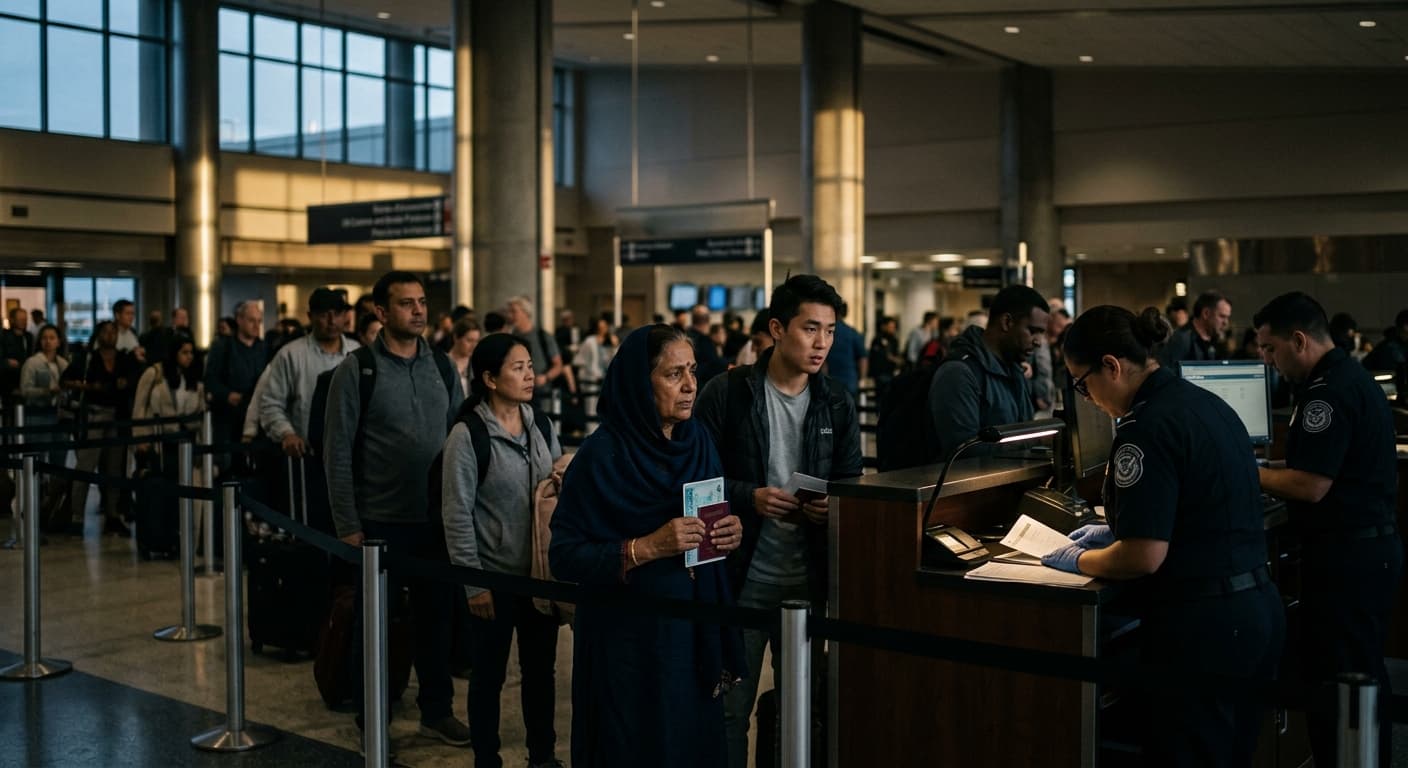
When a Green Card Isn't Enough: Blanche v. Lau's New Border Rule
Blanche v. Lau (June 23, 2026) lets U.S. border officers treat returning green card holders with pending charges as new applicants — no conviction, no clear-and-convincing evidence needed at the port of entry.
The Supreme Court's 6–3 decision in Blanche v. Lau, handed down June 23, 2026, ended a century-old assumption about the border: that a returning lawful permanent resident is home the moment the plane lands. The Court held that a Customs and Border Protection officer can now treat any of the country's roughly 12.7 million green card holders as "seeking an admission" — stripping them of returning-resident status and paroling them into the United States — based on nothing more than a pending charge, without possessing clear and convincing evidence at the port of entry. The ruling does not change the substantive grounds of inadmissibility; it changes when the government must prove them, and that timing shift is the whole story. It converts the border from a checkpoint into an evidence-gathering venue where the government can wait, watch, and build its case while the LPR lives in parole limbo.
The holding, in one paragraph
Justice Clarence Thomas, writing for Chief Justice John Roberts and Justices Samuel Alito, Neil Gorsuch, Brett Kavanaugh and Amy Coney Barrett, framed the question narrowly: the Immigration and Nationality Act "does not require a border officer to have clear and convincing evidence that a lawful permanent resident has committed a crime involving moral turpitude before deeming the resident an applicant for admission," according to the Supreme Court's slip opinion at Cornell LII. The Court declined to read that evidentiary burden into the statute, calling it "nowhere in the statute or even Board precedent" and reserving it — if it applies at all — for the removal hearing before an immigration judge, not the port of entry. The Court vacated a March 4, 2025 Second Circuit decision that had gone the other way,
130 F.4th 42, resolving a circuit split with the Fifth and Ninth Circuits.
The facts illustrate exactly what the ruling permits. Muk Choi Lau, a Chinese national who obtained LPR status in 2007, was charged by New Jersey with trademark counterfeiting on May 7, 2012. While the case was pending, he flew to China. On June 15, 2012, a border officer at JFK paroled him into the country based on the unresolved charge. He pleaded guilty on June 24, 2013. Only then did the government initiate removal proceedings — charging him as an inadmissible applicant, not as a deportable resident. The government's reply brief argued this was permissible because the INA "frames the relevant inquiries in the present tense," directing immigration judges to decide status "based on the facts available in the removal proceedings" — including a conviction obtained after the flight landed.
What actually shifted
The pre-Lau framework, built on the Board of Immigration Appeals' 2011 decision in Matter of Rivens and the 2012 decision in Matter of Valenzuela-Felix, held that DHS bore the burden of proving by clear and convincing evidence that a returning LPR fell into one of six statutory exceptions in 8 U.S.C. § 1101(a)(13)(C). The Second Circuit read that burden as attaching at the border. The Court has now confirmed it attaches only at the removal hearing — and that post-entry evidence, including a guilty plea entered a year later, can be used to justify the border officer's earlier reclassification.
The practical consequence, laid out by Alston & Bird's Immigration Team in a July 2026 client alert, is that CBP "may parole a green card holder into the United States rather than admitting them as a returning lawful permanent resident" whenever it sees a qualifying open charge — fraud, theft, shoplifting, forgery, identity offenses, aggravated assault, or a controlled-substance matter. Parole is not deportation, but it is legally worse than admission: it flips the burden of proof at any subsequent removal hearing onto the LPR, who must show admissibility "clearly and beyond doubt," and it exposes the individual to the more restrictive inadmissibility grounds of § 1182 rather than the deportation grounds of § 1227. Barnes & Thornburg told practitioners the ruling means "evidence developed after entry (e.g., post-entry convictions) can be used in removal proceedings to support an earlier classification," in its
analysis on Mondaq.
Who benefits, who loses
The winner is the Department of Homeland Security's law-enforcement architecture. CBP officers processing "hundreds, maybe thousands, of arrivals a day," in Assistant to the Solicitor General Sopan Joshi's phrase at oral argument on April 22, 2026, no longer need to build a clear-and-convincing case in the seconds available at secondary inspection. They can act on a rap sheet flag, an Interpol notice, or a pending indictment and defer the evidentiary contest to an immigration judge months or years later. This aligns squarely with the Trump administration's stated position — carried by Acting Attorney General Todd Blanche as petitioner after Pam Bondi's departure — that "suspicion of a crime is a sufficient reason to strip green card holders of their legal status," as Al Jazeera characterised the government's argument in its
June 23 report on the decision.
The losers are LPRs with any open criminal exposure — including cases that will ultimately be dismissed. Justice Ketanji Brown Jackson's dissent, joined by Justices Sonia Sotomayor and Elena Kagan, warned that the Court "handed the Government a massive blank check" and detailed the collateral consequences the majority elided. Parole, she wrote in the dissent, "often goes hand in hand with confiscation of the LPR's physical green card ... thrusting the LPR into a state of uncertainty about his immigration status, his future, and his access to the protections the immigration system affords him." An LPR without a physical I-551 card faces immediate practical exclusion from employment verification, banking, licensed housing, and international travel — before an immigration judge has ruled on anything.
The Asian American Legal Defense and Education Fund, as amicus in support of Lau, told the Court that reclassification "could result in detention in addition to revocation of their green card," and that "without a green card, a lawful permanent resident will not be able to secure a job, healthcare, housing, a bank account, or education," per the LII case summary. Those effects begin at the CBP counter and continue whether or not the underlying criminal charge survives.
The non-obvious angle: post-entry conviction as retroactive evidence
The quiet mechanic embedded in the majority opinion is the doctrine of retroactive proof. The government did not just win the right to parole Lau on a pending charge. It won the right to justify that parole in 2013, 2018, or 2026 by pointing to Lau's June 2013 guilty plea as clear and convincing evidence that he had "committed" the offense in March 2012, before he ever boarded the flight home. The Court's holding thus creates a one-way ratchet: the government can defer, the LPR cannot. If prosecutors drop the charge, DHS is under no obligation to rescind parole or restore the LPR's card — the individual must litigate that in immigration court. If prosecutors secure a plea to any lesser included offense that still qualifies as a crime involving moral turpitude, the border officer's initial call is retroactively vindicated.
That mechanic explains why the Justice Department fought so hard for a case with facts that, on their face, seemed unremarkable. In its merits brief, the government wrote that it "need not prove that immigration officers at the border or port of entry possessed clear and convincing evidence of the offense at the time of the LPR's reentry" — a rule that, applied prospectively, transforms every CBP secondary inspection into a plausible removal predicate for the roughly
12.7 million LPRs the CRS reports live in the country, and the
~1 million admitted each year.
The historical parallel that reframes it
The doctrine Lau upends traces to Rosenberg v. Fleuti, 374 U.S. 449 (1963), and its progeny — the line of cases treating returning LPRs as functionally already home. Congress narrowed Fleuti in the 1996 IIRIRA amendments by codifying the six exceptions in § 1101(a)(13)(C), but the BIA in Rivens preserved a procedural firewall: the government carried the burden and had to meet a heightened standard. The Second Circuit's Judge Denny Chin, writing for the panel below, had held the firewall applied at the port of entry itself. Thomas's majority moved it to the immigration court. In practice, that is the difference between a border officer needing evidence before seizing the green card, and one who can seize first and prove later.
What to watch
- Circuit-level implementation, Q3 2026. DHS and CBP have not yet issued public guidance recalibrating secondary-inspection protocols for LPRs with open charges. Watch for a revised CBP Directive and USCIS Policy Manual update; the
State Department's 9 FAM 202.2, governing boarding foils and I-551 documentation, will also need conforming edits.
- Remand of Lau's case to the Second Circuit. The Court "vacate[d] the judgment of the Second Circuit and remand[ed] the case for further proceedings," per the
Cornell LII opinion, because Lau contested that his crime was one involving moral turpitude and the Court did not decide that question. The remand ruling will set the framework for what qualifies as a CIMT-triggering charge at the border.
- Congressional response. Democratic members of the House Judiciary Immigration Subcommittee have signalled interest in an amendment to § 1101(a)(13)(C) restoring a border-stage burden. No bill has been introduced as of July 9, 2026; the earliest legislative vehicle would be an FY2027 DHS appropriations rider.
- Amicus follow-on litigation. AILA and immigration-law professors, both of whom filed amicus briefs on March 27, 2026, are expected to bring test cases challenging CBP's authority to confiscate physical I-551 cards from paroled LPRs prior to a removal order.
The Bottom Line
Blanche v. Lau does not change who is inadmissible — it changes when the government has to prove it, and that shift alone reshapes the calculus for every green card holder with an open criminal file. The ruling converts the border into an evidence-gathering opportunity for DHS and turns a returning resident's physical card into a document the government can take on suspicion and return only if the LPR wins in immigration court. The practical rule after June 23, 2026 is simple: for an LPR with any unresolved criminal matter, international travel is now a decision to submit voluntarily to a reclassification regime whose burden of proof runs against them.
Discover more

US Politics
SNAP Food Assistance Faces Legal Challenges
In 2026, SNAP faces stricter eligibility rules and mounting legal challenges, threatening food assistance for the millions of Americans who rely on the program.
Global Politics
Trump's Conflicting Messages on Iran War
Trump's mixed messages on Iran reflect a strategy of audience management, benefiting Tehran amid a complex geopolitical landscape.

US Politics
House Ethics Committee Pushes Sexual Miscond.
The House Ethics Committee has shifted responsibility for sexual harassment settlement records to the Office of Congressional Workplace Rights, complicating disclosure efforts.

Economics
Fed's Amex AML order puts correspondent banking on notice
Federal Reserve's Amex AML order requires board-level controls and a 90-day plan; OCC fined the bank $350 million over enterprise-wide deficiencies.