BJP Women Protest at Rahul Gandhi's Home
A strategic protest aimed at state elections, not Gandhi.
Model Diplomat7 min readIndia
BJP Women Protest at Rahul Gandhi's Home: The Real Target Was Not the Congress
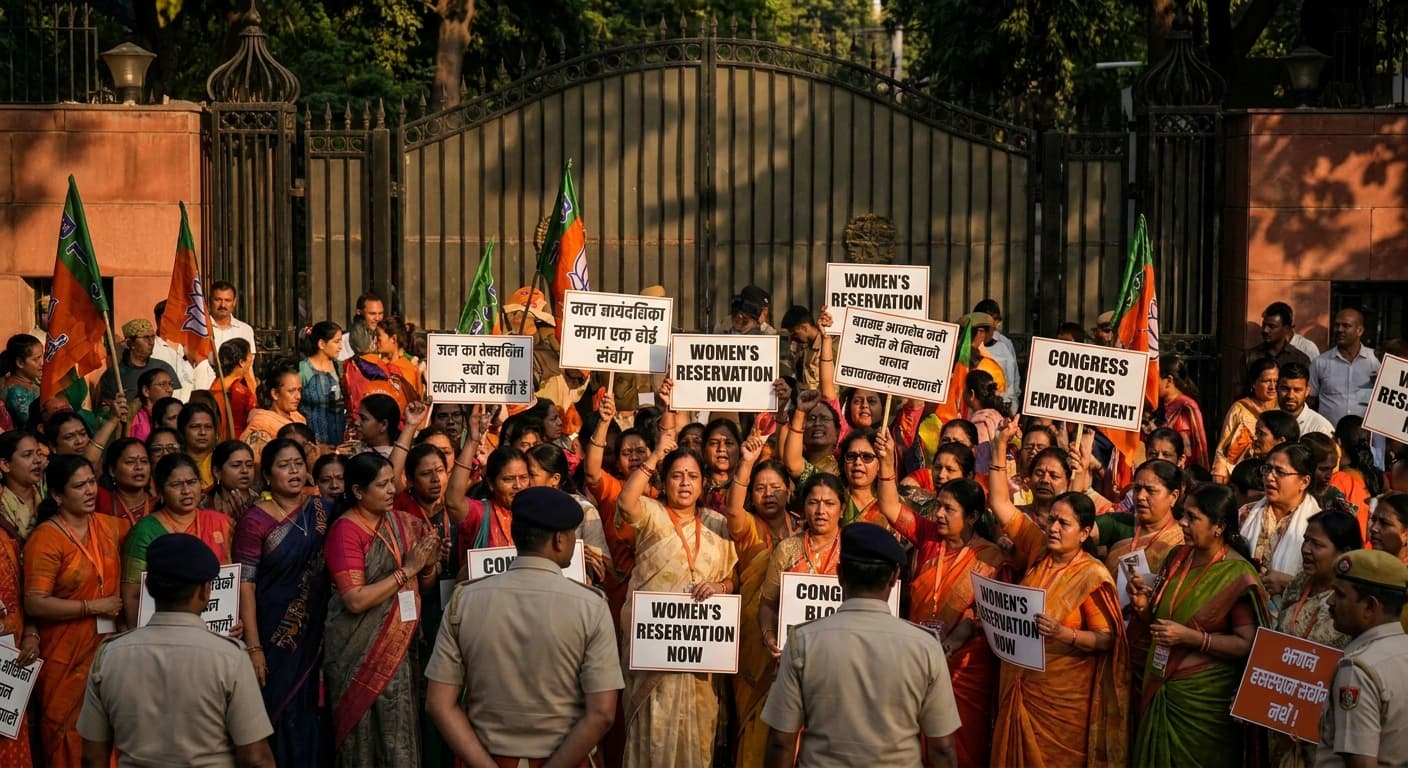
BJP women MPs marched on Rahul Gandhi's Delhi residence on April 18, 2026, after Congress helped sink the women's quota bill. The protest was aimed at Tamil Nadu and West Bengal voters, not at Gandhi.
On April 18, 2026, Delhi Police detained BJP MPs Bansuri Swaraj, Raksha Khadse and Kamaljeet Sehrawat outside Rahul Gandhi's Sunehri Bagh bungalow, and turned water cannon on women workers marching behind them. The protest, one day after the Constitution (131st Amendment) Bill lost 298–230 in the Lok Sabha, was cast as a demand for women's rights. It was in fact the opening salvo of a two-week campaign engineered for two state elections then in progress — a campaign that ended with the BJP taking West Bengal for the first time in its history and levelling the DMK in Tamil Nadu. The march at Gandhi's gate was the visual the ruling party needed. It got it.
What actually happened at Sunehri Bagh
The mechanics are unusually clean for a Delhi political protest. On April 17, the Modi government's package to expand the Lok Sabha from 543 to 850 seats — with the additional 307 reserved for women — fell 54 votes short of the two-thirds threshold under Article 368(2) of the Constitution, according to a Press Information Bureau release summarising the special session. It was, as the
NUS Institute of South Asian Studies noted, the first constitutional amendment blocked in Prime Minister Narendra Modi's twelve years in office.
The next morning, BJP women workers gathered at Moti Lal Nehru Marg, a five-minute walk from Gandhi's residence. According to The Hindu, Delhi Chief Minister Rekha Gupta, Union Minister Raksha Khadse, and MPs Hema Malini, Manju Sharma and Vatsalya Gupta joined the march. Water cannon went up when the group crossed the barricade line. A poster reading dhokebaaz — "cheat" — with Gandhi's face was displayed to television cameras,
NDTV reported. "It's a very sad day for us," Hema Malini told the crowd, according to
Deccan Chronicle. "The Opposition has no confidence in women's power."
That evening, Modi went on national television. He apologised to India's women for the bill's failure and said the opposition had committed "foeticide" by killing it. His exact framing, per ISAS, was that "the opposition has committed a sin by opposing women reservation and they will be surely punished for this." Within hours he was on a plane to Tamil Nadu.
The bill the Congress voted against was not the bill of 2023
The BJP's outrage rests on a slippage voters were meant not to notice. The 33% women's quota — the Nari Shakti Vandan Adhiniyam, or 106th Amendment — passed the Lok Sabha 454–2 in September 2023, as the BBC reported at the time, with Congress voting in favour. That law made implementation contingent on a fresh census and a subsequent delimitation.
What Congress, the DMK, the Trinamool and the Samajwadi Party rejected on April 17 was the vehicle attached to the quota: a three-bill package that also raised the Lok Sabha's cap to 850 seats, based delimitation on the 2011 census, and — crucially — gave Parliament open-ended authority to pick which census future exercises would use. As the Carnegie Endowment laid out in its post-vote analysis, the women's quota was "a vehicle to push through a broader reengineering of India's electoral design."
Southern states have blocked precisely this arithmetic since the 1976 delimitation freeze. Tamil Nadu, Kerala, Karnataka, Andhra Pradesh and Telangana together hold about 20% of India's 1.4 billion people but a disproportionate share of GDP; population-weighted delimitation would strip them of relative seats after decades of successful family-planning policy. BBC coverage captured Chief Minister MK Stalin calling the plan "a massive historic injustice" and burning a copy of the bill on the floor of the Tamil Nadu assembly. Home Minister Amit Shah's counter-assurance — in a
PIB statement issued during the debate — that Tamil Nadu would rise from 39 to 59 seats, and Kerala from 20 to 30, appeared nowhere in the legal text. That gap was the entire opposition case.
Who benefits from the picture
The choice of Gandhi's residence was not incidental. India was mid-way through polling in Tamil Nadu, West Bengal, Kerala and Assam when the protest was staged; results came on May 4. The BJP had a specific problem in each state: it was seen as northern, Hindi-belt, and — despite the 2023 quota — chronically under-represented on female candidacies. As data compiled by the Australian Institute of International Affairs from Election Commission and ADR sources shows, only 14.9% of BJP-Congress-alliance candidates in 2024 were women — well below the 33% the parties in principle endorsed.
Brookings analysis of the 2014 cycle showed the BJP handing out just 37 tickets to women; the
Observer Research Foundation's data run has the BJP at 12.6% in 2019, comparable to Congress but well behind the TMC's 41%.
The ISAS post-election survey is unusually direct on what happened next: the BJP won 207 of 294 seats in West Bengal, a state it had never governed, ending Mamata Banerjee's fifteen-year run. Its vote share rose from ~39% to ~44%.
BBC exit reporting attributed the surge specifically to a shift in urban women voters. The party retained Assam. It lost Tamil Nadu — but to actor C. Joseph Vijay's brand-new TVK, not to the DMK, which was reduced to 59 seats from 133. The DMK's insistence on framing the special session as an assault on Dravidian federalism landed; its incumbency did not survive it.
In other words, the "dhokebaaz" poster at Gandhi's gate did political work in two directions at once. It painted Congress as the party that had first supported women's reservation in 2023 and then blocked it in 2026 — a charge the party's rebuttal, that the 131st was a delimitation bill wearing a quota mask, was too technical to counter on a news cycle. And it gave the BJP a rare piece of visual iconography in which BJP women, not male ministers, were the aggrieved party. Modi's "foeticide" line, coming three hours after the water cannon footage, was designed for that split screen.
The historical parallel worth naming
There is a precedent for a ruling party losing a constitutional vote and pocketing the political dividend anyway: the Rajiv Gandhi government's 1989 defeat of the anti-defection amendment in the Rajya Sabha, which the Congress then used to campaign against the Janata Dal on federal-integrity grounds. What is different in 2026 is that the losing side of the vote is the government, and the constitutional threshold — Article 368(2)'s two-thirds requirement — is the mechanism producing the "loss." The NDA holds 293 Lok Sabha seats; a two-thirds majority needs 360, per Al Jazeera's session preview. The maths of that gap was known before the bill was introduced. Introducing it anyway, on 24 hours' notice, in the last week of two state campaigns, was not a legislative miscalculation. It was the point.
The Takshashila Institution, reviewing the affair on April 28, put the same conclusion more dryly: the bills, "coming in the backdrop of several state elections, were seen as an affront to federalism and were defeated" — but the defeat itself was politically weaponised in real time.
What to watch next
The Modi government's problem is that the arithmetic is unforgiving and the deadline is fixed. The 106th Amendment ties women's reservation implementation to a completed census and a subsequent delimitation. India's 2027 census enumeration begins in the first quarter of that year. Without delimitation, the 33% quota that Modi says he apologises for failing to deliver cannot legally take effect in 2029.
Three catalysts to track in India over the next twelve months:
- The Monsoon Session, July–August 2026. The government has signalled it may re-introduce a stripped-down 131st Amendment — quota only, delimitation deferred — testing whether Congress will vote for the version it says it always supported. If it does, Modi loses his "foeticide" line. If it does not, the BJP has a live grievance to run on in the 2029 general election.
- The Supreme Court hearing on delimitation, expected late 2026. Several southern state governments, led by Tamil Nadu, have signalled Article 32 petitions challenging any population-weighted redraw. A stay would freeze the debate; a green light would collapse the BJP's need for constitutional consent.
- Bihar assembly election, October–November 2026. The first major electoral test after the Sunehri Bagh protest, in a state where the BJP fields fewer women than the state average. A weak female-vote showing here would puncture the party's April narrative faster than any Congress rebuttal.
Diplomat View
The consensus reading of April 18 — that a hardline government embarrassed itself, that the opposition finally united, that Congress won a rare parliamentary victory — is exactly backwards. The BJP staged a legislative defeat that produced a political victory sixteen days later, converting a lost two-thirds vote into a first-ever win in West Bengal and the destruction of the DMK's monopoly in Tamil Nadu. The women protesting outside Rahul Gandhi's home were not the losers of the story; the DMK's Stalin, ejected from his own Kolathur seat, was.
The falsifiable call: if the Modi government re-tables the women's quota in July 2026 stripped of delimitation and Congress votes it through, the April strategy will look like a one-off tactical win with no follow-through. If instead the government keeps the two bills welded together and forces a second defeat before the 2029 campaign, expect the BJP to run nationally on the "opposition denied women 181 seats" line — and expect it to work. The condition for revising this forecast is a Congress or DMK proposal that decouples the two reforms and forces the BJP to vote against its own 2023 law. That has not yet appeared. Until it does, the leverage remains where Sunehri Bagh put it.
The Bottom Line
The BJP did not need the 131st Amendment to pass. It needed Congress to be seen voting it down, and it needed BJP women, not male ministers, to be the face of the grievance the next morning. On both counts the party got exactly what it wanted, and the West Bengal and Tamil Nadu results ratified the bet. The protest at Rahul Gandhi's gate was not the aftermath of a legislative loss — it was the machinery of a state-election win, executing on schedule.
Discover more

India
Berhampur Flips to BJP as Odisha's Swing Deep
The BJP's win in Berhampur marks a major shift in Odisha's political landscape, deepening the state's swing toward the party at the expense of regional rivals.
India
BJP's Falta Win Signals TMC's Decline
The BJP's win in Falta exposes the TMC's fraying local machinery and leadership cracks in West Bengal, signaling deeper trouble for Abhishek Banerjee's party.
India
Amit Shah’s UCC Promise and Tribal Votes
Amit Shah's Uniform Civil Code promise aims to win tribal votes while advancing the BJP's broader agenda, exposing the tensions inside its identity politics.
India
BJP’s West Bengal Sweep Forces Rethink
The BJP's sweeping victory in West Bengal reshapes Indian politics, forcing a battered Opposition to rethink strategy as the party extends its dominance.