BJP Demands Action on Kharge's Terrorist Slur
BJP targets Kharge's remarks ahead of Tamil Nadu polls
Model Diplomat7 min readIndia
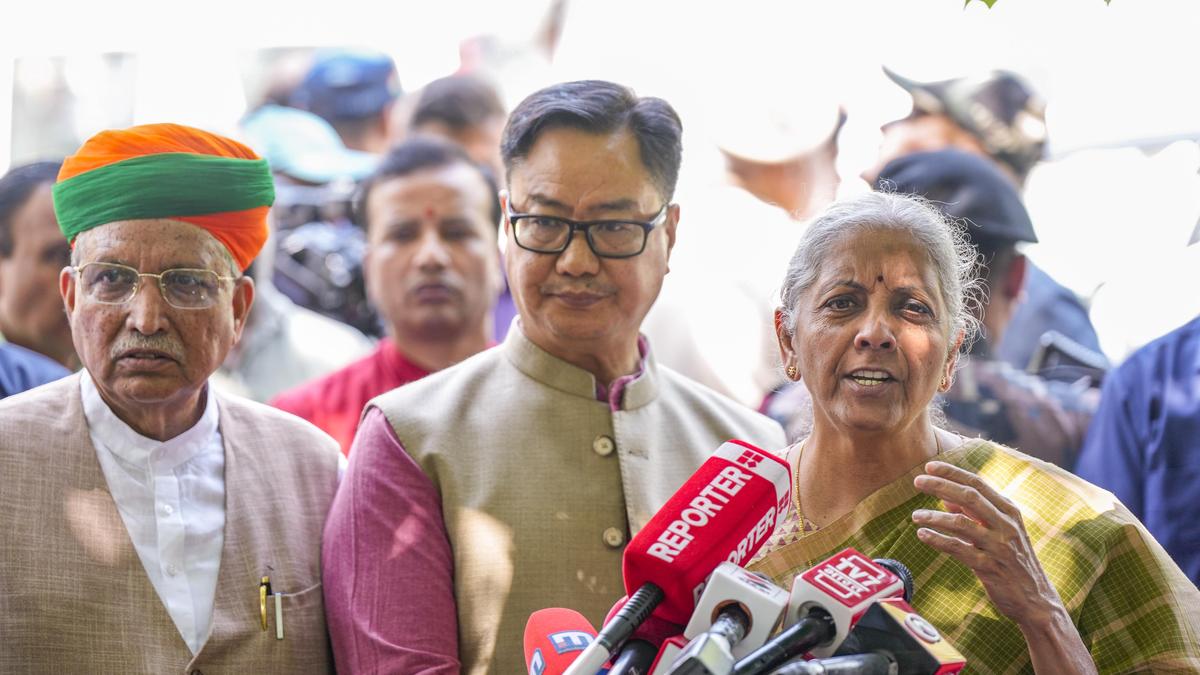
BJP Demands ECI Action on Kharge's 'Terrorist' Slur Against Modi
Union ministers Sitharaman and Rijiju met the Election Commission on April 22, 2026, demanding a public apology and campaign curbs on Congress chief Mallikarjun Kharge. The real target was Tamil Nadu polling day, 48 hours away.
The Bharatiya Janata Party's April 22 demand that the Election Commission of India punish Congress president Mallikarjun Kharge for calling Prime Minister Narendra Modi a "terrorist" was never about a slur — it was a 48-hour information operation timed to Tamil Nadu's polling day, and by the time the votes were counted on May 4, the BJP-AIADMK alliance had 48 seats, the DMK-Congress alliance was gutted, and the ECI had done exactly nothing. That combination — furious complaint, quiet regulator, spectacular electoral outcome — is the template both sides will now try to replicate in every future Indian state election.
The remark itself was made at a Chennai press conference on April 20, where Kharge was attacking the AIADMK's decision to ally with the BJP. Asked to clarify, he narrowed the meaning: "He is terrorising people and political parties. I never said he is a terrorist [in the literal sense]. He is misusing his power and government machinery," Outlook India reported. The BJP did not accept the clarification. Within 24 hours, it filed a memorandum with the ECI seeking "suitable penal and regulatory proceedings" against the Congress president under the
Bharatiya Nyaya Sanhita, the 2023 penal code that replaced the Indian Penal Code,
the Times of India reported.
What the delegation actually asked for
On the morning of April 22, a delegation walked into Nirvachan Sadan, the ECI's headquarters in New Delhi, that was heavy even by BJP standards: Finance Minister Nirmala Sitharaman, Parliamentary Affairs Minister Kiren Rijiju, Law Minister Arjun Ram Meghwal, party general secretary Arun Singh and Om Pathak. Three Cabinet ministers for one press-conference sentence. According to The Hindu, the party requested the ECI to direct Kharge "to submit a public apology and retract his comment, and that appropriate campaign restrictions or other corrective measures should be imposed on him."
Sitharaman framed it in constitutional register: "It's an insult to the mandate given by the people of India… once chosen, he is the leader for the entire country," she told reporters after the meeting. Rijiju was blunter, calling the remark a "disgusting act" and adding that the ECI had assured the delegation of "appropriate action," per Times Now.
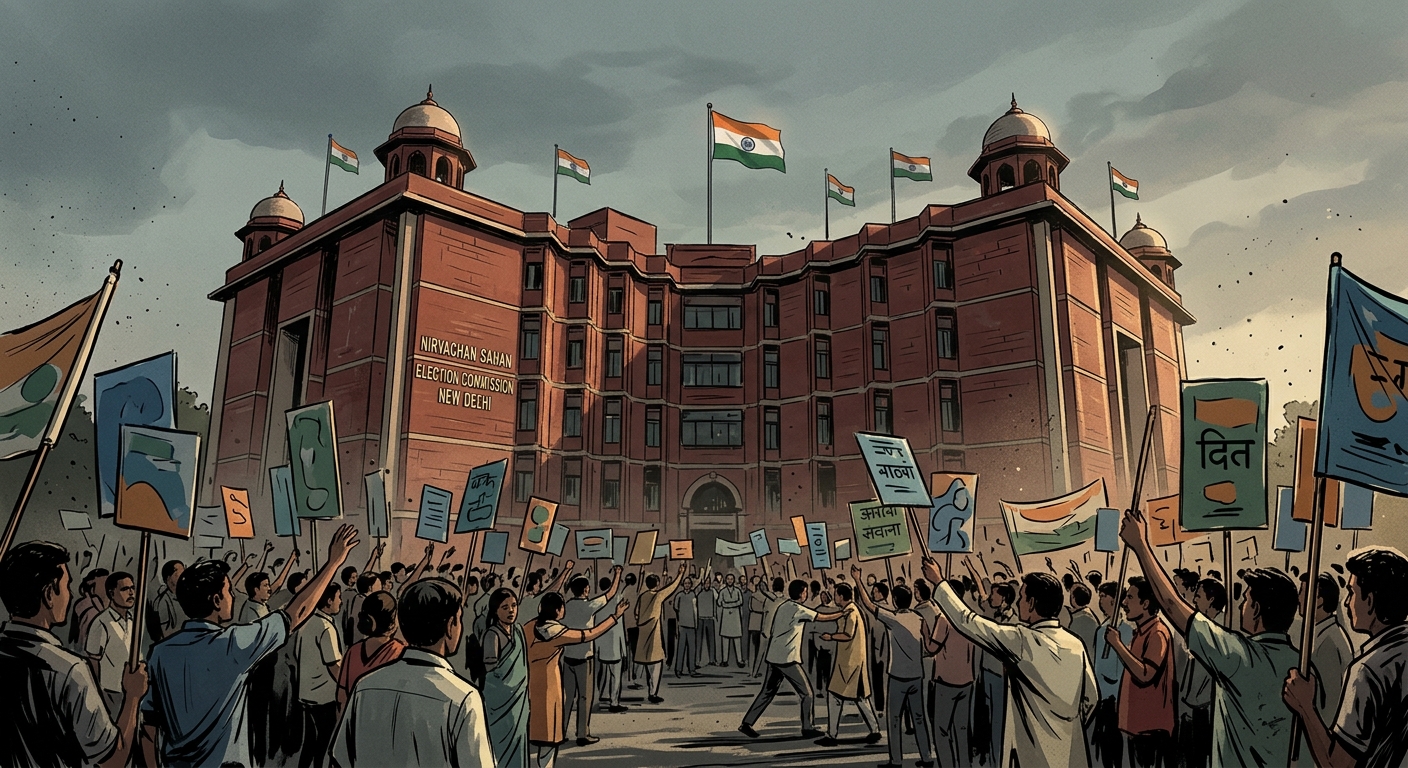
The choreography matters. The ECI had announced the Tamil Nadu and West Bengal Phase-I schedule on March 15, 2026, with polling on April 23 and counting on May 4, according to a Press Information Bureau release. That put the BJP delegation at Nirvachan Sadan on the very last full campaigning day. Any headline the ECI generated — a show-cause notice, a warning, a mild rebuke — would land in Tamil voters' newsfeeds within hours of polling.
The Article 324 arithmetic
The BJP knew the odds of a substantive sanction were low. The Election Commission's disciplinary toolkit under Article 324 of the Constitution runs from mild ("advisory") through show-cause notices, star-campaigner delisting, and — the sharpest weapon — a temporary campaign ban. In 2020, the ECI used the full stick against two of the BJP's own: Anurag Thakur and Parvesh Sahib Singh Verma, both stripped of star-campaigner status and barred from campaigning for 72 and 96 hours respectively for hate-tinged speeches during the Delhi assembly campaign, per the Press Information Bureau. The order cited violations of the Model Code of Conduct and the Representation of the People Act, 1951.
That precedent is what makes the BJP's memorandum plausible on paper. It is also what makes ECI action against Kharge unlikely on the same timeline. In the 2024 general election, when the BJP's own president Modi drew Congress complaints for the "infiltrators" and "those who have many children" speech in Rajasthan, the ECI issued a notice to the party president rather than the prime minister, and imposed no personal restriction, the BBC reported. Congress leaders and independent watchdogs — including analysts at the
Observer Research Foundation — have long argued the commission moves slowly when the target is powerful, and quickly against soft targets. Under Chief Election Commissioner Gyanesh Kumar, that critique has sharpened: in August 2025, the ECI held a rare weekend press conference to swat away Rahul Gandhi's "vote chori" claims, with Kumar demanding Gandhi either file a sworn affidavit or apologise,
the BBC reported.
The pattern: the ECI acts hardest on lower-tier speakers, and treats top-of-ticket leaders through their party presidents. For Kharge — who is himself the party president — that ladder does not exist. The commission's realistic options were an advisory or a show-cause notice, neither of which meaningfully restricts a 84-year-old Rajya Sabha member who was not on any Tamil Nadu ballot.
Why the BJP filed anyway
Because the complaint was the point. Three second-order effects were live from the moment Sitharaman walked into the commission.
First, the Tamil Nadu ballot. The BJP-AIADMK alliance was fighting a state where the party has never held power, against a DMK-Congress incumbent government waging what Chief Minister M K Stalin called a "Tamil Nadu versus New Delhi" campaign, Al Jazeera reported. Kharge's clarified "terrorising" framing captured Stalin's central charge — that the Modi government misuses central agencies and withholds funds from non-BJP states. By pushing the ECI into the news cycle 48 hours before polling, the BJP replaced that federalism argument with a decorum argument. The switch worked in every language the Chennai press covered it in, including
BBC Tamil.
Second, the West Bengal Phase-II ballot on April 29. Mamata Banerjee's Trinamool Congress had spent the campaign painting the BJP as an outside imposition; the "Congress president called the PM a terrorist" cycle handed BJP state units a ready-made reply for their final week of doorstep canvassing.
Third — and most important for what happens next — the criminal-law backdrop. The BJP's memorandum specifically invoked the Bharatiya Nyaya Sanhita, which came into force on July 1, 2024, replacing the Indian Penal Code, according to a Press Information Bureau release. Section 356 of the BNS carries defamation forward from the old IPC's Section 499, with a penalty of up to two years' imprisonment or a fine or both. Rahul Gandhi was convicted in 2023 under the old IPC 499/500 for his "why do all thieves have Modi surnames" speech, briefly losing his Lok Sabha seat, per
Al Jazeera. BJP workers in Karnataka and Gujarat have since filed local FIRs against Kharge on the same template. The ECI complaint gives those criminal filings political air cover.
The results, and what they proved
Tamil Nadu voted on April 23 and West Bengal completed voting on April 29. Counting on May 4 delivered the biggest shock of the cycle. Actor-turned-politician Joseph Vijay's two-year-old Tamilaga Vettri Kazhagam won 108 of 234 assembly seats with 35% vote share, according to a post-election analysis by the NUS Institute of South Asian Studies. The DMK collapsed to 59 seats — down 74 from 2021 — and Stalin lost his Kolathur stronghold. The AIADMK won 47; the BJP took a single seat. In West Bengal, the BJP won 207 of 294 seats, ending Mamata Banerjee's three-term rule. The Congress in Tamil Nadu, contesting alongside the DMK, was reduced to a rump.
None of that was caused by the Kharge row. But two things did happen because of it. The final-week federal-funds argument the DMK had planned to close on was drowned out by wall-to-wall coverage of Sitharaman at Nirvachan Sadan. And Kharge, whose party is 138 years old and was fighting for relevance in a state where it once dominated, spent his final 72 campaign hours defending a single word.
Diplomat View
The evidence points one way: the BJP has learned that the ECI complaint is now a more useful campaign instrument than the ECI ruling. File before polling day, argue on primetime television, get the news cycle you want, and accept the regulator's inaction as an acceptable cost. Kharge will not be barred. He will, at most, receive a written notice. The BJP will treat that as vindication either way — a rebuke if it comes, a "cover-up" if it does not.
The forecast: if the ECI issues even a soft advisory in July or August 2026, expect the BJP to weaponise it as legal precedent against every future opposition speaker in the 2027 Uttar Pradesh, Punjab and Uttarakhand campaigns. If the commission stays silent, expect a Kharge defamation trial under BNS Section 356 to become the vehicle instead, mirroring the 2023 Rahul Gandhi playbook. The forecast changes only under one condition: a Supreme Court bench takes up a live petition to give the Model Code of Conduct statutory teeth — a reform Observer Research Foundation has been arguing for since 2019, and which every recent CEC has quietly resisted.
For India's opposition, the lesson of April 22 is uncomfortable. The BJP does not need the ECI to punish Kharge. It needs Kharge, once a fortnight, to say something that lets the BJP walk into Nirvachan Sadan with three Cabinet ministers and a television pool.
What to watch next
- ECI ruling on the BJP memorandum: expected in a written order by end-July 2026; watch for the phrasing — an "advisory" is a green light for the BJP to repeat the tactic, a show-cause notice would be a modest surprise.
- FIRs against Kharge in BJP-run states: any charge-sheet under BNS Section 356 filed before December 2026 will signal the criminal-defamation escalation is live.
- Congress's 2027 campaign discipline: the Working Committee is expected to meet in September 2026 to finalise the UP campaign structure. If Kharge is quietly stepped back from press conferences in favour of Priyanka Gandhi Vadra, the BJP's April operation will have achieved its unstated goal.
The Bottom Line
The BJP's April 22 complaint against Mallikarjun Kharge was not a request for punishment — it was a media instrument, deployed 48 hours before Tamil Nadu voted, that swapped the DMK's federal-funds argument for a decorum argument on the last day of the campaign. The Election Commission's likely non-action is not a failure of the system; it is the outcome the BJP planned around. Every Indian opposition leader who speaks between now and the 2027 state polls should assume the same trap has been re-set and re-baited.
Discover more
India
CPI MP Accuses PM Modi of MCC Violations
CPI MP P Sandosh Kumar alleges PM Modi breached the Model Code of Conduct in Tamil Nadu, raising election integrity concerns before the 2026 Assembly polls.
India
700 Activists Accuse PM Modi of MCC Breach
Over 700 activists allege PM Modi breached election code with a televised address attacking opposition parties just before state elections.
India
BJP Congress Clash Over MP Bill Defeat
The BJP's defeat of the women's quota amendment sparks a political narrative war with Congress, impacting future elections.

Conflict & Security
Drone Warfare Killing Aid Workers at Unprec
Over 1,000 humanitarian workers killed in three years as cheap armed drones collapse legal protections. Gaza, Sudan, Ukraine, and DRC see deliberate targeting of aid convoys and hospitals with zero prosecutions.