Bikita Minerals Bets $400M on Lithium Plant
Zimbabwe's lithium plant deepens China's grip on battery supply chain.
Model Diplomat8 min readAfrica
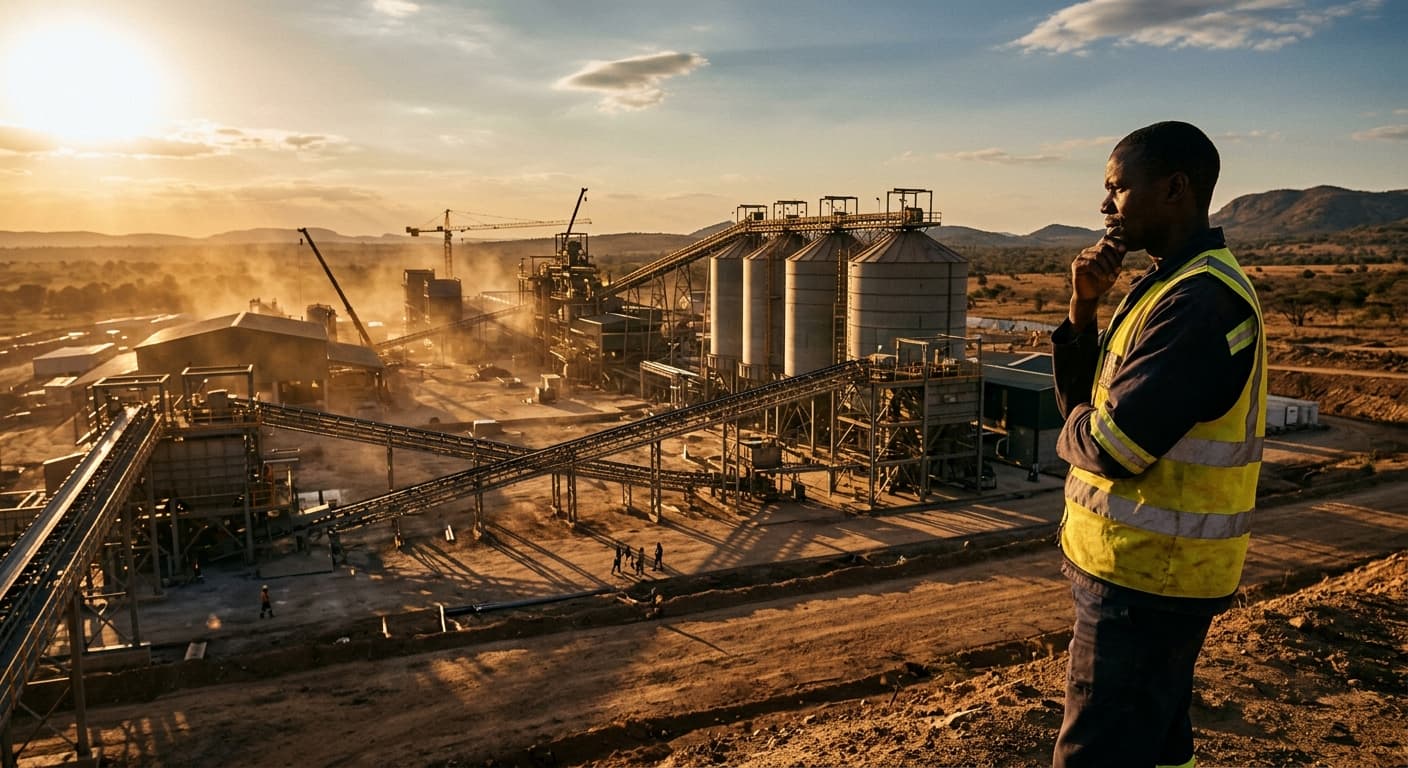
Bikita Minerals Bets $400M on Africa's Biggest Lithium Plant
Sinomine's $400m lithium sulphate plant at Bikita will make Zimbabwe the flag-bearer of African beneficiation — and deepen Beijing's grip on the battery chain.
Sinomine Resource Group's Bikita Minerals will commission the first phase of Africa's largest lithium sulphate plant in the second quarter of 2027, a US$400 million facility with initial capacity of 60,000 tonnes a year that will move Zimbabwe from raw-ore exporter to producer of battery precursor chemicals, according to a company statement to Al Jazeera. Harare is selling the project as the crowning proof of its beneficiation policy. Read the ownership map, though, and the plant does something else entirely: it locks Africa's largest lithium reserve into a Chinese-controlled midstream at the exact moment Washington and Brussels are trying to build one of their own.
That is the story worth watching. Not the tonnage figures, but the geometry of who owns what — and what the plant does to a global supply chain in which a single country already refines 72.8% of the world's lithium, per the IEA's Global Critical Minerals Outlook 2025, cited by the South African Institute of International Affairs.
What is actually being built
Bikita sits 300km south of Harare on a pegmatite deposit holding 10.8 million tonnes of lithium ore, according to SAIIA. Sinomine, a Beijing-listed critical-minerals conglomerate, bought the mine outright in 2022 for $180 million. Since then it has commissioned a 300,000-tpa spodumene and petalite concentrator, laid a 112km 132kV transmission line from the Tokwe substation in a record ten months between May 2023 and March 2024, and — in mid-2025 — sunk a further $400 million into what SAIIA describes as "the world's second caesium smelting plant," a facility that gives Sinomine effective control of both active caesium plants on the planet.
Caesium is the sleeper story here. It is used in oil-well drilling fluids, aerospace navigation and — potentially — perovskite photovoltaics; a 2020 analysis in Resources Policy by Vidal, Alberola-Borràs and Mora-Seró projects that known caesium resources will be exhausted by 2056 at current extraction rates and warns that supply risk spikes sharply "when all Cs production is concentrated in a single place," per the paper indexed on RePEc. With the Bikita smelter, Sinomine now sits astride that chokepoint.
The lithium sulphate plant is the next step up the value chain. Lithium sulphate is the intermediate chemical that feeds directly into lithium carbonate and lithium hydroxide — the actual cathode inputs for EV batteries. Bikita told Al Jazeera it is "implementing a $400m investment programme to move from exporting lithium concentrate to developing lithium precursor chemicals," with 60,000 tonnes of annual sulphate capacity in phase one and a longer-run target closer to 100,000 tonnes, per Mining Zimbabwe. That would make it the single largest lithium chemicals facility on the continent, edging out the $400m plant Zhejiang Huayou Cobalt commissioned at Arcadia near Harare, whose first sulphate exports left the country in April 2026.
The policy that forced everyone's hand
Zimbabwe did not stumble into this position. President Emmerson Mnangagwa's government banned raw-lithium exports under the Base Minerals Export Control Act in December 2022, initially to curb smuggling into South Africa and Mozambique but quickly reframed as an industrial-policy tool. SAIIA calculates Harare was losing roughly $1.8 billion a year exporting unprocessed ore, and that lithium revenue jumped from $70 million in 2022 to more than $600 million in 2024 as the ban forced Chinese buyers to build concentrators on Zimbabwean soil, according to its January 2026 occasional paper on Chinese mining-energy investments.
On 10 June 2025, then-Mines Minister Winston Chitando announced a follow-on ban on lithium concentrate exports from January 2027 — an escalation designed to force the sulphate step onto Zimbabwean soil. Harare then jumped its own timetable. On 25 February 2026, Deputy Mines Minister Polite Kambamura told the Chamber of Mines that exports of all raw minerals and lithium concentrates were suspended "with immediate effect" to curb "continued malpractices during the exportation of minerals," per Al Jazeera. The WTO's most recent Trade Policy Review of
Zimbabwe notes the beneficiation regime is enforced through export taxes on "un-beneficiated" platinum group metals, diamonds and lithium, with sales channelled through two state monopolies — MMCZ and Fidelity Printers — per the
WTO Secretariat report.
The numbers say the policy is working, at least on the export line. MMCZ data cited by Al Jazeera show mineral sales reached $983.85 million in Q1 2026, with export values up 79% and lithium earnings alone jumping from $84.19m to $178.64m year-on-year. Zimbabwe exported 1.128 million tonnes of spodumene concentrate in calendar 2025, up 11% on 2024. In parliament on 13 May 2026, Kambamura told MPs that mineral monitoring inspectors "work with the miners, looking at whether they are mining legally, whether they are following procedures, environmental laws and whether they are declaring what they are mining," per the Hansard transcript — an implicit acknowledgement that the ban's revenue payoff depends entirely on enforcement.
Who wins, who loses
The winners are legible. Sinomine wins twice: it captures the sulphate margin inside Zimbabwe and locks in feedstock for its Chinese refineries at prices insulated from the spot market. Beijing wins strategically — the SAIIA paper documents that Chinese firms have sunk more than $1 billion into Zimbabwean lithium since 2021 and that Zimbabwe's global share of extracted lithium climbed from under 2% to about 9% in 2024, all of it flowing into Chinese-controlled midstream capacity. The IMF's April 2026 World Economic Outlook commodity feature notes that establishing new refining capacity outside China "requires billions in capital investment, years of regulatory approval, and specialized technical expertise, making rapid diversification of processing capacity extremely difficult," per the IMF — meaning every year Bikita operates is a year the West falls further behind.
Mnangagwa's Treasury also wins, at least on the ledger. The government targets a $12 billion mining economy by 2030, and lithium is now the third-largest mineral export after gold and PGMs, per the Observer Research Foundation.
The losers are also legible. Artisanal miners — the people who dug the ore before the Chinese arrived — have been squeezed out; Al Jazeera's 2024 field reporting found raw lithium prices had collapsed from $1,200 to $100 a tonne after the ban, per its account of small miners "left behind" in Zimbabwe's lithium boom. Local governments have lost too: Farai Maguwu, director of the Centre for Natural Resource Governance, told Al Jazeera that Sinomine's promised $10 million bridge project in Bikita "has not been fulfilled" and the company "allegedly refused to sign a memorandum of understanding with the local council, limiting accountability." Zimbabwe's hard-rock geology — unlike Chile's brines — is water- and energy-intensive to process, a variable SAIIA notes "was not adequately considered when instituting the ban."
The biggest loser is the Western diversification project. The US lifted country-specific sanctions on Zimbabwe in March 2024 and replaced them with Global Magnitsky designations on eight individuals including Mnangagwa, according to ORF — a technical opening for Western investment. It hasn't worked. In the first half of 2023 alone, the Zimbabwe Investment Development Agency received 160 lithium investment applications from Chinese firms and just five from American ones, per ORF. The Bikita commissioning in 2027 will formalise the outcome of that race.
The Indonesia parallel — and where it breaks
Every mining minister in Africa now cites Indonesia. Jakarta banned unprocessed nickel exports on 1 January 2020 and rode Chinese capital to a $20 billion downstream nickel industry by 2022, up from under $1 billion in 2015, per Al Jazeera's opinion desk. Namibia has now banned raw exports of lithium, cobalt, manganese, graphite and rare earths; Ghana will buy 30% of large-scale gold output from July 2026; Mali is building a 200-tpa gold refinery. Bikita is the flagship of the same doctrine.
The parallel breaks in one place: power. Zimbabwe's grid is chronically short — ORF flags this bluntly — and the country cannot borrow from the IMF or World Bank to fix it, saddled with roughly $17 billion in external debt and arrears. That is why the plant's most consequential infrastructure is not the sulphate reactor but the 132kV line Sinomine built to the Tokwe substation. In practice, China is not just financing Zimbabwe's beneficiation; it is powering it.
There is also a demand-side wrinkle Harare cannot control. A 2026 study in npj Materials Sustainability notes that lithium carbonate — better suited to the LFP battery chemistry China dominates — already commands 61% of the battery-grade lithium market, while European and US EV makers still prefer nickel-rich NMC cathodes fed by lithium hydroxide, per the paper in Nature. Bikita's sulphate can be converted either way, but the plant's Chinese ownership means the default off-take will feed LFP lines in Jiangsu and Sichuan, not the Inflation Reduction Act–subsidised gigafactories in Georgia or Tennessee.
Diplomat View
Bikita will commission on schedule because both principals need it to. Sinomine needs the sulphate margin to justify a $980m cumulative outlay on a single Zimbabwean asset; Mnangagwa needs a ribbon-cutting before the 2028 election cycle and a headline to justify the abrupt February 2026 export ban to jittery Chinese partners. Our call: the plant will commission Q2 2027 at or near the 60,000-tpa design figure, Zimbabwean lithium export earnings will clear $1 billion for calendar 2027, and no Western off-taker will sign a material term sheet for Bikita product in that window. What would change the forecast: a sovereign-debt breakthrough with the Paris Club or IMF that unlocks Western DFI financing for a competing refinery; a Sinomine ESG scandal serious enough to trigger a licence review under Zimbabwe's Base Minerals Export Control Act; or a collapse in lithium hydroxide prices below $10,000/tonne that makes the phase-two expansion uneconomic. Absent those, Bikita is the template — and the template is Chinese.
What to watch
- Q4 2026: Zimbabwe's 2027 budget and any statutory instrument codifying the February 2026 emergency ban into permanent law.
- Q2 2027: Bikita phase-one commissioning; first lithium sulphate shipment via Beira or Durban.
- January 2027: Original deadline for the lithium concentrate export ban — watch whether laggards (Kamativi, Sabi Star) are granted extensions.
- 2028 Zimbabwean elections: the political test of whether beneficiation revenues translate into rural votes in Masvingo and Manicaland.
The Bottom Line
Bikita is not a beneficiation story dressed up as geopolitics — it is a geopolitical story dressed up as beneficiation. Zimbabwe will get the plant, the jobs and the export receipts; China will get the world's largest single African lithium chemicals facility, a caesium monopoly and a template it can replicate from Namibia to the DRC. The Bikita commissioning in Q2 2027 will be the moment Africa's critical-minerals map is drawn — in Chinese ink, on Zimbabwean paper.
Discover more
US Politics
House Ethics Committee Pushes Sexual Miscond.
The House Ethics Committee has shifted responsibility for sexual harassment settlement records to the Office of Congressional Workplace Rights, complicating disclosure efforts.
International Relations
Economist Impact Sustainability Week 2026
Economist Impact Sustainability Week 2026 spotlights the energy transition, AI in clean technology, and supply chain resilience as themes for global leaders.
India
700 Activists Accuse PM Modi of MCC Breach
Over 700 activists allege PM Modi breached election code with a televised address attacking opposition parties just before state elections.

Conflict & Security
Drone Warfare Killing Aid Workers at Unprec
Over 1,000 humanitarian workers killed in three years as cheap armed drones collapse legal protections. Gaza, Sudan, Ukraine, and DRC see deliberate targeting of aid convoys and hospitals with zero prosecutions.