The Bahamas Bets Its Survival on a UN Seat
Davis's re-election fuels a UN Security Council bid focused on climate.
Model Diplomat4 min readamericas
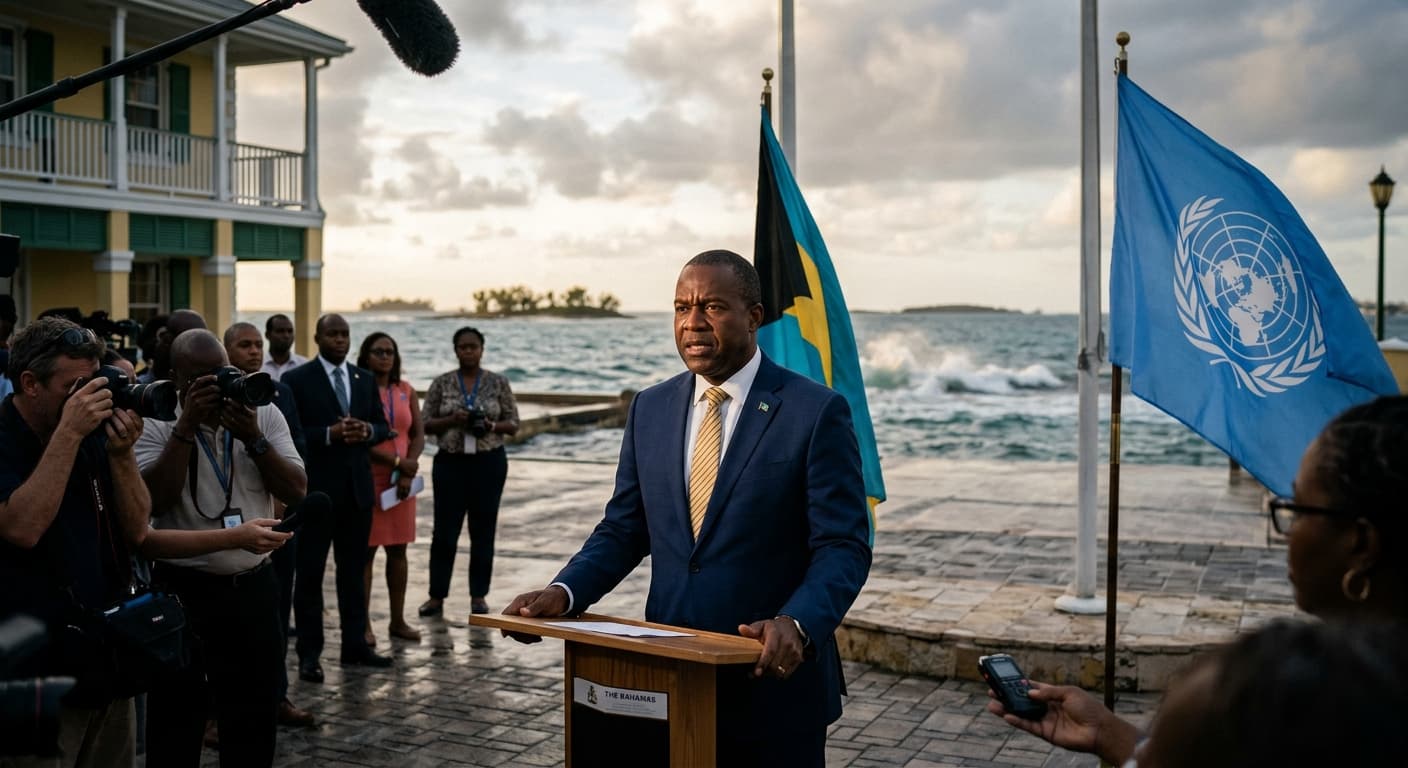
The Bahamas Bets Its Survival on a UN Security Council Seat
Philip Davis's historic re-election gives the 400,000-person island nation a mandate to pursue its first-ever Security Council bid — and climate is the only card that matters.
Prime Minister Philip Davis secured a historic second consecutive term on May 12, 2026, when his Progressive Liberal Party crushed the Free National Movement 33 seats to 8 in a snap general election, according to Al Jazeera. No Bahamian party has pulled off back-to-back wins since 1997. The victory transforms Davis from a single-term caretaker into the most electorally secure Caribbean leader in a generation — and he is spending that capital on an audacious diplomatic project: a first-ever campaign for a non-permanent seat on the UN Security Council.
The bid, formally launched for the 2032–2033 term under the theme "Resilience, Relationships, Representation," marks a sharp escalation for a country of roughly 401,000 people — making it one of the smallest states ever to seek a council seat. The campaign explicitly ties climate change to security, arguing that Small Island Developing States (SIDS) face existential threats that the Council's permanent members have systematically under-prioritized. As the Model Diplomat country profile documents, Nassau's 2026 foreign policy priorities rank climate action first, ahead of economic resilience, citizen security, and migration management — an ordering that reflects genuine hierarchy of interest, not diplomatic theater.
The climate-as-security argument
The Bahamas has been methodically building the legal architecture for this argument. It was a co-sponsor — alongside the EU, Fiji, Marshall Islands, Panama, Paraguay, and Sudan — of the 2021 Human Rights Council resolution that created a UN special rapporteur on human rights and climate change, as documented by Chatham House. It has supported the ICJ advisory proceedings on state obligations for climate harm. And Davis himself has been among the most forceful heads of government on the international stage, telling COP27 leaders in Sharm el-Sheikh to "get real" and warning that inaction "consigns us to a watery grave," according to
BBC News.
This is not rhetoric for domestic consumption. The IMF's April 2025 assessment concluded that the Bahamas faces "existential" risks from sea-level rise, biodiversity loss, and intensifying hurricanes — with smaller, less-developed islands disproportionately exposed. A tourism-dependent economy with a nominal GDP of roughly $15.8 billion cannot self-insure against these threats. The UNSC bid is, at its core, a demand that the powers who control the global security agenda acknowledge that climate is security.
Who benefits, who loses
Davis is the immediate beneficiary. The UNSC campaign gives his second-term government a unifying national project beyond the cost-of-living concerns that dominated the election. It also positions him as a successor to Barbados's Mia Mottley as the Caribbean's leading diplomatic voice — a role that carries real convening power, as demonstrated when then-Vice President Kamala Harris co-hosted a US-Caribbean summit in Nassau in June 2023, the highest-level US visit since Bahamian independence, per Al Jazeera.
Washington faces a complicated calculus. The Bahamas is a critical maritime partner — sitting astride drug-trafficking routes less than 50 miles from Florida — and its security cooperation with the US is deep. But a Bahamian UNSC seat means another voice demanding climate finance and loss-and-damage mechanisms that the US has been reluctant to fund at scale. Davis has already shown he will not defer to Washington reflexively: in December 2024, his office "firmly rejected" a Trump transition proposal to have the Bahamas accept deportation flights of third-country migrants, stating the country "simply does not have the resources," as Al Jazeera reported.
China stands to gain indirectly from any friction. Beijing has already invested heavily in Bahamian infrastructure — including resort and port facilities that have drawn attention from US defense planners — and a Nassau that feels rebuffed by Washington on climate has every incentive to diversify its diplomatic portfolio.
What to watch next
The UNSC election for the 2032–2033 term is years away, but the campaign clock is already ticking. Successful bids — as the BBC has documented in covering past UNSC races — require multi-year lobbying, well-funded diplomatic outreach, and often transactional vote-swapping in the General Assembly. The Bahamas will need two-thirds of voting members. Its natural base is CARICOM, AOSIS, and the Commonwealth, but the math requires significant support from Africa and Asia.
The more immediate test is whether Davis can convert his electoral mandate into concrete climate-finance commitments at the next COP — and whether the ICJ advisory opinion, expected before the decade's end, provides legal ammunition for the argument that climate inaction violates state obligations. Watch Nassau's diplomatic appointments over the next six months. A dedicated UNSC campaign team with experienced multilateral operators will signal how serious this bid actually is.
Discover more

US Politics
SNAP Food Assistance Faces Legal Challenges
In 2026, SNAP faces stricter eligibility rules and mounting legal challenges, threatening food assistance for the millions of Americans who rely on the program.
Global Politics
Trump's Conflicting Messages on Iran War
Trump's mixed messages on Iran reflect a strategy of audience management, benefiting Tehran amid a complex geopolitical landscape.
Global Politics
US-Iran Tensions Rise
Tensions escalate in the Strait of Hormuz as Iran and the US clash over maritime control, with a ceasefire hinging on a contested MoU paragraph.

Conflict & Security
Drone Warfare Killing Aid Workers at Unprec
Over 1,000 humanitarian workers killed in three years as cheap armed drones collapse legal protections. Gaza, Sudan, Ukraine, and DRC see deliberate targeting of aid convoys and hospitals with zero prosecutions.