Burkina Faso Cuts Diplomatic Ties with France
A military government ends relations with its former colonizer.
Model Diplomat4 min readafrica
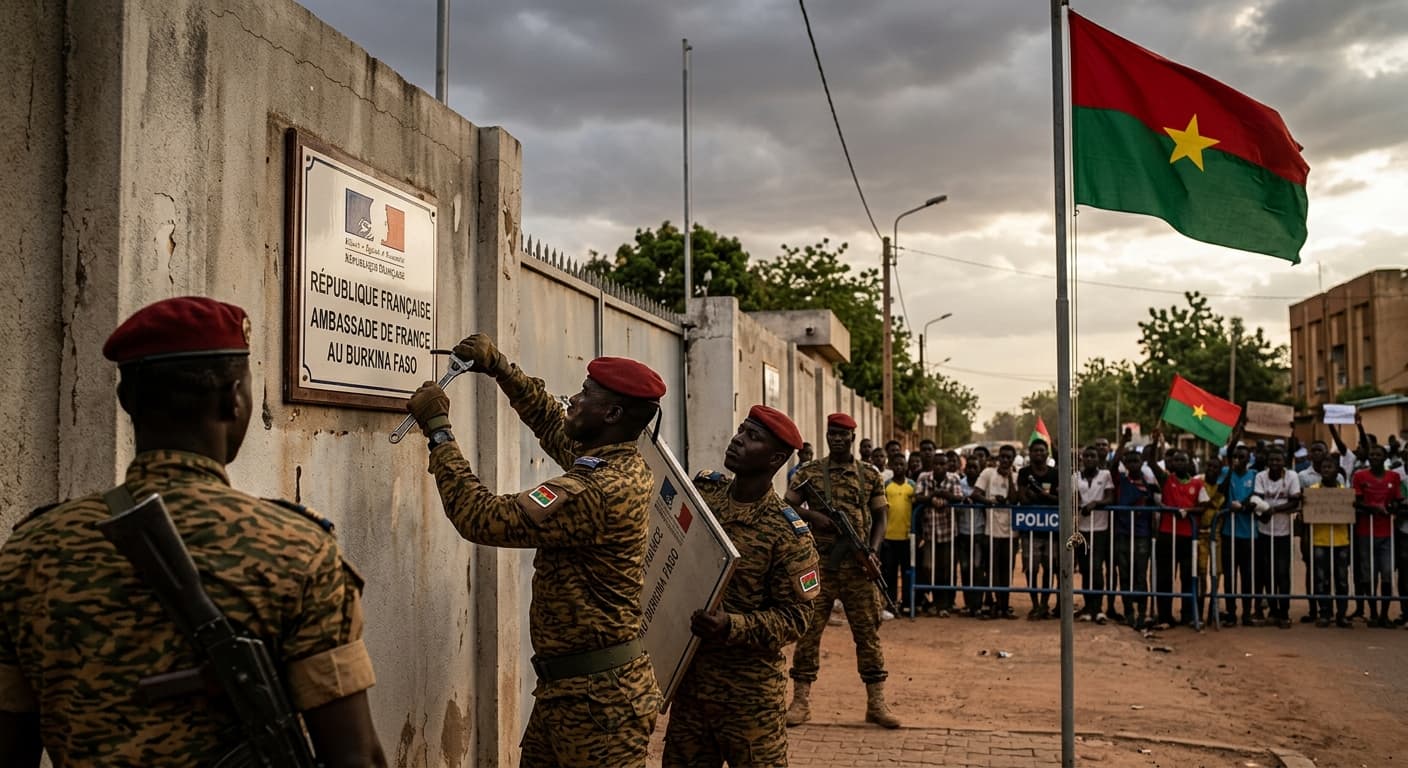
Burkina Faso Severs All Diplomatic Ties with France — the Sahel's Most Definitive Rupture Yet
A military government burns the last bridge with Paris, betting sovereignty rhetoric can fill the gap Western counterterrorism and aid once occupied.
On June 26, 2026, Burkina Faso's military government announced the immediate severance of diplomatic relations with France, the most absolute rupture between an African state and a former colonial power in this generation. The communiqué, read on state television by Communications Minister Pingdwende Gilbert Ouédraogo, accused Paris of harboring "neo-colonial ambitions" and providing "active support to subversive networks and terrorist groups" operating in the Sahel — claims for which no public evidence was offered, as The African Mirror noted. Paris called the decision "hostile and unfounded" and confirmed reciprocal measures are under review, according to
Powers of Africa.
This is not a sudden tantrum. It is the endpoint of a four-year unwinding that began with Captain Ibrahim Traoré's September 2022 coup, accelerated through the 2023 expulsion of 400 French special forces from Camp Kamboinsin, and continued with the shuttering of French media outlets, the suspension of aid, and the refusal to accredit a new French ambassador. As Business Insider Africa reported, the June 26 decision "dismantles the diplomatic framework itself." There is now no ambassador, no embassy channel, no formal relationship left to downgrade. Two states entangled for 130 years — first as colonizer and colony, then as patron and client — now have, on paper, no relationship at all.
The Real Story Is Not the Break — It's What the Junta Is Building in Its Place
The severance is best understood as the public-facing climax of a deeper institutional project. Burkina Faso, Mali, and Niger — the three junta-led states of the Alliance of Sahel States (AES) — have spent the past two years constructing an entirely new regional architecture outside the Western orbit. At their December 2025 summit in Bamako, the three leaders inaugurated a joint investment bank to finance infrastructure without Western lenders, a shared television channel to control the narrative, and a 5,000-strong multinational force under Burkinabè command, as Al Jazeera documented. A biometric AES passport has already been launched, as the
BBC reported. A common currency — dubbed "Sira" — is under active discussion, which would amount to the most direct assault yet on the CFA franc system backed by the French Treasury.
The currency question is not symbolic. Together, the three AES states contribute roughly 8% of ECOWAS's $761 billion GDP. Ditching the CFA franc means abandoning the euro peg and the convertibility guarantee Paris provides — a high-risk bet that Traoré, Mali's Assimi Goïta, and Niger's Abdourahmane Tchiani are framing as a sovereignty imperative.
Who Gains, Who Loses
Traoré's junta gains the most in the short term. The severance allows him to consolidate a domestic narrative in which every security failure — and the jihadist insurgency has not abated — can be blamed on French destabilization rather than governance failures. The pivot toward Moscow, Beijing, Ankara, and Gulf capitals provides access to security contractors and infrastructure financing with fewer human-rights strings. These partners "ask fewer questions," as Convicts and Cops put it.
France loses its last official diplomatic channel into a country at the center of the Sahel's security crisis. As EU Global noted, the rupture "removes one of the remaining official channels between a European power and a country at the centre of the Sahel's security crisis." Even limited consular access had allowed Paris to understand local power structures, assess threats, and prevent miscalculations. Those channels are now gone. Trade, however, is not: bilateral commerce reached $342.6 million in 2025 per International Trade Centre data cited by Powers of Africa, suggesting economic ties may outlast the diplomatic wreckage.
The European Union loses by association. The crisis vindicates a critique long made in Brussels: that European engagement in the Sahel was over-identified with France, making every EU initiative vulnerable to accusations of neocolonialism. EU Global's analysis argues that other EU states must now "develop more independent channels" through the African Union, ECOWAS, and humanitarian organizations — not to bypass Ouagadougou, but to avoid making all European contact contingent on a Franco-Burkinabé reconciliation that is not coming.
What to Watch
Three signals will determine whether this rupture hardens into a permanent realignment or produces a quieter, more pragmatic backchannel arrangement.
First, France's reciprocal measures. Paris said they are "under consideration." If they include withdrawal of consular protection for the roughly 3,500 French nationals in Burkina Faso or a freeze on development projects still in the pipeline, Ouagadougou may face concrete costs beyond the rhetorical victory.
Second, the Sira currency project. If the AES moves from discussion to implementation, it will test whether the three economies can withstand the inflationary shock of de-pegging from the euro. Failure would be politically catastrophic for all three juntas; success would redraw West African monetary architecture.
Third, the security trajectory. The jihadist groups that the French military was deployed to fight — Jama'at Nusrat al-Islam wal-Muslimin (JNIM) and Islamic State in the Greater Sahara — have expanded their territorial reach under junta rule. Without French intelligence-sharing and with Russian mercenaries providing a very different model of force, the AES joint force will face its first real test in the coming months. If violence worsens, Traoré's anti-colonial narrative will collide with the fact that sovereignty is hard to eat.
Discover more

US Politics
US Launches $166B Tariff Refund Portal
The US is launching a $166 billion tariff refund portal to aid importers hit by Trump-era tariffs, with major implications for trade and supply costs.

US Politics
House Ethics Committee Pushes Sexual Miscond.
The House Ethics Committee has shifted responsibility for sexual harassment settlement records to the Office of Congressional Workplace Rights, complicating disclosure efforts.

US Politics
SNAP Food Assistance Faces Legal Challenges
In 2026, SNAP faces stricter eligibility rules and mounting legal challenges, threatening food assistance for the millions of Americans who rely on the program.

Conflict & Security
Drone Warfare Killing Aid Workers at Unprec
Over 1,000 humanitarian workers killed in three years as cheap armed drones collapse legal protections. Gaza, Sudan, Ukraine, and DRC see deliberate targeting of aid convoys and hospitals with zero prosecutions.