Belfast Riots: How Border Politics Fuel the
Anti-immigration violence reveals deep-rooted tensions.
Model Diplomat3 min readEurope
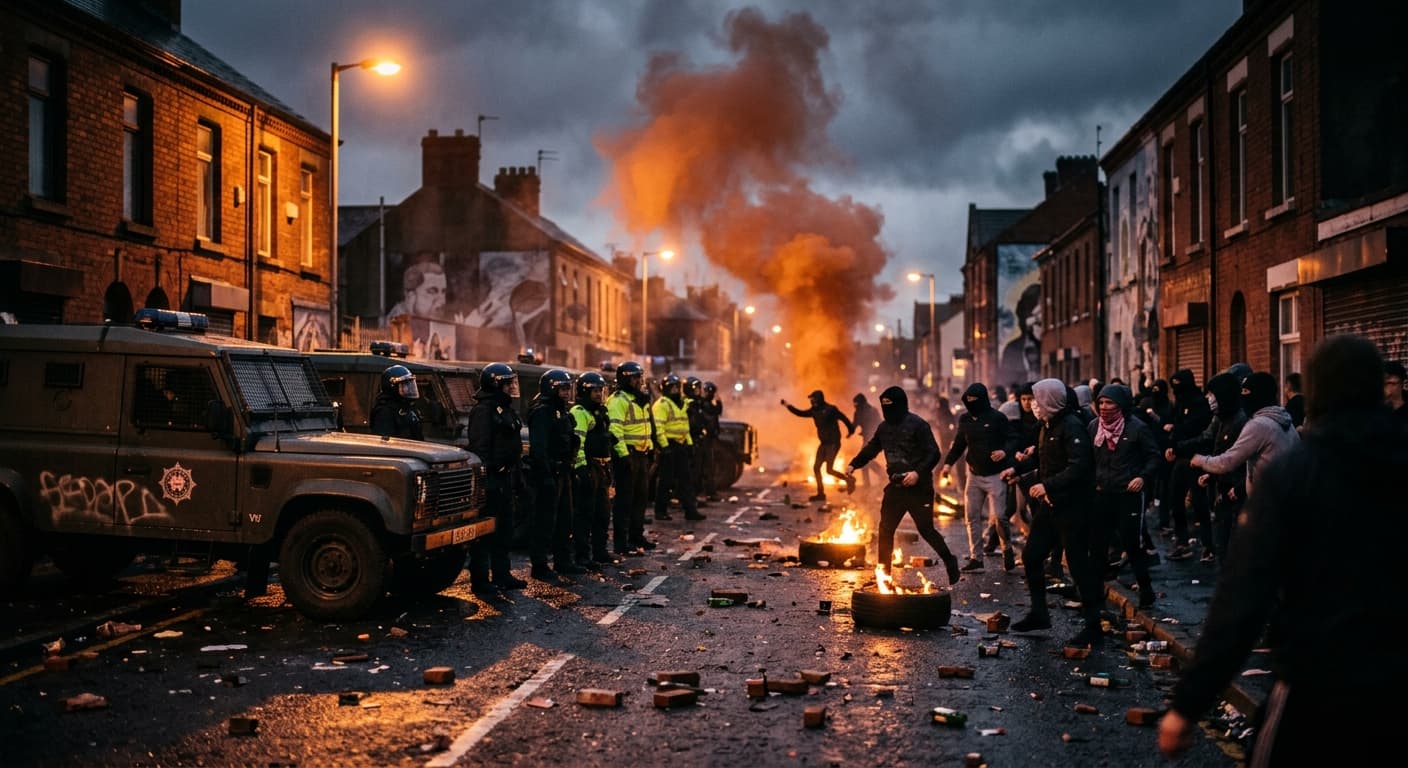
Belfast Riots: How Border Politics Fuel the Far Right
Days of anti-immigration violence in Belfast reveal how the unresolved legacies of the Troubles are being weaponized by a new generation of digital agitators.
A brutal stabbing in North Belfast has ignited days of racially motivated unrest across Northern Ireland, exposing how easily the region's historic sectarian divisions can be redeployed under modern anti-migration banners. On June 8, 2026, a Belfast resident named Stephen Ogilvie was seriously injured in a knife attack, prompting the arrest of Hadi Alodid, a 30-year-old Sudanese national who was subsequently charged with attempted murder, as reported by Al Jazeera. Within hours, coordinated social media campaigns bypassed traditional community leaders to mobilize flash protests. In the ensuing nights of chaos, masked mobs torched cars, targeted properties housing ethnic minorities, and clashed with police, drawing swift condemnation from UK Secretary of State for Northern Ireland Hilary Benn, who branded the violence "racist thuggery" in an interview cited by
Al Jazeera.
Modern Agitators, Segregated Streets
The geographic concentration of the riots highlights how Northern Ireland's post-conflict geography remains dangerously vulnerable to exploitation. While the stabbing occurred in a predominantly nationalist area, the most intense violence occurred in working-class loyalist enclaves in Northern Ireland, such as east Belfast and Glengormley, where the Police Service of Northern Ireland (PSNI) deployed water cannons to disperse hostile crowds, according to the
BBC. Academic observers note that the physical and social segregation left by decades of the Troubles has primed these economically marginalized areas for rapid radicalization.
Crucially, the power to mobilize these mobs has shifted away from traditional paramilitary command structures. PSNI Assistant Chief Constable Ryan Henderson confirmed that there was no evidence that the loyalist paramilitaries historically active in these areas had coordinated the riots, according to the BBC. Instead, coordinated online activity bypassed established local leadership, utilizing social media to broadcast the home addresses of asylum seekers and direct crowds to specific junctions to cut off municipal infrastructure.
Political Divisions Under Strain
The unrest has intensified existing partisan fractures within the Stormont power-sharing executive, preventing a unified official response to the underlying social anxieties. First Minister Michelle O’Neill of Sinn Féin immediately condemned the attacks as "pure racism," as cited by the BBC. Conversely, unionist politicians have sought political leverage by redirecting the focus toward border security.
Democratic Unionist Party (DUP) leader Gavin Robinson defended peaceful protests as expressions of legitimate frustration, calling on the UK government to clamp down on what he characterized as an "open and porous border" with Ireland, as reported by Al Jazeera. Unionist hardliners are weaponizing the crisis to renew efforts to alter post-Brexit border arrangements, seeking to align Northern Ireland’s border policy more closely with mainland Great Britain. This dynamic risks turning a localized policing crisis into a wider constitutional debate.
What to Watch Next
The immediate concern is whether the PSNI can maintain order without relying indefinitely on external reinforcements. The deployment of over 200 British "mutual aid" officers, as reported by the BBC, demonstrates that the local state apparatus lacks the unilateral capacity to manage multi-front civil unrest.
The next key date is July 8, 2026, when Hadi Alodid is scheduled to reappear in court, according to Al Jazeera. This legal milestone will serve as a prospective flashpoint for further digital mobilization. Policymakers should watch whether Sinn Féin and the DUP can draft a joint security strategy in the Stormont Executive before this date, or if deepening divisions will leave Belfast's small immigrant community exposed to a prolonged summer of vigilante actions.
Discover more
US Politics
Next Generation Republicans
A leaked survey shows 39% of Republicans under 30 do not identify as MAGA, revealing a split in the GOP's future leadership.

Conflict & Security
Drone Warfare Killing Aid Workers at Unprec
Over 1,000 humanitarian workers killed in three years as cheap armed drones collapse legal protections. Gaza, Sudan, Ukraine, and DRC see deliberate targeting of aid convoys and hospitals with zero prosecutions.

Global
World Normalises Taliban as Afghan Women Eras
UN data shows Afghan women erased from public life as Russia recognises the Taliban, EU hosts officials in Brussels, and ICC warrants for gender persecution go unenforced.
Conflict & Security
West Africa Food Crisis: Three Shocks in 2026
Conflict, climate extremes, and the Strait of Hormuz closure drive a severe food crisis in West and Central Africa, with fertilizer prices surging 80% and millions displaced.