Belgium's Defence Spending Dilemma
New coalition faces fiscal and security challenges ahead.
Model Diplomat3 min readeurope
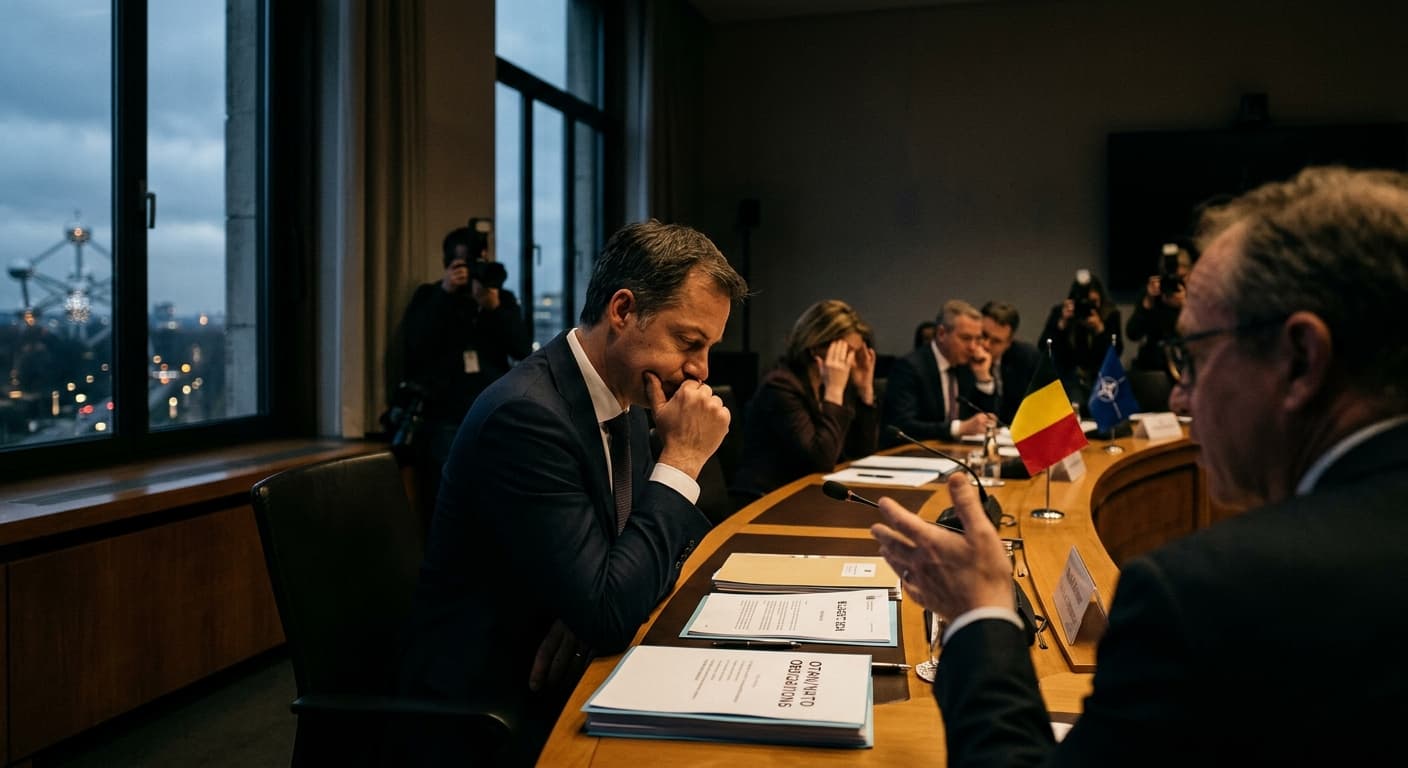
Belgium's De Wever Government Faces a Defence Spending Trap
An Egmont Institute assessment finds Belgium "vulnerable" — and the new coalition's early pledges are already colliding with fiscal and political reality.
On 3 February 2025, after 236 days of negotiations, Belgium's new government under Prime Minister Bart De Wever was sworn in — a five-party coalition spanning Flemish nationalists (N-VA), Francophone liberals (MR), Christian democrats (cd&v), centrists (Les Engagés), and Flemish social democrats (Vooruit). Two months later, the Egmont Institute published a sobering question as its title: Will the New Government Safely Navigate Belgium through Turbulent International Waters?
The answer, assembled by a cohort of young scholars in Egmont Paper 130, is more diagnosis than prediction. The central finding is that Belgium's security position has been hollowed out by a decade of budgetary neglect, leaving the country — in the words of Major-General Phaleg Bernard at an October 2024 Defence Commission hearing — "vulnerable." The paper documents threats across three scales: global (US-China competition, Trump's return, trade wars), regional (Russian conventional war in Ukraine, High North tensions, subversive attacks on European infrastructure), and local (terrorism, hybrid warfare, espionage, disinformation). The conclusion: Belgium is "altogether dependent on the goodwill of its allies and the availability of their national assets."
The coalition agreement reflects awareness of the problem. At 199 pages, it devotes 8 pages to defence and 11 to foreign affairs — a sharp increase from the 2020 agreement's 2 and 5 pages respectively. The ambition is real, but the Egmont scholars' central warning is about "the risk of empty promises" — that competing domestic demands on pensions, healthcare, and education will push necessary investments into the next government's lap.
What has happened since April 2025 suggests the tension is playing out exactly as the paper anticipated.
Belgium is set to hit NATO's 2% GDP defence spending target for the first time in 2025, with a 57.4% budget increase from 1.3% to 2% of GDP, according to Belga. Prime Minister De Wever announced plans to inject an additional €4 billion annually into the military budget and floated the acquisition of 11 additional F-35A fighters beyond the 34 already ordered in 2018, as reported by
AZERTAC. Defence Minister Theo Francken also announced a voluntary one-year military service programme, launching September 2026 with 500 recruits, aiming for 1,000 annually by 2028.
But at the June 2025 NATO summit in The Hague, allies adopted a new benchmark: 5% of GDP (3.5% for pure military spending, 1.5% for security-related investments). De Wever's response was telling. He called reaching 3.5% "a realistic goal in ten years" — and stated his government had no plans for additional spending before 2029, according to EFE. The timeline effectively defers the hardest choices beyond the current government's mandate.
The fiscal squeeze is not abstract. De Wever's cost-cutting triggered seven nationwide strikes in 2025 — a historic record — as trade unions mobilised against reductions in social benefits, BTA reported. Meanwhile, De Wever blocked EU unanimity on using frozen Russian assets held at Brussels-based Euroclear to fund Ukraine, drawing sharp criticism but winning domestic plaudits — he was subsequently named Belgian of the Year.
The Egmont paper identified this bind before it materialised. The authors argued the government must "articulate a convincing narrative on national security to explain to Belgian society why these additional investments are essential." That narrative has not yet materialised. Instead, the government is doing just enough to shed its "free rider" reputation — Francken's own phrase — while postponing the structural shift the young scholars argue is necessary.
What to watch: The NATO capability assessment scheduled for 2029 will land near the end of De Wever's term. If Belgium enters that review still at or near 2% while allies move toward 3.5%, the credibility gap the Egmont paper warned about will become a diplomatic liability. The earlier test comes with the 2027 timeline set by SACEUR General Alexus Grynkewic for NATO to be ready for potential simultaneous wars in Europe and the Pacific — a scenario that would expose Belgium's dependence on allied assets with brutal clarity.
Discover more

US Politics
SNAP Food Assistance Faces Legal Challenges
In 2026, SNAP faces stricter eligibility rules and mounting legal challenges, threatening food assistance for the millions of Americans who rely on the program.
India
Congress Accuses Modi of Stalling Women's Law
Congress accuses Modi of stalling women's reservation law by linking it to delimitation, revealing a deeper electoral strategy.

India
Delhi CM Rekha Gupta Blasts Opposition's Delm
Delhi CM Rekha Gupta's remarks on women's quota defeat reveal BJP's strategy for the 2029 Lok Sabha elections, focusing on delimitation.

Economics
Fed's Amex AML order puts correspondent banking on notice
Federal Reserve's Amex AML order requires board-level controls and a 90-day plan; OCC fined the bank $350 million over enterprise-wide deficiencies.