Bank of England Holds Rate at 3.75% Amid Iran
MPC bets on US–Iran ceasefire to manage inflation
Model Diplomat8 min readEurope
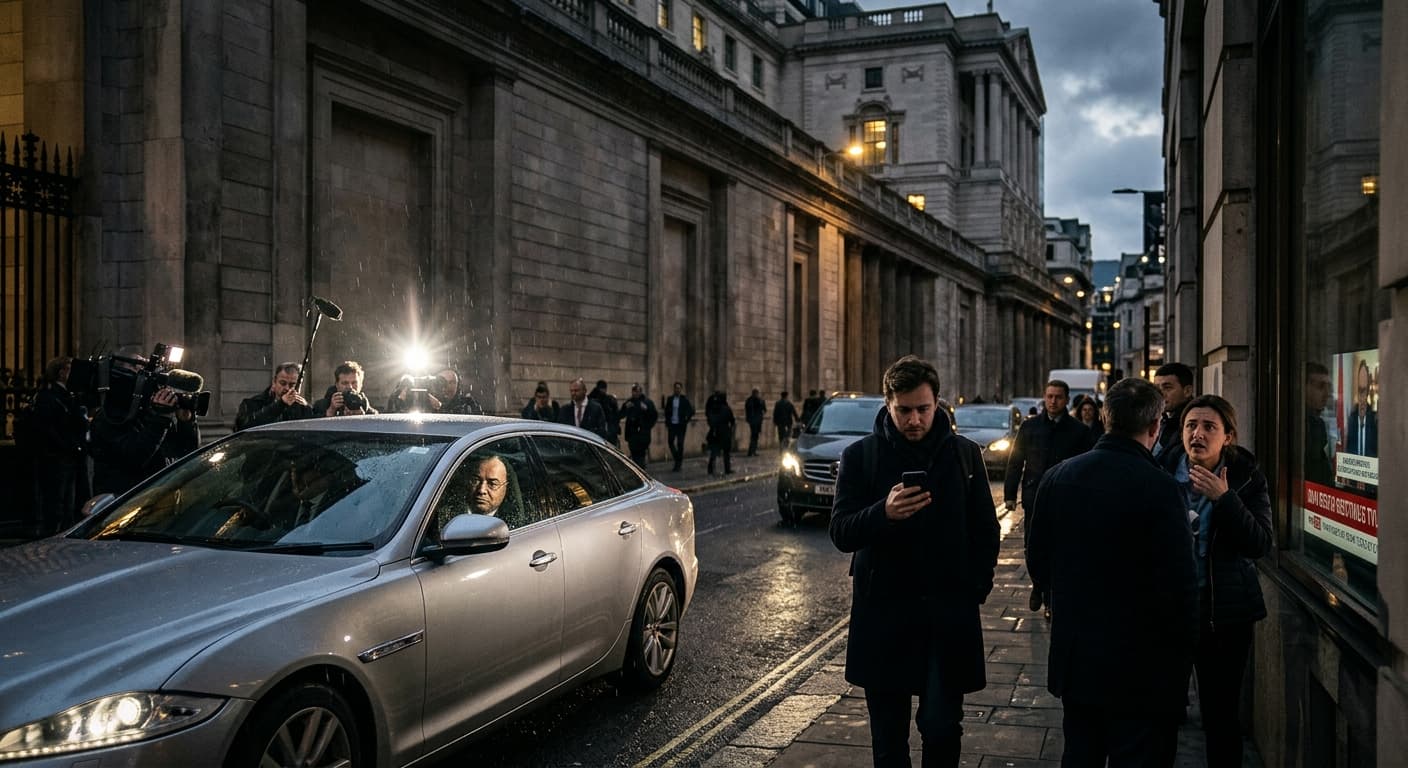
Bank of England Holds at 3.75% as Iran Peace Bet Splits MPC
The Bank of England held its base rate at 3.75% for a fourth straight meeting on June 18, 2026, betting a fragile US–Iran ceasefire will contain a UK inflation shock that has already forced the ECB to hike.
Andrew Bailey's Monetary Policy Committee voted 7–2 on June 17 to keep Bank Rate at 3.75% — a decision that reads like a hold but functions as a wager on the durability of the US–Iran peace deal signed 48 hours later. Two members, chief economist Huw Pill and external member Megan Greene, wanted an immediate quarter-point hike to 4% to lean against second-round effects from the energy shock. Coming days after the European Central Bank became the first G7 central bank in almost three years to raise rates, the vote tally reframes the story: Threadneedle Street is now the outlier holding a dovish line, and the UK gilt market is quietly pricing in that Bailey will be forced to move first, and higher, if the ceasefire cracks.
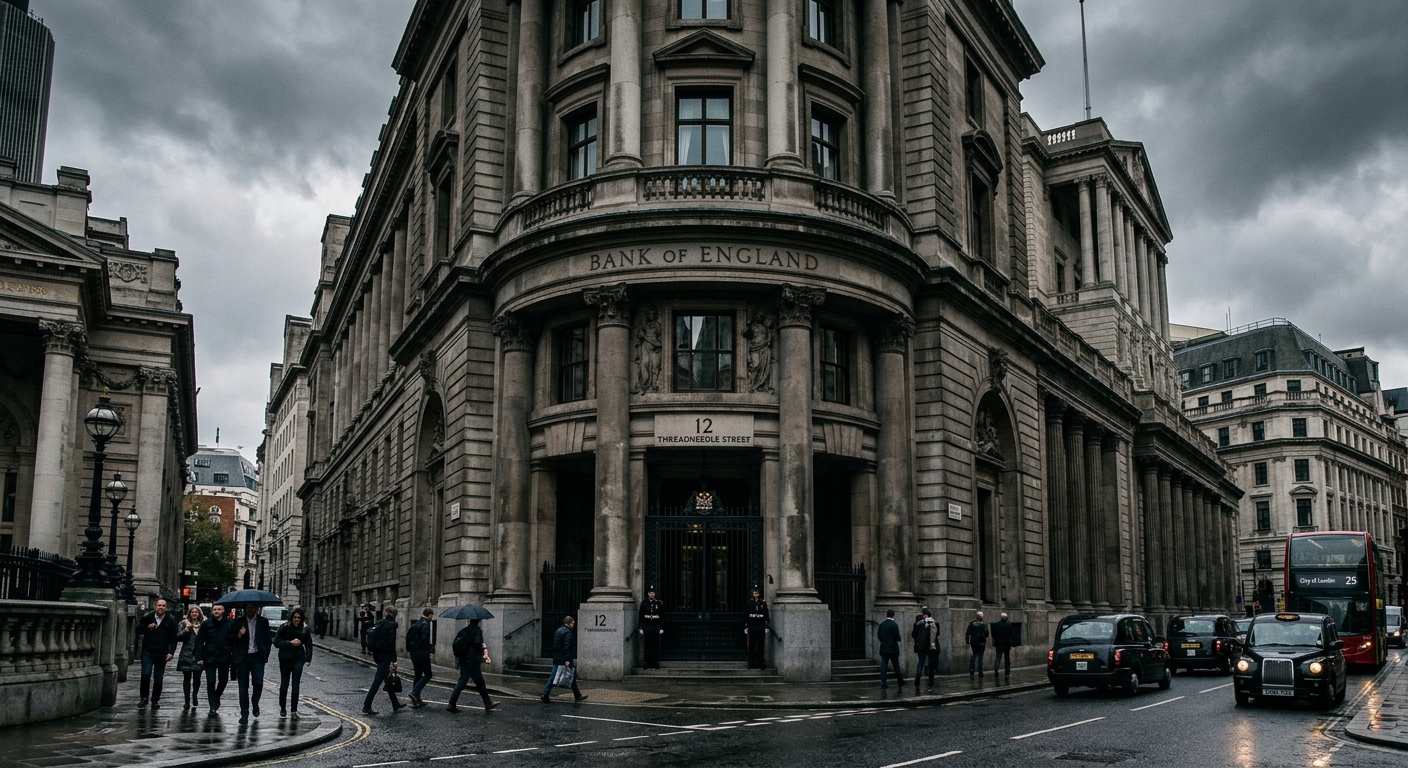
What the minutes actually say
The Bank's own June 2026 Monetary Policy Summary is unusually specific about the trigger. Brent crude averaged $100 a barrel and UK wholesale gas 116 pence per therm between the April and June meetings — up from $66 and 87p before the war — before falling to $79 and 100p when a Middle East peace framework was announced in the days leading up to the vote. UK two-year overnight index swap rates, the market's cleanest read on where policy is heading, sit "around 70 basis points above their pre-war level," according to the minutes.
The Committee's guidance is deliberately double-sided:
"The risk of material second-round effects in price and wage-setting, against which policy needs to lean, is greater the longer higher energy prices persist. But the labour market continues to loosen, and signs of a weakening economy could contain inflationary pressures."
Translation: the MPC is watching two clocks. One is oil and gas; the other is a UK labour market softening quickly enough that the Bank may not need to hike even if the ceasefire wobbles. CPI came in at 2.8% in April and again in May, according to the Office for National Statistics data reported by the BBC, against consensus expectations of 3%. That is the surprise doing most of the work in the hold. Food inflation slowed to a 17-month low of 2.2%; the pipeline pressure is coming almost entirely from energy and the delayed pass-through of March–May wholesale spikes into the July Ofgem cap.
Why this hold is not really a hold
Read the June minutes against the April scenario analysis published by the Bank and the stance is closer to conditional easing than genuine restraint. In April, Bailey sketched three paths: a benign "A" case with inflation peaking near 3.6%, a "B" case at 3.7% with slower normalisation, and an adverse "C" case in which oil stayed above $120 and rates rose to 5.5% via as many as six hikes. The June meeting effectively retired scenario C. The Committee cut its year-end inflation forecast to about 3.25% — below even the benign April path — as
reported by the BBC.
That is the news the sterling curve is trading. A Financial Times survey of economists now sees the Bank on hold through the rest of 2026, with cuts pushed into 2027. The market has quietly moved from pricing two hikes in June to pricing none — but not back to pricing the cuts that were consensus in January.
The peer contrast matters for anyone allocating gilts. The European Central Bank raised its deposit rate to 2.25% on June 11 — a 25 basis-point move — citing that the war was "generating inflation pressures". Eurozone inflation touched 3.3% in May before easing to 2.8% in June, according to the
Financial Times. The Federal Reserve, at Kevin Warsh's first meeting as chair, held its target range at 3.5–3.75%; nine of 18 FOMC participants now project a hike this year, per the
BBC's write-up of the dot plot. Only the Bank of England has both an above-target inflation profile and a market pricing no move in either direction.
The two-vote dissent is the loudest signal
Greene's vote is the tell. She had been in the hawkish camp for a year but had not previously moved to a dissent, warning as recently as June 4 in the Financial Times that "monetary policy will need to remain restrictive for some time" and that the Bank "should proactively lean against second-round effects from the energy shock." Pill's vote to hike had been telegraphed at April's 8–1 meeting; Greene joining him doubles the internal case that the July 30 meeting could turn on a single new data point.
The reason this matters is mechanical. On a nine-member committee, a 7–2 split needs only two more converts to flip. With the July Ofgem cap already locked in at a 13% increase — a £221 rise to £1,862 for the typical dual-fuel household, according to the regulator's decision reported by the BBC — the July CPI print released before the September meeting will almost certainly show a headline reacceleration. If wage settlements in the autumn round pick up in response, Pill and Greene's argument writes itself. The July 30 decision is therefore not really about July; it is a preview of who blinks in September.
That is also why the "hold" language is misleading in market terms. Interest rates faced by UK households and businesses are already higher than before the conflict, the June minutes note, driven by that 70-basis-point rise in OIS rates. The Bank has been passively tightening for three months without touching Bank Rate.
The gilt-market subplot the rate decision cannot fix
The uncomfortable truth for the Treasury is that monetary policy has become a sideshow to a bigger repricing at the long end of the curve. The 30-year gilt yield reached 5.78% in early May, its highest level since 1998, as the BBC reported; by July 9 it was trading around 5.63%, according to
FT market data. That is a 28-year high held for months, and it is happening while the policy rate is stuck.
Some of this is global — German, French and Dutch 30-year yields have climbed to their highest since 2011, per BBC reporting — but the UK component is domestic. Prime Minister Keir Starmer announced his resignation in late June; Andy Burnham is expected to take over as prime minister on July 20, and Chancellor Rachel Reeves is widely expected to be demoted, according to
BBC political reporting. Burnham has publicly committed to Reeves's fiscal rules, a move
BBC economics editor Faisal Islam linked directly to a fall in 10-year gilt yields. Bond veteran Mohamed El-Erian, quoted in the same piece, credited Burnham's commitment with the outperformance of UK bonds that morning. The IMF has urged the incoming government to stick to those rules.
For the Bank of England, this creates an awkward split. Short rates are governed by inflation and the labour market; long rates are governed by fiscal credibility, political turnover and a defence-spending gap of £4.7bn that the next chancellor will need to fill, according to BBC reporting on the delayed defence plan. A dovish MPC cannot lower 30-year yields if a market is worried about who signs the next Budget.
The historical parallel is not 2022's mini-Budget shock — that repriced the whole curve in days — but the slower stagflationary drift of the mid-1990s, when Kenneth Clarke ran double-digit long yields alongside a policy rate below inflation. Today's setup is milder but structurally similar: a supply shock the central bank cannot influence, a fiscal position it cannot control, and a currency doing the adjusting quietly.
Who wins, who loses
The winner from a hold at 3.75% is the mortgage market. About 600,000 tracker-mortgage holders keep the cheaper monthly payment they secured after the December cut, and the roughly 40% of variable-tariff households on the Ofgem cap absorb the July rise without a compounding rate move. Savers are the mirror-image loser: real returns on cash are negative while headline inflation runs 80 basis points above target.
The bigger loser is the Treasury. Even before Starmer's resignation, the yield on 10-year gilts climbed steadily through 2025 and into 2026, as Foreign Affairs argued — not primarily because of Labour fiscal choices, but because global term premia have risen and the Fed has been slow to cut. That squeezes Reeves's — or her successor's — fiscal headroom just as the defence bill comes due.
The quiet winner is the ECB. By hiking on June 11, Lagarde has bought optionality: if the ceasefire holds, she can pause with credibility; if it collapses, she has already moved. Bailey has neither. His guidance depends on a peace deal negotiated by an administration in Washington that his own government has publicly criticised — Reeves called the war "not our war, but one we have to respond to," per BBC coverage of the April meeting.
Diplomat View
The June hold is a bet that a US–Iran peace deal negotiated in the back half of 2026 sticks long enough for UK inflation to peak at 3.25% and drift back toward target through 2027. It is a defensible bet, but a narrow one. The forecast changes on three specific triggers: a Strait of Hormuz reopening that stalls or reverses; a July or August CPI print materially above 3.5%; or a new UK chancellor who signals loosened fiscal rules and drives 10-year gilt yields above 5.2%. Any of those, and the July 30 meeting flips from consensus hold to a 6–3 or 5–4 split, with a hike back on the table for September. If none of them fires, the Bank sits at 3.75% until 2027 — and the first move, when it comes, will be down.
What to watch next:
- July 30, 2026: Next MPC decision. First meeting after the US–Iran ceasefire. Watch whether the 7–2 split narrows.
- Mid-August: July CPI release. The Ofgem cap increase will be visible in the print. A reading above 3.5% shifts the debate.
- July 20: Expected Burnham premiership. His chancellor pick — and whether the fiscal rules survive intact — will drive long-gilt yields as much as any Bank of England move.
The Bottom Line
The Bank of England is not really holding — it is passively tightening through market rates while betting a Middle East peace deal sticks. If the ceasefire holds, 3.75% is a ceiling and the next move is a cut in 2027; if it cracks, Pill and Greene already have the votes lined up to force a hike. Either way, the decisive variable for the UK economy is no longer Threadneedle Street but the 30-year gilt yield, which sits at a 28-year high and is being set by fiscal politics the MPC cannot touch.
Discover more

India
Women’s Reservation Bill 2026
The Constitution (131st Amendment) Bill, 2026 was defeated in Lok Sabha, revealing deeper political conflicts over women's reservation and delimitation.
US Politics
House Ethics Committee Pushes Sexual Miscond.
The House Ethics Committee has shifted responsibility for sexual harassment settlement records to the Office of Congressional Workplace Rights, complicating disclosure efforts.

India
BJP's Misunderstanding of Women's Quota Needs
The BJP's linking of the Women Reservation Bill to delimitation risks delaying women's empowerment in India, misreading the aspirations of female voters.

Economics
Fed's Amex AML order puts correspondent banking on notice
Federal Reserve's Amex AML order requires board-level controls and a 90-day plan; OCC fined the bank $350 million over enterprise-wide deficiencies.